POLICIES AND PLANNING
PREMISES
R.ArunKumar,AP/Mech,RIT
DEFINITION:
 Policy is a general guideline for decision making.
 According to Koontz and Weihrich, “Policies are general
statements of understandings which guides or channelize
thinking in decision making or subordinates.
R.ArunKumar,AP/Mech,RIT
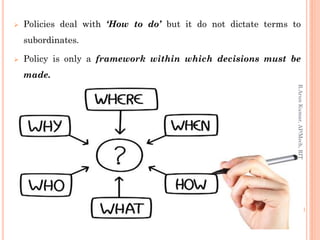
 Policies deal with ‘How to do’ but it do not dictate terms to
subordinates.
 Policy is only a framework within which decisions must be
made.
R.ArunKumar,AP/Mech,RIT
NATURE OF POLICY:
1. Relationship to organization’s objectives:
 Policies are based on the objectives and they contribute towards
the attainment of objectives.
R.ArunKumar,AP/Mech,RIT
NATURE OF POLICY:
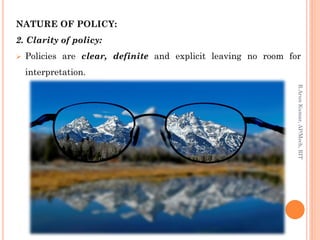
2. Clarity of policy:
 Policies are clear, definite and explicit leaving no room for
interpretation.
R.ArunKumar,AP/Mech,RIT
NATURE OF POLICY:
3. Guideline towards decision making:
 Prescribes the criteria for current and future actions.
R.ArunKumar,AP/Mech,RIT
NATURE OF POLICY:
4. Policies are written:
 Policies are stared with precise covering of all anticipated
conditions.
R.ArunKumar,AP/Mech,RIT
NATURE OF POLICY:
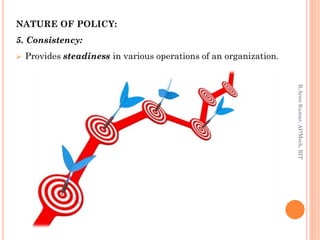
5. Consistency:
 Provides steadiness in various operations of an organization.
R.ArunKumar,AP/Mech,RIT
NATURE OF POLICY:
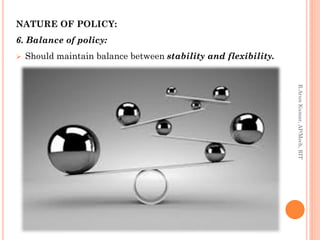
6. Balance of policy:
 Should maintain balance between stability and flexibility.
R.ArunKumar,AP/Mech,RIT
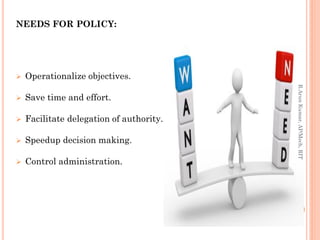
NEEDS FOR POLICY:
 Operationalize objectives.
 Save time and effort.
 Facilitate delegation of authority.
 Speedup decision making.
 Control administration.
R.ArunKumar,AP/Mech,RIT
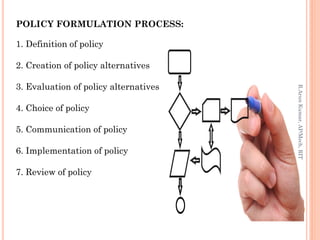
POLICY FORMULATION PROCESS:
1. Definition of policy
2. Creation of policy alternatives
3. Evaluation of policy alternatives
4. Choice of policy
5. Communication of policy
6. Implementation of policy
7. Review of policy
R.ArunKumar,AP/Mech,RIT
TYPES OF POLICIES:
Classification on the basis of sources:
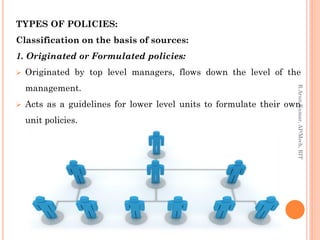
1. Originated or Formulated policies:
 Originated by top level managers, flows down the level of the
management.
 Acts as a guidelines for lower level units to formulate their own
unit policies.
R.ArunKumar,AP/Mech,RIT
TYPES OF POLICIES:
Classification on the basis of sources:
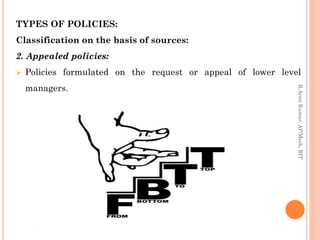
2. Appealed policies:
 Policies formulated on the request or appeal of lower level
managers.
R.ArunKumar,AP/Mech,RIT
TYPES OF POLICIES:
Classification on the basis of sources:
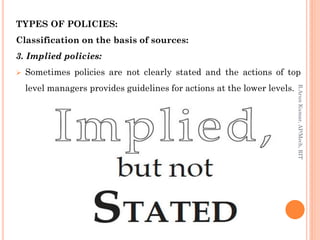
3. Implied policies:
 Sometimes policies are not clearly stated and the actions of top
level managers provides guidelines for actions at the lower levels.
R.ArunKumar,AP/Mech,RIT
TYPES OF POLICIES:
Classification on the basis of sources:
4. Externally imposed policies:
 Policies that are imposed by some external forces such as unions,
government, association, etc.
R.ArunKumar,AP/Mech,RIT
TYPES OF POLICIES:
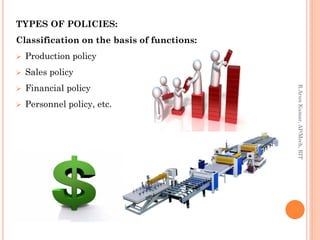
Classification on the basis of functions:
 Production policy
 Sales policy
 Financial policy
 Personnel policy, etc.
R.ArunKumar,AP/Mech,RIT
TYPES OF POLICIES:
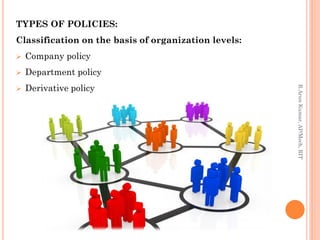
Classification on the basis of organization levels:
 Company policy
 Department policy
 Derivative policy
R.ArunKumar,AP/Mech,RIT
Advantages:
 Ensures uniformity in actions.
 Speeds up decision at lower levels.
 Delegation of Authority or work becomes easier.
 Gives practical shape to the objectives by elaborating and
directing the way in which the predetermined objectives are to be
attained.
R.ArunKumar,AP/Mech,RIT
PLANNING PREMISES:
 Usually plans are prepared for future, which are uncertain. Thus
the management makes certain assumptions about the future.
R.ArunKumar,AP/Mech,RIT
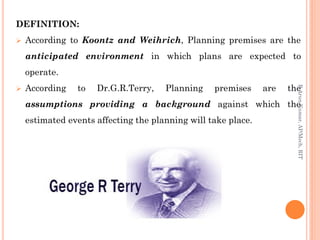
DEFINITION:
 According to Koontz and Weihrich, Planning premises are the
anticipated environment in which plans are expected to
operate.
 According to Dr.G.R.Terry, Planning premises are the
assumptions providing a background against which the
estimated events affecting the planning will take place.
R.ArunKumar,AP/Mech,RIT
IMPORTANCE:
 Well organized planning can be done.
 Risk of uncertainty reduces.
 Risk of flexibility reduces.
 Co-ordination becomes effective.
 Increases in profitability.
R.ArunKumar,AP/Mech,RIT
CLASSIFICATION:
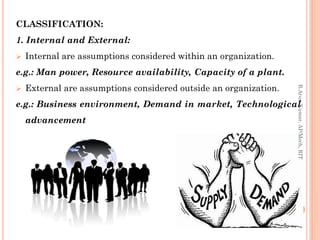
1. Internal and External:
 Internal are assumptions considered within an organization.
e.g.: Man power, Resource availability, Capacity of a plant.
 External are assumptions considered outside an organization.
e.g.: Business environment, Demand in market, Technological
advancement
R.ArunKumar,AP/Mech,RIT
CLASSIFICATION:
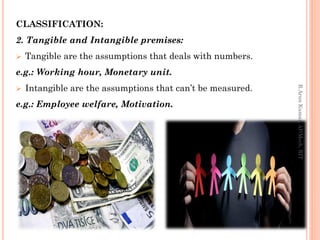
2. Tangible and Intangible premises:
 Tangible are the assumptions that deals with numbers.
e.g.: Working hour, Monetary unit.
 Intangible are the assumptions that can’t be measured.
e.g.: Employee welfare, Motivation.
R.ArunKumar,AP/Mech,RIT
CLASSIFICATION:
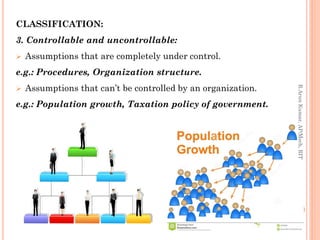
3. Controllable and uncontrollable:
 Assumptions that are completely under control.
e.g.: Procedures, Organization structure.
 Assumptions that can’t be controlled by an organization.
e.g.: Population growth, Taxation policy of government.
R.ArunKumar,AP/Mech,RIT
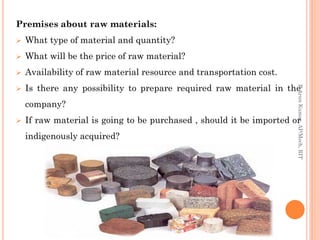
Premises about raw materials:
 What type of material and quantity?
 What will be the price of raw material?
 Availability of raw material resource and transportation cost.
 Is there any possibility to prepare required raw material in the
company?
 If raw material is going to be purchased , should it be imported or
indigenously acquired?
R.ArunKumar,AP/Mech,RIT
Premises about personnel:
 How much skilled , unskilled , male, female, workmen, are needed
for implementation of a plan?
 How much training should be imparted in the context of new
technological development ?
 To make an estimate regarding present and future employees.
R.ArunKumar,AP/Mech,RIT
Premises about organization:
 What will be the structure of the organization?
 Coordination among departments.
 Whether to centralize or decentralize the authority?
R.ArunKumar,AP/Mech,RIT
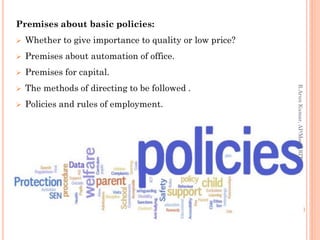
Premises about basic policies:
 Whether to give importance to quality or low price?
 Premises about automation of office.
 Premises for capital.
 The methods of directing to be followed .
 Policies and rules of employment.
R.ArunKumar,AP/Mech,RIT

Policies and planning premises

  • 1.
  • 2.
    DEFINITION:  Policy isa general guideline for decision making.  According to Koontz and Weihrich, “Policies are general statements of understandings which guides or channelize thinking in decision making or subordinates. R.ArunKumar,AP/Mech,RIT
  • 3.
     Policies dealwith ‘How to do’ but it do not dictate terms to subordinates.  Policy is only a framework within which decisions must be made. R.ArunKumar,AP/Mech,RIT
  • 4.
    NATURE OF POLICY: 1.Relationship to organization’s objectives:  Policies are based on the objectives and they contribute towards the attainment of objectives. R.ArunKumar,AP/Mech,RIT
  • 5.
    NATURE OF POLICY: 2.Clarity of policy:  Policies are clear, definite and explicit leaving no room for interpretation. R.ArunKumar,AP/Mech,RIT
  • 6.
    NATURE OF POLICY: 3.Guideline towards decision making:  Prescribes the criteria for current and future actions. R.ArunKumar,AP/Mech,RIT
  • 7.
    NATURE OF POLICY: 4.Policies are written:  Policies are stared with precise covering of all anticipated conditions. R.ArunKumar,AP/Mech,RIT
  • 8.
    NATURE OF POLICY: 5.Consistency:  Provides steadiness in various operations of an organization. R.ArunKumar,AP/Mech,RIT
  • 9.
    NATURE OF POLICY: 6.Balance of policy:  Should maintain balance between stability and flexibility. R.ArunKumar,AP/Mech,RIT
  • 10.
    NEEDS FOR POLICY: Operationalize objectives.  Save time and effort.  Facilitate delegation of authority.  Speedup decision making.  Control administration. R.ArunKumar,AP/Mech,RIT
  • 11.
    POLICY FORMULATION PROCESS: 1.Definition of policy 2. Creation of policy alternatives 3. Evaluation of policy alternatives 4. Choice of policy 5. Communication of policy 6. Implementation of policy 7. Review of policy R.ArunKumar,AP/Mech,RIT
  • 12.
    TYPES OF POLICIES: Classificationon the basis of sources: 1. Originated or Formulated policies:  Originated by top level managers, flows down the level of the management.  Acts as a guidelines for lower level units to formulate their own unit policies. R.ArunKumar,AP/Mech,RIT
  • 13.
    TYPES OF POLICIES: Classificationon the basis of sources: 2. Appealed policies:  Policies formulated on the request or appeal of lower level managers. R.ArunKumar,AP/Mech,RIT
  • 14.
    TYPES OF POLICIES: Classificationon the basis of sources: 3. Implied policies:  Sometimes policies are not clearly stated and the actions of top level managers provides guidelines for actions at the lower levels. R.ArunKumar,AP/Mech,RIT
  • 15.
    TYPES OF POLICIES: Classificationon the basis of sources: 4. Externally imposed policies:  Policies that are imposed by some external forces such as unions, government, association, etc. R.ArunKumar,AP/Mech,RIT
  • 16.
    TYPES OF POLICIES: Classificationon the basis of functions:  Production policy  Sales policy  Financial policy  Personnel policy, etc. R.ArunKumar,AP/Mech,RIT
  • 17.
    TYPES OF POLICIES: Classificationon the basis of organization levels:  Company policy  Department policy  Derivative policy R.ArunKumar,AP/Mech,RIT
  • 18.
    Advantages:  Ensures uniformityin actions.  Speeds up decision at lower levels.  Delegation of Authority or work becomes easier.  Gives practical shape to the objectives by elaborating and directing the way in which the predetermined objectives are to be attained. R.ArunKumar,AP/Mech,RIT
  • 19.
    PLANNING PREMISES:  Usuallyplans are prepared for future, which are uncertain. Thus the management makes certain assumptions about the future. R.ArunKumar,AP/Mech,RIT
  • 20.
    DEFINITION:  According toKoontz and Weihrich, Planning premises are the anticipated environment in which plans are expected to operate.  According to Dr.G.R.Terry, Planning premises are the assumptions providing a background against which the estimated events affecting the planning will take place. R.ArunKumar,AP/Mech,RIT
  • 21.
    IMPORTANCE:  Well organizedplanning can be done.  Risk of uncertainty reduces.  Risk of flexibility reduces.  Co-ordination becomes effective.  Increases in profitability. R.ArunKumar,AP/Mech,RIT
  • 22.
    CLASSIFICATION: 1. Internal andExternal:  Internal are assumptions considered within an organization. e.g.: Man power, Resource availability, Capacity of a plant.  External are assumptions considered outside an organization. e.g.: Business environment, Demand in market, Technological advancement R.ArunKumar,AP/Mech,RIT
  • 23.
    CLASSIFICATION: 2. Tangible andIntangible premises:  Tangible are the assumptions that deals with numbers. e.g.: Working hour, Monetary unit.  Intangible are the assumptions that can’t be measured. e.g.: Employee welfare, Motivation. R.ArunKumar,AP/Mech,RIT
  • 24.
    CLASSIFICATION: 3. Controllable anduncontrollable:  Assumptions that are completely under control. e.g.: Procedures, Organization structure.  Assumptions that can’t be controlled by an organization. e.g.: Population growth, Taxation policy of government. R.ArunKumar,AP/Mech,RIT
  • 25.
    Premises about rawmaterials:  What type of material and quantity?  What will be the price of raw material?  Availability of raw material resource and transportation cost.  Is there any possibility to prepare required raw material in the company?  If raw material is going to be purchased , should it be imported or indigenously acquired? R.ArunKumar,AP/Mech,RIT
  • 26.
    Premises about personnel: How much skilled , unskilled , male, female, workmen, are needed for implementation of a plan?  How much training should be imparted in the context of new technological development ?  To make an estimate regarding present and future employees. R.ArunKumar,AP/Mech,RIT
  • 27.
    Premises about organization: What will be the structure of the organization?  Coordination among departments.  Whether to centralize or decentralize the authority? R.ArunKumar,AP/Mech,RIT
  • 28.
    Premises about basicpolicies:  Whether to give importance to quality or low price?  Premises about automation of office.  Premises for capital.  The methods of directing to be followed .  Policies and rules of employment. R.ArunKumar,AP/Mech,RIT