













OBJECTIVES AND
SETTING OBJECTIVES
R.ArunKumar,AP/Mech,RIT
DEFINITIONS:
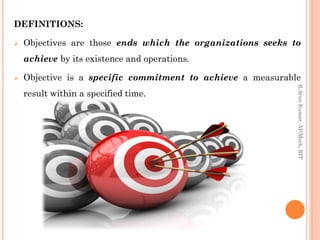
 Objectives are those ends which the organizations seeks to
achieve by its existence and operations.
 Objective is a specific commitment to achieve a measurable
result within a specified time.
R.ArunKumar,AP/Mech,RIT
Characteristics of Organizational Objectives:
 Multiplicity
 Hierarchy
 Networking
 Time dimension
 Quantifiable and non – quantifiable objectives.
 Social sanction
R.ArunKumar,AP/Mech,RIT
Characteristics of Organizational Objectives:
1. Multiplicity:
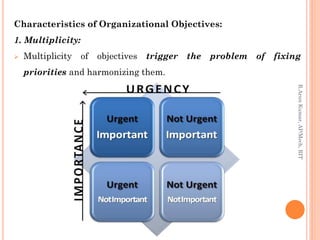
 Multiplicity of objectives trigger the problem of fixing
priorities and harmonizing them.
R.ArunKumar,AP/Mech,RIT
Characteristics of Organizational Objectives:
2. Hierarchy: (Top – down and bottom – up approaches)
 Objectives are framed across different levels of an
organization.
 e.g. achieving profit, improving shares – top level management
cost reduction, waste management – middle level management
reducing absenteeism, maintenance – low level management
R.ArunKumar,AP/Mech,RIT
Characteristics of Organizational Objectives:
3. Networking:
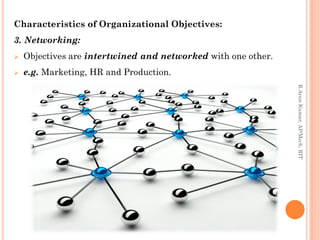
 Objectives are intertwined and networked with one other.
 e.g. Marketing, HR and Production.
R.ArunKumar,AP/Mech,RIT
Characteristics of Organizational Objectives:
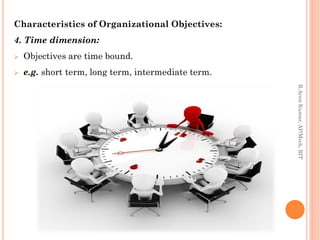
4. Time dimension:
 Objectives are time bound.
 e.g. short term, long term, intermediate term.
R.ArunKumar,AP/Mech,RIT
Characteristics of Organizational Objectives:
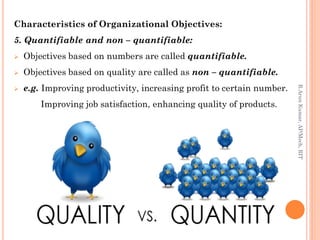
5. Quantifiable and non – quantifiable:
 Objectives based on numbers are called quantifiable.
 Objectives based on quality are called as non – quantifiable.
 e.g. Improving productivity, increasing profit to certain number.
Improving job satisfaction, enhancing quality of products.
R.ArunKumar,AP/Mech,RIT
Characteristics of Organizational Objectives:
6. Social sanction:
 Objectives will confirm to general needs of the society.
R.ArunKumar,AP/Mech,RIT
Importance and role of objectives:
 Legitimacy
 Sense of direction
 Motivational aid
 Control mechanism
 Co – ordination
 Unifying force
R.ArunKumar,AP/Mech,RIT
Importance and role of objectives:
1. Legitimacy
 They describe the purpose of an organization.
 They provide the identity to an organization.
R.ArunKumar,AP/Mech,RIT
Importance and role of objectives:
2. Sense of direction:
 Provides the guide way towards the target.
 Every employee must have clear idea about what he/she is
supposed to do in his/her job.
R.ArunKumar,AP/Mech,RIT
Importance and role of objectives:
3. Motivational aid:
 Apart from incentives and rewards, objective of an organization
will be the driving force to attain a goal.
R.ArunKumar,AP/Mech,RIT
Importance and role of objectives:
4. Control mechanism:
 Being a driving force, objectives restricts employees from
deviation.
R.ArunKumar,AP/Mech,RIT
Importance and role of objectives:
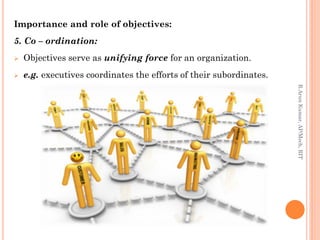
5. Co – ordination:
 Objectives serve as unifying force for an organization.
 e.g. executives coordinates the efforts of their subordinates.
R.ArunKumar,AP/Mech,RIT
Importance and role of objectives:
6. Uniqueness:
 They are core force to planning.
 They serve as reference points for the formulation of policies,
strategies, procedures, etc.
R.ArunKumar,AP/Mech,RIT
SETTING OBJECTIVES:
R.ArunKumar,AP/Mech,RIT
SETTING OBJECTIVES:
 Setting objective must meet following criteria:
1. Should be consistent with the values of management.
2. Should pin point strength of an organization.
3. Should satisfy external environment factors.
R.ArunKumar,AP/Mech,RIT
Objective setting guidelines:
 Objectives should be clear and specific.
 Should be expressed in measurable terms.
 Objectives should be attainable and realistic.
 Objectives should be time bound.
 Should be whole heartedly accepted by employees.
 Objectives should be challenging.
 Objectives should have sub-goals and linked to rewards.
 Objectives should be inter – connected and mutually
supportive.
 Objectives should be flexible and adaptable.
 It should be set down in all key – result areas.
R.ArunKumar,AP/Mech,RIT
Benefits of objectives formulation:
 Sets specific target.
 Provides direction for employee.
 Increases staff motivation.
 Helps to focus on specific task.
 Builds relationship.
 Helps to measure the performance of employee.
 Helps to prioritize.
 Enables the success to be measured.
R.ArunKumar,AP/Mech,RIT
Limitations in objectives formulation:
 Immeasurability
 Inadequate resource allocation
 Stress on employee
 Neglecting ground reality
 Avoiding consultation
 Unclear and rigid objective
 Time constraint
R.ArunKumar,AP/Mech,RIT
SMART Objectives:
R.ArunKumar,AP/Mech,RIT

Objectives and setting objectives

  • 1.
  • 2.
    DEFINITIONS:  Objectives arethose ends which the organizations seeks to achieve by its existence and operations.  Objective is a specific commitment to achieve a measurable result within a specified time. R.ArunKumar,AP/Mech,RIT
  • 3.
    Characteristics of OrganizationalObjectives:  Multiplicity  Hierarchy  Networking  Time dimension  Quantifiable and non – quantifiable objectives.  Social sanction R.ArunKumar,AP/Mech,RIT
  • 4.
    Characteristics of OrganizationalObjectives: 1. Multiplicity:  Multiplicity of objectives trigger the problem of fixing priorities and harmonizing them. R.ArunKumar,AP/Mech,RIT
  • 5.
    Characteristics of OrganizationalObjectives: 2. Hierarchy: (Top – down and bottom – up approaches)  Objectives are framed across different levels of an organization.  e.g. achieving profit, improving shares – top level management cost reduction, waste management – middle level management reducing absenteeism, maintenance – low level management R.ArunKumar,AP/Mech,RIT
  • 6.
    Characteristics of OrganizationalObjectives: 3. Networking:  Objectives are intertwined and networked with one other.  e.g. Marketing, HR and Production. R.ArunKumar,AP/Mech,RIT
  • 7.
    Characteristics of OrganizationalObjectives: 4. Time dimension:  Objectives are time bound.  e.g. short term, long term, intermediate term. R.ArunKumar,AP/Mech,RIT
  • 8.
    Characteristics of OrganizationalObjectives: 5. Quantifiable and non – quantifiable:  Objectives based on numbers are called quantifiable.  Objectives based on quality are called as non – quantifiable.  e.g. Improving productivity, increasing profit to certain number. Improving job satisfaction, enhancing quality of products. R.ArunKumar,AP/Mech,RIT
  • 9.
    Characteristics of OrganizationalObjectives: 6. Social sanction:  Objectives will confirm to general needs of the society. R.ArunKumar,AP/Mech,RIT
  • 10.
    Importance and roleof objectives:  Legitimacy  Sense of direction  Motivational aid  Control mechanism  Co – ordination  Unifying force R.ArunKumar,AP/Mech,RIT
  • 11.
    Importance and roleof objectives: 1. Legitimacy  They describe the purpose of an organization.  They provide the identity to an organization. R.ArunKumar,AP/Mech,RIT
  • 12.
    Importance and roleof objectives: 2. Sense of direction:  Provides the guide way towards the target.  Every employee must have clear idea about what he/she is supposed to do in his/her job. R.ArunKumar,AP/Mech,RIT
  • 13.
    Importance and roleof objectives: 3. Motivational aid:  Apart from incentives and rewards, objective of an organization will be the driving force to attain a goal. R.ArunKumar,AP/Mech,RIT
  • 14.
    Importance and roleof objectives: 4. Control mechanism:  Being a driving force, objectives restricts employees from deviation. R.ArunKumar,AP/Mech,RIT
  • 15.
    Importance and roleof objectives: 5. Co – ordination:  Objectives serve as unifying force for an organization.  e.g. executives coordinates the efforts of their subordinates. R.ArunKumar,AP/Mech,RIT
  • 16.
    Importance and roleof objectives: 6. Uniqueness:  They are core force to planning.  They serve as reference points for the formulation of policies, strategies, procedures, etc. R.ArunKumar,AP/Mech,RIT
  • 17.
  • 18.
    SETTING OBJECTIVES:  Settingobjective must meet following criteria: 1. Should be consistent with the values of management. 2. Should pin point strength of an organization. 3. Should satisfy external environment factors. R.ArunKumar,AP/Mech,RIT
  • 19.
    Objective setting guidelines: Objectives should be clear and specific.  Should be expressed in measurable terms.  Objectives should be attainable and realistic.  Objectives should be time bound.  Should be whole heartedly accepted by employees.  Objectives should be challenging.  Objectives should have sub-goals and linked to rewards.  Objectives should be inter – connected and mutually supportive.  Objectives should be flexible and adaptable.  It should be set down in all key – result areas. R.ArunKumar,AP/Mech,RIT
  • 20.
    Benefits of objectivesformulation:  Sets specific target.  Provides direction for employee.  Increases staff motivation.  Helps to focus on specific task.  Builds relationship.  Helps to measure the performance of employee.  Helps to prioritize.  Enables the success to be measured. R.ArunKumar,AP/Mech,RIT
  • 21.
    Limitations in objectivesformulation:  Immeasurability  Inadequate resource allocation  Stress on employee  Neglecting ground reality  Avoiding consultation  Unclear and rigid objective  Time constraint R.ArunKumar,AP/Mech,RIT
  • 22.