BUDGETARY CONTROL
TECHNIQUES
R.ArunKumar,AP/Mech,RIT
BUDGET:
 According to Brown and Howard, ‘A budget is a pre – determined
statement of management policy which provides a standard for
comparison with actual results during a given period’.
R.ArunKumar,AP/Mech,RIT
BUDGETARY CONTROL:
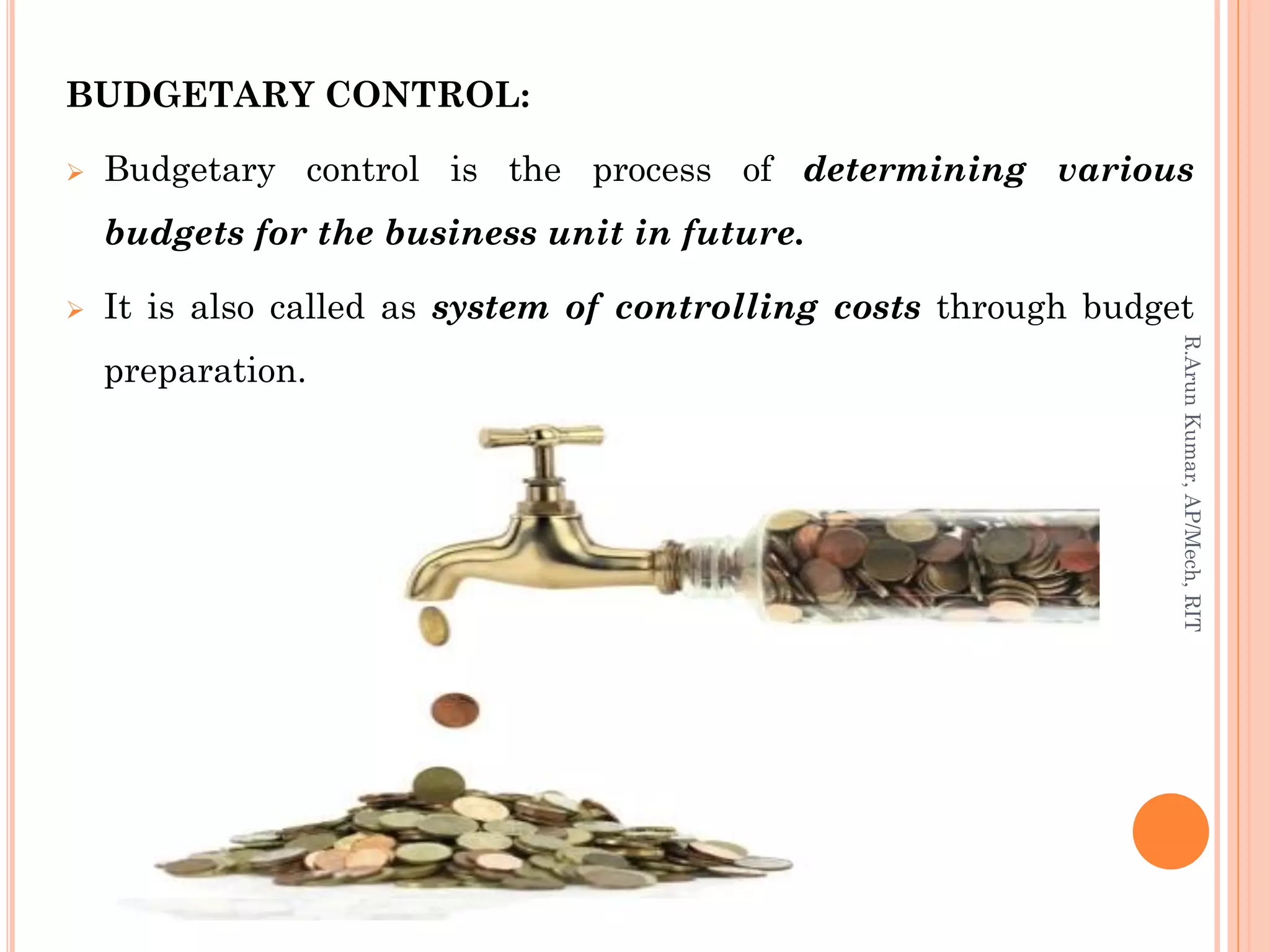
 Budgetary control is the process of determining various
budgets for the business unit in future.
 It is also called as system of controlling costs through budget
preparation.
R.ArunKumar,AP/Mech,RIT
OBJECTIVES OF BUDGETARY CONTROL:
1. Helps to plan and control the income and expenditure of the
organization.
R.ArunKumar,AP/Mech,RIT
OBJECTIVES OF BUDGETARY CONTROL:
2. Maximizes the profit for the organization.
R.ArunKumar,AP/Mech,RIT
OBJECTIVES OF BUDGETARY CONTROL:
3. Provides adequate capital for working.
R.ArunKumar,AP/Mech,RIT
OBJECTIVES OF BUDGETARY CONTROL:
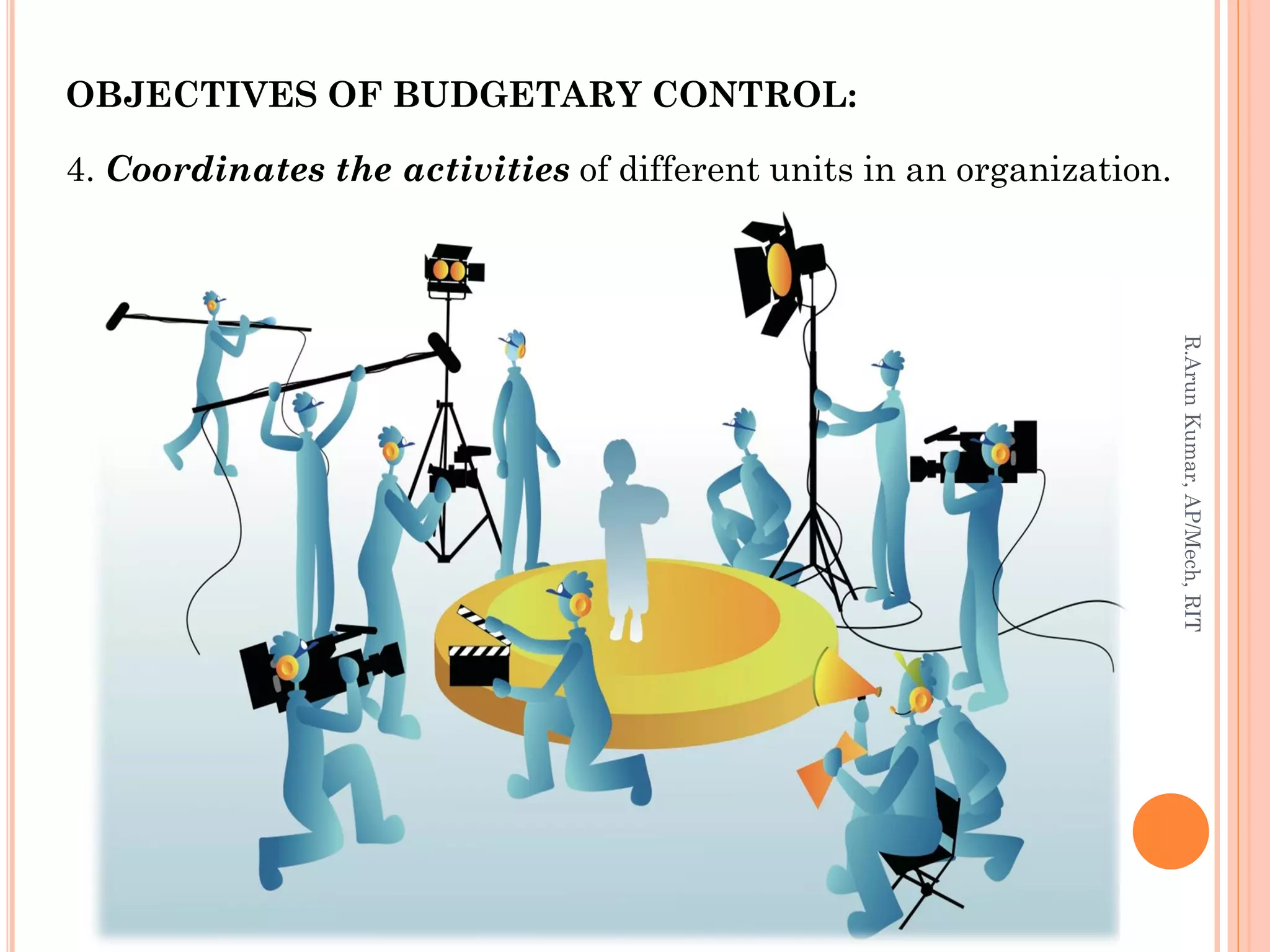
4. Coordinates the activities of different units in an organization.
R.ArunKumar,AP/Mech,RIT
OBJECTIVES OF BUDGETARY CONTROL:
5. Helps to evaluate the performance.
R.ArunKumar,AP/Mech,RIT
OBJECTIVES OF BUDGETARY CONTROL:
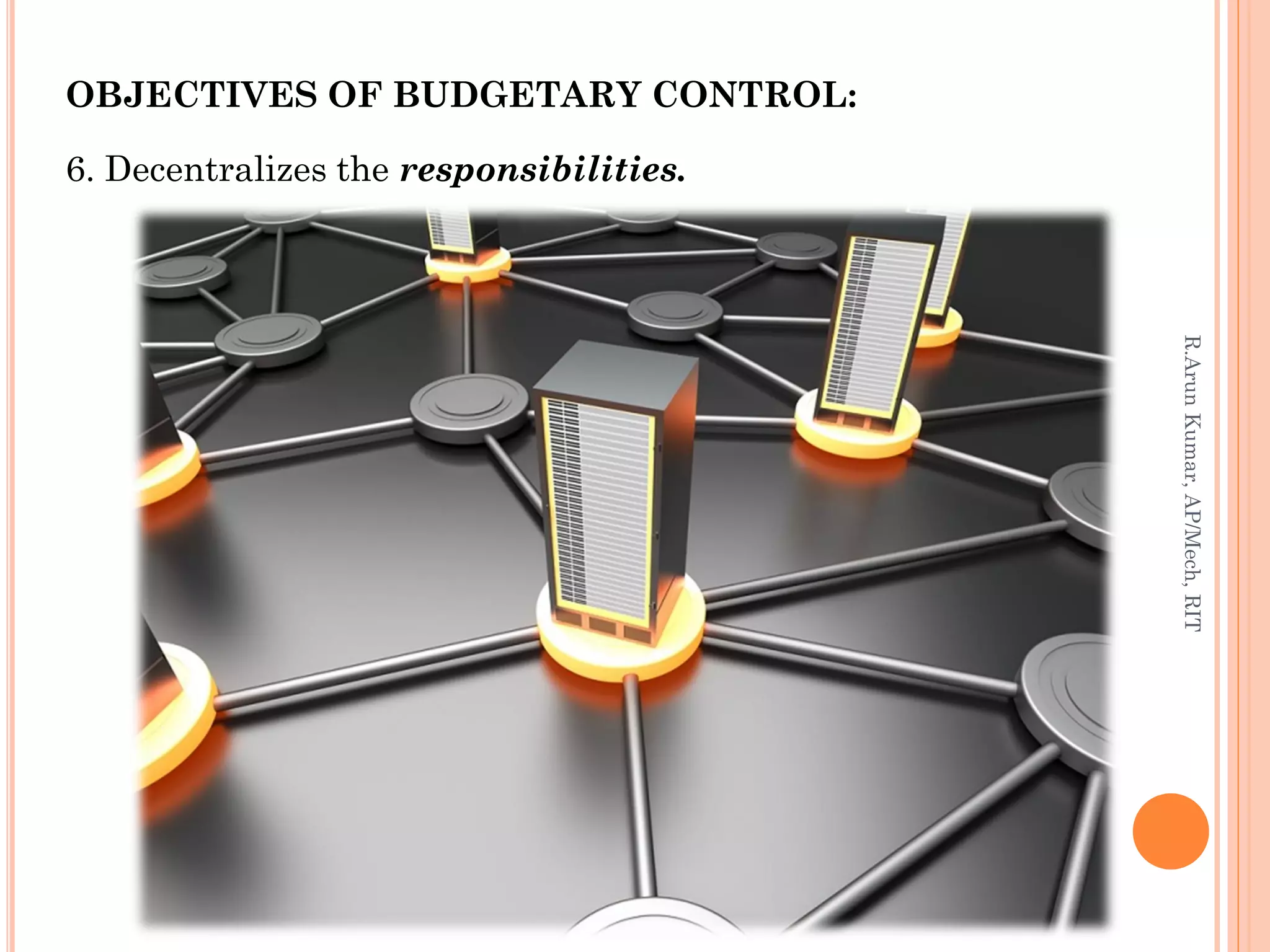
6. Decentralizes the responsibilities.
R.ArunKumar,AP/Mech,RIT
CLASSIFICATIONS OF BUDGET:
1. Classification based on function:
1a) Sales budget:
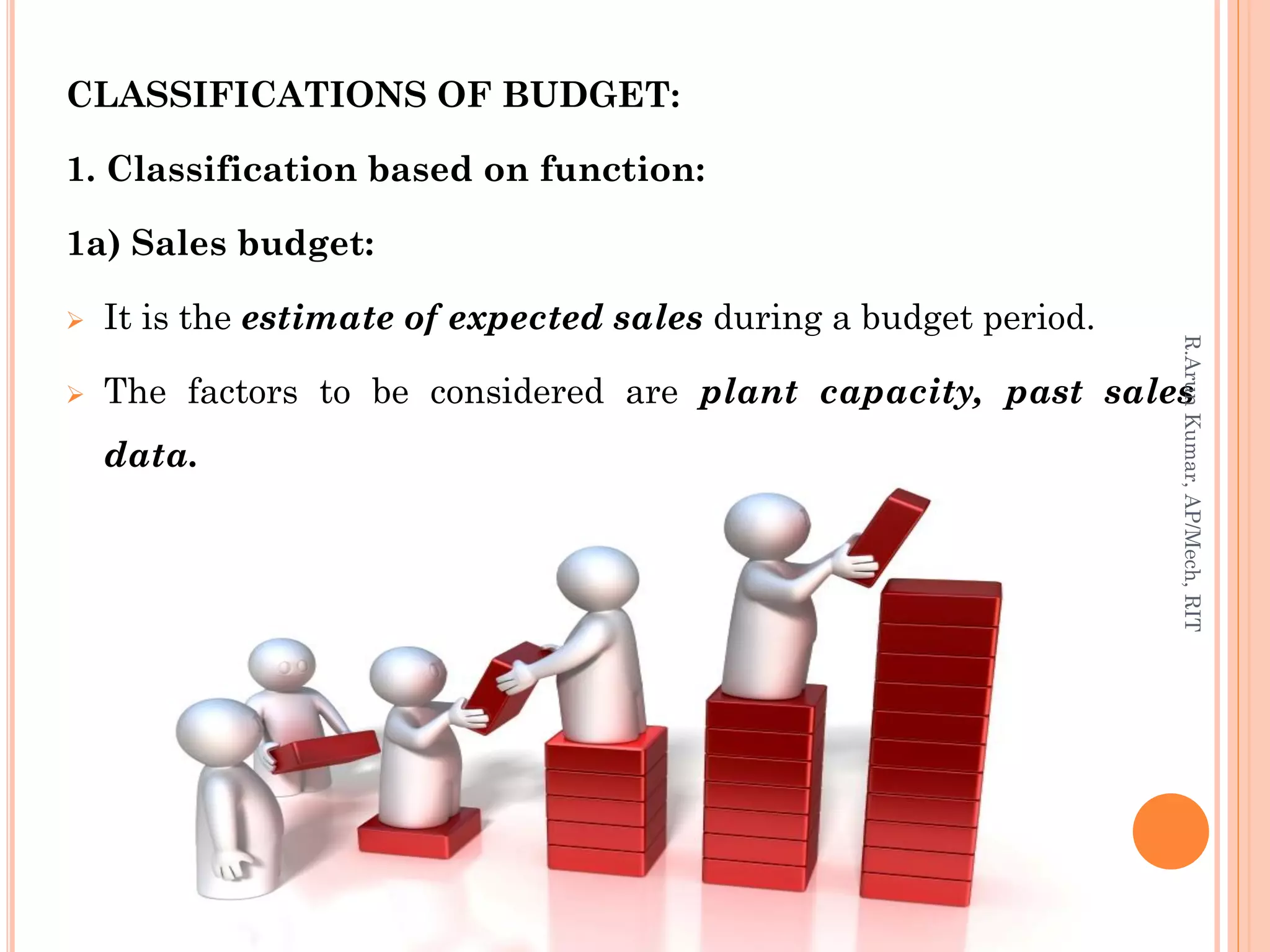
 It is the estimate of expected sales during a budget period.
 The factors to be considered are plant capacity, past sales
data.
R.ArunKumar,AP/Mech,RIT
CLASSIFICATIONS OF BUDGET:
1. Classification based on function:
1b) Production budget:
 Production budget is a forecast of the output for the period
analyzed.
 The factors to be considered are plant capacity, resource
availability, sales requirements.
R.ArunKumar,AP/Mech,RIT
CLASSIFICATIONS OF BUDGET:
1. Classification based on function:
1c) Labour budget:
 It is the forecast of requirements of direct labour essential to
meet the production targets.
R.ArunKumar,AP/Mech,RIT
CLASSIFICATIONS OF BUDGET:
1. Classification based on function:
1d) Capital expenditure budget:
 It includes all the initial investment cost of the organization.
R.ArunKumar,AP/Mech,RIT
CLASSIFICATIONS OF BUDGET:
1. Classification based on function:
1e) Research and development budget:
 Focuses on budget required to develop new products.
R.ArunKumar,AP/Mech,RIT
CLASSIFICATIONS OF BUDGET:
1. Classification based on function:
1f) Profit budget:
 Profit budget is also called as master budget.
R.ArunKumar,AP/Mech,RIT
CLASSIFICATIONS OF BUDGET:
2. Classification based on time:
2a) Long term budget:
 Period of time for long term budgets are 5 to 10 years.
R.ArunKumar,AP/Mech,RIT
CLASSIFICATIONS OF BUDGET:
2. Classification based on time:
2b) Short term budget:
 Period of time for short term budgets are less than 5 years.
R.ArunKumar,AP/Mech,RIT
CLASSIFICATIONS OF BUDGET:
2. Classification based on time:
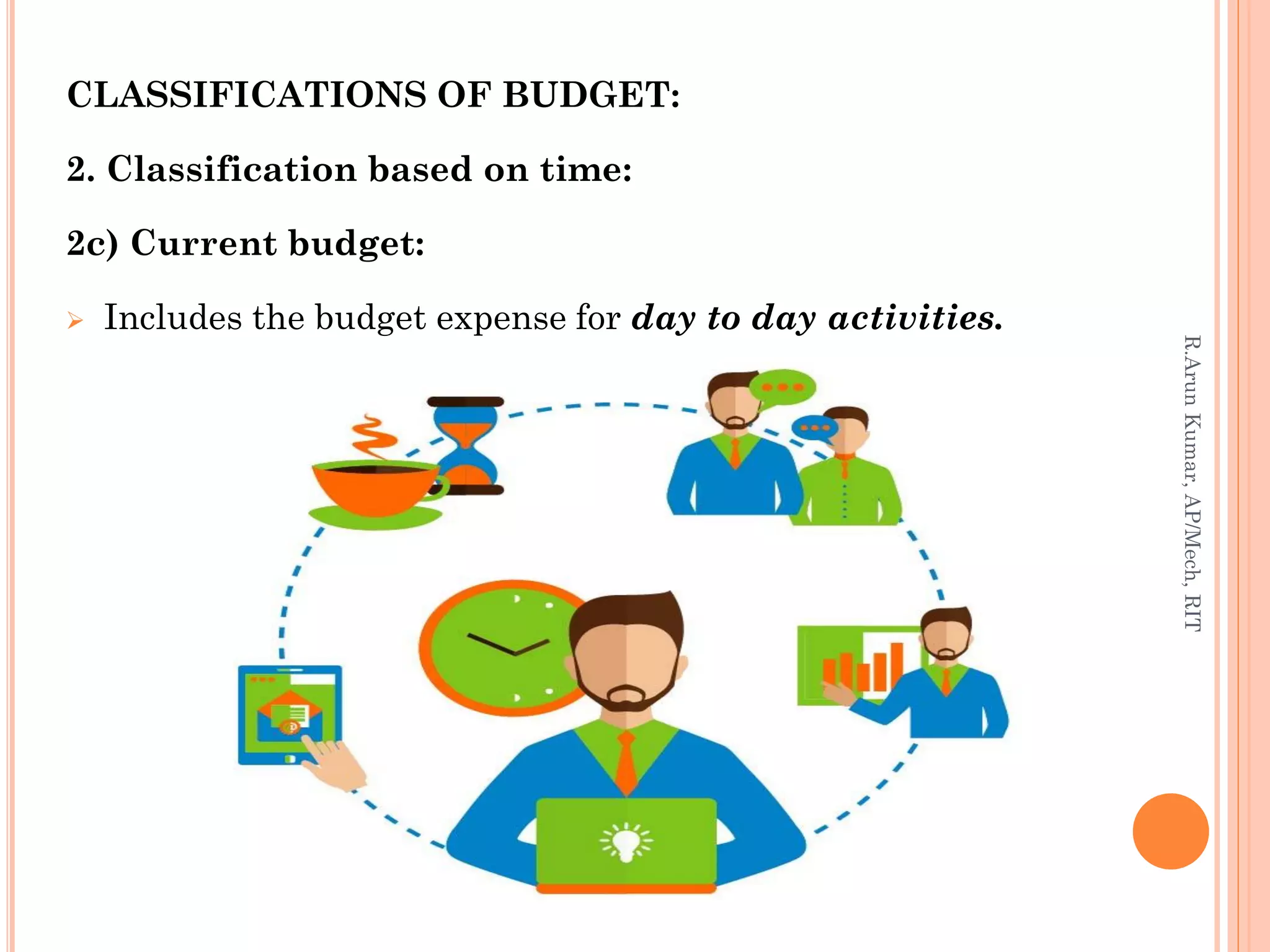
2c) Current budget:
 Includes the budget expense for day to day activities.
R.ArunKumar,AP/Mech,RIT
CLASSIFICATIONS OF BUDGET:
3. Classification based on rigidity:
3a) Fixed budget:
 Budget expenses that are predefined are called as fixed budget.
R.ArunKumar,AP/Mech,RIT
CLASSIFICATIONS OF BUDGET:
3. Classification based on rigidity:
3b) Flexible budget:
 Budget expenses that tends to vary are called as flexible budget.
R.ArunKumar,AP/Mech,RIT
BUDGETARY CONTROL TECHNIQUES:
1. Planning – programme budgetary systems (PPBS):
 Analyzing the basic objectives of policies and activity of each
programme in the organization.
 Measuring the total cost and choosing the best alternative.
R.ArunKumar,AP/Mech,RIT
BUDGETARY CONTROL TECHNIQUES:
2. Zero – based budgeting:
 In this method, every next year budget is made on nil base.
 The expected income will be equal to the expected expenses.
 This process involves three steps: Scheduling, prioritizing and
resource allocation.
R.ArunKumar,AP/Mech,RIT
BUDGETARY CONTROL TECHNIQUES:
3. Variance analysis:
 Estimated budget of the organization expenditure will be
compared with actual accounting figures to measure the
variance.
R.ArunKumar,AP/Mech,RIT
BUDGETARY CONTROL TECHNIQUES:
4. Responsibility accounting:
 The organization is classified as cost centre, profit centre and
investment centre.
 Based on this classification employee will be assigned with a
target.
 On the basis of achievement he / she will be rewarded.
R.ArunKumar,AP/Mech,RIT
BUDGETARY CONTROL TECHNIQUES:
5. Fund adjustment:
 Top management will be altering the fund allocation based on
the requirement.
R.ArunKumar,AP/Mech,RIT
BUDGETARY CONTROL TECHNIQUES:
6. HR accounting:
 It deals with human resource control.
 Investment on HR is a long term investment for any
organization.
 e.g.: training and development programme, disciplinary
programs.
R.ArunKumar,AP/Mech,RIT

Budgetary control techniques

  • 1.
  • 2.
    BUDGET:  According toBrown and Howard, ‘A budget is a pre – determined statement of management policy which provides a standard for comparison with actual results during a given period’. R.ArunKumar,AP/Mech,RIT
  • 3.
    BUDGETARY CONTROL:  Budgetarycontrol is the process of determining various budgets for the business unit in future.  It is also called as system of controlling costs through budget preparation. R.ArunKumar,AP/Mech,RIT
  • 4.
    OBJECTIVES OF BUDGETARYCONTROL: 1. Helps to plan and control the income and expenditure of the organization. R.ArunKumar,AP/Mech,RIT
  • 5.
    OBJECTIVES OF BUDGETARYCONTROL: 2. Maximizes the profit for the organization. R.ArunKumar,AP/Mech,RIT
  • 6.
    OBJECTIVES OF BUDGETARYCONTROL: 3. Provides adequate capital for working. R.ArunKumar,AP/Mech,RIT
  • 7.
    OBJECTIVES OF BUDGETARYCONTROL: 4. Coordinates the activities of different units in an organization. R.ArunKumar,AP/Mech,RIT
  • 8.
    OBJECTIVES OF BUDGETARYCONTROL: 5. Helps to evaluate the performance. R.ArunKumar,AP/Mech,RIT
  • 9.
    OBJECTIVES OF BUDGETARYCONTROL: 6. Decentralizes the responsibilities. R.ArunKumar,AP/Mech,RIT
  • 10.
    CLASSIFICATIONS OF BUDGET: 1.Classification based on function: 1a) Sales budget:  It is the estimate of expected sales during a budget period.  The factors to be considered are plant capacity, past sales data. R.ArunKumar,AP/Mech,RIT
  • 11.
    CLASSIFICATIONS OF BUDGET: 1.Classification based on function: 1b) Production budget:  Production budget is a forecast of the output for the period analyzed.  The factors to be considered are plant capacity, resource availability, sales requirements. R.ArunKumar,AP/Mech,RIT
  • 12.
    CLASSIFICATIONS OF BUDGET: 1.Classification based on function: 1c) Labour budget:  It is the forecast of requirements of direct labour essential to meet the production targets. R.ArunKumar,AP/Mech,RIT
  • 13.
    CLASSIFICATIONS OF BUDGET: 1.Classification based on function: 1d) Capital expenditure budget:  It includes all the initial investment cost of the organization. R.ArunKumar,AP/Mech,RIT
  • 14.
    CLASSIFICATIONS OF BUDGET: 1.Classification based on function: 1e) Research and development budget:  Focuses on budget required to develop new products. R.ArunKumar,AP/Mech,RIT
  • 15.
    CLASSIFICATIONS OF BUDGET: 1.Classification based on function: 1f) Profit budget:  Profit budget is also called as master budget. R.ArunKumar,AP/Mech,RIT
  • 16.
    CLASSIFICATIONS OF BUDGET: 2.Classification based on time: 2a) Long term budget:  Period of time for long term budgets are 5 to 10 years. R.ArunKumar,AP/Mech,RIT
  • 17.
    CLASSIFICATIONS OF BUDGET: 2.Classification based on time: 2b) Short term budget:  Period of time for short term budgets are less than 5 years. R.ArunKumar,AP/Mech,RIT
  • 18.
    CLASSIFICATIONS OF BUDGET: 2.Classification based on time: 2c) Current budget:  Includes the budget expense for day to day activities. R.ArunKumar,AP/Mech,RIT
  • 19.
    CLASSIFICATIONS OF BUDGET: 3.Classification based on rigidity: 3a) Fixed budget:  Budget expenses that are predefined are called as fixed budget. R.ArunKumar,AP/Mech,RIT
  • 20.
    CLASSIFICATIONS OF BUDGET: 3.Classification based on rigidity: 3b) Flexible budget:  Budget expenses that tends to vary are called as flexible budget. R.ArunKumar,AP/Mech,RIT
  • 21.
    BUDGETARY CONTROL TECHNIQUES: 1.Planning – programme budgetary systems (PPBS):  Analyzing the basic objectives of policies and activity of each programme in the organization.  Measuring the total cost and choosing the best alternative. R.ArunKumar,AP/Mech,RIT
  • 22.
    BUDGETARY CONTROL TECHNIQUES: 2.Zero – based budgeting:  In this method, every next year budget is made on nil base.  The expected income will be equal to the expected expenses.  This process involves three steps: Scheduling, prioritizing and resource allocation. R.ArunKumar,AP/Mech,RIT
  • 23.
    BUDGETARY CONTROL TECHNIQUES: 3.Variance analysis:  Estimated budget of the organization expenditure will be compared with actual accounting figures to measure the variance. R.ArunKumar,AP/Mech,RIT
  • 24.
    BUDGETARY CONTROL TECHNIQUES: 4.Responsibility accounting:  The organization is classified as cost centre, profit centre and investment centre.  Based on this classification employee will be assigned with a target.  On the basis of achievement he / she will be rewarded. R.ArunKumar,AP/Mech,RIT
  • 25.
    BUDGETARY CONTROL TECHNIQUES: 5.Fund adjustment:  Top management will be altering the fund allocation based on the requirement. R.ArunKumar,AP/Mech,RIT
  • 26.
    BUDGETARY CONTROL TECHNIQUES: 6.HR accounting:  It deals with human resource control.  Investment on HR is a long term investment for any organization.  e.g.: training and development programme, disciplinary programs. R.ArunKumar,AP/Mech,RIT