LEVELS OF
MANAGEMENT

By group 5
Group members
• Ankit tiwari

• Archit kumar
• Ashutosh Parashar
• Ayanul Haq
Introduction


Management in all business and
organizational activities is the act of
coordinating the efforts of people to
accomplish desired goals
and objectives using available resources
efficiently and effectively.
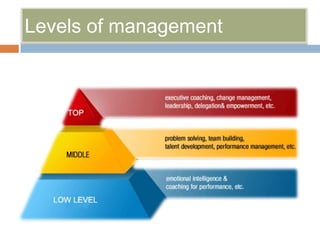
Levels of management


The term “Levels of Management’ refers to a
line of demarcation between various
managerial positions in an organization. The
number of levels in management increases
when the size of the business and work force
increases and vice versa. The level of
management determines a chain of
command, the amount of authority & status
enjoyed by any managerial position.
Top level management


The top consists of the board of
directors , president, vicepresident, CEOs and other members of
the C-level executives. They are
responsible for controlling and
overseeing the entire organization. They
set a tone at the top and develop
strategic plans, company policies, and
make decisions on the direction of the
business.
Functions of top level
management
• The top level management determines the
objectives, policies and plans of the organisation.
• They mobilises (assemble and bring together) available
resources.
• They spend more time in planning and organising.
• They prepare long-term plans of the organisation which
are generally made for 5 to 20 years.
• They require more conceptual skills and less technical
Skills.
MIDDLE LEVEL MANAGEMENT


The Middle Level Management consists of
the Departmental Heads (HOD), Branch
Managers, and the Junior Executives. The
Departmental heads are Finance
Managers, Purchase Managers, etc. The
Branch Managers are the head of a branch
or local unit.
FUNCTIONS OF MIDDLE LEVEL MANAGEMENT
 Design and implement effective group and intergroup work and information systems.
 Define and monitor group-level performance
indicators.
 Diagnose and resolve problems within and among
work groups.
Design and implement reward systems that support
cooperative behaviour
LOWER LEVEL MANAGEMENT
The lower level management
consists of the Foremen and the
Supervisors. They are selected by
the middle level management. It is
also called Operative / Supervisory
level or First Line of Management.
Functions of lower level management
• Lower level management directs the workers /
•
•
•
•

employees.
They develops morale in the workers.
It maintains a link between workers and the middle level
management.
They spend more time in directing and controlling.
The lower level managers make daily, weekly and monthly
plans.
Levels of management

Levels of management

  • 1.
  • 2.
    Group members • Ankittiwari • Archit kumar • Ashutosh Parashar • Ayanul Haq
  • 3.
    Introduction  Management in allbusiness and organizational activities is the act of coordinating the efforts of people to accomplish desired goals and objectives using available resources efficiently and effectively.
  • 4.
  • 5.
    Levels of management  Theterm “Levels of Management’ refers to a line of demarcation between various managerial positions in an organization. The number of levels in management increases when the size of the business and work force increases and vice versa. The level of management determines a chain of command, the amount of authority & status enjoyed by any managerial position.
  • 6.
    Top level management  Thetop consists of the board of directors , president, vicepresident, CEOs and other members of the C-level executives. They are responsible for controlling and overseeing the entire organization. They set a tone at the top and develop strategic plans, company policies, and make decisions on the direction of the business.
  • 7.
    Functions of toplevel management • The top level management determines the objectives, policies and plans of the organisation. • They mobilises (assemble and bring together) available resources. • They spend more time in planning and organising. • They prepare long-term plans of the organisation which are generally made for 5 to 20 years. • They require more conceptual skills and less technical Skills.
  • 8.
    MIDDLE LEVEL MANAGEMENT  TheMiddle Level Management consists of the Departmental Heads (HOD), Branch Managers, and the Junior Executives. The Departmental heads are Finance Managers, Purchase Managers, etc. The Branch Managers are the head of a branch or local unit.
  • 9.
    FUNCTIONS OF MIDDLELEVEL MANAGEMENT  Design and implement effective group and intergroup work and information systems.  Define and monitor group-level performance indicators.  Diagnose and resolve problems within and among work groups. Design and implement reward systems that support cooperative behaviour
  • 10.
    LOWER LEVEL MANAGEMENT Thelower level management consists of the Foremen and the Supervisors. They are selected by the middle level management. It is also called Operative / Supervisory level or First Line of Management.
  • 11.
    Functions of lowerlevel management • Lower level management directs the workers / • • • • employees. They develops morale in the workers. It maintains a link between workers and the middle level management. They spend more time in directing and controlling. The lower level managers make daily, weekly and monthly plans.