PRESENTED BY 
LEKSHMI RAJEEV
MEANING OF PLANNING 
Planning means deciding in advance 
what is to be done 
when is to be done 
& by whom it is to be done.
DEFINITION OF PLANNING 
Henry Fayol defines” Planning is deciding 
the best alternative among others to 
perform different managerial operations in 
order to achieve the predetermined goals”
FEATURES OF PLANNING 
Goal Oriented 
Every organization have goals to be 
fulfilled. Planning is a means towards the 
accomplished of objective. 
• Primacy of Planning 
Planning is the basic function of 
management. Without planning, there is 
nothing to organize.
Continuous Process 
Planning is prepared for a specific 
period. At the end of the period a new 
plan is prepared. 
• Flexibility 
Plans must be flexible so as to 
accommodate future changes. 
• Forward Looking 
Planning involves looking ahead 
&preparing for the future to accomplish 
objective.
IMPORTANCE OF PLANNING 
REDUCES UNCERTAINTY 
Uncertainty & changes are inevitable. Planning 
cannot eliminate changes. 
• HELPS IN EFFECTIVE COORDINATION 
Planning determines the activities of each 
departments and individuals. 
• GUIDES DECISION MAKING 
Planning helps in decision making by selecting the 
best alternative among various alternatives.
ENCOURAGES INNOVATION 
Since planning is deciding in advance. We have to find 
better & different methods to achieve the desired result.
TYPES OF PLANS 
GOAL 
Every organisation have a goal. A goal is an end 
towards which an organisation strives to achieve 
the objectives. 
• OBJECTIVES 
Every organisation exists to achieve the objective. 
Objectives are the end towards which activities are 
directed. 
• POLICIES 
It is a statement formulated to provide guidelines 
in decision making to various managers.
BUDGET 
It is a plan which states expected results of a given 
future period
PROCEDURE 
It is a chronological sequence and the established way of 
performing the work to be accomplished. 
• RULE 
It is a decision made by the management regarding what 
is to done and what is not to be done. 
• METHOD 
It provide detailed and specific guidance for day to day 
actions. 
• PROGRAMMES 
It include all the activities necessary for achieving a 
given objective.
QUALITIES OF AN IDEAL PLAN 
SIMPLICITY 
Plans must be simple & easy to understand. 
CLARITY 
It must be in clear terms. 
INCREASE IN EFFICIENCY 
Planning must aim at increase in efficiency of 
individuals ,group etc 
BALANCE 
There must be a balance between physical& human 
resources. 
REGULAR FEED BACK
STEPS IN PLANNING 
SETTING THE OBJECTIVES 
Plans are formulated to achieve objectives. Objectives 
must be specific & clear. 
• DEVELOP PLANNING PREMISES 
Planning is done for the future which is uncertain. 
Certain assumptions are made about the future 
environment. These assumptions are known as 
Planning Premises
DETERMINE ALTERNATIVE COURSES OF ACTION 
There are alternative ways for achieving the same 
goal. So alternative courses of action should be 
determined. 
• SELECTING THE BEST ALTERNATIVE 
The most appropriate alternative should be selected. 
FORMULATION OF DERIVATIVE PLANS 
Inorder to support the main plan, several sub plans are 
required.The detailed sub plans are known as 
DERIVATIVE PLANS.
• IMPLEMENTATION OF PLANS 
It means putting the plans into action so as to 
achieve the desired objective. 
FOLLOW UP 
Plans are evaluated regularly to check whether they 
are proceeding into the right way.
IMPORTANCE 
SETTING THE OBJECTIVE 
DEVELOP PLANNING PREMISES 
DETERMINE ALTERNATIVE COURSE OF ACTION 
SELECTING THE BEST ALTERNATIVE 
FORMULATING DERIVATIVE PLANS 
IMPLEMENTATION OF PLANS. 
FOLLOW UP
LIMITATIONS OF PLANNING 
TIME AND COST 
Planning is time consuming 
RESISTANCE TO CHANGE 
The required changes are made ,planning will be 
ineffective. 
LACK OF ACCURATE INFORMATION 
The quality of planning depends upon accurate 
information. 
LIMITED SCOPE 
Planning is said to be limited under changing 
circumstances.
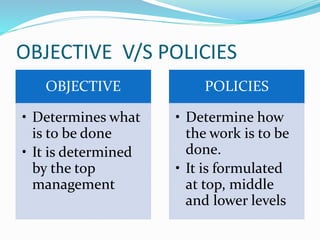
OBJECTIVE V/S POLICIES 
OBJECTIVE 
• Determines what 
is to be done 
• It is determined 
by the top 
management 
POLICIES 
• Determine how 
the work is to be 
done. 
• It is formulated 
at top, middle 
and lower levels
Objectives 
are the end 
points 
Policies 
are 
guidelines

Planning

  • 1.
  • 2.
    MEANING OF PLANNING Planning means deciding in advance what is to be done when is to be done & by whom it is to be done.
  • 3.
    DEFINITION OF PLANNING Henry Fayol defines” Planning is deciding the best alternative among others to perform different managerial operations in order to achieve the predetermined goals”
  • 4.
    FEATURES OF PLANNING Goal Oriented Every organization have goals to be fulfilled. Planning is a means towards the accomplished of objective. • Primacy of Planning Planning is the basic function of management. Without planning, there is nothing to organize.
  • 5.
    Continuous Process Planningis prepared for a specific period. At the end of the period a new plan is prepared. • Flexibility Plans must be flexible so as to accommodate future changes. • Forward Looking Planning involves looking ahead &preparing for the future to accomplish objective.
  • 6.
    IMPORTANCE OF PLANNING REDUCES UNCERTAINTY Uncertainty & changes are inevitable. Planning cannot eliminate changes. • HELPS IN EFFECTIVE COORDINATION Planning determines the activities of each departments and individuals. • GUIDES DECISION MAKING Planning helps in decision making by selecting the best alternative among various alternatives.
  • 7.
    ENCOURAGES INNOVATION Sinceplanning is deciding in advance. We have to find better & different methods to achieve the desired result.
  • 8.
    TYPES OF PLANS GOAL Every organisation have a goal. A goal is an end towards which an organisation strives to achieve the objectives. • OBJECTIVES Every organisation exists to achieve the objective. Objectives are the end towards which activities are directed. • POLICIES It is a statement formulated to provide guidelines in decision making to various managers.
  • 9.
    BUDGET It isa plan which states expected results of a given future period
  • 10.
    PROCEDURE It isa chronological sequence and the established way of performing the work to be accomplished. • RULE It is a decision made by the management regarding what is to done and what is not to be done. • METHOD It provide detailed and specific guidance for day to day actions. • PROGRAMMES It include all the activities necessary for achieving a given objective.
  • 11.
    QUALITIES OF ANIDEAL PLAN SIMPLICITY Plans must be simple & easy to understand. CLARITY It must be in clear terms. INCREASE IN EFFICIENCY Planning must aim at increase in efficiency of individuals ,group etc BALANCE There must be a balance between physical& human resources. REGULAR FEED BACK
  • 12.
    STEPS IN PLANNING SETTING THE OBJECTIVES Plans are formulated to achieve objectives. Objectives must be specific & clear. • DEVELOP PLANNING PREMISES Planning is done for the future which is uncertain. Certain assumptions are made about the future environment. These assumptions are known as Planning Premises
  • 13.
    DETERMINE ALTERNATIVE COURSESOF ACTION There are alternative ways for achieving the same goal. So alternative courses of action should be determined. • SELECTING THE BEST ALTERNATIVE The most appropriate alternative should be selected. FORMULATION OF DERIVATIVE PLANS Inorder to support the main plan, several sub plans are required.The detailed sub plans are known as DERIVATIVE PLANS.
  • 14.
    • IMPLEMENTATION OFPLANS It means putting the plans into action so as to achieve the desired objective. FOLLOW UP Plans are evaluated regularly to check whether they are proceeding into the right way.
  • 15.
    IMPORTANCE SETTING THEOBJECTIVE DEVELOP PLANNING PREMISES DETERMINE ALTERNATIVE COURSE OF ACTION SELECTING THE BEST ALTERNATIVE FORMULATING DERIVATIVE PLANS IMPLEMENTATION OF PLANS. FOLLOW UP
  • 16.
    LIMITATIONS OF PLANNING TIME AND COST Planning is time consuming RESISTANCE TO CHANGE The required changes are made ,planning will be ineffective. LACK OF ACCURATE INFORMATION The quality of planning depends upon accurate information. LIMITED SCOPE Planning is said to be limited under changing circumstances.
  • 17.
    OBJECTIVE V/S POLICIES OBJECTIVE • Determines what is to be done • It is determined by the top management POLICIES • Determine how the work is to be done. • It is formulated at top, middle and lower levels
  • 18.
    Objectives are theend points Policies are guidelines