NON – BUDGETARY CONTROL
TECHNIQUES
R.ArunKumar,AP/Mech,RIT
NON – BUDGETARY CONTROL:
 Control over the organization other than the financial resources
are called as non – budgetary control techniques.
 Non budgetary control techniques are classified into:
 Traditional techniques
 Modern techniques
R.ArunKumar,AP/Mech,RIT
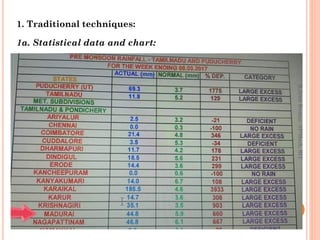
1. Traditional techniques:
1a. Statistical data and chart:
R.ArunKumar,AP/Mech,RIT
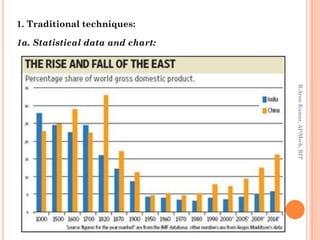
1. Traditional techniques:
1a. Statistical data and chart:
R.ArunKumar,AP/Mech,RIT
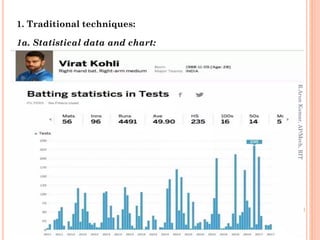
1. Traditional techniques:
1a. Statistical data and chart:
R.ArunKumar,AP/Mech,RIT
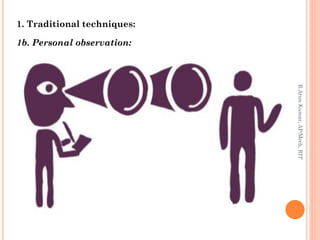
1. Traditional techniques:
1b. Personal observation:
R.ArunKumar,AP/Mech,RIT
1. Traditional techniques:
1c. Operational audit:
R.ArunKumar,AP/Mech,RIT
1. Traditional techniques:
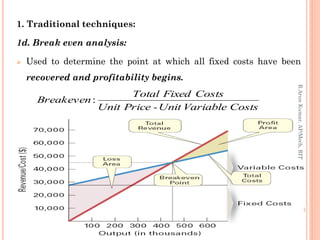
1d. Break even analysis:
 Used to determine the point at which all fixed costs have been
recovered and profitability begins.
CostsVariableUnit-PriceUnit
CostsFixedTotal
Breakeven:
R.ArunKumar,AP/Mech,RIT
1. Traditional techniques:
1e. Special reports:
R.ArunKumar,AP/Mech,RIT
1. Traditional techniques:
1f. Responsibility accounting:
 On the basis of achievement employee will be rewarded.
R.ArunKumar,AP/Mech,RIT
1. Traditional techniques:
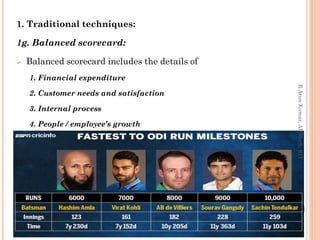
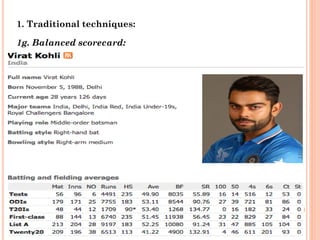
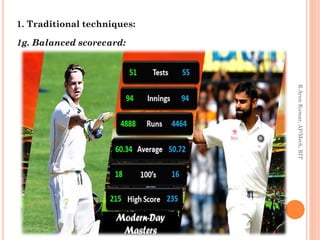
1g. Balanced scorecard:
 Balanced scorecard includes the details of
1. Financial expenditure
2. Customer needs and satisfaction
3. Internal process
4. People / employee’s growth
R.ArunKumar,AP/Mech,RIT
1. Traditional techniques:
1g. Balanced scorecard:
R.ArunKumar,AP/Mech,RIT
1. Traditional techniques:
1g. Balanced scorecard:
R.ArunKumar,AP/Mech,RIT
2. Modern techniques:
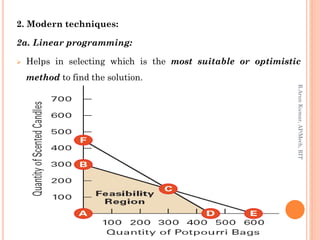
2a. Linear programming:
 Helps in selecting which is the most suitable or optimistic
method to find the solution.
R.ArunKumar,AP/Mech,RIT
2. Modern techniques:
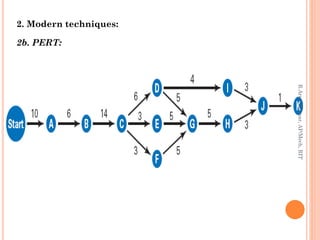
2b. PERT:
 A flow chart diagram that depicts the sequence of activities
needed to complete a project and the time or costs associated
with each activity.
 To understand this one must know the following terms:
1. Events: endpoints for completion.
2. Activities: time required for each activity.
3. Slack time: Time an individual activity can be delayed.
4. Critical path: Most time consuming sequence of events.
R.ArunKumar,AP/Mech,RIT
2. Modern techniques:
2b. PERT:
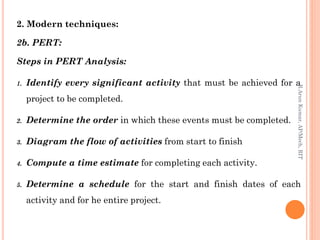
Steps in PERT Analysis:
1. Identify every significant activity that must be achieved for a
project to be completed.
2. Determine the order in which these events must be completed.
3. Diagram the flow of activities from start to finish
4. Compute a time estimate for completing each activity.
5. Determine a schedule for the start and finish dates of each
activity and for he entire project.
R.ArunKumar,AP/Mech,RIT
2. Modern techniques:
2b. PERT:
R.ArunKumar,AP/Mech,RIT
2. Modern techniques:
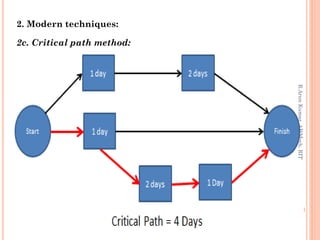
2c. Critical path method:
R.ArunKumar,AP/Mech,RIT
2. Modern techniques:
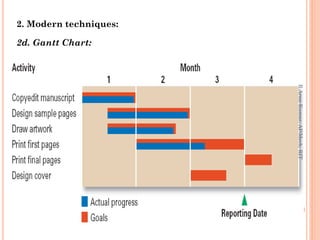
2d. Gantt Chart:
R.ArunKumar,AP/Mech,RIT
2. Modern techniques:
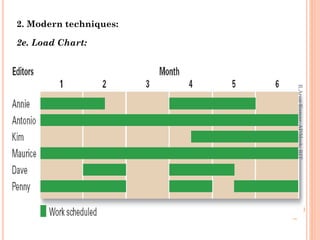
2e. Load Chart:
R.ArunKumar,AP/Mech,RIT
2. Modern techniques:
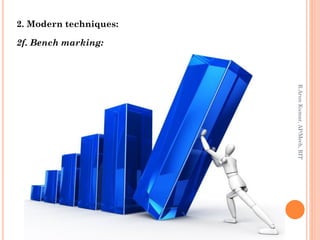
2f. Bench marking:
R.ArunKumar,AP/Mech,RIT

Non budgetary control techniques

  • 1.
    NON – BUDGETARYCONTROL TECHNIQUES R.ArunKumar,AP/Mech,RIT
  • 2.
    NON – BUDGETARYCONTROL:  Control over the organization other than the financial resources are called as non – budgetary control techniques.  Non budgetary control techniques are classified into:  Traditional techniques  Modern techniques R.ArunKumar,AP/Mech,RIT
  • 3.
    1. Traditional techniques: 1a.Statistical data and chart: R.ArunKumar,AP/Mech,RIT
  • 4.
    1. Traditional techniques: 1a.Statistical data and chart: R.ArunKumar,AP/Mech,RIT
  • 5.
    1. Traditional techniques: 1a.Statistical data and chart: R.ArunKumar,AP/Mech,RIT
  • 6.
    1. Traditional techniques: 1b.Personal observation: R.ArunKumar,AP/Mech,RIT
  • 7.
    1. Traditional techniques: 1c.Operational audit: R.ArunKumar,AP/Mech,RIT
  • 8.
    1. Traditional techniques: 1d.Break even analysis:  Used to determine the point at which all fixed costs have been recovered and profitability begins. CostsVariableUnit-PriceUnit CostsFixedTotal Breakeven: R.ArunKumar,AP/Mech,RIT
  • 9.
    1. Traditional techniques: 1e.Special reports: R.ArunKumar,AP/Mech,RIT
  • 10.
    1. Traditional techniques: 1f.Responsibility accounting:  On the basis of achievement employee will be rewarded. R.ArunKumar,AP/Mech,RIT
  • 11.
    1. Traditional techniques: 1g.Balanced scorecard:  Balanced scorecard includes the details of 1. Financial expenditure 2. Customer needs and satisfaction 3. Internal process 4. People / employee’s growth R.ArunKumar,AP/Mech,RIT
  • 12.
    1. Traditional techniques: 1g.Balanced scorecard: R.ArunKumar,AP/Mech,RIT
  • 13.
    1. Traditional techniques: 1g.Balanced scorecard: R.ArunKumar,AP/Mech,RIT
  • 14.
    2. Modern techniques: 2a.Linear programming:  Helps in selecting which is the most suitable or optimistic method to find the solution. R.ArunKumar,AP/Mech,RIT
  • 15.
    2. Modern techniques: 2b.PERT:  A flow chart diagram that depicts the sequence of activities needed to complete a project and the time or costs associated with each activity.  To understand this one must know the following terms: 1. Events: endpoints for completion. 2. Activities: time required for each activity. 3. Slack time: Time an individual activity can be delayed. 4. Critical path: Most time consuming sequence of events. R.ArunKumar,AP/Mech,RIT
  • 16.
    2. Modern techniques: 2b.PERT: Steps in PERT Analysis: 1. Identify every significant activity that must be achieved for a project to be completed. 2. Determine the order in which these events must be completed. 3. Diagram the flow of activities from start to finish 4. Compute a time estimate for completing each activity. 5. Determine a schedule for the start and finish dates of each activity and for he entire project. R.ArunKumar,AP/Mech,RIT
  • 17.
    2. Modern techniques: 2b.PERT: R.ArunKumar,AP/Mech,RIT
  • 18.
    2. Modern techniques: 2c.Critical path method: R.ArunKumar,AP/Mech,RIT
  • 19.
    2. Modern techniques: 2d.Gantt Chart: R.ArunKumar,AP/Mech,RIT
  • 20.
    2. Modern techniques: 2e.Load Chart: R.ArunKumar,AP/Mech,RIT
  • 21.
    2. Modern techniques: 2f.Bench marking: R.ArunKumar,AP/Mech,RIT