
PLANNING AND
TYPES OF
PLANNING
Abdussamad Abid | Safwan Rao | Sikandar
Azam | Mazharuddin
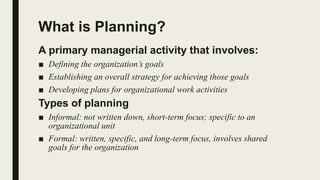
What is Planning?
A primary managerial activity that involves:
■ Defining the organization’s goals
■ Establishing an overall strategy for achieving those goals
■ Developing plans for organizational work activities
Types of planning
■ Informal: not written down, short-term focus; specific to an
organizational unit
■ Formal: written, specific, and long-term focus, involves shared
goals for the organization
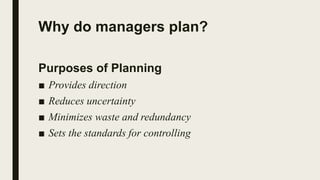
Why do managers plan?
Purposes of Planning
■ Provides direction
■ Reduces uncertainty
■ Minimizes waste and redundancy
■ Sets the standards for controlling
How do managers plan?
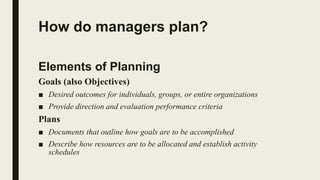
Elements of Planning
Goals (also Objectives)
■ Desired outcomes for individuals, groups, or entire organizations
■ Provide direction and evaluation performance criteria
Plans
■ Documents that outline how goals are to be accomplished
■ Describe how resources are to be allocated and establish activity
schedules
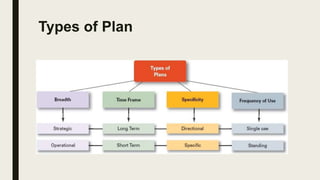
Types of Plan
Types of Plans (cont.)
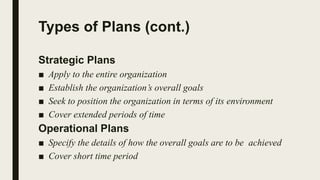
Strategic Plans
■ Apply to the entire organization
■ Establish the organization’s overall goals
■ Seek to position the organization in terms of its environment
■ Cover extended periods of time
Operational Plans
■ Specify the details of how the overall goals are to be achieved
■ Cover short time period
Types of Plans (cont.)
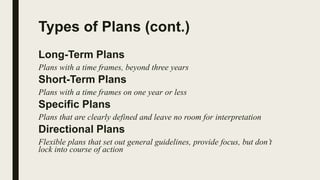
Long-Term Plans
Plans with a time frames, beyond three years
Short-Term Plans
Plans with a time frames on one year or less
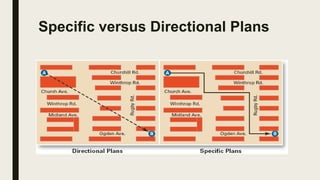
Specific Plans
Plans that are clearly defined and leave no room for interpretation
Directional Plans
Flexible plans that set out general guidelines, provide focus, but don’t
lock into course of action
Specific versus Directional Plans
Types of Plans (cont.)
Single-Use Plan
A one-time plan specifically designed to meet the need of a unique situation
Standing Plans
Ongoing plans that provide guidance for activities performed repeatedly
Approaches to Planning
Establishing a formal planning department
■ A group of planning specialists who help managers write organizational
plans
■ Planning is a function of management; it should never become the sole
responsibility of planners
Involving organizational members in the
process
Plans are developed by members of organizational units at various levels
and then coordinated with other units across the organization
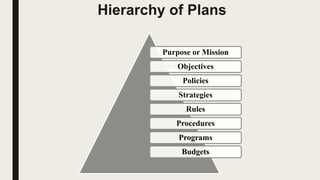
Hierarchy of Plans
Purpose or Mission
Objectives
Policies
Strategies
Rules
Procedures
Programs
Budgets
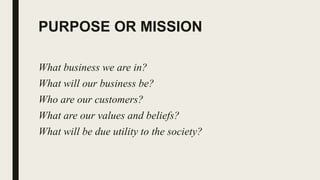
PURPOSE OR MISSION
What business we are in?
What will our business be?
Who are our customers?
What are our values and beliefs?
What will be due utility to the society?
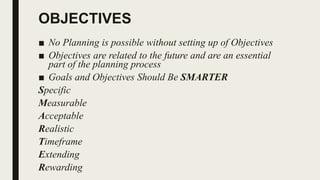
OBJECTIVES
■ No Planning is possible without setting up of Objectives
■ Objectives are related to the future and are an essential
part of the planning process
■ Goals and Objectives Should Be SMARTER
Specific
Measurable
Acceptable
Realistic
Timeframe
Extending
Rewarding
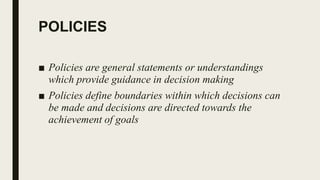
POLICIES
■ Policies are general statements or understandings
which provide guidance in decision making
■ Policies define boundaries within which decisions can
be made and decisions are directed towards the
achievement of goals
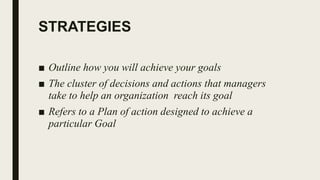
STRATEGIES
■ Outline how you will achieve your goals
■ The cluster of decisions and actions that managers
take to help an organization reach its goal
■ Refers to a Plan of action designed to achieve a
particular Goal
PROCEDURES
■ Procedures are details of action or the guidelines for the
achievement of business objectives
■ Procedures give detail of how things are to be done
■ Also determine the policy of responsibility and
accountability
■ A procedure is a set of step-by-step directions that explains
how activities or tasks are to be carried out
RULES
■ A Rule is definite and rigid and allows no deviation or discretion
to the Subordinates
■ Rules channel the behavior of workers in a desired direction
■ A rule is an explicit statement that tells an employee what he or
she can and cannot do
■ Rules are “do” and “don't” statements put into place to promote
the safety of employees and the uniform treatment and behavior
of employees
PROGRAMS
■ A Program is a sequence of activities designed to
implement policies and accomplish objectives
■ Program may be taken as a combination of policies,
procedures, rules, budgets, task assignment, etc.
developed for specific purpose of carrying out a
particulars course of action
BUDGETS
■ A pre-determined statement of management policy
during period which provides a standard for
comparison with the results actually achieved
■ There should be an active involvement of top
management while preparing a budget
THANKYOU

PLANNING & TYPES OF PLANNING

  • 1.
    PLANNING AND TYPES OF PLANNING AbdussamadAbid | Safwan Rao | Sikandar Azam | Mazharuddin
  • 2.
    What is Planning? Aprimary managerial activity that involves: ■ Defining the organization’s goals ■ Establishing an overall strategy for achieving those goals ■ Developing plans for organizational work activities Types of planning ■ Informal: not written down, short-term focus; specific to an organizational unit ■ Formal: written, specific, and long-term focus, involves shared goals for the organization
  • 3.
    Why do managersplan? Purposes of Planning ■ Provides direction ■ Reduces uncertainty ■ Minimizes waste and redundancy ■ Sets the standards for controlling
  • 4.
    How do managersplan? Elements of Planning Goals (also Objectives) ■ Desired outcomes for individuals, groups, or entire organizations ■ Provide direction and evaluation performance criteria Plans ■ Documents that outline how goals are to be accomplished ■ Describe how resources are to be allocated and establish activity schedules
  • 5.
  • 6.
    Types of Plans(cont.) Strategic Plans ■ Apply to the entire organization ■ Establish the organization’s overall goals ■ Seek to position the organization in terms of its environment ■ Cover extended periods of time Operational Plans ■ Specify the details of how the overall goals are to be achieved ■ Cover short time period
  • 7.
    Types of Plans(cont.) Long-Term Plans Plans with a time frames, beyond three years Short-Term Plans Plans with a time frames on one year or less Specific Plans Plans that are clearly defined and leave no room for interpretation Directional Plans Flexible plans that set out general guidelines, provide focus, but don’t lock into course of action
  • 8.
  • 9.
    Types of Plans(cont.) Single-Use Plan A one-time plan specifically designed to meet the need of a unique situation Standing Plans Ongoing plans that provide guidance for activities performed repeatedly
  • 10.
    Approaches to Planning Establishinga formal planning department ■ A group of planning specialists who help managers write organizational plans ■ Planning is a function of management; it should never become the sole responsibility of planners Involving organizational members in the process Plans are developed by members of organizational units at various levels and then coordinated with other units across the organization
  • 11.
    Hierarchy of Plans Purposeor Mission Objectives Policies Strategies Rules Procedures Programs Budgets
  • 12.
    PURPOSE OR MISSION Whatbusiness we are in? What will our business be? Who are our customers? What are our values and beliefs? What will be due utility to the society?
  • 13.
    OBJECTIVES ■ No Planningis possible without setting up of Objectives ■ Objectives are related to the future and are an essential part of the planning process ■ Goals and Objectives Should Be SMARTER Specific Measurable Acceptable Realistic Timeframe Extending Rewarding
  • 14.
    POLICIES ■ Policies aregeneral statements or understandings which provide guidance in decision making ■ Policies define boundaries within which decisions can be made and decisions are directed towards the achievement of goals
  • 15.
    STRATEGIES ■ Outline howyou will achieve your goals ■ The cluster of decisions and actions that managers take to help an organization reach its goal ■ Refers to a Plan of action designed to achieve a particular Goal
  • 16.
    PROCEDURES ■ Procedures aredetails of action or the guidelines for the achievement of business objectives ■ Procedures give detail of how things are to be done ■ Also determine the policy of responsibility and accountability ■ A procedure is a set of step-by-step directions that explains how activities or tasks are to be carried out
  • 17.
    RULES ■ A Ruleis definite and rigid and allows no deviation or discretion to the Subordinates ■ Rules channel the behavior of workers in a desired direction ■ A rule is an explicit statement that tells an employee what he or she can and cannot do ■ Rules are “do” and “don't” statements put into place to promote the safety of employees and the uniform treatment and behavior of employees
  • 18.
    PROGRAMS ■ A Programis a sequence of activities designed to implement policies and accomplish objectives ■ Program may be taken as a combination of policies, procedures, rules, budgets, task assignment, etc. developed for specific purpose of carrying out a particulars course of action
  • 19.
    BUDGETS ■ A pre-determinedstatement of management policy during period which provides a standard for comparison with the results actually achieved ■ There should be an active involvement of top management while preparing a budget
  • 20.