

SELECTION, TRAINING AND
DEVELOPMENT
R.ArunKumar,AP/Mech,RIT
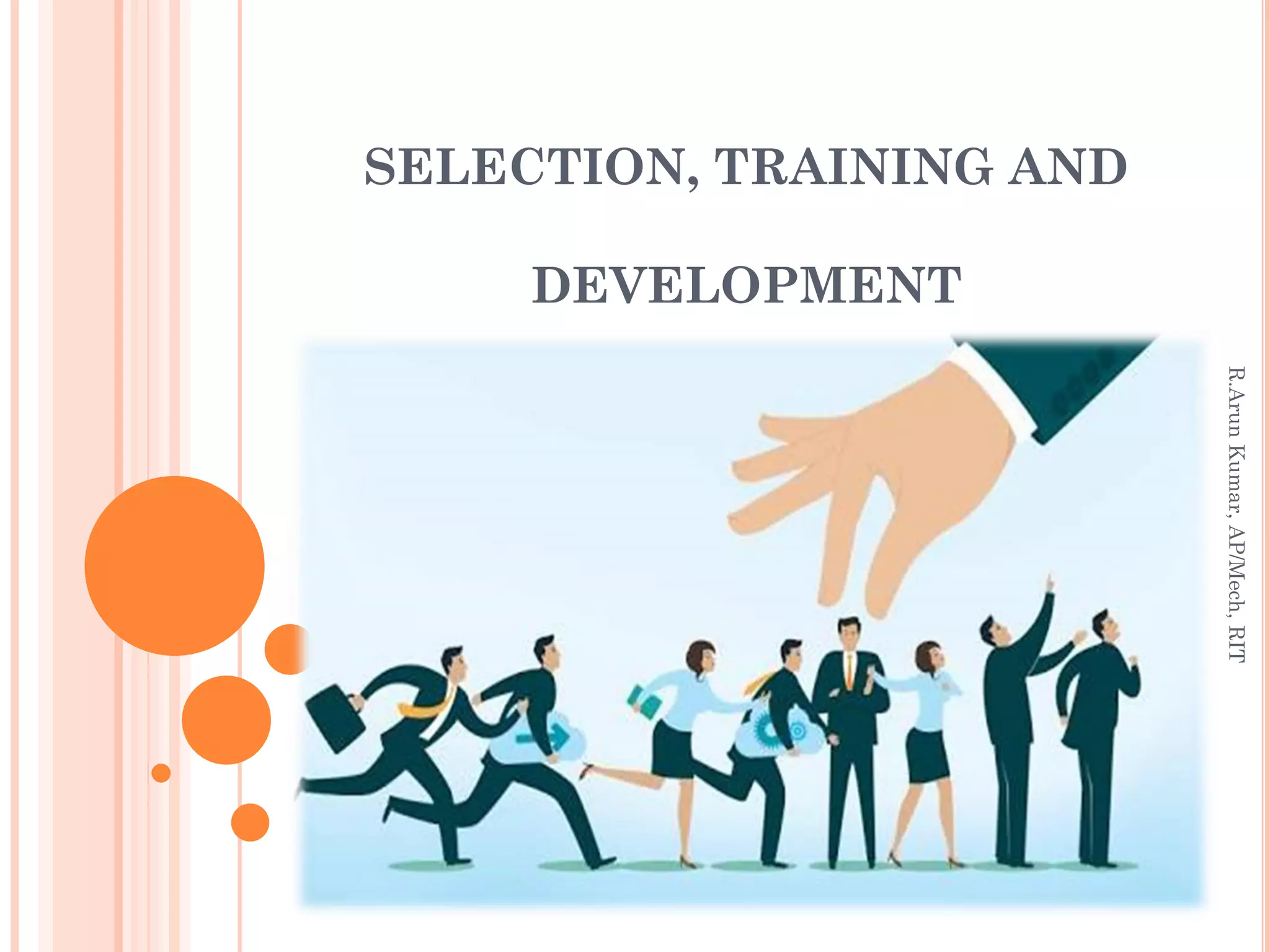
SELECTION:
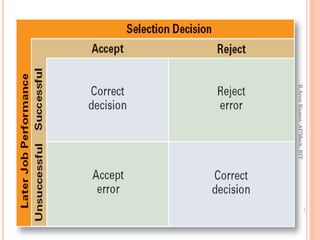
 Selection is the process of choosing the most suitable persons
out of all applicants.
 According to O’Donnell, selection is the process of choosing
candidates within or outside the organization, for the current
position or for the future position.
R.ArunKumar,AP/Mech,RIT
SELECTION:
 In this process, relevant information about the applicant is
collected and deserving candidates are provided with job
opportunity.
R.ArunKumar,AP/Mech,RIT
SELECTION PROCESS:
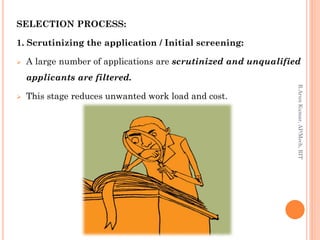
1. Scrutinizing the application / Initial screening:
 A large number of applications are scrutinized and unqualified
applicants are filtered.
 This stage reduces unwanted work load and cost.
R.ArunKumar,AP/Mech,RIT
SELECTION PROCESS:
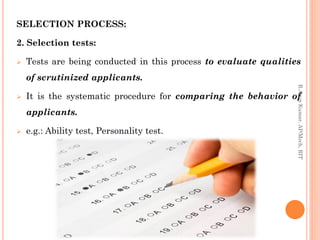
2. Selection tests:
 Tests are being conducted in this process to evaluate qualities
of scrutinized applicants.
 It is the systematic procedure for comparing the behavior of
applicants.
 e.g.: Ability test, Personality test.
R.ArunKumar,AP/Mech,RIT
SELECTION PROCESS:
3. Interview process:
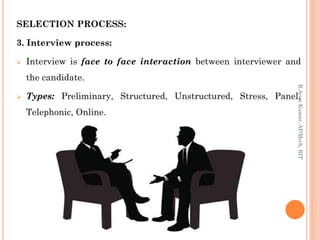
 Interview is face to face interaction between interviewer and
the candidate.
 Types: Preliminary, Structured, Unstructured, Stress, Panel,
Telephonic, Online.
R.ArunKumar,AP/Mech,RIT
SELECTION PROCESS:
4. Physical examination:
 Stage where the medical fitness of the candidates is examined.
R.ArunKumar,AP/Mech,RIT
SELECTION PROCESS:
5. Reference check:
 Getting feedback from the referees.
R.ArunKumar,AP/Mech,RIT
SELECTION PROCESS:
6. Final Selection:
 Offering formal appointment order for the shortlisted
candidate.
R.ArunKumar,AP/Mech,RIT
TRAINING AND DEVELOPMENT:
 Training is a set of activities that provide opportunity to
acquire and improve job – related skills.
 Development means all round improvement on the
performance, personality growth in proficiency, advancement
and progress in all other traits.
R.ArunKumar,AP/Mech,RIT
NEEDS:
 Orientation to new hires.
 Orientation to potential promotes.
 Refreshing knowledge of existing employees.
 Awareness against risk factors.
 Human relations.
 Complexity in organization.
 Upgrading the knowledge.
R.ArunKumar,AP/Mech,RIT
IMPORTANCE:
 A trained worker can contribute more towards output of the
organization.
 Trained employees will make better use of resources.
 Helps the employees to be loyal to the organization.
 Helps to attain promotions.
 Eliminates risk and accidents.
 Helps in standardizing the system.
 Reduces the time to learn the system.
R.ArunKumar,AP/Mech,RIT
TRAINING METHODS:
 Employee training and development should be guided by
principles of motivation, progressive information, practice,
individual ability enhancement.
 The types of training are:
1. On job training
2. Off job training
R.ArunKumar,AP/Mech,RIT
ON JOB TRAINING:
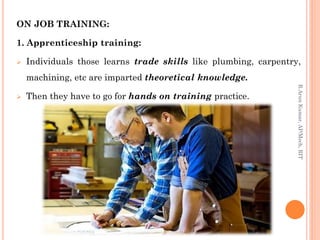
1. Apprenticeship training:
 Individuals those learns trade skills like plumbing, carpentry,
machining, etc are imparted theoretical knowledge.
 Then they have to go for hands on training practice.
R.ArunKumar,AP/Mech,RIT
ON JOB TRAINING:
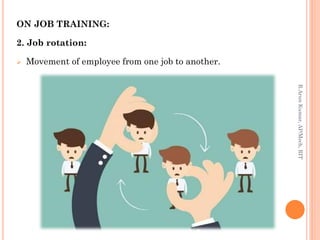
2. Job rotation:
 Movement of employee from one job to another.
R.ArunKumar,AP/Mech,RIT
ON JOB TRAINING:
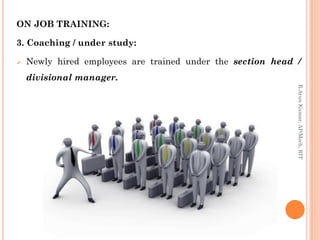
3. Coaching / under study:
 Newly hired employees are trained under the section head /
divisional manager.
R.ArunKumar,AP/Mech,RIT
ON JOB TRAINING:
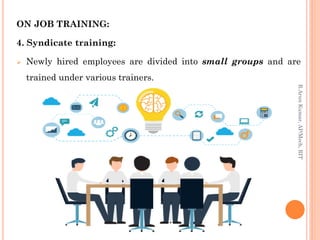
4. Syndicate training:
 Newly hired employees are divided into small groups and are
trained under various trainers.
R.ArunKumar,AP/Mech,RIT
ON JOB TRAINING:
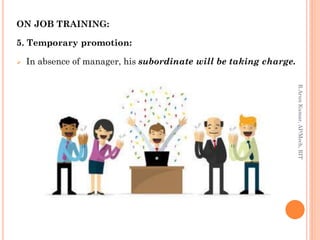
5. Temporary promotion:
 In absence of manager, his subordinate will be taking charge.
R.ArunKumar,AP/Mech,RIT
OFF JOB TRAINING:
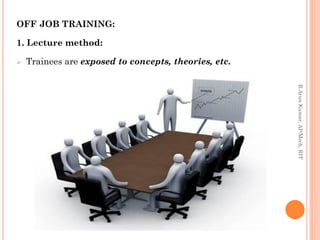
1. Lecture method:
 Trainees are exposed to concepts, theories, etc.
R.ArunKumar,AP/Mech,RIT
OFF JOB TRAINING:
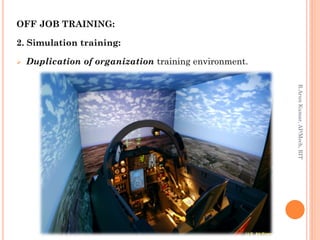
2. Simulation training:
 Duplication of organization training environment.
R.ArunKumar,AP/Mech,RIT
OFF JOB TRAINING:
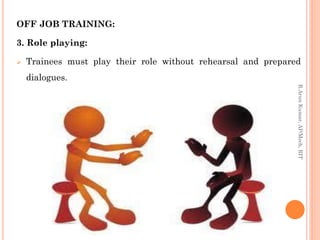
3. Role playing:
 Trainees must play their role without rehearsal and prepared
dialogues.
R.ArunKumar,AP/Mech,RIT
OFF JOB TRAINING:
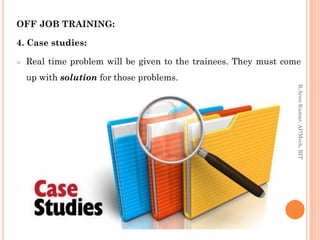
4. Case studies:
 Real time problem will be given to the trainees. They must come
up with solution for those problems.
R.ArunKumar,AP/Mech,RIT
STEPS IN TRAINING:
 Identification of needs.
 Establish objectives of the training process.
 Methodology selection.
 Preparation of schedule and resources.
 Implementation.
 Evaluation.
 Feedback.
R.ArunKumar,AP/Mech,RIT
EVALUATION TECHNIQUES OF TRAINING:
 Productivity of the organization.
 Quality of the product and process.
 Feedback from supervisor.
 Evaluation test.
 Behavioral test.
R.ArunKumar,AP/Mech,RIT

Selection, training and development

  • 1.
  • 2.
    SELECTION:  Selection isthe process of choosing the most suitable persons out of all applicants.  According to O’Donnell, selection is the process of choosing candidates within or outside the organization, for the current position or for the future position. R.ArunKumar,AP/Mech,RIT
  • 3.
    SELECTION:  In thisprocess, relevant information about the applicant is collected and deserving candidates are provided with job opportunity. R.ArunKumar,AP/Mech,RIT
  • 4.
    SELECTION PROCESS: 1. Scrutinizingthe application / Initial screening:  A large number of applications are scrutinized and unqualified applicants are filtered.  This stage reduces unwanted work load and cost. R.ArunKumar,AP/Mech,RIT
  • 5.
    SELECTION PROCESS: 2. Selectiontests:  Tests are being conducted in this process to evaluate qualities of scrutinized applicants.  It is the systematic procedure for comparing the behavior of applicants.  e.g.: Ability test, Personality test. R.ArunKumar,AP/Mech,RIT
  • 6.
    SELECTION PROCESS: 3. Interviewprocess:  Interview is face to face interaction between interviewer and the candidate.  Types: Preliminary, Structured, Unstructured, Stress, Panel, Telephonic, Online. R.ArunKumar,AP/Mech,RIT
  • 7.
    SELECTION PROCESS: 4. Physicalexamination:  Stage where the medical fitness of the candidates is examined. R.ArunKumar,AP/Mech,RIT
  • 8.
    SELECTION PROCESS: 5. Referencecheck:  Getting feedback from the referees. R.ArunKumar,AP/Mech,RIT
  • 9.
    SELECTION PROCESS: 6. FinalSelection:  Offering formal appointment order for the shortlisted candidate. R.ArunKumar,AP/Mech,RIT
  • 10.
  • 11.
    TRAINING AND DEVELOPMENT: Training is a set of activities that provide opportunity to acquire and improve job – related skills.  Development means all round improvement on the performance, personality growth in proficiency, advancement and progress in all other traits. R.ArunKumar,AP/Mech,RIT
  • 12.
    NEEDS:  Orientation tonew hires.  Orientation to potential promotes.  Refreshing knowledge of existing employees.  Awareness against risk factors.  Human relations.  Complexity in organization.  Upgrading the knowledge. R.ArunKumar,AP/Mech,RIT
  • 13.
    IMPORTANCE:  A trainedworker can contribute more towards output of the organization.  Trained employees will make better use of resources.  Helps the employees to be loyal to the organization.  Helps to attain promotions.  Eliminates risk and accidents.  Helps in standardizing the system.  Reduces the time to learn the system. R.ArunKumar,AP/Mech,RIT
  • 14.
    TRAINING METHODS:  Employeetraining and development should be guided by principles of motivation, progressive information, practice, individual ability enhancement.  The types of training are: 1. On job training 2. Off job training R.ArunKumar,AP/Mech,RIT
  • 15.
    ON JOB TRAINING: 1.Apprenticeship training:  Individuals those learns trade skills like plumbing, carpentry, machining, etc are imparted theoretical knowledge.  Then they have to go for hands on training practice. R.ArunKumar,AP/Mech,RIT
  • 16.
    ON JOB TRAINING: 2.Job rotation:  Movement of employee from one job to another. R.ArunKumar,AP/Mech,RIT
  • 17.
    ON JOB TRAINING: 3.Coaching / under study:  Newly hired employees are trained under the section head / divisional manager. R.ArunKumar,AP/Mech,RIT
  • 18.
    ON JOB TRAINING: 4.Syndicate training:  Newly hired employees are divided into small groups and are trained under various trainers. R.ArunKumar,AP/Mech,RIT
  • 19.
    ON JOB TRAINING: 5.Temporary promotion:  In absence of manager, his subordinate will be taking charge. R.ArunKumar,AP/Mech,RIT
  • 20.
    OFF JOB TRAINING: 1.Lecture method:  Trainees are exposed to concepts, theories, etc. R.ArunKumar,AP/Mech,RIT
  • 21.
    OFF JOB TRAINING: 2.Simulation training:  Duplication of organization training environment. R.ArunKumar,AP/Mech,RIT
  • 22.
    OFF JOB TRAINING: 3.Role playing:  Trainees must play their role without rehearsal and prepared dialogues. R.ArunKumar,AP/Mech,RIT
  • 23.
    OFF JOB TRAINING: 4.Case studies:  Real time problem will be given to the trainees. They must come up with solution for those problems. R.ArunKumar,AP/Mech,RIT
  • 24.
    STEPS IN TRAINING: Identification of needs.  Establish objectives of the training process.  Methodology selection.  Preparation of schedule and resources.  Implementation.  Evaluation.  Feedback. R.ArunKumar,AP/Mech,RIT
  • 25.
    EVALUATION TECHNIQUES OFTRAINING:  Productivity of the organization.  Quality of the product and process.  Feedback from supervisor.  Evaluation test.  Behavioral test. R.ArunKumar,AP/Mech,RIT