What is Project Human Resource
               Management?
The processes required to make the most effective use
   of the people involved with the project.
It includes all the project stakeholders-sponsors,
   customers, partners, individual contributors,
   performing organization, project and team members.


                                                        1
Project Human Resource Management
            Major Processes
• Organizational Planning
   – Identify, document, and assign project roles,
     responsibilities, and reporting relationships
• Staff Acquisition
   – Getting the human resources needed assigned to and
     working on the project
• Team Development
   – developing individual and group competencies to
     enhance project performance


                                                          2
Organizational Planning Process

• Usually done as part of the earliest project phases
• Results should be reviewed throughout the project
• Organizational planning is often tightly linked with
  communications planning
• involves identifying, documenting and assigning project
  roles, responsibilities, and reporting relationships


                                                        3
Organizational Planning Process
                Inputs

• Project Interfaces
  – Organizational interfaces - formal and informal
    reporting relationships
  – Technical interfaces - relationships among different
    technical disciplines
  – Interpersonal interfaces - relationships among
    individuals on the project
• Staffing Requirements - kinds of
  competencies and individuals needed and
  in what time frame

                                                           4
Organizational Planning Process
                Inputs Cont.

• Constraints - factors that limit a project team’s
  options such as:
   –   Organizational structure
   –   Collective bargaining agreements
   –   Preferences of the project management team
   –   Expected staff assignments


                                                      5
Organizational Planning
            Types of Organizations
• Functional - stove pipe/ managers and territories
  and no crossovers (do have a clear chain of command)
• Project Expeditor - functional organization with
  recognition of project activities, PM reports to
  functional management
• Project coordinator - PM reports to higher
  management


                                                         6
Organizational Planning
         Types of Organizations Cont.

• Weak Matrix - Functional managers and project
  managers in a matrix organization with all money done
  within the functions of the organizations
• Strong Matrix - PMs have budget authority with
  firing/hiring/rewards decisions
• Projectized - PM is a supervisor in control of all
  activities


                                                          7
Organizational Planning Process
              Tools and Techniques

• Templates - Often prior projects role and responsibility
definitions or reporting relationships can help expedite the process
•Human Resource Practices - Knowledge of HR policies,
guidelines, and procedures can help with organizational planning
•Organizational Theory - Understanding organizational theory will
better enable the PM to respond to project requirements
•Stakeholder Analysis - Identification and analysis of needs of
stakeholders will ensure that their needs will be met


                                                                   8
Organizational Planning
            Outputs


• Role and responsibility assignments
   – A responsibility Assignment Matrix is often used to
     closely link assignments to the project scope
     definition
• Staffing management Plan
   – describes when and how human resources will be
     brought onto and taken off of the project team


                                                           9
Organizational Planning
           Outputs Cont.


• Organization chart
   – Any graphic display of project reporting
     relationships
• Supporting detail - includes such detail as:
   –   Organizational impact
   –   Job descriptions
   –   Training needs


                                                 10
Human Resource Management
        Roles and Responsibilities
• Roles and responsibilities
   – PMI states that it is the project manager’s responsibility to
     plan, estimate, and schedule a project, interface management and
     integration of our project’s subsystems.
   – The team’s role is to help plan what needs to be done
     (WBS), the project flow (Network Diagram), as well as to
     estimate times for their tasks.
   – Senior management’s role is to approve the overall project
     plan, budget, and schedule and to approve any changes to
     these.


                                                                   11
Human Resource Management
     Roles and Responsibilities Cont.
• Roles of a PM - Integrator, communicator, team
  leader, decision maker, and climate creator
• Qualifications - works well with others; experienced
  in particular areas of expertise (such as technical,
  contract negotiations, supervisory, etc.); level of
  education; previous project management experience
• PM’s leadership skills - Directive, facilitating,
  coaching, supportive


                                                         12
Human Resource Management
         Responsibility Chart
• Responsibility Assignment Matrix
   – A chart that cross references team members with the tasks
     they are to accomplish.
   – It may also cross reference team members and issues.
   – NOTE: The matrix does not show when people will do
     their jobs (time).


                                                            13
Human Resource Management
                    Powers
• Powers of the project manager
   –   Formal (legitimate) - power based on your position
   –   Reward - Giving rewards
   –   Penalty (coercive) - being able to penalize team members
   –   Expert - Being the technical or project management expert
   –   Referent - Referring to the authority of someone in a higher
       position


                                                                      14
Human Resource Management
                  Powers
• Powers of the project manager cont.
   – Purse string - whoever has the money has the power
   – Bureaucratic - Because you know the system and how to
     work it you have the power
   – Charismatic - your power derives from your charm
• PMI says the best forms of power are EXPERT and
  REWARD. PENALTY is the worst. FORMAL,
  REWARD, and PENALTY are powers derived from
  the PM’s position in the company. EXPERT power is
  earned on your own

                                                             15
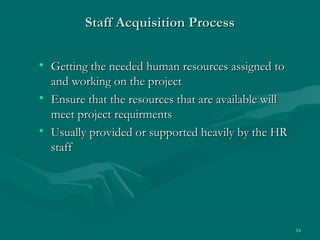
Staff Acquisition Process

• Getting the needed human resources assigned to
  and working on the project
• Ensure that the resources that are available will
  meet project requirments
• Usually provided or supported heavily by the HR
  staff


                                                      16
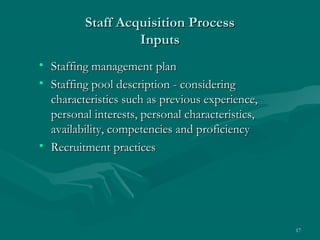
Staff Acquisition Process
                  Inputs
• Staffing management plan
• Staffing pool description - considering
  characteristics such as previous experience,
  personal interests, personal characteristics,
  availability, competencies and proficiency
• Recruitment practices


                                                  17
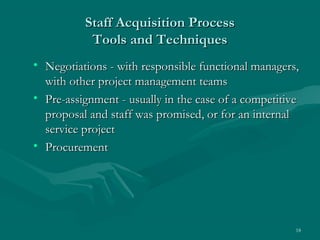
Staff Acquisition Process
           Tools and Techniques
• Negotiations - with responsible functional managers,
  with other project management teams
• Pre-assignment - usually in the case of a competitive
  proposal and staff was promised, or for an internal
  service project
• Procurement


                                                      18
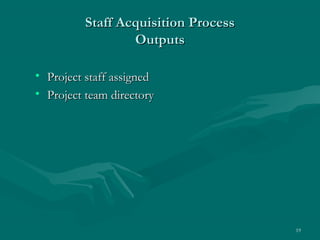
Staff Acquisition Process
                  Outputs

• Project staff assigned
• Project team directory


                                      19
Team Development Process


Team development includes both enhancing the ability
  of stakeholders to contribute as individuals as well as
  enhancing the ability of the team to function as a
  team.
Team development on a project is often complicated
  when individual team members are accountable to
  both a functional manger and the project manager.


                                                            20
Team Development Process
                  Inputs
• Project staff
• Project plan
• Staffing management plan
• performance reports - provide feedback to the project
  team about performance against the project plan.
• external feedback - periodical measure against the
  expectations of those outside the project.


                                                      21
Team Development Process
             Tools and Techniques
•   Team-building activities
•   General management skills
•   reward and recognition systems
•   collocation
•   training


                                      22
Team Development Process
                     Outputs
• Performance improvements - can come from many
  sources and affect many areas of project performance;
  for example:
   –   Improvement in individual skills
   –   Improvements in team behaviors
   –   Improvements in either individual or team competencies
• Input to performance appraisals


                                                                23
Team Development
                         Team Building
•   Concerted team building at the start of a project
•   Look for opportunities to build the team throughout the project
•   Team members need to be aware of:
    –   interdependent - work together
    –   Consensus - together on project goals and objectives
    –   committed - working together in a positive way
    –   Accountable - to the organization and roles that each has
    –   conflict/competition - acknowledge ahead of time that their will be
        conflict and competition


                                                                              24
Team Development
            Symptoms of Poor Teamwork
•   Frustration
•   Unhealthy competition
•   Unproductive meetings
•   Lack of trust in the project manager


                                           25
Team Development
                 Team Building Rules
• Start early in team building
• Do it early and often
• Recruit the best people
• Everyone is ON THE TEAM (including part-timers, vendors
  etc.) and they recognize themselves as on the team
• PM needs to behave as a role model
• Trust and delegate (don’t try to force or manipulate)
• Process: Plan ahead, negotiate for team members, organize the
  team and have a kickoff


                                                                  26
Team Development
                Team Building Exercises
•   Needed to get team members motivated
•   Understanding various motivational theories
•   Know personnel issues


                                                  27
Team Development
                  Motivation Theories
• Maslow - Hierarchy of needs; people don’t work for security or
  money, they work to get a chance to contribute and to use their
  skills (highest level is self actualization)
• McGregor - Theory of X / Y; all people are either X (people
  need to be watched every minute) or Y (people are willing to
  work without supervision and want to achieve); theory Z (put a
  firm environment around Y workers)


                                                                    28
Team Development
                     Motivation Theories
• Herzberg - Hygiene factors and motivating agents
   – Hygiene factors related to dissatisfaction such as working conditions,
     salary, personal life, relationships at work, security, status
   – Motivators - relate to increased satisfaction such as responsibility, self-
     actualization, professional growth, recognition
   – To retain or maintain team members need to think of hygiene factors but
     to really jazz members need to consider motivations
• Expectancy theory - Employees who believe that their efforts
  will lead to effective performance and who expect to be
  rewarded for their accomplishments stay productive as rewards
  meet their expectations


                                                                               29
Team Development
                    Personnel Issues
• Arbitration
• Perquisites (perks usually more individualized) - Parking spaces,
  corner offices, work from home, etc.
• Fringe benefits - (generally everybody gets) Education, benefits,
  insurance, profit sharing
• Halo effect - tendency to rate high or low all factors
• War room - project team located in one room also called co-
  location


                                                                      30
Human Resource Management
                Conflict


• Conflict is unavoidable because of the
   –   Nature of projects
   –   Limited power of the project manager
   –   Necessity for obtaining resources from the functional
       managers
• Conflict can be avoided by: Informing the team,
  clearly assigned tasks, making work assignments
  interesting and challenging

                                                               31
Human Resource Management
          Sources of conflict
              in actual order of frequency

•   Schedules
•   Project priorities
•   Resources
•   Technical opinions
•   Administrative procedures
•   Cost
•   Personality


                                             32
Human Resource Management
    Conflict management methods
• Problem solving / confrontation (same thing);
  confrontation is usually the correct choice
• Compromising - favorite mode for dealing with
  peers
• Smoothing - de-emphasizing the opponents
  differences
• Withdrawal - Retreat or postpone
• Forcing - (worst method) JUST DO IT {usually
  results in a stalemate}

                                                  33
Questions?


             34

Project human resource management

  • 1.
    What is ProjectHuman Resource Management? The processes required to make the most effective use of the people involved with the project. It includes all the project stakeholders-sponsors, customers, partners, individual contributors, performing organization, project and team members. 1
  • 2.
    Project Human ResourceManagement Major Processes • Organizational Planning – Identify, document, and assign project roles, responsibilities, and reporting relationships • Staff Acquisition – Getting the human resources needed assigned to and working on the project • Team Development – developing individual and group competencies to enhance project performance 2
  • 3.
    Organizational Planning Process •Usually done as part of the earliest project phases • Results should be reviewed throughout the project • Organizational planning is often tightly linked with communications planning • involves identifying, documenting and assigning project roles, responsibilities, and reporting relationships 3
  • 4.
    Organizational Planning Process Inputs • Project Interfaces – Organizational interfaces - formal and informal reporting relationships – Technical interfaces - relationships among different technical disciplines – Interpersonal interfaces - relationships among individuals on the project • Staffing Requirements - kinds of competencies and individuals needed and in what time frame 4
  • 5.
    Organizational Planning Process Inputs Cont. • Constraints - factors that limit a project team’s options such as: – Organizational structure – Collective bargaining agreements – Preferences of the project management team – Expected staff assignments 5
  • 6.
    Organizational Planning Types of Organizations • Functional - stove pipe/ managers and territories and no crossovers (do have a clear chain of command) • Project Expeditor - functional organization with recognition of project activities, PM reports to functional management • Project coordinator - PM reports to higher management 6
  • 7.
    Organizational Planning Types of Organizations Cont. • Weak Matrix - Functional managers and project managers in a matrix organization with all money done within the functions of the organizations • Strong Matrix - PMs have budget authority with firing/hiring/rewards decisions • Projectized - PM is a supervisor in control of all activities 7
  • 8.
    Organizational Planning Process Tools and Techniques • Templates - Often prior projects role and responsibility definitions or reporting relationships can help expedite the process •Human Resource Practices - Knowledge of HR policies, guidelines, and procedures can help with organizational planning •Organizational Theory - Understanding organizational theory will better enable the PM to respond to project requirements •Stakeholder Analysis - Identification and analysis of needs of stakeholders will ensure that their needs will be met 8
  • 9.
    Organizational Planning Outputs • Role and responsibility assignments – A responsibility Assignment Matrix is often used to closely link assignments to the project scope definition • Staffing management Plan – describes when and how human resources will be brought onto and taken off of the project team 9
  • 10.
    Organizational Planning Outputs Cont. • Organization chart – Any graphic display of project reporting relationships • Supporting detail - includes such detail as: – Organizational impact – Job descriptions – Training needs 10
  • 11.
    Human Resource Management Roles and Responsibilities • Roles and responsibilities – PMI states that it is the project manager’s responsibility to plan, estimate, and schedule a project, interface management and integration of our project’s subsystems. – The team’s role is to help plan what needs to be done (WBS), the project flow (Network Diagram), as well as to estimate times for their tasks. – Senior management’s role is to approve the overall project plan, budget, and schedule and to approve any changes to these. 11

  • 12.
    Human Resource Management Roles and Responsibilities Cont. • Roles of a PM - Integrator, communicator, team leader, decision maker, and climate creator • Qualifications - works well with others; experienced in particular areas of expertise (such as technical, contract negotiations, supervisory, etc.); level of education; previous project management experience • PM’s leadership skills - Directive, facilitating, coaching, supportive 12
  • 13.
    Human Resource Management Responsibility Chart • Responsibility Assignment Matrix – A chart that cross references team members with the tasks they are to accomplish. – It may also cross reference team members and issues. – NOTE: The matrix does not show when people will do their jobs (time). 13
  • 14.
    Human Resource Management Powers • Powers of the project manager – Formal (legitimate) - power based on your position – Reward - Giving rewards – Penalty (coercive) - being able to penalize team members – Expert - Being the technical or project management expert – Referent - Referring to the authority of someone in a higher position 14
  • 15.
    Human Resource Management Powers • Powers of the project manager cont. – Purse string - whoever has the money has the power – Bureaucratic - Because you know the system and how to work it you have the power – Charismatic - your power derives from your charm • PMI says the best forms of power are EXPERT and REWARD. PENALTY is the worst. FORMAL, REWARD, and PENALTY are powers derived from the PM’s position in the company. EXPERT power is earned on your own 15
  • 16.
    Staff Acquisition Process •Getting the needed human resources assigned to and working on the project • Ensure that the resources that are available will meet project requirments • Usually provided or supported heavily by the HR staff 16
  • 17.
    Staff Acquisition Process Inputs • Staffing management plan • Staffing pool description - considering characteristics such as previous experience, personal interests, personal characteristics, availability, competencies and proficiency • Recruitment practices 17
  • 18.
    Staff Acquisition Process Tools and Techniques • Negotiations - with responsible functional managers, with other project management teams • Pre-assignment - usually in the case of a competitive proposal and staff was promised, or for an internal service project • Procurement 18
  • 19.
    Staff Acquisition Process Outputs • Project staff assigned • Project team directory 19
  • 20.
    Team Development Process Teamdevelopment includes both enhancing the ability of stakeholders to contribute as individuals as well as enhancing the ability of the team to function as a team. Team development on a project is often complicated when individual team members are accountable to both a functional manger and the project manager. 20
  • 21.
    Team Development Process Inputs • Project staff • Project plan • Staffing management plan • performance reports - provide feedback to the project team about performance against the project plan. • external feedback - periodical measure against the expectations of those outside the project. 21
  • 22.
    Team Development Process Tools and Techniques • Team-building activities • General management skills • reward and recognition systems • collocation • training 22
  • 23.
    Team Development Process Outputs • Performance improvements - can come from many sources and affect many areas of project performance; for example: – Improvement in individual skills – Improvements in team behaviors – Improvements in either individual or team competencies • Input to performance appraisals 23
  • 24.
    Team Development Team Building • Concerted team building at the start of a project • Look for opportunities to build the team throughout the project • Team members need to be aware of: – interdependent - work together – Consensus - together on project goals and objectives – committed - working together in a positive way – Accountable - to the organization and roles that each has – conflict/competition - acknowledge ahead of time that their will be conflict and competition 24
  • 25.
    Team Development Symptoms of Poor Teamwork • Frustration • Unhealthy competition • Unproductive meetings • Lack of trust in the project manager 25
  • 26.
    Team Development Team Building Rules • Start early in team building • Do it early and often • Recruit the best people • Everyone is ON THE TEAM (including part-timers, vendors etc.) and they recognize themselves as on the team • PM needs to behave as a role model • Trust and delegate (don’t try to force or manipulate) • Process: Plan ahead, negotiate for team members, organize the team and have a kickoff 26
  • 27.
    Team Development Team Building Exercises • Needed to get team members motivated • Understanding various motivational theories • Know personnel issues 27
  • 28.
    Team Development Motivation Theories • Maslow - Hierarchy of needs; people don’t work for security or money, they work to get a chance to contribute and to use their skills (highest level is self actualization) • McGregor - Theory of X / Y; all people are either X (people need to be watched every minute) or Y (people are willing to work without supervision and want to achieve); theory Z (put a firm environment around Y workers) 28
  • 29.
    Team Development Motivation Theories • Herzberg - Hygiene factors and motivating agents – Hygiene factors related to dissatisfaction such as working conditions, salary, personal life, relationships at work, security, status – Motivators - relate to increased satisfaction such as responsibility, self- actualization, professional growth, recognition – To retain or maintain team members need to think of hygiene factors but to really jazz members need to consider motivations • Expectancy theory - Employees who believe that their efforts will lead to effective performance and who expect to be rewarded for their accomplishments stay productive as rewards meet their expectations 29
  • 30.
    Team Development Personnel Issues • Arbitration • Perquisites (perks usually more individualized) - Parking spaces, corner offices, work from home, etc. • Fringe benefits - (generally everybody gets) Education, benefits, insurance, profit sharing • Halo effect - tendency to rate high or low all factors • War room - project team located in one room also called co- location 30
  • 31.
    Human Resource Management Conflict • Conflict is unavoidable because of the – Nature of projects – Limited power of the project manager – Necessity for obtaining resources from the functional managers • Conflict can be avoided by: Informing the team, clearly assigned tasks, making work assignments interesting and challenging 31
  • 32.
    Human Resource Management Sources of conflict in actual order of frequency • Schedules • Project priorities • Resources • Technical opinions • Administrative procedures • Cost • Personality 32
  • 33.
    Human Resource Management Conflict management methods • Problem solving / confrontation (same thing); confrontation is usually the correct choice • Compromising - favorite mode for dealing with peers • Smoothing - de-emphasizing the opponents differences • Withdrawal - Retreat or postpone • Forcing - (worst method) JUST DO IT {usually results in a stalemate} 33
  • 34.