Human Resource
Management for Construction
Projects
Jayadeva de Silva
M.Sc.FIPM,FITD
•Welcome
– Introduction
The Definition of Project
• Project – temporary endeavor undertaken to create a
unique product or service
• Has a definite beginning and end and interrelated
activities
• Under the restriction of resources
• For some purpose of a organization or even a person.
Typical Projects
• R & D projects
• BPR and Reorganization
• Information system integration
• Construction and Engineering
• Scientific research and Dissertation
• Olympic Games and other sports games
• Every kind shows and performance
– Introduction
– Introduction
The Characteristics of a Project
• Products or Service are unique – -
– Progressively: proceeding in steps
– Elaborated: worked with care and detail
• The work is temporary.
– Time limited
– There are resource restrictions.
. The Definition of Project Management
• Project Management is the overall planning, control
and coordination of project from inception to
completion.
• Project Management focus on completing project
on-time, within the allotted budget and defined
scope, and satisfying the required quality standard.
- Introduction
- Introduction
The Methods and Tools of PM
• Project Management should apply of knowledge,
skills, tools and techniques to project activities in
order to meet or exceed stakeholder needs and
expectations from a defined project –balancing and
integrating the following:
– Scope, time, cost, and quality
– Stakeholders’ expectations
– Requirements (needs) vs. unidentified requirements
(expectations)
- Introduction
The difference between Program and Project
• Programs adopt new set of objectives and continue to work;
Projects cease when declared objectives have been attained
• Programs are groups of projects managed in a coordinated
way to obtain benefits not available from managing the
projects individually
• Most programs have elements of ongoing operations
– Series of repetitive or cyclical undertakings
• Projects is no ongoing operation, are often divided into
“subprojects” for more manageability
– Often contracted out to external organizations
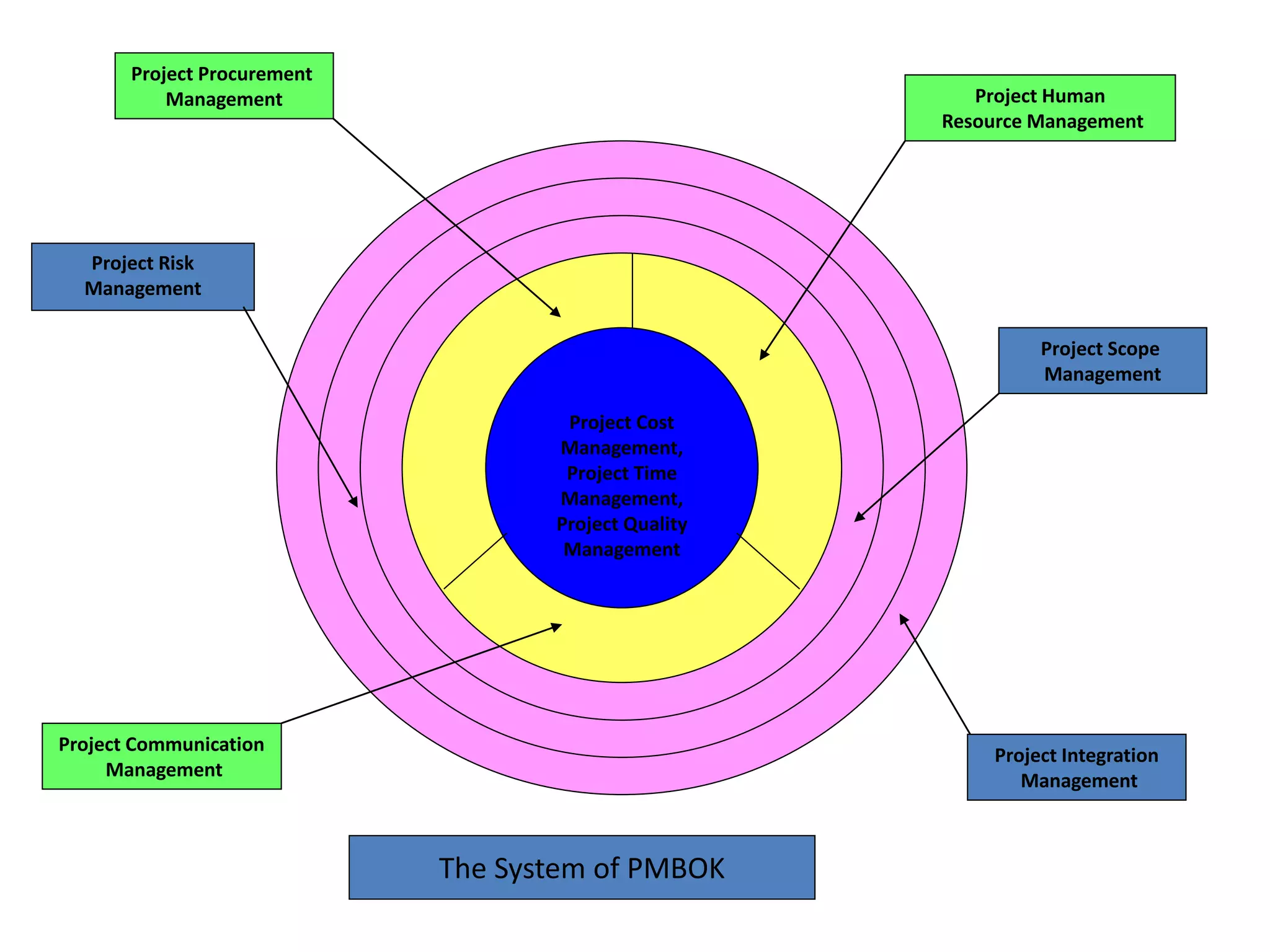
Project Management Body of Knowledge
– Project integration management
– Project scope management
– Project time management
– Project cost management
– Project quality management
– Project human resource management
– Project communication management
– Project risk management
– Project procurement management
All these make up a knowledge system of PM
- Introduction
Project Cost
Management,
Project Time
Management,
Project Quality
Management
Project Risk
Management
Project Communication
Management
Project Procurement
Management
Project Integration
Management
Project Human
Resource Management
Project Scope
Management
The System of PMBOK
General
management
knowledge and
practices
Application
area knowledge
and practices
Generally
accepted PM
knowledge
and practices
PMBOK
The relationship of the knowledge
– Project Management Context
1. Project Life Cycle
• Project Life Cycle defines or tells:
– The phases of the project (time)
– The work performed in each phase (work)
– The input and output of each phase (result)
– The milestone of each phase (end sign)
• Common Characteristics of Project Life Cycles:
– Cost and Staffing levels are low at start and move higher towards the end
– Probability of successfully completing project is low at beginning, higher
towards the end as project continues
– Stakeholder influence is high at the beginning and progressively lowers as
project continues
Phase 1 Phase 2 Phase 3 Phase 4
Project ”go” decision
Major contract let
Installation
substantially complete
Full operation
Feasibility
study
-suggestion
-feasibility
-pre-design
-approve
Planning &
Design
-tech-design
-cost estimate
-scheduling
-contracting
-plan details
Execution
-fabrication
-construction
-installation
-trial
Turnover
-final testing
-maintenance
Percentage
Complete
100%
Project Human Resource
Management
Jayadeva de Siva
M.Sc,FIPM,FITD
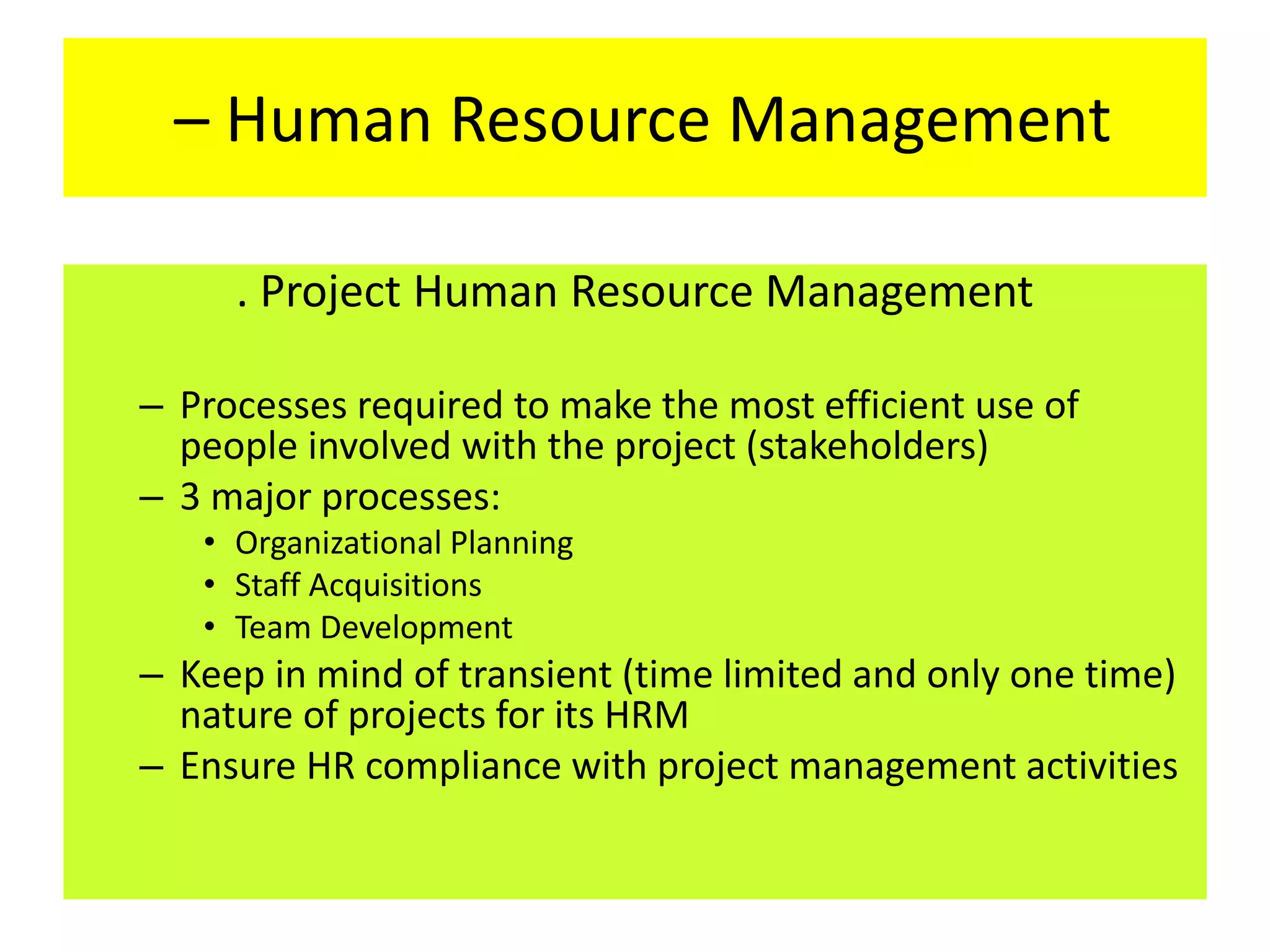
– Human Resource Management
. Project Human Resource Management
– Processes required to make the most efficient use of
people involved with the project (stakeholders)
– 3 major processes:
• Organizational Planning
• Staff Acquisitions
• Team Development
– Keep in mind of transient (time limited and only one time)
nature of projects for its HRM
– Ensure HR compliance with project management activities
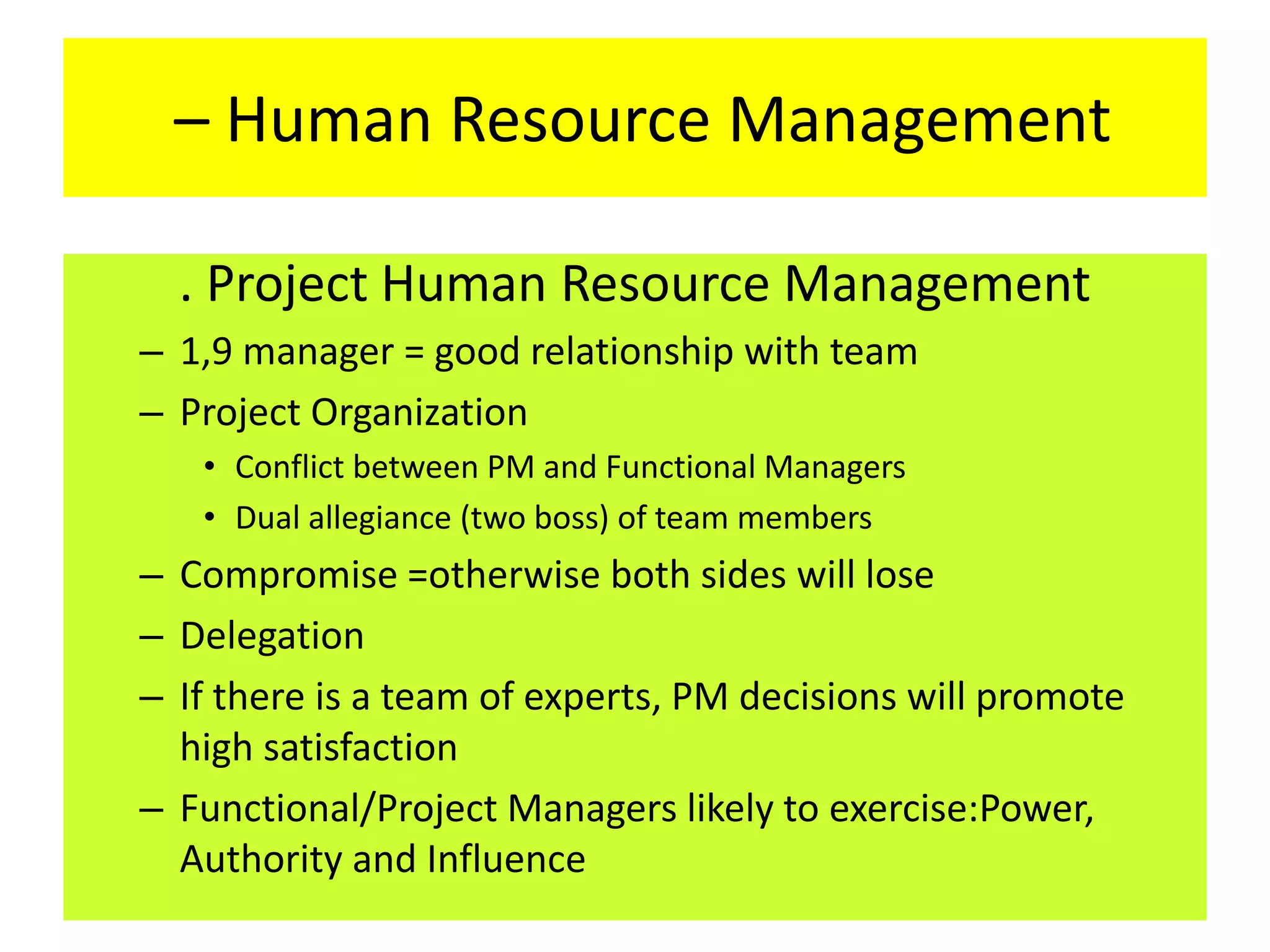
– Human Resource Management
. Project Human Resource Management
– 1,9 manager = good relationship with team
– Project Organization
• Conflict between PM and Functional Managers
• Dual allegiance (two boss) of team members
– Compromise =otherwise both sides will lose
– Delegation
– If there is a team of experts, PM decisions will promote
high satisfaction
– Functional/Project Managers likely to exercise:Power,
Authority and Influence
– Human Resource Management
Organizational Planning
– Identifying, documenting and assigning project
roles, responsibilities, and reporting relationships
• Individual and group assignments
• Internal and external employees
• Linked with communication planning
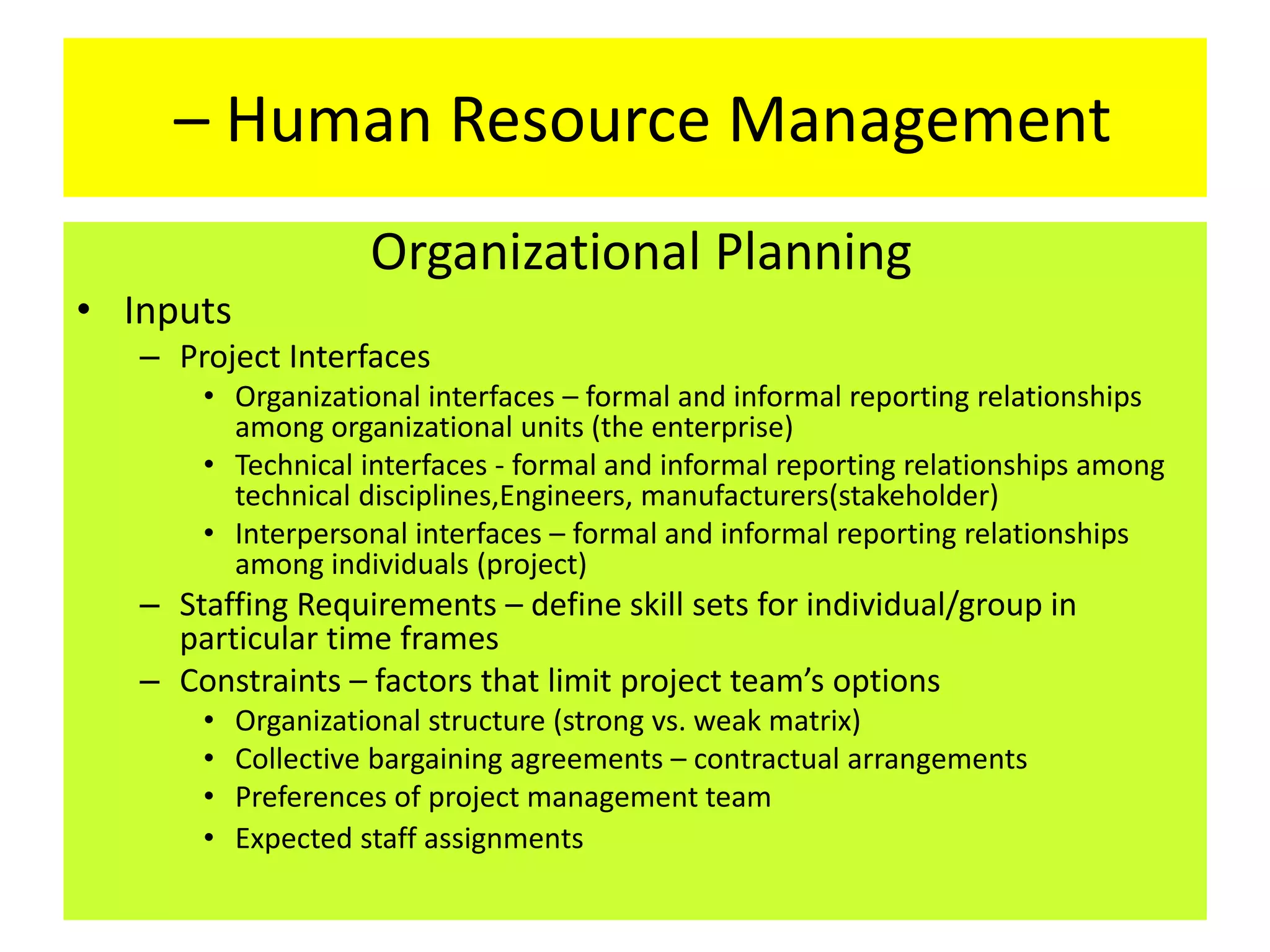
– Human Resource Management
Organizational Planning
• Inputs
– Project Interfaces
• Organizational interfaces – formal and informal reporting relationships
among organizational units (the enterprise)
• Technical interfaces - formal and informal reporting relationships among
technical disciplines,Engineers, manufacturers(stakeholder)
• Interpersonal interfaces – formal and informal reporting relationships
among individuals (project)
– Staffing Requirements – define skill sets for individual/group in
particular time frames
– Constraints – factors that limit project team’s options
• Organizational structure (strong vs. weak matrix)
• Collective bargaining agreements – contractual arrangements
• Preferences of project management team
• Expected staff assignments
– Human Resource Management
Organizational Planning
• Tools & Techniques
– Templates – reuse a similar project’s role and responsibility
definitions
– Human Resource Management Practices – corporate
policies, guidelines, and practices
– Organizational Theory – how organizations are structured
(functional, projectized,matrix)
– Stakeholder Analysis – needs of stakeholders are ensured
– Human Resource Management
Organizational Planning
• Outputs (continued)
– Role and Responsibility Assignments
• Utilizes a Responsibility Assignment Matrix (RAM) to define
responsibility for each item in the Work Breakdown Structure/task
or activity list
• Roles and responsibilities
– Project Manger – plan, estimate and schedule of project
– Team – help prepare the WBS, Network Diagrams, and
estimate time for tasks, complete tasks
– Senior Management – approve Overall project plan, budget
and schedule and to approve any changes that are made to
those figures
– The person experiencing the problem must try to solve it
themselves as long as means are in their control
Organizational Planning
• Outputs (continued)
– Staffing Management Plan
• when and how personnel are included and removed from the
project team.
• Resource leveling, reduce transition periods, eliminate “dead time”
between assignments, sensitivity to morale
– Organizational Chart
• Organization chart can display the project reporting relationships.
• An Organizational Breakdown Structure (OBS) is a specific type of
organization chart that shows which organizational units are
responsible for which work items.
– Supporting Detail
• Organizational impact,Job descriptions,Training needs
– Human Resource Management
Staff Acquisition
– Ensure labor and human resources are available for project work
– Involve getting the human resources needed (individuals or groups)
and assigned to or working on the project.
• Inputs
– Staffing Management Plan
– Staffing Pool Description
• Previous experience
• Personal interests
• Personal characteristics
• Availability
– Recruitment Practices
– Human Resource Management
. Staff Acquisition
• Tools & Techniques
– Negotiations with functional managers and other teams
(Staff utilization and corporate politics)
– Pre-assignment – result of a competitive proposal, or an
internal initiative
– Procurement – outside services are needed (lacking
internal skills or availability can not be met)
Staff Acquisition
• Outputs
– Project staff assigned
– Project Team Directory – contact list
– Human Resource Management
Team Development
– Enhancing stakeholders to contribute along with
maintaining the project team’s functionality
– Personal development is the foundation
– Team members often balance responsibilities to a
functional manager and project manager
– Critical to success of project
– Human Resource Management
Team Development
• Inputs
– Project Staff
– Project Plan
– Staffing Management Plan
– Performance Reports
– External Feedback
• Periodic measurements of performanc
– Human Resource Management
. Team Development
• Tools & Techniques
– Team-building activities
– General Management Skills
– Reward and recognition systems
• Promote desired behavior
• Must be achievable; apply to the project
• Cultural differences recognition
– Co-location – place members in physical location
– Training – enhance skills, knowledge, and capabilities of
project team
• Must be factored in cost analysis of project
– Human Resource Management
Team Development
• Outputs
– Performance Improvements
• Individual skills
• Team Behavior
• Identify more efficient methods of work
– Input for performance appraisals
Other things for HRM
– Conflict
• Inevitable consequence of organizational interactions
• Can be beneficial
• Resolved by identifying the causes and problem solving by people
that are involved & their immediate manager
• Nature of project
• Limited power of the project manager
• Necessity for obtaining resources from functional managers
– Conflict Sources (in order of frequency)
• 1)Schedules, 2)Project Priorities, 3)Resources,4)Technical opinions,
5)Administrative Procedures,6)Cost,7)Personality
– Human Resource Management
. Other things for HRM
• Conflict Avoiding
– Informing the team
– Clearly assigning tasks without ambiguity
– Challenging and interesting work assignments
• Leadership Skills
– Directive, Facilitating, Coaching, Supportive
• Projectized Organization
– Conflict between PM and Functional Managers
– Dual Allegiance of team members
– Complex prioritization of resources
– Loss of developed procedures on project dissolution
– Project Communications Management
Project Communications Management
– Processes to ensure timely and proper generation,
collection, dissemination and disposition of project
information
– General communications management
• Communications Planning – determining informational needs, who
needs what and when; 90% of PM’s time is spent on
communicating
• Information Distribution – making information available
• Performance Reporting – collecting and disseminating project
information
• Administrative Closure – formalize project/phase completion
(continued)
Project Communications Management
– Communication Methods
• Pick the form of communication that is best for the
situation
– Formal Written – complex problems, all plans, communicating
over long distances
– Formal Verbal – presentations, speeches
– Informal Written – memos, e-mail, notes
– Informal Verbal – meetings, conversations
– Communication Blockers
• Noise, Distance, Improper en-coding, “bad idea”, Hostility,
Language, Culture
– Project Communications Management
Communications Planning
– Determining information requirements of stakeholders
– Tightly linked with organizational planning
– There are 5 directions of communication
• Top down
• Bottom up
• The peer
• Internal
• External
– Complex messages need oral, written and non verbal
methods
– Least effective form of communication for complex
situations is verbal and formal
– Project Communications Management
. Information Distribution
• Tools & Techniques
– Communication Skills
• used to exchange information. Sender is responsible for clarity;
receiver is responsible for receipt and understanding
– Information retrieval systems
• filing systems, software
– Information distribution systems
• meetings, correspondence, networked databases, video/audio
conferencing
• Outputs
– Project Records
• maintained in an organized fashion
– Project Communications Management
. Performance Reporting
– Collecting and disseminating performance indicators to
provide stakeholders information how resources are
achieving project objectives
• Status reporting
• Progress reporting
• Forecasting
• Variance Report (actual results vs. planned)
• Earned Value
• Project scope, schedule, cost and quality, risk and procurement
– Project Communications Management
Performance Reporting
• Inputs
– Project Plan
– Work Results – deliverables completed, %
completed, costs incurred
– Other Project records
– Project Communications Management
Performance Reporting
• Tools & Techniques
– Performance review meetings(to assess status)
– Variance Analysis (comparing actual results to planned)
– Trend Analysis (to determine future performance)
– Earned Value Analysis
• integrates scope, cost and schedule measures
• calculate 3 keys:
– Budgeted Cost of Work (BCWS)
– Actual Cost of Work Performed (ACWP)
– Earned Value (Budgeted Cost of Work Performed – BCWP)
» Cost Variance (CV) = BCWP – ACWP
» Schedule Variance (SV) = BCWP – BCWS
» Cost Performance Index (CPI) = BCWP/ACWP
– Information Distribution Tools & Techniques
– Project Communications Management
Performance Reporting
• Outputs
– Performance Reports – organize and summarize
information gathered and present results
• Bar charts, Gantt charts, S-curves, etc.
– Change Requests – handled as part of change
control
Supplement – Professional Responsibility
Understand Project Management Professional Code of
Conduct
– Ethics
– Legal Issues
– Cultural Sensitivity
– Managing conflicts of interest
Supplement – Professional Responsibility
Integrity(honesty) and Professionalism
– Understand the legal requirements surrounding the
practice of projects
– Know ethical standards that should govern the behavior of
project managers
– Comprehend the values of the community and the various
project stakeholders
– Practice proper judgment in the pursuit of successful
project work
– Compliance with all organizational rules and policies
• Upon a reasonable and clear factual basis report violations
• Responsibility to disclose circumstances that could be construed as
a conflict of interest or appearance of impropriety
Supplement – Professional Responsibility
. Integrity and Professionalism
– Provide accurate and truthful representation to the public
– Maintain and satisfy the scope and objectives of
professional services
– Maintain the confidentiality of sensitive information
– Ensure a conflict of interest does not compromise
legitimate interests of client/customer or interfere with
professional judgment
– Refrain from accepting gifts, inappropriate payments,
compensation for personal gain unless in conformity with
applicable laws or customs
Supplement – Professional Responsibility
Contribute to advancing the project management
profession
– Overall understanding of project management principles
– Understand the community and media surrounding
projects
– Knowledge of research strategies available and proper
communication techniques
– Learn to communicate and transfer knowledge effectively
as a coach and mentor and to use available research
strategies
– Respect and recognize intellectual property
Supplement – Professional Responsibility
Enhance Individual Competence
– Understand the project manager’s strengths and
weaknesses and learning style – become aware of
instructional processes and tools
– Know the useful competencies for project managers and
possible training
– Be able to perform self-assessment and competencies
development plan
– Ability to apply lessons learned
Supplement – Professional Responsibility
. Balance Stakeholder’s Objectives
– Understand the various competing stakeholders’
interests and needs
– Comprehend the conflict resolution techniques
useful in handling differing objectives
– Be able to resolve conflicts in a fair manner
– Exercise negotiation skills based on proper
information
Supplement – Professional Responsibility
Interact with team and stakeholders in a
professional and cooperative manner
– Understand cultural diversity, norms and
stakeholders’ communication styles
– Show flexibility towards diversity, tolerance and
self control
– Becoming empathetic to differences
Thank you for your
Support

human resource management for construction projects

  • 1.
    Human Resource Management forConstruction Projects Jayadeva de Silva M.Sc.FIPM,FITD
  • 2.
  • 4.
    – Introduction The Definitionof Project • Project – temporary endeavor undertaken to create a unique product or service • Has a definite beginning and end and interrelated activities • Under the restriction of resources • For some purpose of a organization or even a person.
  • 5.
    Typical Projects • R& D projects • BPR and Reorganization • Information system integration • Construction and Engineering • Scientific research and Dissertation • Olympic Games and other sports games • Every kind shows and performance – Introduction
  • 6.
    – Introduction The Characteristicsof a Project • Products or Service are unique – - – Progressively: proceeding in steps – Elaborated: worked with care and detail • The work is temporary. – Time limited – There are resource restrictions.
  • 7.
    . The Definitionof Project Management • Project Management is the overall planning, control and coordination of project from inception to completion. • Project Management focus on completing project on-time, within the allotted budget and defined scope, and satisfying the required quality standard. - Introduction
  • 8.
    - Introduction The Methodsand Tools of PM • Project Management should apply of knowledge, skills, tools and techniques to project activities in order to meet or exceed stakeholder needs and expectations from a defined project –balancing and integrating the following: – Scope, time, cost, and quality – Stakeholders’ expectations – Requirements (needs) vs. unidentified requirements (expectations)
  • 9.
    - Introduction The differencebetween Program and Project • Programs adopt new set of objectives and continue to work; Projects cease when declared objectives have been attained • Programs are groups of projects managed in a coordinated way to obtain benefits not available from managing the projects individually • Most programs have elements of ongoing operations – Series of repetitive or cyclical undertakings • Projects is no ongoing operation, are often divided into “subprojects” for more manageability – Often contracted out to external organizations
  • 10.
    Project Management Bodyof Knowledge – Project integration management – Project scope management – Project time management – Project cost management – Project quality management – Project human resource management – Project communication management – Project risk management – Project procurement management All these make up a knowledge system of PM - Introduction
  • 11.
    Project Cost Management, Project Time Management, ProjectQuality Management Project Risk Management Project Communication Management Project Procurement Management Project Integration Management Project Human Resource Management Project Scope Management The System of PMBOK
  • 12.
    General management knowledge and practices Application area knowledge andpractices Generally accepted PM knowledge and practices PMBOK The relationship of the knowledge
  • 13.
    – Project ManagementContext 1. Project Life Cycle • Project Life Cycle defines or tells: – The phases of the project (time) – The work performed in each phase (work) – The input and output of each phase (result) – The milestone of each phase (end sign) • Common Characteristics of Project Life Cycles: – Cost and Staffing levels are low at start and move higher towards the end – Probability of successfully completing project is low at beginning, higher towards the end as project continues – Stakeholder influence is high at the beginning and progressively lowers as project continues
  • 14.
    Phase 1 Phase2 Phase 3 Phase 4 Project ”go” decision Major contract let Installation substantially complete Full operation Feasibility study -suggestion -feasibility -pre-design -approve Planning & Design -tech-design -cost estimate -scheduling -contracting -plan details Execution -fabrication -construction -installation -trial Turnover -final testing -maintenance Percentage Complete 100%
  • 15.
  • 16.
    – Human ResourceManagement . Project Human Resource Management – Processes required to make the most efficient use of people involved with the project (stakeholders) – 3 major processes: • Organizational Planning • Staff Acquisitions • Team Development – Keep in mind of transient (time limited and only one time) nature of projects for its HRM – Ensure HR compliance with project management activities
  • 17.
    – Human ResourceManagement . Project Human Resource Management – 1,9 manager = good relationship with team – Project Organization • Conflict between PM and Functional Managers • Dual allegiance (two boss) of team members – Compromise =otherwise both sides will lose – Delegation – If there is a team of experts, PM decisions will promote high satisfaction – Functional/Project Managers likely to exercise:Power, Authority and Influence
  • 18.
    – Human ResourceManagement Organizational Planning – Identifying, documenting and assigning project roles, responsibilities, and reporting relationships • Individual and group assignments • Internal and external employees • Linked with communication planning
  • 19.
    – Human ResourceManagement Organizational Planning • Inputs – Project Interfaces • Organizational interfaces – formal and informal reporting relationships among organizational units (the enterprise) • Technical interfaces - formal and informal reporting relationships among technical disciplines,Engineers, manufacturers(stakeholder) • Interpersonal interfaces – formal and informal reporting relationships among individuals (project) – Staffing Requirements – define skill sets for individual/group in particular time frames – Constraints – factors that limit project team’s options • Organizational structure (strong vs. weak matrix) • Collective bargaining agreements – contractual arrangements • Preferences of project management team • Expected staff assignments
  • 20.
    – Human ResourceManagement Organizational Planning • Tools & Techniques – Templates – reuse a similar project’s role and responsibility definitions – Human Resource Management Practices – corporate policies, guidelines, and practices – Organizational Theory – how organizations are structured (functional, projectized,matrix) – Stakeholder Analysis – needs of stakeholders are ensured
  • 21.
    – Human ResourceManagement Organizational Planning • Outputs (continued) – Role and Responsibility Assignments • Utilizes a Responsibility Assignment Matrix (RAM) to define responsibility for each item in the Work Breakdown Structure/task or activity list • Roles and responsibilities – Project Manger – plan, estimate and schedule of project – Team – help prepare the WBS, Network Diagrams, and estimate time for tasks, complete tasks – Senior Management – approve Overall project plan, budget and schedule and to approve any changes that are made to those figures – The person experiencing the problem must try to solve it themselves as long as means are in their control
  • 22.
    Organizational Planning • Outputs(continued) – Staffing Management Plan • when and how personnel are included and removed from the project team. • Resource leveling, reduce transition periods, eliminate “dead time” between assignments, sensitivity to morale – Organizational Chart • Organization chart can display the project reporting relationships. • An Organizational Breakdown Structure (OBS) is a specific type of organization chart that shows which organizational units are responsible for which work items. – Supporting Detail • Organizational impact,Job descriptions,Training needs – Human Resource Management
  • 23.
    – Human ResourceManagement Staff Acquisition – Ensure labor and human resources are available for project work – Involve getting the human resources needed (individuals or groups) and assigned to or working on the project. • Inputs – Staffing Management Plan – Staffing Pool Description • Previous experience • Personal interests • Personal characteristics • Availability – Recruitment Practices
  • 24.
    – Human ResourceManagement . Staff Acquisition • Tools & Techniques – Negotiations with functional managers and other teams (Staff utilization and corporate politics) – Pre-assignment – result of a competitive proposal, or an internal initiative – Procurement – outside services are needed (lacking internal skills or availability can not be met)
  • 25.
    Staff Acquisition • Outputs –Project staff assigned – Project Team Directory – contact list – Human Resource Management
  • 26.
    – Human ResourceManagement Team Development – Enhancing stakeholders to contribute along with maintaining the project team’s functionality – Personal development is the foundation – Team members often balance responsibilities to a functional manager and project manager – Critical to success of project
  • 27.
    – Human ResourceManagement Team Development • Inputs – Project Staff – Project Plan – Staffing Management Plan – Performance Reports – External Feedback • Periodic measurements of performanc
  • 28.
    – Human ResourceManagement . Team Development • Tools & Techniques – Team-building activities – General Management Skills – Reward and recognition systems • Promote desired behavior • Must be achievable; apply to the project • Cultural differences recognition – Co-location – place members in physical location – Training – enhance skills, knowledge, and capabilities of project team • Must be factored in cost analysis of project
  • 29.
    – Human ResourceManagement Team Development • Outputs – Performance Improvements • Individual skills • Team Behavior • Identify more efficient methods of work – Input for performance appraisals
  • 30.
    Other things forHRM – Conflict • Inevitable consequence of organizational interactions • Can be beneficial • Resolved by identifying the causes and problem solving by people that are involved & their immediate manager • Nature of project • Limited power of the project manager • Necessity for obtaining resources from functional managers – Conflict Sources (in order of frequency) • 1)Schedules, 2)Project Priorities, 3)Resources,4)Technical opinions, 5)Administrative Procedures,6)Cost,7)Personality – Human Resource Management
  • 31.
    – Human ResourceManagement . Other things for HRM • Conflict Avoiding – Informing the team – Clearly assigning tasks without ambiguity – Challenging and interesting work assignments • Leadership Skills – Directive, Facilitating, Coaching, Supportive • Projectized Organization – Conflict between PM and Functional Managers – Dual Allegiance of team members – Complex prioritization of resources – Loss of developed procedures on project dissolution
  • 32.
    – Project CommunicationsManagement Project Communications Management – Processes to ensure timely and proper generation, collection, dissemination and disposition of project information – General communications management • Communications Planning – determining informational needs, who needs what and when; 90% of PM’s time is spent on communicating • Information Distribution – making information available • Performance Reporting – collecting and disseminating project information • Administrative Closure – formalize project/phase completion (continued)
  • 33.
    Project Communications Management –Communication Methods • Pick the form of communication that is best for the situation – Formal Written – complex problems, all plans, communicating over long distances – Formal Verbal – presentations, speeches – Informal Written – memos, e-mail, notes – Informal Verbal – meetings, conversations – Communication Blockers • Noise, Distance, Improper en-coding, “bad idea”, Hostility, Language, Culture – Project Communications Management
  • 34.
    – Project CommunicationsManagement Communications Planning – Determining information requirements of stakeholders – Tightly linked with organizational planning – There are 5 directions of communication • Top down • Bottom up • The peer • Internal • External – Complex messages need oral, written and non verbal methods – Least effective form of communication for complex situations is verbal and formal
  • 35.
    – Project CommunicationsManagement . Information Distribution • Tools & Techniques – Communication Skills • used to exchange information. Sender is responsible for clarity; receiver is responsible for receipt and understanding – Information retrieval systems • filing systems, software – Information distribution systems • meetings, correspondence, networked databases, video/audio conferencing • Outputs – Project Records • maintained in an organized fashion
  • 36.
    – Project CommunicationsManagement . Performance Reporting – Collecting and disseminating performance indicators to provide stakeholders information how resources are achieving project objectives • Status reporting • Progress reporting • Forecasting • Variance Report (actual results vs. planned) • Earned Value • Project scope, schedule, cost and quality, risk and procurement
  • 37.
    – Project CommunicationsManagement Performance Reporting • Inputs – Project Plan – Work Results – deliverables completed, % completed, costs incurred – Other Project records
  • 38.
    – Project CommunicationsManagement Performance Reporting • Tools & Techniques – Performance review meetings(to assess status) – Variance Analysis (comparing actual results to planned) – Trend Analysis (to determine future performance) – Earned Value Analysis • integrates scope, cost and schedule measures • calculate 3 keys: – Budgeted Cost of Work (BCWS) – Actual Cost of Work Performed (ACWP) – Earned Value (Budgeted Cost of Work Performed – BCWP) » Cost Variance (CV) = BCWP – ACWP » Schedule Variance (SV) = BCWP – BCWS » Cost Performance Index (CPI) = BCWP/ACWP – Information Distribution Tools & Techniques
  • 39.
    – Project CommunicationsManagement Performance Reporting • Outputs – Performance Reports – organize and summarize information gathered and present results • Bar charts, Gantt charts, S-curves, etc. – Change Requests – handled as part of change control
  • 40.
    Supplement – ProfessionalResponsibility Understand Project Management Professional Code of Conduct – Ethics – Legal Issues – Cultural Sensitivity – Managing conflicts of interest
  • 41.
    Supplement – ProfessionalResponsibility Integrity(honesty) and Professionalism – Understand the legal requirements surrounding the practice of projects – Know ethical standards that should govern the behavior of project managers – Comprehend the values of the community and the various project stakeholders – Practice proper judgment in the pursuit of successful project work – Compliance with all organizational rules and policies • Upon a reasonable and clear factual basis report violations • Responsibility to disclose circumstances that could be construed as a conflict of interest or appearance of impropriety
  • 42.
    Supplement – ProfessionalResponsibility . Integrity and Professionalism – Provide accurate and truthful representation to the public – Maintain and satisfy the scope and objectives of professional services – Maintain the confidentiality of sensitive information – Ensure a conflict of interest does not compromise legitimate interests of client/customer or interfere with professional judgment – Refrain from accepting gifts, inappropriate payments, compensation for personal gain unless in conformity with applicable laws or customs
  • 43.
    Supplement – ProfessionalResponsibility Contribute to advancing the project management profession – Overall understanding of project management principles – Understand the community and media surrounding projects – Knowledge of research strategies available and proper communication techniques – Learn to communicate and transfer knowledge effectively as a coach and mentor and to use available research strategies – Respect and recognize intellectual property
  • 44.
    Supplement – ProfessionalResponsibility Enhance Individual Competence – Understand the project manager’s strengths and weaknesses and learning style – become aware of instructional processes and tools – Know the useful competencies for project managers and possible training – Be able to perform self-assessment and competencies development plan – Ability to apply lessons learned
  • 45.
    Supplement – ProfessionalResponsibility . Balance Stakeholder’s Objectives – Understand the various competing stakeholders’ interests and needs – Comprehend the conflict resolution techniques useful in handling differing objectives – Be able to resolve conflicts in a fair manner – Exercise negotiation skills based on proper information
  • 46.
    Supplement – ProfessionalResponsibility Interact with team and stakeholders in a professional and cooperative manner – Understand cultural diversity, norms and stakeholders’ communication styles – Show flexibility towards diversity, tolerance and self control – Becoming empathetic to differences
  • 47.
    Thank you foryour Support