1 www.pmtutor.org Powered by POeT Solvers Limited
PROJECT HUMAN RESOURCE
MANAGEMENT
2 www.pmtutor.org Powered by POeT Solvers Limited
PROJECT HUMAN RESOURCE MANAGEMENT
WHAT DOES THE HUMAN RESOURCE KNOWLEDGE AREA DO?
Organize & manage the project team (also referred to as project staff)
• The project team comprises of the people who have assigned roles and responsibilities for
completing the project (who report directly or indirectly to the Project Manager and perform the
project work).
• Team members should be involved in much of the project’s planning and decision-making.
• Early involvement of team members adds expertise during the planning process and strengthens
commitment to the project.
• The Project Management Team is a subset of the project team and responsible for project
management activities such as planning, controlling, and closing.
• Project sponsor works with project management team, typically assisting with matters such as
project funding, clarifying scope questions, and influencing other in order to benefit the project.
3 www.pmtutor.org Powered by POeT Solvers Limited
HUMAN RESOURCE PROCESSES
HUMAN RESOURCE PROCESS DEFINITIONS
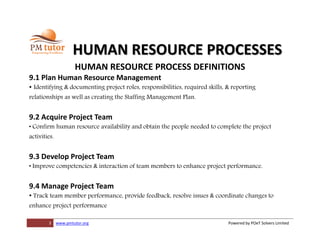
9.1 Plan Human Resource Management
• Identifying & documenting project roles, responsibilities, required skills, & reporting
relationships as well as creating the Staffing Management Plan.
9.2 Acquire Project Team
• Confirm human resource availability and obtain the people needed to complete the project
activities.
9.3 Develop Project Team
• Improve competencies & interaction of team members to enhance project performance.
9.4 Manage Project Team
• Track team member performance, provide feedback, resolve issues & coordinate changes to
enhance project performance
4 www.pmtutor.org Powered by POeT Solvers Limited
HUMAN RESOURCE PROCESSES
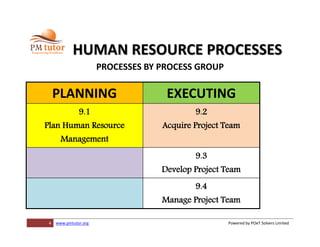
PROCESSES BY PROCESS GROUP
PLANNING EXECUTING
9.1
Plan Human Resource
Management
9.2
Acquire Project Team
9.3
Develop Project Team
9.4
Manage Project Team
5 www.pmtutor.org Powered by POeT Solvers Limited
PLAN HUMAN RESOURCE MANAGEMENT
WHAT DOES ‘PLAN HUMAN RESOURCE MANAGEMENT’ DO?
Identifies & documents project roles, responsibilities, and required skills, reporting
relationships, and creates a staffing management plan
• Can include how & when project team members will be acquired (the persons can
be from inside or outside the performing org.)
• Criteria for releasing them from the project
• Identification of training needs
• Plans for recognition & rewards
• Compliance considerations (e.g. labor laws), safety issues (e.g. Workman’s safety)
6 www.pmtutor.org Powered by POeT Solvers Limited
PLAN HUMAN RESOURCE MANAGEMENT
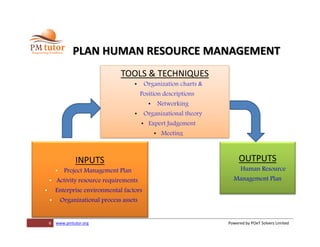
INPUTS
• Project Management Plan
• Activity resource requirements
• Enterprise environmental factors
• Organizational process assets
TOOLS & TECHNIQUES
• Organization charts &
Position descriptions
• Networking
• Organizational theory
• Expert Judgement
• Meeting
OUTPUTS
Human Resource
Management Plan
7 www.pmtutor.org Powered by POeT Solvers Limited
PLAN HUMAN RESOURCE MANAGEMENT
INPUTS
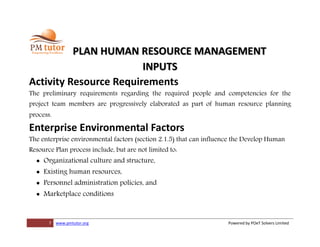
Activity Resource Requirements
The preliminary requirements regarding the required people and competencies for the
project team members are progressively elaborated as part of human resource planning
process.
Enterprise Environmental Factors
The enterprise environmental factors (section 2.1.5) that can influence the Develop Human
Resource Plan process include, but are not limited to:
 Organizational culture and structure,
 Existing human resources,
 Personnel administration policies, and
 Marketplace conditions
8 www.pmtutor.org Powered by POeT Solvers Limited
PLAN HUMAN RESOURCE MANAGEMENT
Plan Human Resource Management INPUTS cont’d
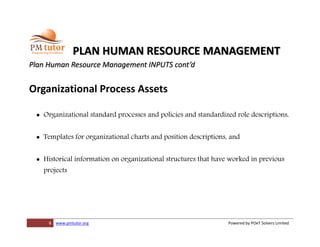
Organizational Process Assets
 Organizational standard processes and policies and standardized role descriptions,
 Templates for organizational charts and position descriptions, and
 Historical information on organizational structures that have worked in previous
projects
9 www.pmtutor.org Powered by POeT Solvers Limited
PLAN HUMAN RESOURCE MANAGEMENT
Tools & Techniques
Organization Charts & Position Descriptions
Used to ensure each work package has an unambiguous owner & that all team members
have a clear understanding of their roles & responsibilities (See Figure 9-4, p.261 shows
three different types of chart)
• Hierarchical- type charts
Organizational breakdown structure (OBS) - looks similar to WBS, but is broken down by
organization’s existing departments, units or teams
Resource breakdown structure (RBS) – another hierarchical chart broken down by types of
resources, e.g. welders, graphic designers, etc. RBS can help tracking project costs, and can be
aligned with the organization’s accounting system (RBS can contain resource categories other than
human resources).
10 www.pmtutor.org Powered by POeT Solvers Limited
PLAN HUMAN RESOURCE MANAGEMENT – T&T
• Matrix-based charts
Responsibility assignment matrix (RAM) is used to shows connections between work &
people. See Figure 9-5, p.262, is a type of RAM called a RACI chart (responsible,
accountable, consult, inform)
• Text-oriented formats
Detailed job or position descriptions; documents that provide information such as
responsibilities, authority, competencies, and qualifications; etc.
• Other sections of the project management plan
Some responsibilities related to managing the project are listed and explained in other
sections of the project management plan. For example, the risk register lists risk owners;
the communication plan lists team members responsible for communication activities.
11 www.pmtutor.org Powered by POeT Solvers Limited
PLAN HUMAN RESOURCE MANAGEMENT
Tools & Techniques
Networking
 Informal interaction with others is an effective way to understand political &
interpersonal factors that will impact the effectiveness of staffing options
 Include proactive correspondence, luncheon meetings, informal conversations, and
trade conferences
Organizational Theory
 Provides information regarding the ways people, teams & organizational units
behave.
 Helps managing people & groups; includes motivational theories
12 www.pmtutor.org Powered by POeT Solvers Limited
PLAN HUMAN RESOURCE MANAGEMENT
OUTPUTS
Roles & Responsibilities
List includes:
Role – the label describing the portion of a project for which a person is accountable;
examples of project roles are business analyst, electrical engineer, testing coordinator, etc.
Authority – The right to apply project resources makes decisions & sign approvals
(members work best with authority matching their responsibility)
Responsibility – The work that a project team member is expected to perform in order to
complete the project activities
Competency – The skill & capacity needed to complete project activities
Project Organization Charts
Graphic display of project team members & their reporting relationships
13 www.pmtutor.org Powered by POeT Solvers Limited
PLAN HUMAN RESOURCE MANAGEMENT
OUTPUTS
Staffing Management Plan
 Describes when & how human resource requirements will be met
 May be tied with Procurement processes
Includes:
• Staff acquisition – from internal/external contracted sources; need to work in a
central location or can they work from distant locations costs associated with each level of
expertise, HR department’s assistance to project management team, etc.
14 www.pmtutor.org Powered by POeT Solvers Limited
PLAN HUMAN RESOURCE MANAGEMENT
OUTPUTS
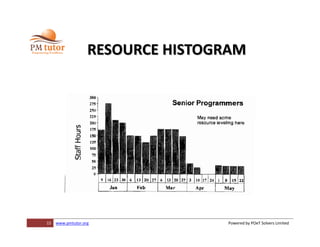
 Timetable - describes necessary time frames for project team members, either
individually or collectively, as well as when acquisition activities such as recruiting
should start. One tool for charting human resources is a resource histogram (see Fig 9-
6, p.266)
15 www.pmtutor.org Powered by POeT Solvers Limited
RESOURCE HISTOGRAM
16 www.pmtutor.org Powered by POeT Solvers Limited
PLAN HUMAN RESOURCE MANAGEMENT
OUTPUTS
Staffing Management Plan (contd.)
 Staff Release plan - method & timing of releasing team members
 Training Needs – If the team members to be assigned are not expected to have the
required competencies, a training plan can be developed as part of the project. The plan can
also include ways to help team members obtain certifications that would support their ability
to benefit the project
 Recognition & rewards - criteria for recognition and rewards are planned;
awarded as part of the Develop Project Team process
 Compliance - Government regulations, union contracts & HR policies
 Safety – policies & procedures that protect team members from safety hazards
17 www.pmtutor.org Powered by POeT Solvers Limited
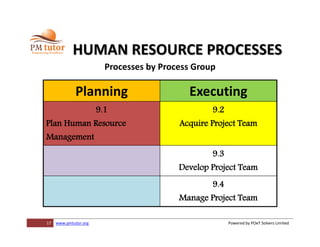
HUMAN RESOURCE PROCESSES
Processes by Process Group
Planning Executing
9.1
Plan Human Resource
Management
9.2
Acquire Project Team
9.3
Develop Project Team
9.4
Manage Project Team
18 www.pmtutor.org Powered by POeT Solvers Limited
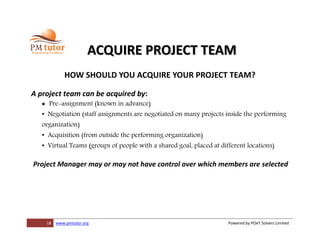
ACQUIRE PROJECT TEAM
HOW SHOULD YOU ACQUIRE YOUR PROJECT TEAM?
A project team can be acquired by:
 Pre-assignment (known in advance)
• Negotiation (staff assignments are negotiated on many projects inside the performing
organization)
• Acquisition (from outside the performing organization)
• Virtual Teams (groups of people with a shared goal, placed at different locations)
Project Manager may or may not have control over which members are selected
19 www.pmtutor.org Powered by POeT Solvers Limited
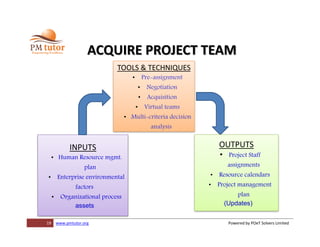
ACQUIRE PROJECT TEAM
TOOLS & TECHNIQUES
• Pre-assignment
• Negotiation
• Acquisition
• Virtual teams
• Multi-criteria decision
analysis
INPUTS
• Human Resource mgmt.
plan
• Enterprise environmental
factors
• Organizational process
assets
OUTPUTS
• Project Staff
assignments
• Resource calendars
• Project management
plan
(Updates)
20 www.pmtutor.org Powered by POeT Solvers Limited
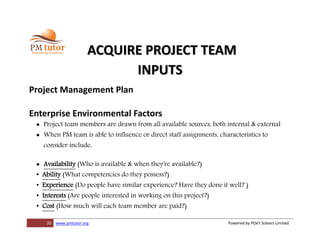
ACQUIRE PROJECT TEAM
INPUTS
Project Management Plan
Enterprise Environmental Factors
 Project team members are drawn from all available sources, both internal & external
 When PM team is able to influence or direct staff assignments, characteristics to
consider include:
 Availability (Who is available & when they're available?)
• Ability (What competencies do they possess?)
• Experience (Do people have similar experience? Have they done it well? )
• Interests (Are people interested in working on this project?)
• Cost (How much will each team member are paid?)
21 www.pmtutor.org Powered by POeT Solvers Limited
ACQUIRE PROJECT TEAM
INPUTS
Organizational Process Assets
HR department (policies, guidelines, or procedures governing staff assignments)
22 www.pmtutor.org Powered by POeT Solvers Limited
ACQUIRE PROJECT TEAM-T&T
Tools & Techniques
Pre-Assignment
Specific people may be promised as part of a competitive proposal, if the project is dependent
on expertise of particular persons. Some staff assignments are defined within the Project
Charter
Negotiation
PM team uses their influencing skills to obtain staff members from within the performing
organization. May need to negotiate with
• Functional managers
• Other project management teams
23 www.pmtutor.org Powered by POeT Solvers Limited
ACQUIRE PROJECT TEAM-T&T
Acquisition
 Required services can be acquired from outside sources when the performing
organization lacks in-house staff.
Virtual Teams
 People with a shared goal who perform with little or no face to face meetings
 Benefit from e-mail & video conferencing; must plan communications carefully
Virtual team format makes it possible to:
 Form teams from widespread geographic areas
 Add special expertise to a project team, even though the expert is not in the same
geographic area
 Incorporate employees who work from home offices
 Form teams of people who work different shifts or hours
 Include people with mobility handicaps
 Move forward with projects otherwise ignored due to travel expenses
24 www.pmtutor.org Powered by POeT Solvers Limited
ACQUIRE PROJECT TEAM
OUTPUTS
Project Staff Assignments
 Project is staffed when appropriate people are assigned to work on it
 Documentation can include a project team directory, memos to team members, and
names inserted into other parts of project management plan (such as organization
charts & schedules)
Resource Calendars
 Documents the time periods (or calendar) each project team member can work on the
project
 Creating a reliable final schedule depends on having a good understanding of each
person’s schedule conflicts, including vacation time and commitments to other projects
25 www.pmtutor.org Powered by POeT Solvers Limited
ACQUIRE PROJECT TEAM
OUTPUTS
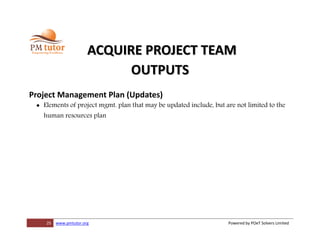
Project Management Plan (Updates)
 Elements of project mgmt. plan that may be updated include, but are not limited to the
human resources plan
26 www.pmtutor.org Powered by POeT Solvers Limited
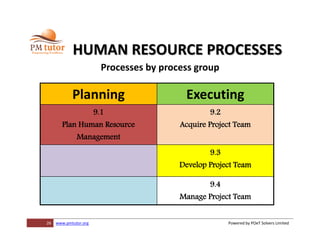
HUMAN RESOURCE PROCESSES
Processes by process group
Planning Executing
9.1
Plan Human Resource
Management
9.2
Acquire Project Team
9.3
Develop Project Team
9.4
Manage Project Team
27 www.pmtutor.org Powered by POeT Solvers Limited
DEVELOP PROJECT TEAM
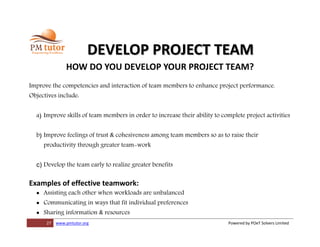
HOW DO YOU DEVELOP YOUR PROJECT TEAM?
Improve the competencies and interaction of team members to enhance project performance.
Objectives include:
a) Improve skills of team members in order to increase their ability to complete project activities
b) Improve feelings of trust & cohesiveness among team members so as to raise their
productivity through greater team-work
c) Develop the team early to realize greater benefits
Examples of effective teamwork:
 Assisting each other when workloads are unbalanced
 Communicating in ways that fit individual preferences
 Sharing information & resources
28 www.pmtutor.org Powered by POeT Solvers Limited
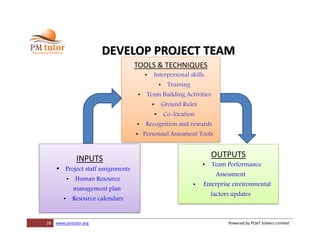
DEVELOP PROJECT TEAM
TOOLS & TECHNIQUES
• Interpersonal skills
• Training
• Team Building Activities
• Ground Rules
• Co-location
• Recognition and rewards
• Personnel Assesment Tools
INPUTS
• Project staff assignments
• Human Resource
management plan
• Resource calendars
OUTPUTS
• Team Performance
Assessment
• Enterprise environmental
factors updates
29 www.pmtutor.org Powered by POeT Solvers Limited
DEVELOP PROJECT TEAM
INPUTS
Project Staff Assignments
Project Management Plan
Resource Calendars
30 www.pmtutor.org Powered by POeT Solvers Limited
DEVELOP PROJECT TEAM
Tools & Techniques
Interpersonal Skills
Interpersonal skills, sometimes known as "soft skills" are particularly important to team
development. Understanding the sentiments of team members, anticipating their actions,
acknowledging their concerns and following up on their issues can greatly reduce problems
and increase cooperation.
Skills such as: empathy, influence, creativity, group facilitation is valuable assets when
managing the project team
31 www.pmtutor.org Powered by POeT Solvers Limited
DEVELOP PROJECT TEAM
Tools & Techniques
Training
Activities designed to enhance the competencies of the project team members. Examples of
training methods include:
Classroom, online, computer-based, on-the-job training from another project team member,
mentoring, and coaching from other team members (Training includes diversity/cultural
training as well)
32 www.pmtutor.org Powered by POeT Solvers Limited
DEVELOP PROJECT TEAM
Tools & Techniques
Team-Building Activities
Could be
 a ten minute agenda item in a status review meeting
 an off-site, professionally facilitated experience designed to improve interpersonal
relationships
 some group activities, although not specifically designed for team building, like
developing a WBS (can increase team cohesiveness)
 Encourage informal communication & activities
 Team building strategies are particularly valuable when team members operate from
remote locations
 Five stages of team development (explained later)
33 www.pmtutor.org Powered by POeT Solvers Limited
DEVELOP PROJECT TEAM
Tools & Techniques
Ground Rules
 Establish clear expectations regarding acceptable behavior by project team members to
decrease misunderstandings & increase productivity
Co-Location
 Placing many or all of the most active team members in the same physical location
enhances their ability to perform as a team
 Can be temporary, only at strategically important times in the project
 Co-location strategy can include a meeting room ("war room") with electronic
communication devices and other conveniences that enhance communication and a
sense of community
34 www.pmtutor.org Powered by POeT Solvers Limited
DEVELOP PROJECT TEAM
Tools & Techniques
Recognition and Rewards
 The original plans concerning ways to reward people are developed during Human
Resource Planning.
 Process involves recognizing & rewarding only desirable behavior, e.g. need to work
overtime because of poor planning should not be rewarded (undesirable behavior)
 Win-lose (zero sum) rewards that only limited number of project team members can
achieve, e.g. employee of the month etc. (can hurt team cohesiveness)
 Rewarding win-win behavior that everyone can achieve tends to increase support
among team members
35 www.pmtutor.org Powered by POeT Solvers Limited
DEVELOP PROJECT TEAM
OUTPUTS
Team Performance Assessment
 Informal or formal evaluation of a team's effectiveness can include indicators like:
 Improvements in skills that allow a person to perform assigned activities more
effectively
 Improvement in competencies and sentiments that help team perform better as a group
 Reduced staff turnover rate
Enterprise Environmental Factors Updates
36 www.pmtutor.org Powered by POeT Solvers Limited
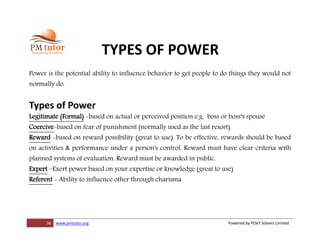
TYPES OF POWER
Power is the potential ability to influence behavior to get people to do things they would not
normally do.
Types of Power
Legitimate (Formal) -based on actual or perceived position e.g. boss or boss‘s spouse
Coercive-based on fear of punishment (normally used as the last resort)
Reward -based on reward possibility (great to use). To be effective, rewards should be based
on activities & performance under a person's control. Reward must have clear criteria with
planned systems of evaluation. Reward must be awarded in public.
Expert –Exert power based on your expertise or knowledge (great to use)
Referent - Ability to influence other through charisma
37 www.pmtutor.org Powered by POeT Solvers Limited
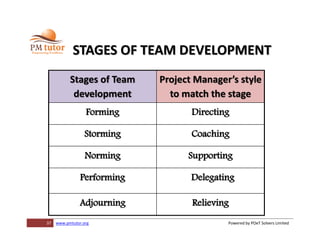
STAGES OF TEAM DEVELOPMENT
Stages of Team
development
Project Manager’s style
to match the stage
Forming Directing
Storming Coaching
Norming Supporting
Performing Delegating
Adjourning Relieving
38 www.pmtutor.org Powered by POeT Solvers Limited
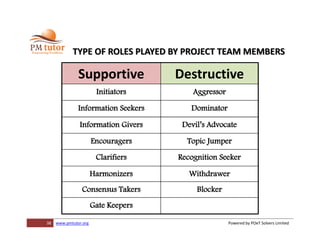
TYPE OF ROLES PLAYED BY PROJECT TEAM MEMBERS
Supportive Destructive
Initiators Aggressor
Information Seekers Dominator
Information Givers Devil’s Advocate
Encouragers Topic Jumper
Clarifiers Recognition Seeker
Harmonizers Withdrawer
Consensus Takers Blocker
Gate Keepers
39 www.pmtutor.org Powered by POeT Solvers Limited
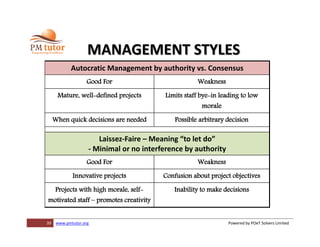
MANAGEMENT STYLES
Autocratic Management by authority vs. Consensus
Good For Weakness
Mature, well-defined projects Limits staff bye-in leading to low
morale
When quick decisions are needed Possible arbitrary decision
Laissez-Faire – Meaning “to let do”
- Minimal or no interference by authority
Good For Weakness
Innovative projects Confusion about project objectives
Projects with high morale, self-
motivated staff – promotes creativity
Inability to make decisions
40 www.pmtutor.org Powered by POeT Solvers Limited
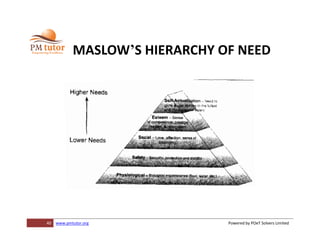
MASLOW’S HIERARCHY OF NEED
41 www.pmtutor.org Powered by POeT Solvers Limited
MANAGEMENT THEORIES
MANAGEMENT THEORIES
McGregor's Theory
Theory X
 Workers viewed as inherently self-centered, lazy
 Traditional view of management; top-down.
 Managers control & micromanage the workers
Theory Y
 People will perform their best if they are properly motivated
 Workers viewed as willing & eager to accept responsibility
 Managers create environment that aids workers in achieving goals
42 www.pmtutor.org Powered by POeT Solvers Limited
MANAGEMENT THEORIES
43 www.pmtutor.org Powered by POeT Solvers Limited
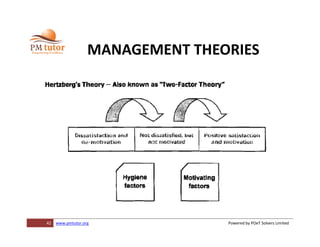
MANAGEMENT THEORIES
HYGIENE FACTORS
 Absence of proper hygiene factors are linked to dissatisfaction at the work-place.
Examples of Hygiene factor are:
• company policies & job security
• pay, remuneration, salaries
• working conditions
• supervision
MOTIVATING FACTORS
When they exist, team members have a good time at their place of work. It includes,
• sense of achievement & recognition for things done
• opportunity for growth & advancement
• responsibility & stimulating work
44 www.pmtutor.org Powered by POeT Solvers Limited
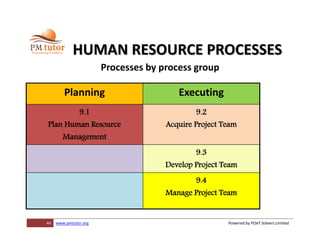
HUMAN RESOURCE PROCESSES
Processes by process group
Planning Executing
9.1
Plan Human Resource
Management
9.2
Acquire Project Team
9.3
Develop Project Team
9.4
Manage Project Team
45 www.pmtutor.org Powered by POeT Solvers Limited
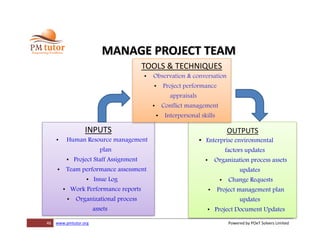
MANAGE PROJECT TEAM
HOW SHOULD YOU MANAGE YOUR PROJECT TEAM?
 Track & appraise team member performance
 Provide feedback
 Observe team behavior, manage conflict & resolve issues
 Coordinate changes to enhance project performance
 As a result of managing the project team, staffing management plan is updated, change
requests are submitted, issues are resolved, input is given to organizational performance
appraisals, and lessons learned are added to the organization’s database.
 Management of the project team is complicated when team members are accountable to both
a functional manager and the project manager within a matrix organization
 Effective management of this dual reporting is often a critical success factor for the project,
and is generally the responsibility of the project manager
46 www.pmtutor.org Powered by POeT Solvers Limited
MANAGE PROJECT TEAM
INPUTS
• Human Resource management
plan
• Project Staff Assignment
• Team performance assessment
• Issue Log
• Work Performance reports
• Organizational process
assets
OUTPUTS
• Enterprise environmental
factors updates
• Organization process assets
updates
• Change Requests
• Project management plan
updates
• Project Document Updates
TOOLS & TECHNIQUES
• Observation & conversation
• Project performance
appraisals
• Conflict management
• Interpersonal skills
47 www.pmtutor.org Powered by POeT Solvers Limited
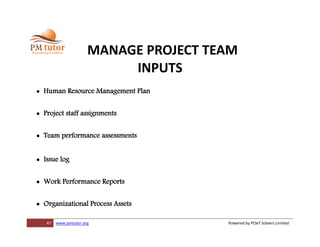
MANAGE PROJECT TEAM
INPUTS
 Human Resource Management Plan
 Project staff assignments
 Team performance assessments
 Issue log
 Work Performance Reports
 Organizational Process Assets
48 www.pmtutor.org Powered by POeT Solvers Limited
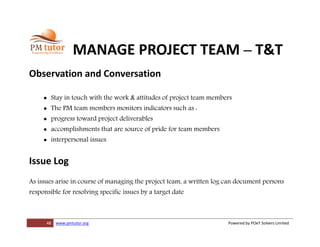
MANAGE PROJECT TEAM – T&T
Observation and Conversation
 Stay in touch with the work & attitudes of project team members
 The PM team members monitors indicators such as :
 progress toward project deliverables
 accomplishments that are source of pride for team members
 interpersonal issues
Issue Log
As issues arise in course of managing the project team, a written log can document persons
responsible for resolving specific issues by a target date
49 www.pmtutor.org Powered by POeT Solvers Limited
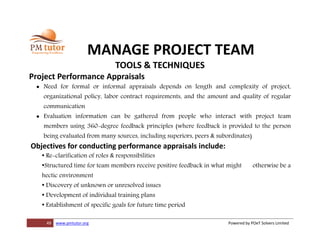
MANAGE PROJECT TEAM
TOOLS & TECHNIQUES
Project Performance Appraisals
 Need for formal or informal appraisals depends on length and complexity of project,
organizational policy, labor contract requirements, and the amount and quality of regular
communication
 Evaluation information can be gathered from people who interact with project team
members using 360-degree feedback principles (where feedback is provided to the person
being evaluated from many sources, including superiors, peers & subordinates)
Objectives for conducting performance appraisals include:
• Re-clarification of roles & responsibilities
•Structured time for team members receive positive feedback in what might otherwise be a
hectic environment
• Discovery of unknown or unresolved issues
• Development of individual training plans
• Establishment of specific goals for future time period
50 www.pmtutor.org Powered by POeT Solvers Limited
MANAGE PROJECT TEAM – T&T
Conflict Management
• Successful conflict management results in greater productivity and positive working
relationships
• Common sources of conflict include scarce resources, scheduling priorities & personal
working styles
• Conflict reduction techniques include team ground rules, group norms, and solid
project management practices, like communication planning & role definition
• Differences of opinion can be healthy, can lead to increased creativity and better
decision-making, if managed properly
When the differences become a negative factor:
• project team members are initially responsible for solving their own conflicts
• if escalates, then PM should help facilitate a satisfactory resolution
• conflicts should be addressed early, usually in private, using a direct & collaborative
approach
51 www.pmtutor.org Powered by POeT Solvers Limited
MANAGE PROJECT TEAM
TOOLS AND TECHNIQUES
Conflict Resolution Techniques
• Forcing (Win/lose) - one person forces solution on the other parties
• Smoothing (accommodating) (lose/lose) - attempts are made to make conflict appear
less important than it is
• Compromise (negotiating) (neutral/neutral) - each party gives up something to reach a
solution
• Withdrawal (avoiding) (lose/lose) - one party gives up & refuses to discuss the conflict,
which is probably the worst technique
• Confrontation (collaboration/problem solving) (win/win) - the only true and best
solution -a fact finding mission results in some possible solutions which are chosen
from
52 www.pmtutor.org Powered by POeT Solvers Limited
MANAGE PROJECT TEAM
TOOLS AND TECHNIQUES
Issue Log
Issues arise in course of managing project team. A written log documents and helps
monitor who is responsible for resolving specific issues by a target date. Issue resolution
addresses obstacles that can block the team from achieving its goals.
Interpersonal Skills
Project managers use combination of technical, human, and conceptual skills to analyze
situations and interact appropriately with team members. This aids PM capitalizing on the
strengths of all team members (read Appendix X3 in PMBOK).
53 www.pmtutor.org Powered by POeT Solvers Limited
MANAGE PROJECT TEAM
OUTPUTS
Enterprise Environmental Factors Updates
EEF that may require updates as a result of the Manage
Project Team process include, but are not limited to:
Input to organizational performance appraisals, and
Personnel skill updates
Organizational Process Assets (Updates)
Organizational process assets that may require updates as a result of the Manage
Project Team process include, but are not limited to:
• Historical information and lessons learned documentation
• Template, and
• Organizational standard processes
54 www.pmtutor.org Powered by POeT Solvers Limited
MANAGE PROJECT TEAM
OUTPUTS
Change Requests
• Staffing changes, whether by choice or by uncontrollable events
Project Management plan (Updates)
• Updates to Staffing Management Plan – they include new roles, training, reward
decisions
55 www.pmtutor.org Powered by POeT Solvers Limited
HUMAN RESOURCE QUIZ
Quiz
You're the Project Manager for a one-year construction project. The project is a
quarter done and your team consists of six sellers and 25 company employees.
To understand who is responsible for what work, you would look at the:
A. Resource histograms
B. Bar chart
C. Responsibility assignment matrix
D. Project organization chart
56 www.pmtutor.org Powered by POeT Solvers Limited
HUMAN RESOURCE QUIZ
Answer
C is the answer.
The responsibility assignment matrix maps who will do what work. The
resource histogram show the number of resources used in each time period.
The bar chart, in its pure form, shows only activity and calendar dates. An
organizational chart shows who reports to whom.

7._Project_Human_Resources_Management.pdf

  • 1.
    1 www.pmtutor.org Poweredby POeT Solvers Limited PROJECT HUMAN RESOURCE MANAGEMENT
  • 2.
    2 www.pmtutor.org Poweredby POeT Solvers Limited PROJECT HUMAN RESOURCE MANAGEMENT WHAT DOES THE HUMAN RESOURCE KNOWLEDGE AREA DO? Organize & manage the project team (also referred to as project staff) • The project team comprises of the people who have assigned roles and responsibilities for completing the project (who report directly or indirectly to the Project Manager and perform the project work). • Team members should be involved in much of the project’s planning and decision-making. • Early involvement of team members adds expertise during the planning process and strengthens commitment to the project. • The Project Management Team is a subset of the project team and responsible for project management activities such as planning, controlling, and closing. • Project sponsor works with project management team, typically assisting with matters such as project funding, clarifying scope questions, and influencing other in order to benefit the project.
  • 3.
    3 www.pmtutor.org Poweredby POeT Solvers Limited HUMAN RESOURCE PROCESSES HUMAN RESOURCE PROCESS DEFINITIONS 9.1 Plan Human Resource Management • Identifying & documenting project roles, responsibilities, required skills, & reporting relationships as well as creating the Staffing Management Plan. 9.2 Acquire Project Team • Confirm human resource availability and obtain the people needed to complete the project activities. 9.3 Develop Project Team • Improve competencies & interaction of team members to enhance project performance. 9.4 Manage Project Team • Track team member performance, provide feedback, resolve issues & coordinate changes to enhance project performance
  • 4.
    4 www.pmtutor.org Poweredby POeT Solvers Limited HUMAN RESOURCE PROCESSES PROCESSES BY PROCESS GROUP PLANNING EXECUTING 9.1 Plan Human Resource Management 9.2 Acquire Project Team 9.3 Develop Project Team 9.4 Manage Project Team
  • 5.
    5 www.pmtutor.org Poweredby POeT Solvers Limited PLAN HUMAN RESOURCE MANAGEMENT WHAT DOES ‘PLAN HUMAN RESOURCE MANAGEMENT’ DO? Identifies & documents project roles, responsibilities, and required skills, reporting relationships, and creates a staffing management plan • Can include how & when project team members will be acquired (the persons can be from inside or outside the performing org.) • Criteria for releasing them from the project • Identification of training needs • Plans for recognition & rewards • Compliance considerations (e.g. labor laws), safety issues (e.g. Workman’s safety)
  • 6.
    6 www.pmtutor.org Poweredby POeT Solvers Limited PLAN HUMAN RESOURCE MANAGEMENT INPUTS • Project Management Plan • Activity resource requirements • Enterprise environmental factors • Organizational process assets TOOLS & TECHNIQUES • Organization charts & Position descriptions • Networking • Organizational theory • Expert Judgement • Meeting OUTPUTS Human Resource Management Plan
  • 7.
    7 www.pmtutor.org Poweredby POeT Solvers Limited PLAN HUMAN RESOURCE MANAGEMENT INPUTS Activity Resource Requirements The preliminary requirements regarding the required people and competencies for the project team members are progressively elaborated as part of human resource planning process. Enterprise Environmental Factors The enterprise environmental factors (section 2.1.5) that can influence the Develop Human Resource Plan process include, but are not limited to:  Organizational culture and structure,  Existing human resources,  Personnel administration policies, and  Marketplace conditions
  • 8.
    8 www.pmtutor.org Poweredby POeT Solvers Limited PLAN HUMAN RESOURCE MANAGEMENT Plan Human Resource Management INPUTS cont’d Organizational Process Assets  Organizational standard processes and policies and standardized role descriptions,  Templates for organizational charts and position descriptions, and  Historical information on organizational structures that have worked in previous projects
  • 9.
    9 www.pmtutor.org Poweredby POeT Solvers Limited PLAN HUMAN RESOURCE MANAGEMENT Tools & Techniques Organization Charts & Position Descriptions Used to ensure each work package has an unambiguous owner & that all team members have a clear understanding of their roles & responsibilities (See Figure 9-4, p.261 shows three different types of chart) • Hierarchical- type charts Organizational breakdown structure (OBS) - looks similar to WBS, but is broken down by organization’s existing departments, units or teams Resource breakdown structure (RBS) – another hierarchical chart broken down by types of resources, e.g. welders, graphic designers, etc. RBS can help tracking project costs, and can be aligned with the organization’s accounting system (RBS can contain resource categories other than human resources).
  • 10.
    10 www.pmtutor.org Poweredby POeT Solvers Limited PLAN HUMAN RESOURCE MANAGEMENT – T&T • Matrix-based charts Responsibility assignment matrix (RAM) is used to shows connections between work & people. See Figure 9-5, p.262, is a type of RAM called a RACI chart (responsible, accountable, consult, inform) • Text-oriented formats Detailed job or position descriptions; documents that provide information such as responsibilities, authority, competencies, and qualifications; etc. • Other sections of the project management plan Some responsibilities related to managing the project are listed and explained in other sections of the project management plan. For example, the risk register lists risk owners; the communication plan lists team members responsible for communication activities.
  • 11.
    11 www.pmtutor.org Poweredby POeT Solvers Limited PLAN HUMAN RESOURCE MANAGEMENT Tools & Techniques Networking  Informal interaction with others is an effective way to understand political & interpersonal factors that will impact the effectiveness of staffing options  Include proactive correspondence, luncheon meetings, informal conversations, and trade conferences Organizational Theory  Provides information regarding the ways people, teams & organizational units behave.  Helps managing people & groups; includes motivational theories
  • 12.
    12 www.pmtutor.org Poweredby POeT Solvers Limited PLAN HUMAN RESOURCE MANAGEMENT OUTPUTS Roles & Responsibilities List includes: Role – the label describing the portion of a project for which a person is accountable; examples of project roles are business analyst, electrical engineer, testing coordinator, etc. Authority – The right to apply project resources makes decisions & sign approvals (members work best with authority matching their responsibility) Responsibility – The work that a project team member is expected to perform in order to complete the project activities Competency – The skill & capacity needed to complete project activities Project Organization Charts Graphic display of project team members & their reporting relationships
  • 13.
    13 www.pmtutor.org Poweredby POeT Solvers Limited PLAN HUMAN RESOURCE MANAGEMENT OUTPUTS Staffing Management Plan  Describes when & how human resource requirements will be met  May be tied with Procurement processes Includes: • Staff acquisition – from internal/external contracted sources; need to work in a central location or can they work from distant locations costs associated with each level of expertise, HR department’s assistance to project management team, etc.
  • 14.
    14 www.pmtutor.org Poweredby POeT Solvers Limited PLAN HUMAN RESOURCE MANAGEMENT OUTPUTS  Timetable - describes necessary time frames for project team members, either individually or collectively, as well as when acquisition activities such as recruiting should start. One tool for charting human resources is a resource histogram (see Fig 9- 6, p.266)
  • 15.
    15 www.pmtutor.org Poweredby POeT Solvers Limited RESOURCE HISTOGRAM
  • 16.
    16 www.pmtutor.org Poweredby POeT Solvers Limited PLAN HUMAN RESOURCE MANAGEMENT OUTPUTS Staffing Management Plan (contd.)  Staff Release plan - method & timing of releasing team members  Training Needs – If the team members to be assigned are not expected to have the required competencies, a training plan can be developed as part of the project. The plan can also include ways to help team members obtain certifications that would support their ability to benefit the project  Recognition & rewards - criteria for recognition and rewards are planned; awarded as part of the Develop Project Team process  Compliance - Government regulations, union contracts & HR policies  Safety – policies & procedures that protect team members from safety hazards
  • 17.
    17 www.pmtutor.org Poweredby POeT Solvers Limited HUMAN RESOURCE PROCESSES Processes by Process Group Planning Executing 9.1 Plan Human Resource Management 9.2 Acquire Project Team 9.3 Develop Project Team 9.4 Manage Project Team
  • 18.
    18 www.pmtutor.org Poweredby POeT Solvers Limited ACQUIRE PROJECT TEAM HOW SHOULD YOU ACQUIRE YOUR PROJECT TEAM? A project team can be acquired by:  Pre-assignment (known in advance) • Negotiation (staff assignments are negotiated on many projects inside the performing organization) • Acquisition (from outside the performing organization) • Virtual Teams (groups of people with a shared goal, placed at different locations) Project Manager may or may not have control over which members are selected
  • 19.
    19 www.pmtutor.org Poweredby POeT Solvers Limited ACQUIRE PROJECT TEAM TOOLS & TECHNIQUES • Pre-assignment • Negotiation • Acquisition • Virtual teams • Multi-criteria decision analysis INPUTS • Human Resource mgmt. plan • Enterprise environmental factors • Organizational process assets OUTPUTS • Project Staff assignments • Resource calendars • Project management plan (Updates)
  • 20.
    20 www.pmtutor.org Poweredby POeT Solvers Limited ACQUIRE PROJECT TEAM INPUTS Project Management Plan Enterprise Environmental Factors  Project team members are drawn from all available sources, both internal & external  When PM team is able to influence or direct staff assignments, characteristics to consider include:  Availability (Who is available & when they're available?) • Ability (What competencies do they possess?) • Experience (Do people have similar experience? Have they done it well? ) • Interests (Are people interested in working on this project?) • Cost (How much will each team member are paid?)
  • 21.
    21 www.pmtutor.org Poweredby POeT Solvers Limited ACQUIRE PROJECT TEAM INPUTS Organizational Process Assets HR department (policies, guidelines, or procedures governing staff assignments)
  • 22.
    22 www.pmtutor.org Poweredby POeT Solvers Limited ACQUIRE PROJECT TEAM-T&T Tools & Techniques Pre-Assignment Specific people may be promised as part of a competitive proposal, if the project is dependent on expertise of particular persons. Some staff assignments are defined within the Project Charter Negotiation PM team uses their influencing skills to obtain staff members from within the performing organization. May need to negotiate with • Functional managers • Other project management teams
  • 23.
    23 www.pmtutor.org Poweredby POeT Solvers Limited ACQUIRE PROJECT TEAM-T&T Acquisition  Required services can be acquired from outside sources when the performing organization lacks in-house staff. Virtual Teams  People with a shared goal who perform with little or no face to face meetings  Benefit from e-mail & video conferencing; must plan communications carefully Virtual team format makes it possible to:  Form teams from widespread geographic areas  Add special expertise to a project team, even though the expert is not in the same geographic area  Incorporate employees who work from home offices  Form teams of people who work different shifts or hours  Include people with mobility handicaps  Move forward with projects otherwise ignored due to travel expenses
  • 24.
    24 www.pmtutor.org Poweredby POeT Solvers Limited ACQUIRE PROJECT TEAM OUTPUTS Project Staff Assignments  Project is staffed when appropriate people are assigned to work on it  Documentation can include a project team directory, memos to team members, and names inserted into other parts of project management plan (such as organization charts & schedules) Resource Calendars  Documents the time periods (or calendar) each project team member can work on the project  Creating a reliable final schedule depends on having a good understanding of each person’s schedule conflicts, including vacation time and commitments to other projects
  • 25.
    25 www.pmtutor.org Poweredby POeT Solvers Limited ACQUIRE PROJECT TEAM OUTPUTS Project Management Plan (Updates)  Elements of project mgmt. plan that may be updated include, but are not limited to the human resources plan
  • 26.
    26 www.pmtutor.org Poweredby POeT Solvers Limited HUMAN RESOURCE PROCESSES Processes by process group Planning Executing 9.1 Plan Human Resource Management 9.2 Acquire Project Team 9.3 Develop Project Team 9.4 Manage Project Team
  • 27.
    27 www.pmtutor.org Poweredby POeT Solvers Limited DEVELOP PROJECT TEAM HOW DO YOU DEVELOP YOUR PROJECT TEAM? Improve the competencies and interaction of team members to enhance project performance. Objectives include: a) Improve skills of team members in order to increase their ability to complete project activities b) Improve feelings of trust & cohesiveness among team members so as to raise their productivity through greater team-work c) Develop the team early to realize greater benefits Examples of effective teamwork:  Assisting each other when workloads are unbalanced  Communicating in ways that fit individual preferences  Sharing information & resources
  • 28.
    28 www.pmtutor.org Poweredby POeT Solvers Limited DEVELOP PROJECT TEAM TOOLS & TECHNIQUES • Interpersonal skills • Training • Team Building Activities • Ground Rules • Co-location • Recognition and rewards • Personnel Assesment Tools INPUTS • Project staff assignments • Human Resource management plan • Resource calendars OUTPUTS • Team Performance Assessment • Enterprise environmental factors updates
  • 29.
    29 www.pmtutor.org Poweredby POeT Solvers Limited DEVELOP PROJECT TEAM INPUTS Project Staff Assignments Project Management Plan Resource Calendars
  • 30.
    30 www.pmtutor.org Poweredby POeT Solvers Limited DEVELOP PROJECT TEAM Tools & Techniques Interpersonal Skills Interpersonal skills, sometimes known as "soft skills" are particularly important to team development. Understanding the sentiments of team members, anticipating their actions, acknowledging their concerns and following up on their issues can greatly reduce problems and increase cooperation. Skills such as: empathy, influence, creativity, group facilitation is valuable assets when managing the project team
  • 31.
    31 www.pmtutor.org Poweredby POeT Solvers Limited DEVELOP PROJECT TEAM Tools & Techniques Training Activities designed to enhance the competencies of the project team members. Examples of training methods include: Classroom, online, computer-based, on-the-job training from another project team member, mentoring, and coaching from other team members (Training includes diversity/cultural training as well)
  • 32.
    32 www.pmtutor.org Poweredby POeT Solvers Limited DEVELOP PROJECT TEAM Tools & Techniques Team-Building Activities Could be  a ten minute agenda item in a status review meeting  an off-site, professionally facilitated experience designed to improve interpersonal relationships  some group activities, although not specifically designed for team building, like developing a WBS (can increase team cohesiveness)  Encourage informal communication & activities  Team building strategies are particularly valuable when team members operate from remote locations  Five stages of team development (explained later)
  • 33.
    33 www.pmtutor.org Poweredby POeT Solvers Limited DEVELOP PROJECT TEAM Tools & Techniques Ground Rules  Establish clear expectations regarding acceptable behavior by project team members to decrease misunderstandings & increase productivity Co-Location  Placing many or all of the most active team members in the same physical location enhances their ability to perform as a team  Can be temporary, only at strategically important times in the project  Co-location strategy can include a meeting room ("war room") with electronic communication devices and other conveniences that enhance communication and a sense of community
  • 34.
    34 www.pmtutor.org Poweredby POeT Solvers Limited DEVELOP PROJECT TEAM Tools & Techniques Recognition and Rewards  The original plans concerning ways to reward people are developed during Human Resource Planning.  Process involves recognizing & rewarding only desirable behavior, e.g. need to work overtime because of poor planning should not be rewarded (undesirable behavior)  Win-lose (zero sum) rewards that only limited number of project team members can achieve, e.g. employee of the month etc. (can hurt team cohesiveness)  Rewarding win-win behavior that everyone can achieve tends to increase support among team members
  • 35.
    35 www.pmtutor.org Poweredby POeT Solvers Limited DEVELOP PROJECT TEAM OUTPUTS Team Performance Assessment  Informal or formal evaluation of a team's effectiveness can include indicators like:  Improvements in skills that allow a person to perform assigned activities more effectively  Improvement in competencies and sentiments that help team perform better as a group  Reduced staff turnover rate Enterprise Environmental Factors Updates
  • 36.
    36 www.pmtutor.org Poweredby POeT Solvers Limited TYPES OF POWER Power is the potential ability to influence behavior to get people to do things they would not normally do. Types of Power Legitimate (Formal) -based on actual or perceived position e.g. boss or boss‘s spouse Coercive-based on fear of punishment (normally used as the last resort) Reward -based on reward possibility (great to use). To be effective, rewards should be based on activities & performance under a person's control. Reward must have clear criteria with planned systems of evaluation. Reward must be awarded in public. Expert –Exert power based on your expertise or knowledge (great to use) Referent - Ability to influence other through charisma
  • 37.
    37 www.pmtutor.org Poweredby POeT Solvers Limited STAGES OF TEAM DEVELOPMENT Stages of Team development Project Manager’s style to match the stage Forming Directing Storming Coaching Norming Supporting Performing Delegating Adjourning Relieving
  • 38.
    38 www.pmtutor.org Poweredby POeT Solvers Limited TYPE OF ROLES PLAYED BY PROJECT TEAM MEMBERS Supportive Destructive Initiators Aggressor Information Seekers Dominator Information Givers Devil’s Advocate Encouragers Topic Jumper Clarifiers Recognition Seeker Harmonizers Withdrawer Consensus Takers Blocker Gate Keepers
  • 39.
    39 www.pmtutor.org Poweredby POeT Solvers Limited MANAGEMENT STYLES Autocratic Management by authority vs. Consensus Good For Weakness Mature, well-defined projects Limits staff bye-in leading to low morale When quick decisions are needed Possible arbitrary decision Laissez-Faire – Meaning “to let do” - Minimal or no interference by authority Good For Weakness Innovative projects Confusion about project objectives Projects with high morale, self- motivated staff – promotes creativity Inability to make decisions
  • 40.
    40 www.pmtutor.org Poweredby POeT Solvers Limited MASLOW’S HIERARCHY OF NEED
  • 41.
    41 www.pmtutor.org Poweredby POeT Solvers Limited MANAGEMENT THEORIES MANAGEMENT THEORIES McGregor's Theory Theory X  Workers viewed as inherently self-centered, lazy  Traditional view of management; top-down.  Managers control & micromanage the workers Theory Y  People will perform their best if they are properly motivated  Workers viewed as willing & eager to accept responsibility  Managers create environment that aids workers in achieving goals
  • 42.
    42 www.pmtutor.org Poweredby POeT Solvers Limited MANAGEMENT THEORIES
  • 43.
    43 www.pmtutor.org Poweredby POeT Solvers Limited MANAGEMENT THEORIES HYGIENE FACTORS  Absence of proper hygiene factors are linked to dissatisfaction at the work-place. Examples of Hygiene factor are: • company policies & job security • pay, remuneration, salaries • working conditions • supervision MOTIVATING FACTORS When they exist, team members have a good time at their place of work. It includes, • sense of achievement & recognition for things done • opportunity for growth & advancement • responsibility & stimulating work
  • 44.
    44 www.pmtutor.org Poweredby POeT Solvers Limited HUMAN RESOURCE PROCESSES Processes by process group Planning Executing 9.1 Plan Human Resource Management 9.2 Acquire Project Team 9.3 Develop Project Team 9.4 Manage Project Team
  • 45.
    45 www.pmtutor.org Poweredby POeT Solvers Limited MANAGE PROJECT TEAM HOW SHOULD YOU MANAGE YOUR PROJECT TEAM?  Track & appraise team member performance  Provide feedback  Observe team behavior, manage conflict & resolve issues  Coordinate changes to enhance project performance  As a result of managing the project team, staffing management plan is updated, change requests are submitted, issues are resolved, input is given to organizational performance appraisals, and lessons learned are added to the organization’s database.  Management of the project team is complicated when team members are accountable to both a functional manager and the project manager within a matrix organization  Effective management of this dual reporting is often a critical success factor for the project, and is generally the responsibility of the project manager
  • 46.
    46 www.pmtutor.org Poweredby POeT Solvers Limited MANAGE PROJECT TEAM INPUTS • Human Resource management plan • Project Staff Assignment • Team performance assessment • Issue Log • Work Performance reports • Organizational process assets OUTPUTS • Enterprise environmental factors updates • Organization process assets updates • Change Requests • Project management plan updates • Project Document Updates TOOLS & TECHNIQUES • Observation & conversation • Project performance appraisals • Conflict management • Interpersonal skills
  • 47.
    47 www.pmtutor.org Poweredby POeT Solvers Limited MANAGE PROJECT TEAM INPUTS  Human Resource Management Plan  Project staff assignments  Team performance assessments  Issue log  Work Performance Reports  Organizational Process Assets
  • 48.
    48 www.pmtutor.org Poweredby POeT Solvers Limited MANAGE PROJECT TEAM – T&T Observation and Conversation  Stay in touch with the work & attitudes of project team members  The PM team members monitors indicators such as :  progress toward project deliverables  accomplishments that are source of pride for team members  interpersonal issues Issue Log As issues arise in course of managing the project team, a written log can document persons responsible for resolving specific issues by a target date
  • 49.
    49 www.pmtutor.org Poweredby POeT Solvers Limited MANAGE PROJECT TEAM TOOLS & TECHNIQUES Project Performance Appraisals  Need for formal or informal appraisals depends on length and complexity of project, organizational policy, labor contract requirements, and the amount and quality of regular communication  Evaluation information can be gathered from people who interact with project team members using 360-degree feedback principles (where feedback is provided to the person being evaluated from many sources, including superiors, peers & subordinates) Objectives for conducting performance appraisals include: • Re-clarification of roles & responsibilities •Structured time for team members receive positive feedback in what might otherwise be a hectic environment • Discovery of unknown or unresolved issues • Development of individual training plans • Establishment of specific goals for future time period
  • 50.
    50 www.pmtutor.org Poweredby POeT Solvers Limited MANAGE PROJECT TEAM – T&T Conflict Management • Successful conflict management results in greater productivity and positive working relationships • Common sources of conflict include scarce resources, scheduling priorities & personal working styles • Conflict reduction techniques include team ground rules, group norms, and solid project management practices, like communication planning & role definition • Differences of opinion can be healthy, can lead to increased creativity and better decision-making, if managed properly When the differences become a negative factor: • project team members are initially responsible for solving their own conflicts • if escalates, then PM should help facilitate a satisfactory resolution • conflicts should be addressed early, usually in private, using a direct & collaborative approach
  • 51.
    51 www.pmtutor.org Poweredby POeT Solvers Limited MANAGE PROJECT TEAM TOOLS AND TECHNIQUES Conflict Resolution Techniques • Forcing (Win/lose) - one person forces solution on the other parties • Smoothing (accommodating) (lose/lose) - attempts are made to make conflict appear less important than it is • Compromise (negotiating) (neutral/neutral) - each party gives up something to reach a solution • Withdrawal (avoiding) (lose/lose) - one party gives up & refuses to discuss the conflict, which is probably the worst technique • Confrontation (collaboration/problem solving) (win/win) - the only true and best solution -a fact finding mission results in some possible solutions which are chosen from
  • 52.
    52 www.pmtutor.org Poweredby POeT Solvers Limited MANAGE PROJECT TEAM TOOLS AND TECHNIQUES Issue Log Issues arise in course of managing project team. A written log documents and helps monitor who is responsible for resolving specific issues by a target date. Issue resolution addresses obstacles that can block the team from achieving its goals. Interpersonal Skills Project managers use combination of technical, human, and conceptual skills to analyze situations and interact appropriately with team members. This aids PM capitalizing on the strengths of all team members (read Appendix X3 in PMBOK).
  • 53.
    53 www.pmtutor.org Poweredby POeT Solvers Limited MANAGE PROJECT TEAM OUTPUTS Enterprise Environmental Factors Updates EEF that may require updates as a result of the Manage Project Team process include, but are not limited to: Input to organizational performance appraisals, and Personnel skill updates Organizational Process Assets (Updates) Organizational process assets that may require updates as a result of the Manage Project Team process include, but are not limited to: • Historical information and lessons learned documentation • Template, and • Organizational standard processes
  • 54.
    54 www.pmtutor.org Poweredby POeT Solvers Limited MANAGE PROJECT TEAM OUTPUTS Change Requests • Staffing changes, whether by choice or by uncontrollable events Project Management plan (Updates) • Updates to Staffing Management Plan – they include new roles, training, reward decisions
  • 55.
    55 www.pmtutor.org Poweredby POeT Solvers Limited HUMAN RESOURCE QUIZ Quiz You're the Project Manager for a one-year construction project. The project is a quarter done and your team consists of six sellers and 25 company employees. To understand who is responsible for what work, you would look at the: A. Resource histograms B. Bar chart C. Responsibility assignment matrix D. Project organization chart
  • 56.
    56 www.pmtutor.org Poweredby POeT Solvers Limited HUMAN RESOURCE QUIZ Answer C is the answer. The responsibility assignment matrix maps who will do what work. The resource histogram show the number of resources used in each time period. The bar chart, in its pure form, shows only activity and calendar dates. An organizational chart shows who reports to whom.