Monitoring  &  Reducing   CHANGE  ORDERS p  r  e  s  e  n  t  a  t  i  o  n
Presentation Outline Introduction Identify Issues  Identify Goals Collect Data (Macro) Analyze Results (Macro) Collect Data (Micro) Analyze Results (Micro) Strategy of Improvement Conclusion
Introduction Change Order: Description Written  instruction  to the contractor issued after execution of the agreement which  authorizes  an  addition, deletion,   or   revision  of the contract  sum , contract  time , or  both . AIA Document G701 I:\Forms\AIA Forms\AIAG701 Change order.pdf Executed by the  Owner  (prepared by Architect)  Agreed to by  ALL : Owner, Contractor & Architect
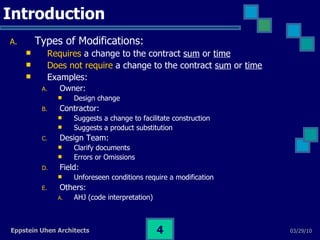
Introduction Types of Modifications: Requires  a change to the contract  sum  or  time Does not require  a change to the contract  sum  or  time Examples: Owner:  Design change Contractor:  Suggests a change to facilitate construction Suggests a product substitution Design Team:  Clarify documents Errors or Omissions Field:  Unforeseen conditions require a modification Others:  AHJ (code interpretation)
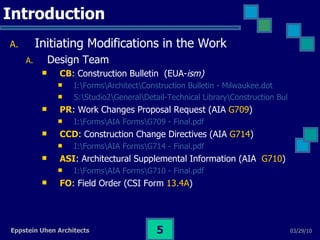
Introduction Initiating Modifications in the Work Design Team CB : Construction Bulletin  (EUA- ism) I:\Forms\Architect\Construction Bulletin - Milwaukee.dot S:\Studio2\General\Detail-Technical Library\Construction Bulletin.dot PR : Work Changes Proposal Request (AIA  G709 ) I:\Forms\AIA Forms\G709 - Final.pdf CCD : Construction Change Directives (AIA  G714 ) I:\Forms\AIA Forms\G714 - Final.pdf ASI : Architectural Supplemental Information (AIA  G710 ) I:\Forms\AIA Forms\G710 - Final.pdf FO : Field Order (CSI Form  13.4A )
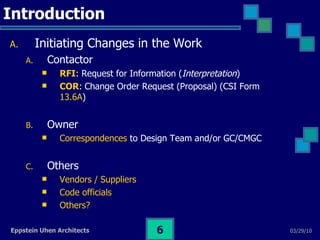
Introduction Initiating Changes in the Work Contactor RFI : Request for Information ( Interpretation )  COR :   Change Order Request (Proposal) (CSI Form  13.6A )  Owner Correspondences  to Design Team and/or GC/CMGC Others Vendors / Suppliers Code officials Others?
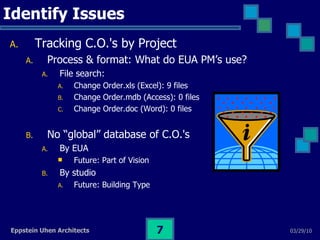
Identify Issues Tracking C.O.'s by Project Process & format: What do EUA PM’s use? File search:  Change Order.xls (Excel): 9 files Change Order.mdb (Access): 0 files Change Order.doc (Word): 0 files No “global” database of C.O.'s By EUA  Future: Part of Vision By studio Future: Building Type
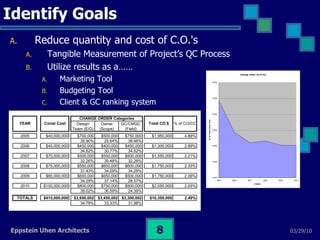
Identify Goals Reduce quantity and cost of C.O.'s Tangible Measurement of Project’s QC Process Utilize results as a…… Marketing Tool Budgeting Tool Client & GC ranking system
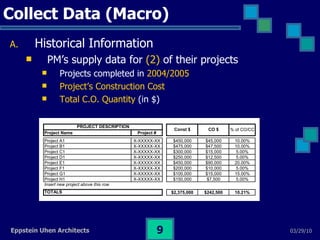
Collect Data (Macro) Historical Information  PM’s supply data for  (2)  of their projects  Projects completed in  2004/2005   Project’s Construction Cost Total C.O. Quantity  (in $)
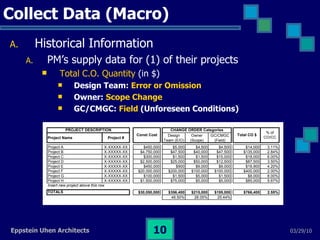
Collect Data (Macro) Historical Information  PM’s supply data for (1) of their projects  Total C.O. Quantity  (in $) Design Team:  Error or Omission Owner:  Scope Change GC/CMGC:  Field  (Unforeseen Conditions)
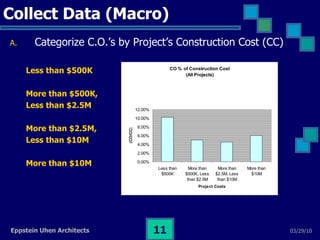
Collect Data (Macro) Categorize C.O.’s by Project’s Construction Cost (CC) Less than $500K More than $500K,  Less than $2.5M More than $2.5M,  Less than $10M More than $10M
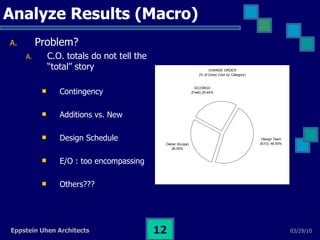
Analyze Results (Macro) Problem?  C.O. totals do not tell the “total” story Contingency Additions vs. New Design Schedule E/O : too encompassing Others???
Analyze Results (Macro) Example A:  Health Care Addition   $10M Const Cost $1M Contingency (10% of Const Cost) Delivery: GC (Design-Bid-Build) Owner requests numerous scope changes during const C.O.'s = $750K Owner’s viewpoint: Successful  Owner  happy  with project  Added scope + $250K left in contingency Hires EUA again On paper: Unsuccessful  7.5% C.O.'s  of Const Cost (more than EUA benchmark)
Analyze Results (Macro) Example B:  New apartment building   $10M Const Cost   $500K Contingency (5% of Const Cost) Delivery: CMGC (Design-GMP-Build) Error & Omissions + Field Issues C.O.'s = $500K  (adds) Owner “VE” interior finishes C.O.'s = -$300K  (deducts) Total C.O.'s = $200K Owner’s viewpoint: Unsuccessful  Owner  unhappy  with project  VE finishes = Reduced Sales Never hires EUA again On paper: Successful  2.0% C.O.'s  of Const Cost (less than EUA benchmark)
Analyze Results (Macro) Successful Project Profitable EUA/Design Team Minimal rework  Where does profit evaporate:  CA Phase Owner GC & Subcontractors Risk Management Minimal (no) litigation (by owner/GC) Minimal (no) claims (paid by design team) Future Work Referrals to other clients Repeat work for that client
Collect Data (Micro) Dissect the reasons WHY C.O.'s occur Collect more detailed C.O. information C.O. Log WHY?   Identify cause of C.O. WHO? Requests change: Design Team / Owner / GC WHAT? Description of change WHEN? Origination – Review – Sign-off WHERE? By building system (Uniformat, BIM – future)
Collect Data (Micro) C.O. Log (CA Log?) Format:  Access  or  Excel ? Related  information (links?) RFI  (Request for Information)  COR  (Change Order Request) CB  (Construction Bulletin) ASI  (Architectural Supplemental Information) CCD  (Construction Change Directive)  Semi-related  information (links) Construction Budget Contingency & Allowances Pay Application Non-related  information Submittals + Addendum
Analyze Results (Micro) Important to EUA Continuous Improvement (staff, process, etc) Risk Management (reduce) Profitability (increase) Important to Staff Development EUA Design Team involvement in project PD (Pre-Design): Designer SD-DD: PM & (1) support staff CD: PM, PAR, (2-3) support staff CA: PAR PC (Post Construction)
Strategy of Improvement Identify “problem” areas Example A:  50% of C.O.'s are MEP Coordination issues Fix: Improve “light table” process  Example B:  40% of Bldg System C.O.'s are B. Shell-related  Fix: Focus in-house training sessions Training of EUA Staff  Improve Project-Related Info Mgmt Track issues during design process Connect decisions made during SD-DD-CD with issues that occur during CA
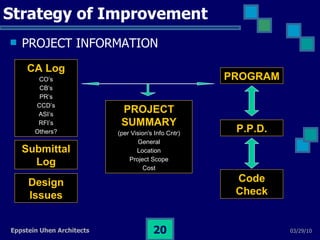
Strategy of Improvement PROJECT INFORMATION CA Log CO’s CB’s PR’s CCD’s ASI’s RFI’s Others? PROJECT SUMMARY (per Vision's Info Cntr) General Location Project Scope Cost Submittal Log Design Issues Code Check PROGRAM P.P.D.
Conclusion Q uestions??? C omments??? C oncerns??? S uggestions???
T  H  A  N  K  Y  O  U   Monitoring  &  Reducing   CHANGE  ORDERS

PM : Change Orders

  • 1.
    Monitoring & Reducing CHANGE ORDERS p r e s e n t a t i o n
  • 2.
    Presentation Outline IntroductionIdentify Issues Identify Goals Collect Data (Macro) Analyze Results (Macro) Collect Data (Micro) Analyze Results (Micro) Strategy of Improvement Conclusion
  • 3.
    Introduction Change Order:Description Written instruction to the contractor issued after execution of the agreement which authorizes an addition, deletion, or revision of the contract sum , contract time , or both . AIA Document G701 I:\Forms\AIA Forms\AIAG701 Change order.pdf Executed by the Owner (prepared by Architect) Agreed to by ALL : Owner, Contractor & Architect
  • 4.
    Introduction Types ofModifications: Requires a change to the contract sum or time Does not require a change to the contract sum or time Examples: Owner: Design change Contractor: Suggests a change to facilitate construction Suggests a product substitution Design Team: Clarify documents Errors or Omissions Field: Unforeseen conditions require a modification Others: AHJ (code interpretation)
  • 5.
    Introduction Initiating Modificationsin the Work Design Team CB : Construction Bulletin (EUA- ism) I:\Forms\Architect\Construction Bulletin - Milwaukee.dot S:\Studio2\General\Detail-Technical Library\Construction Bulletin.dot PR : Work Changes Proposal Request (AIA G709 ) I:\Forms\AIA Forms\G709 - Final.pdf CCD : Construction Change Directives (AIA G714 ) I:\Forms\AIA Forms\G714 - Final.pdf ASI : Architectural Supplemental Information (AIA G710 ) I:\Forms\AIA Forms\G710 - Final.pdf FO : Field Order (CSI Form 13.4A )
  • 6.
    Introduction Initiating Changesin the Work Contactor RFI : Request for Information ( Interpretation ) COR : Change Order Request (Proposal) (CSI Form 13.6A ) Owner Correspondences to Design Team and/or GC/CMGC Others Vendors / Suppliers Code officials Others?
  • 7.
    Identify Issues TrackingC.O.'s by Project Process & format: What do EUA PM’s use? File search: Change Order.xls (Excel): 9 files Change Order.mdb (Access): 0 files Change Order.doc (Word): 0 files No “global” database of C.O.'s By EUA Future: Part of Vision By studio Future: Building Type
  • 8.
    Identify Goals Reducequantity and cost of C.O.'s Tangible Measurement of Project’s QC Process Utilize results as a…… Marketing Tool Budgeting Tool Client & GC ranking system
  • 9.
    Collect Data (Macro)Historical Information PM’s supply data for (2) of their projects Projects completed in 2004/2005 Project’s Construction Cost Total C.O. Quantity (in $)
  • 10.
    Collect Data (Macro)Historical Information PM’s supply data for (1) of their projects Total C.O. Quantity (in $) Design Team: Error or Omission Owner: Scope Change GC/CMGC: Field (Unforeseen Conditions)
  • 11.
    Collect Data (Macro)Categorize C.O.’s by Project’s Construction Cost (CC) Less than $500K More than $500K, Less than $2.5M More than $2.5M, Less than $10M More than $10M
  • 12.
    Analyze Results (Macro)Problem? C.O. totals do not tell the “total” story Contingency Additions vs. New Design Schedule E/O : too encompassing Others???
  • 13.
    Analyze Results (Macro)Example A: Health Care Addition $10M Const Cost $1M Contingency (10% of Const Cost) Delivery: GC (Design-Bid-Build) Owner requests numerous scope changes during const C.O.'s = $750K Owner’s viewpoint: Successful Owner happy with project Added scope + $250K left in contingency Hires EUA again On paper: Unsuccessful 7.5% C.O.'s of Const Cost (more than EUA benchmark)
  • 14.
    Analyze Results (Macro)Example B: New apartment building $10M Const Cost $500K Contingency (5% of Const Cost) Delivery: CMGC (Design-GMP-Build) Error & Omissions + Field Issues C.O.'s = $500K (adds) Owner “VE” interior finishes C.O.'s = -$300K (deducts) Total C.O.'s = $200K Owner’s viewpoint: Unsuccessful Owner unhappy with project VE finishes = Reduced Sales Never hires EUA again On paper: Successful 2.0% C.O.'s of Const Cost (less than EUA benchmark)
  • 15.
    Analyze Results (Macro)Successful Project Profitable EUA/Design Team Minimal rework Where does profit evaporate: CA Phase Owner GC & Subcontractors Risk Management Minimal (no) litigation (by owner/GC) Minimal (no) claims (paid by design team) Future Work Referrals to other clients Repeat work for that client
  • 16.
    Collect Data (Micro)Dissect the reasons WHY C.O.'s occur Collect more detailed C.O. information C.O. Log WHY? Identify cause of C.O. WHO? Requests change: Design Team / Owner / GC WHAT? Description of change WHEN? Origination – Review – Sign-off WHERE? By building system (Uniformat, BIM – future)
  • 17.
    Collect Data (Micro)C.O. Log (CA Log?) Format: Access or Excel ? Related information (links?) RFI (Request for Information) COR (Change Order Request) CB (Construction Bulletin) ASI (Architectural Supplemental Information) CCD (Construction Change Directive) Semi-related information (links) Construction Budget Contingency & Allowances Pay Application Non-related information Submittals + Addendum
  • 18.
    Analyze Results (Micro)Important to EUA Continuous Improvement (staff, process, etc) Risk Management (reduce) Profitability (increase) Important to Staff Development EUA Design Team involvement in project PD (Pre-Design): Designer SD-DD: PM & (1) support staff CD: PM, PAR, (2-3) support staff CA: PAR PC (Post Construction)
  • 19.
    Strategy of ImprovementIdentify “problem” areas Example A: 50% of C.O.'s are MEP Coordination issues Fix: Improve “light table” process Example B: 40% of Bldg System C.O.'s are B. Shell-related Fix: Focus in-house training sessions Training of EUA Staff Improve Project-Related Info Mgmt Track issues during design process Connect decisions made during SD-DD-CD with issues that occur during CA
  • 20.
    Strategy of ImprovementPROJECT INFORMATION CA Log CO’s CB’s PR’s CCD’s ASI’s RFI’s Others? PROJECT SUMMARY (per Vision's Info Cntr) General Location Project Scope Cost Submittal Log Design Issues Code Check PROGRAM P.P.D.
  • 21.
    Conclusion Q uestions???C omments??? C oncerns??? S uggestions???
  • 22.
    T H A N K Y O U Monitoring & Reducing CHANGE ORDERS