Software Project Management
Lecture # 14
Outline
 Software Configuration Management (SCM)
 What is SCM
 What is software configuration
 Sources of Change
 People in typical SCM Scenario
 Baselines
 Configuration objects
 SCM Repository
 SCM Process
 Change Control
 Version Control
 CSR
What is SCM?
 Change management is commonly called software
configuration management (SCM or CM)
 Babich defines Configuration Management as:
 the art of identifying, organizing and controlling
modifications to the software being built by a programming
team.
 SCM activities have been developed to manage
change throughout the life cycle of computer
software
 SCM can be viewed as a quality assurance activity
What is SCM? (Contd.)
 SCM is a set of activities designed to
manage change by:
 Identifying s/w work products that are likely to
change,
 Establishing relationships among them,
 Defining mechanisms for managing different
versions of these work products
 Controlling changes
 And auditing and reporting on the changes
made
Difference between Software
Support and SCM
 Support is a set of s/w engg. activities that
occur after software has been delivered to
the customer and put into operation.
 While SCM is a set of tracking and control
activities that initiate when the s/w engg
project begins & end only when the s/w is
taken out of operation
What is software configuration?
 The items that comprise all information
produced as part of the software process
are collectively called a software
configuration
 This information (also termed as output of
software process) is broadly divided into:
 Computer programs (both source level &
executable forms)
 Work products that describe the computer
programs
 Data (contained within program or external to it)
Sources of Changes
 New business or market conditions
 dictate changes in product requirements or business
rules.
 New customer needs
 demand modification of data produced by information
systems, functionality delivered by products, or services
delivered by a computer-based system.
 Reorganization or business growth/ downsizing
 causes changes in project priorities or software engg
team structure.
 Budgetary or scheduling constraints
 cause a redefinition of the system or product.
People involved in a typical SCM
Scenario
 Project Manager
 In charge of s/w group
 Ensures that product is developed within time frame
 Monitors development, recognizes & reacts to problems
 by generating & analyzing reports about system status
 By performing reviews
 Configuration Manager
 In charge of CM procedures
 Ensures that procedures & policies for creating,
changing & testing of code are followed
 To control changes in code, introduces mechanisms for
official change requests, their evaluation & authoriza-
tion.
People involved in a typical SCM
Scenario
 Software engineers
 Work efficiently without interfering in each other’s code
creation, testing & supporting documentation.
 But at the same time communicate & coordinate
efficiently by
 Updating each other about tasks required & tasks
completed
 Propagating changes across each others work by
merging files
 Customers
 Use the product
 Follows formal procedures of requesting changes and
for indicting bugs in the product
Baselines
 IEEE defines baseline as:
 A specification or product that has been formally reviewed
and agreed upon, that thereafter serves as basis for
further development, and that can be changed only
through formal change control procedures.
 Before a s/w configuration item becomes a
baseline, changes may be made quickly &
informally.
 However, once it becomes a baseline, formal
procedures must be applied to evaluate & verify
every change.
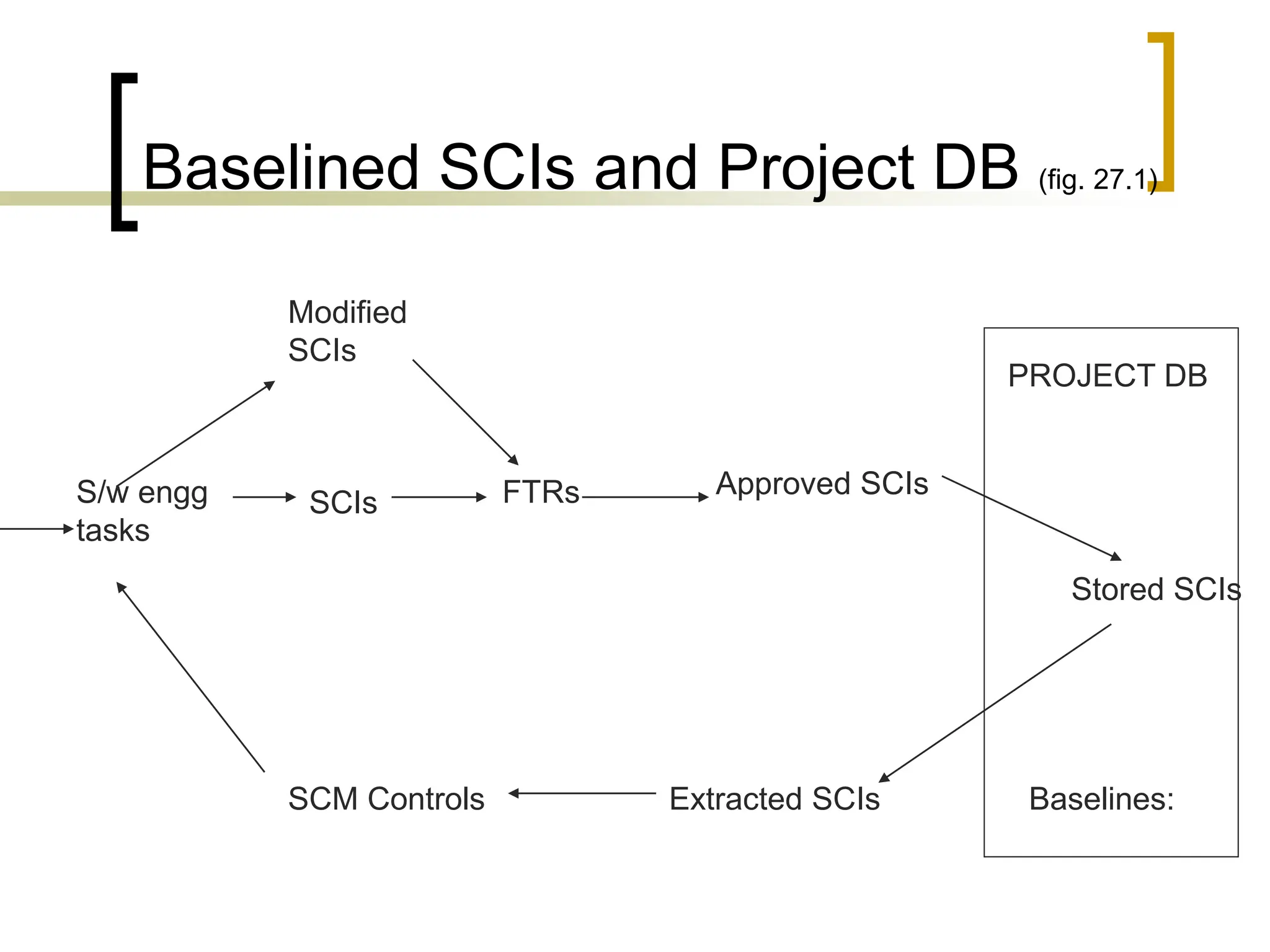
 Refer to figure 27.1 to see steps for forming a
baseline.
S/w engg
tasks
Modified
SCIs
SCIs
SCM Controls
FTRs Approved SCIs
Extracted SCIs
Stored SCIs
PROJECT DB
Baselines:
Baselined SCIs and Project DB (fig. 27.1)
Configuration Objects
 SCIs are organized to form configuration objects.
 A config. object has a name, attributes and is
related to other objects.
 Example:
 Test Specification – Config. Object
 It comprises of SCIs like Test Plan, Test Procedure, Test
Cases
 It is related to config. object SourceCode
 Config. Objects are related to other cong. objects,
the relationship is either compositional (part-of
relationship) or interrelated.
 In related config. objects, if one of them changes,
the other one has to be changed.
SCM Repository
 In early days of s/w engg, software configuration
items were maintained as paper documents (or
punch cards), placed in files and folders.
 The problems of this approach were:
 Finding a configuration item when it was needed was
often difficult
 Determining which items were changed, when and by
whom was often challenging
 Constructing a new version of existing program was error-
prone & time consuming
 Describing complex relationships among configuration
items was virtually impossible
 Today SCIs are maintained in a project database or
repository.
 It acts as the center for accumulation and storage of
SCIs
Role of repository
 SCM Repository is a set of mechanisms & data
structures that allow a software team to manage
change in an effective manner.
 It provides functions of a DBMS but in addition has
the following functions:
 Data integrity
 Info sharing
 Tool integration
 Data integration
 Methodology enforcement
 Document standardization
 See page 778 for details of the above
SCM Process
 SCM process defines a series of tasks
having 4 primary objectives
 To identify all items that collectively define the
s/w configuration.
 To manage changes to one or more of these
items.
 To facilitate construction of different versions of
an application.
 To ensure that s/w quality is maintained as
configuration evolves over time.
Version Control
 Combines procedures and tools to manage the
different versions of configuration objects created
during the software process.
 Version
 A particular version is an instance of a system that
differs in some way from other instances (difference
may be enhanced performance, functionality or
repaired faults).
 A software component with a particular version is a
collection of objects.
 A new version is defined when major changes have
been made to one or more objects
 Variant
 A variant is a collection of objects at the same revision
level and coexists with other variants.
 Variants have minor differences among each other.
Version Control
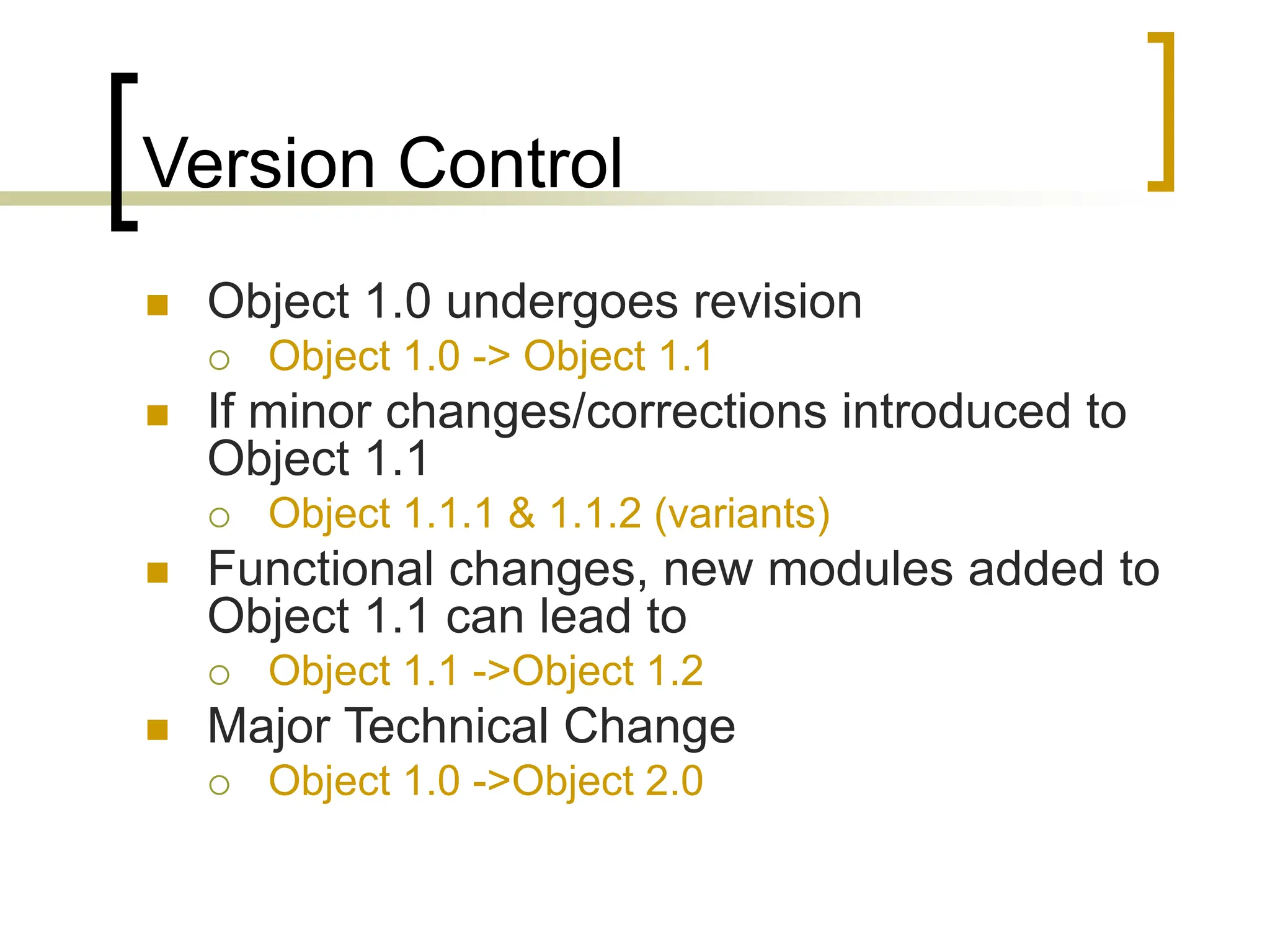
 Object 1.0 undergoes revision
 Object 1.0 -> Object 1.1
 If minor changes/corrections introduced to
Object 1.1
 Object 1.1.1 & 1.1.2 (variants)
 Functional changes, new modules added to
Object 1.1 can lead to
 Object 1.1 ->Object 1.2
 Major Technical Change
 Object 1.0 ->Object 2.0
Version Control System
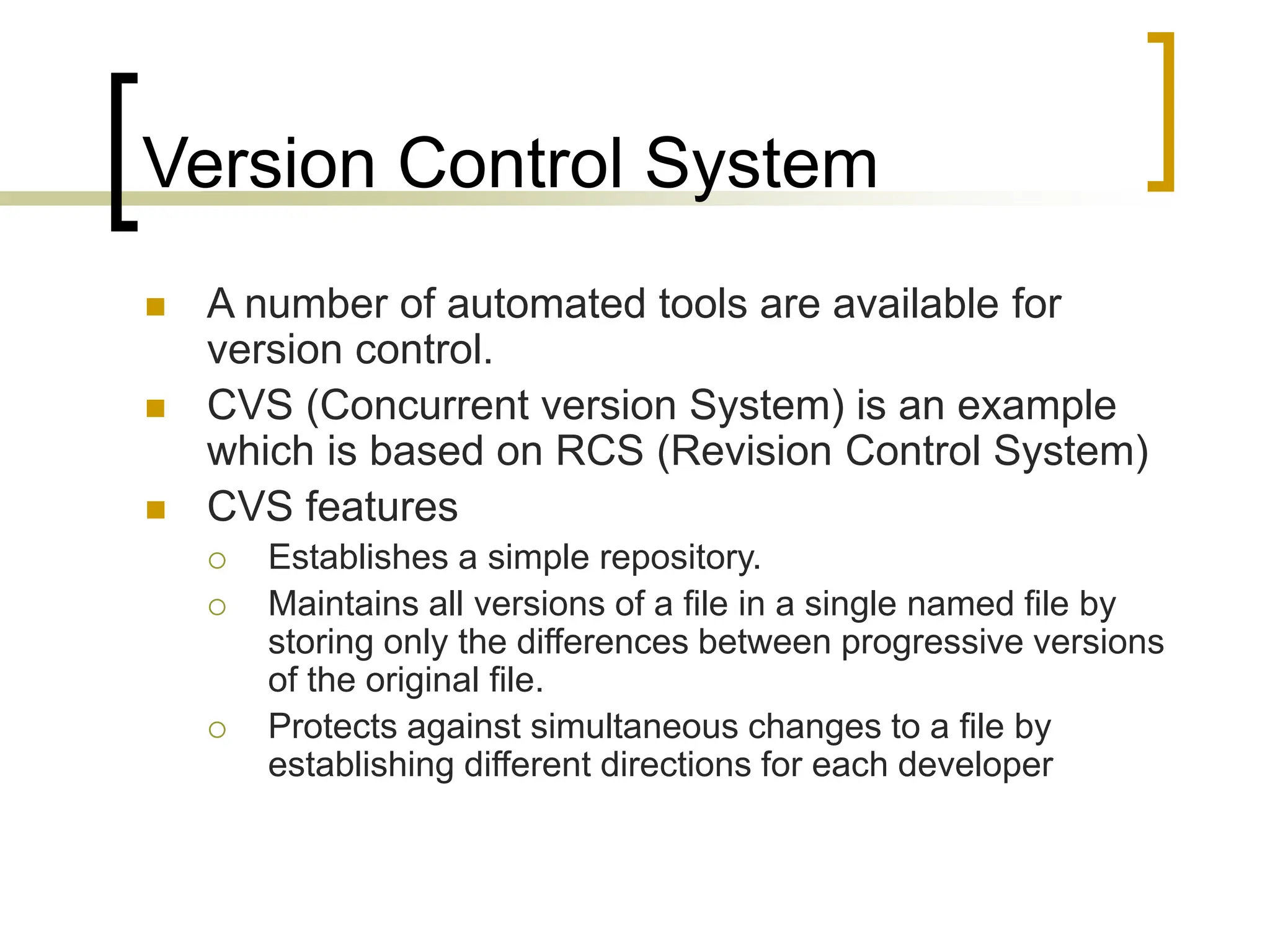
 A number of automated tools are available for
version control.
 CVS (Concurrent version System) is an example
which is based on RCS (Revision Control System)
 CVS features
 Establishes a simple repository.
 Maintains all versions of a file in a single named file by
storing only the differences between progressive versions
of the original file.
 Protects against simultaneous changes to a file by
establishing different directions for each developer
Change Control
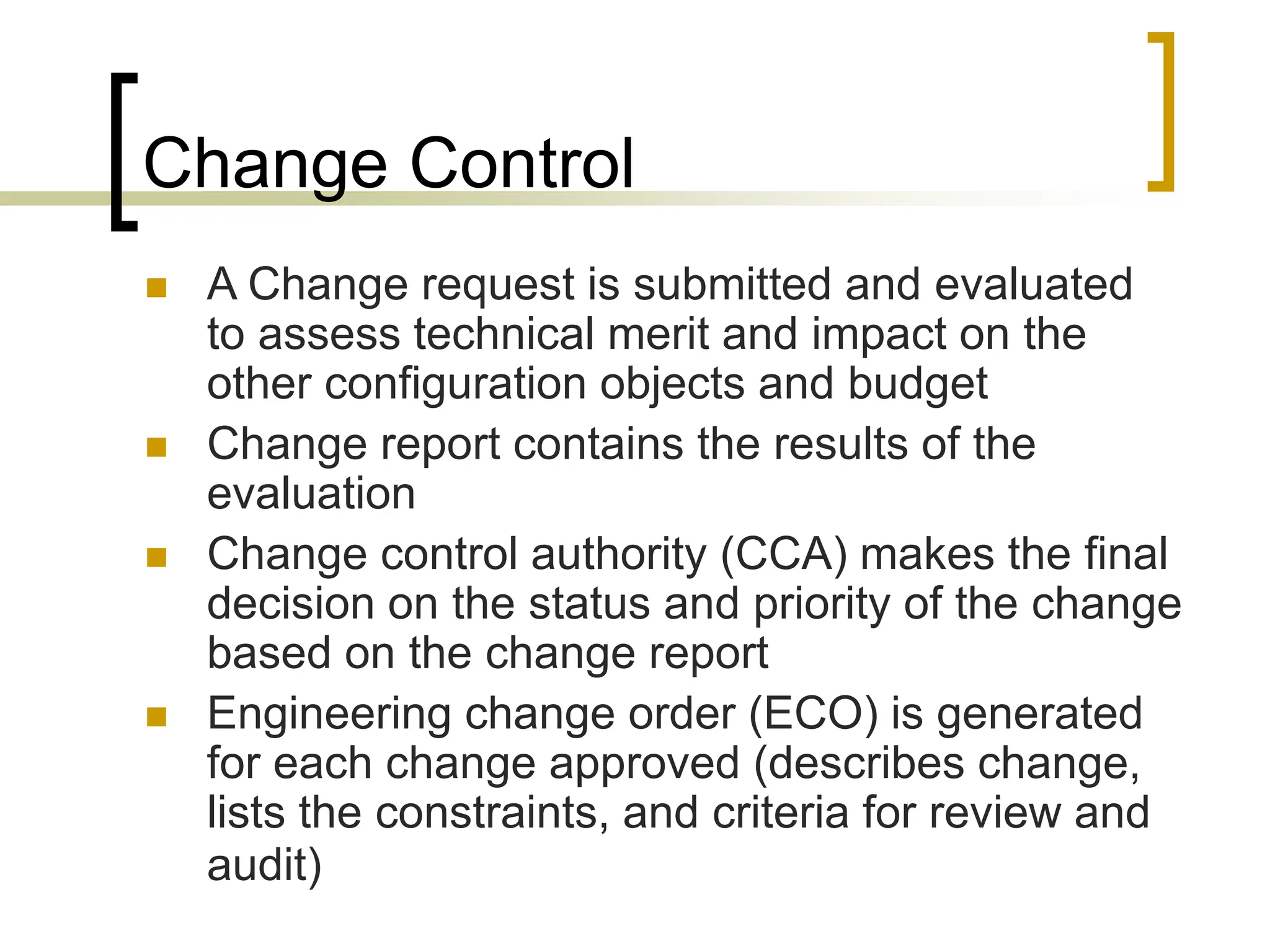
 A Change request is submitted and evaluated
to assess technical merit and impact on the
other configuration objects and budget
 Change report contains the results of the
evaluation
 Change control authority (CCA) makes the final
decision on the status and priority of the change
based on the change report
 Engineering change order (ECO) is generated
for each change approved (describes change,
lists the constraints, and criteria for review and
audit)
Change Control (Contd.)
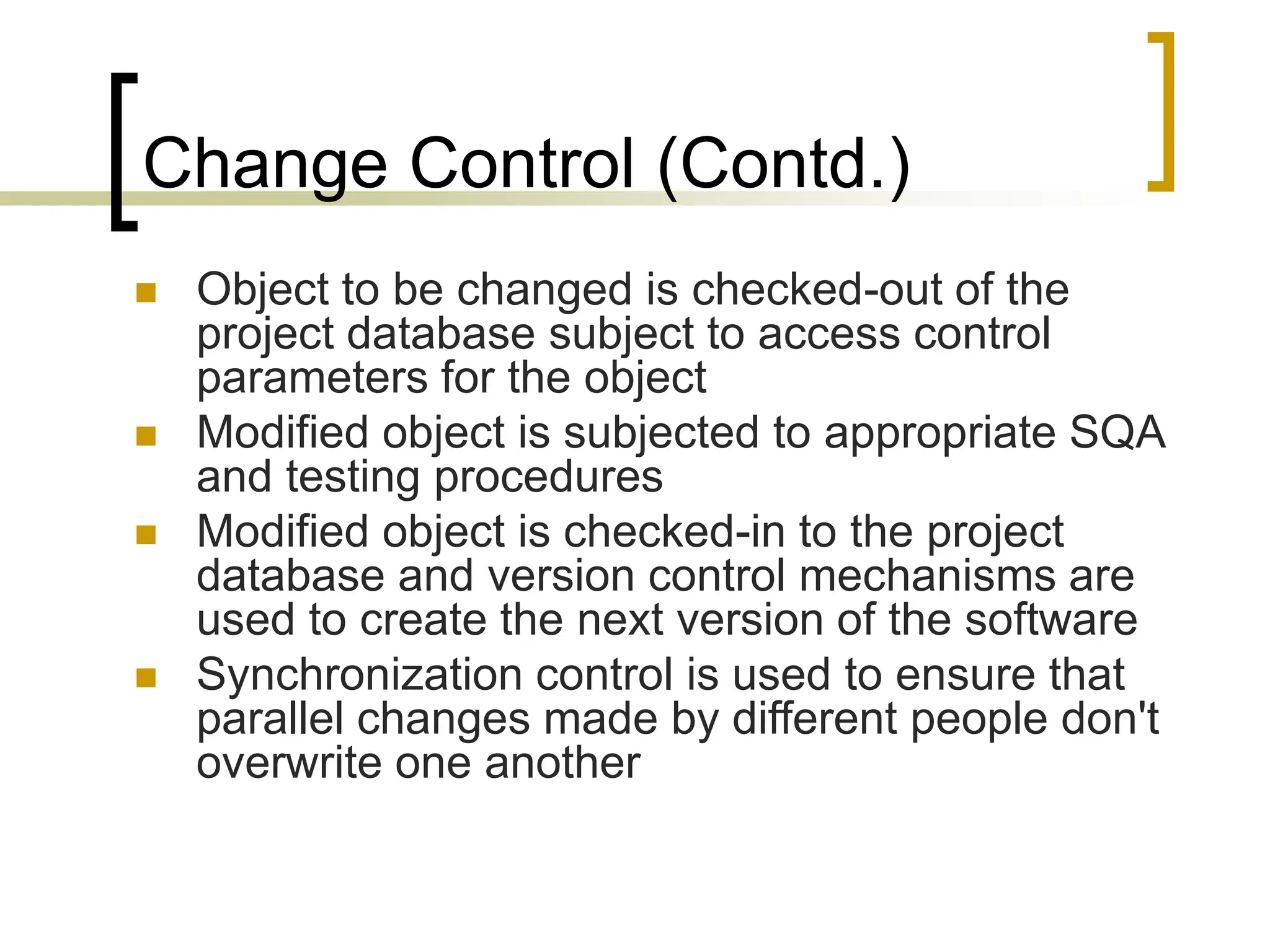
 Object to be changed is checked-out of the
project database subject to access control
parameters for the object
 Modified object is subjected to appropriate SQA
and testing procedures
 Modified object is checked-in to the project
database and version control mechanisms are
used to create the next version of the software
 Synchronization control is used to ensure that
parallel changes made by different people don't
overwrite one another
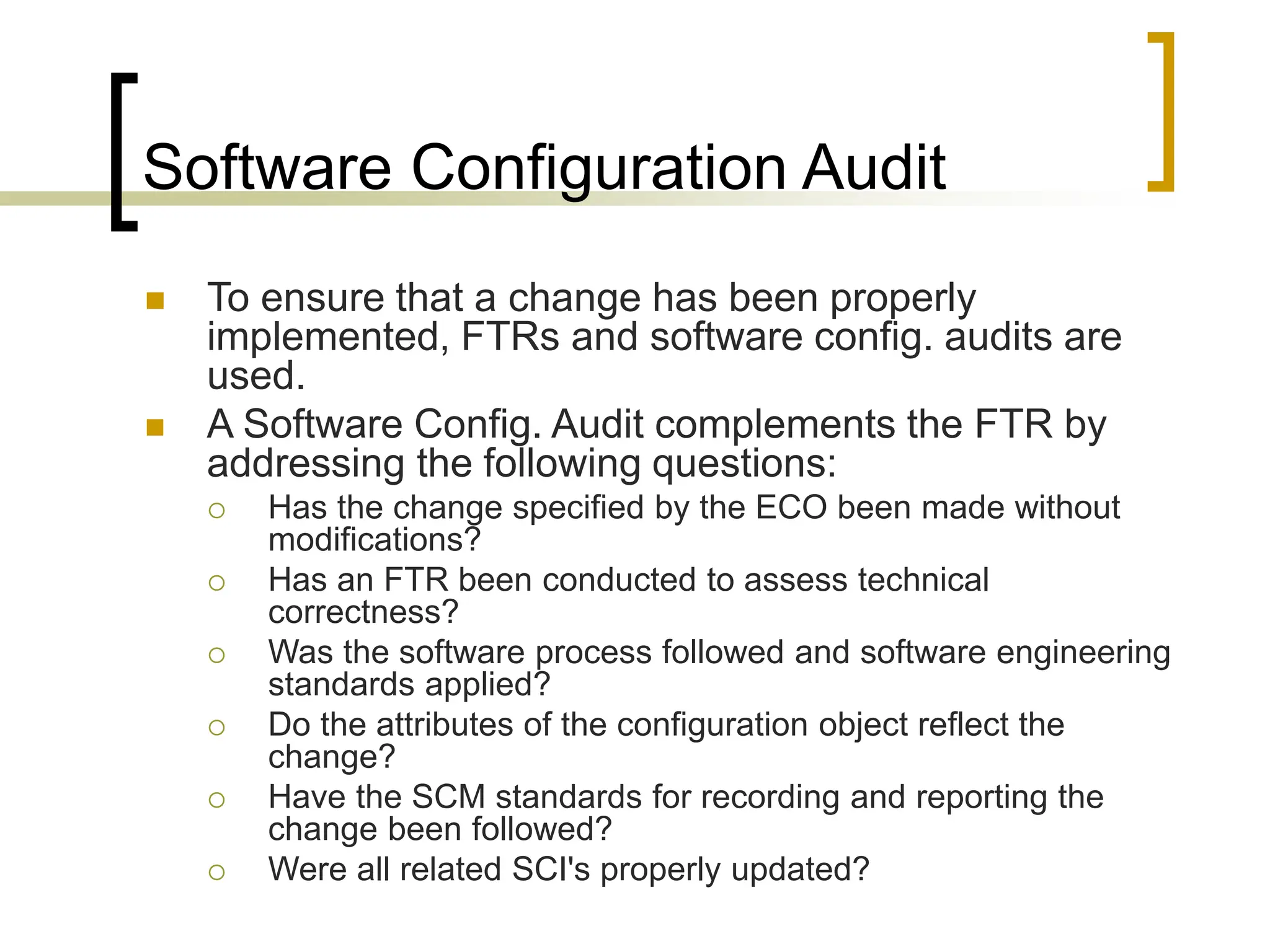
Software Configuration Audit
 To ensure that a change has been properly
implemented, FTRs and software config. audits are
used.
 A Software Config. Audit complements the FTR by
addressing the following questions:
 Has the change specified by the ECO been made without
modifications?
 Has an FTR been conducted to assess technical
correctness?
 Was the software process followed and software engineering
standards applied?
 Do the attributes of the configuration object reflect the
change?
 Have the SCM standards for recording and reporting the
change been followed?
 Were all related SCI's properly updated?
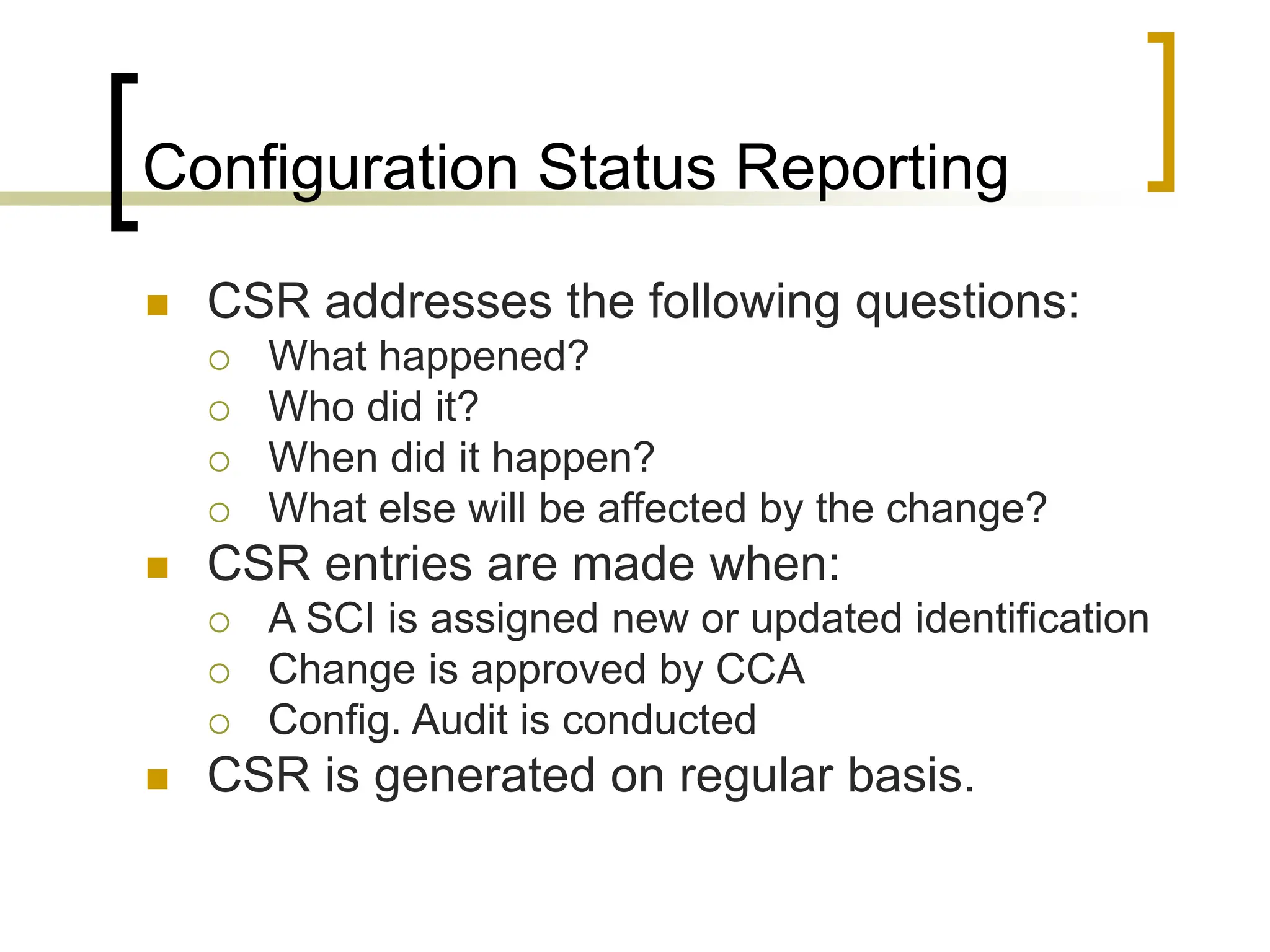
Configuration Status Reporting
 CSR addresses the following questions:
 What happened?
 Who did it?
 When did it happen?
 What else will be affected by the change?
 CSR entries are made when:
 A SCI is assigned new or updated identification
 Change is approved by CCA
 Config. Audit is conducted
 CSR is generated on regular basis.
THE END ….
 …. Of SPM …!

lecture14.ppt

  • 1.
  • 2.
    Outline  Software ConfigurationManagement (SCM)  What is SCM  What is software configuration  Sources of Change  People in typical SCM Scenario  Baselines  Configuration objects  SCM Repository  SCM Process  Change Control  Version Control  CSR
  • 3.
    What is SCM? Change management is commonly called software configuration management (SCM or CM)  Babich defines Configuration Management as:  the art of identifying, organizing and controlling modifications to the software being built by a programming team.  SCM activities have been developed to manage change throughout the life cycle of computer software  SCM can be viewed as a quality assurance activity
  • 4.
    What is SCM?(Contd.)  SCM is a set of activities designed to manage change by:  Identifying s/w work products that are likely to change,  Establishing relationships among them,  Defining mechanisms for managing different versions of these work products  Controlling changes  And auditing and reporting on the changes made
  • 5.
    Difference between Software Supportand SCM  Support is a set of s/w engg. activities that occur after software has been delivered to the customer and put into operation.  While SCM is a set of tracking and control activities that initiate when the s/w engg project begins & end only when the s/w is taken out of operation
  • 6.
    What is softwareconfiguration?  The items that comprise all information produced as part of the software process are collectively called a software configuration  This information (also termed as output of software process) is broadly divided into:  Computer programs (both source level & executable forms)  Work products that describe the computer programs  Data (contained within program or external to it)
  • 7.
    Sources of Changes New business or market conditions  dictate changes in product requirements or business rules.  New customer needs  demand modification of data produced by information systems, functionality delivered by products, or services delivered by a computer-based system.  Reorganization or business growth/ downsizing  causes changes in project priorities or software engg team structure.  Budgetary or scheduling constraints  cause a redefinition of the system or product.
  • 8.
    People involved ina typical SCM Scenario  Project Manager  In charge of s/w group  Ensures that product is developed within time frame  Monitors development, recognizes & reacts to problems  by generating & analyzing reports about system status  By performing reviews  Configuration Manager  In charge of CM procedures  Ensures that procedures & policies for creating, changing & testing of code are followed  To control changes in code, introduces mechanisms for official change requests, their evaluation & authoriza- tion.
  • 9.
    People involved ina typical SCM Scenario  Software engineers  Work efficiently without interfering in each other’s code creation, testing & supporting documentation.  But at the same time communicate & coordinate efficiently by  Updating each other about tasks required & tasks completed  Propagating changes across each others work by merging files  Customers  Use the product  Follows formal procedures of requesting changes and for indicting bugs in the product
  • 10.
    Baselines  IEEE definesbaseline as:  A specification or product that has been formally reviewed and agreed upon, that thereafter serves as basis for further development, and that can be changed only through formal change control procedures.  Before a s/w configuration item becomes a baseline, changes may be made quickly & informally.  However, once it becomes a baseline, formal procedures must be applied to evaluate & verify every change.  Refer to figure 27.1 to see steps for forming a baseline.
  • 11.
    S/w engg tasks Modified SCIs SCIs SCM Controls FTRsApproved SCIs Extracted SCIs Stored SCIs PROJECT DB Baselines: Baselined SCIs and Project DB (fig. 27.1)
  • 12.
    Configuration Objects  SCIsare organized to form configuration objects.  A config. object has a name, attributes and is related to other objects.  Example:  Test Specification – Config. Object  It comprises of SCIs like Test Plan, Test Procedure, Test Cases  It is related to config. object SourceCode  Config. Objects are related to other cong. objects, the relationship is either compositional (part-of relationship) or interrelated.  In related config. objects, if one of them changes, the other one has to be changed.
  • 13.
    SCM Repository  Inearly days of s/w engg, software configuration items were maintained as paper documents (or punch cards), placed in files and folders.  The problems of this approach were:  Finding a configuration item when it was needed was often difficult  Determining which items were changed, when and by whom was often challenging  Constructing a new version of existing program was error- prone & time consuming  Describing complex relationships among configuration items was virtually impossible  Today SCIs are maintained in a project database or repository.  It acts as the center for accumulation and storage of SCIs
  • 14.
    Role of repository SCM Repository is a set of mechanisms & data structures that allow a software team to manage change in an effective manner.  It provides functions of a DBMS but in addition has the following functions:  Data integrity  Info sharing  Tool integration  Data integration  Methodology enforcement  Document standardization  See page 778 for details of the above
  • 15.
    SCM Process  SCMprocess defines a series of tasks having 4 primary objectives  To identify all items that collectively define the s/w configuration.  To manage changes to one or more of these items.  To facilitate construction of different versions of an application.  To ensure that s/w quality is maintained as configuration evolves over time.
  • 16.
    Version Control  Combinesprocedures and tools to manage the different versions of configuration objects created during the software process.  Version  A particular version is an instance of a system that differs in some way from other instances (difference may be enhanced performance, functionality or repaired faults).  A software component with a particular version is a collection of objects.  A new version is defined when major changes have been made to one or more objects  Variant  A variant is a collection of objects at the same revision level and coexists with other variants.  Variants have minor differences among each other.
  • 17.
    Version Control  Object1.0 undergoes revision  Object 1.0 -> Object 1.1  If minor changes/corrections introduced to Object 1.1  Object 1.1.1 & 1.1.2 (variants)  Functional changes, new modules added to Object 1.1 can lead to  Object 1.1 ->Object 1.2  Major Technical Change  Object 1.0 ->Object 2.0
  • 18.
    Version Control System A number of automated tools are available for version control.  CVS (Concurrent version System) is an example which is based on RCS (Revision Control System)  CVS features  Establishes a simple repository.  Maintains all versions of a file in a single named file by storing only the differences between progressive versions of the original file.  Protects against simultaneous changes to a file by establishing different directions for each developer
  • 19.
    Change Control  AChange request is submitted and evaluated to assess technical merit and impact on the other configuration objects and budget  Change report contains the results of the evaluation  Change control authority (CCA) makes the final decision on the status and priority of the change based on the change report  Engineering change order (ECO) is generated for each change approved (describes change, lists the constraints, and criteria for review and audit)
  • 20.
    Change Control (Contd.) Object to be changed is checked-out of the project database subject to access control parameters for the object  Modified object is subjected to appropriate SQA and testing procedures  Modified object is checked-in to the project database and version control mechanisms are used to create the next version of the software  Synchronization control is used to ensure that parallel changes made by different people don't overwrite one another
  • 21.
    Software Configuration Audit To ensure that a change has been properly implemented, FTRs and software config. audits are used.  A Software Config. Audit complements the FTR by addressing the following questions:  Has the change specified by the ECO been made without modifications?  Has an FTR been conducted to assess technical correctness?  Was the software process followed and software engineering standards applied?  Do the attributes of the configuration object reflect the change?  Have the SCM standards for recording and reporting the change been followed?  Were all related SCI's properly updated?
  • 22.
    Configuration Status Reporting CSR addresses the following questions:  What happened?  Who did it?  When did it happen?  What else will be affected by the change?  CSR entries are made when:  A SCI is assigned new or updated identification  Change is approved by CCA  Config. Audit is conducted  CSR is generated on regular basis.
  • 23.
    THE END …. …. Of SPM …!