Training & Development
Contract Management
Contents
 Introduction to Contract Management
 Definition
 Contract Management Issues
 Activities Overview
 Contract Manager: DECS
 Importance of the role
 Responsibilities
 Skills
 Appointing a Contract Manager
 Contract Manager Authority
 Implementing a Contract
 Contract Management Plan
 Risk Management
 Monitoring Performance
 Occupational Health, Safety & Welfare
 Variations
 Contract Management: Key Tasks
 DECS Procurement Policies & Guidelines
Introduction to Contract
Management
 Final stage of the tendering and contract cycle.
 Includes all administrative activities associated with
administering a contract after it is executed.
 Level of contract management may vary from contract to
contract
 Simple to Complex contracts
Contract Management Definition
 An administrative process to ensure all parties
understand their responsibilities and obligations
to a contract, allowing efficient and effective
contract performance
 Undertaken by DECS worksites
Contract Management Issues
 Relationships: buyers, suppliers & end users
 Lack of preparation or contingency planning
 Requirement changes
 Variations to the contract
 Failure to consult
 Description errors
 Pricing errors/omissions
 Failure or refusal to perform
 Suppliers experiencing financial difficulties
 Delivery/transport problems
Contract Manager:
Importance of the role
 Obtain value for money
 Ensure contractual obligations met
 Improve communication
 Control risks
Contract Manager: Responsibilities
(Varies in Complexity of Contract)
 Establish Contract Management Plan
 Process reviews inc Post-contract reviews
 Liaise between and provide advice/information to
internal managers, users & suppliers
 Monitor performance
 Accurate and timely reporting
Contract Manager: Responsibilities
(cont)
(Varies in Complexity of Contract)
 Maintain insurance policy(s) & terms and conditions
 Ensure certification and specifications are met
 Manage contract change procedures
 Resolve disputes
 Ethical standards
 Refer to Code of Ethics for the South Australian
Public Sector
Contract Manager: Skills
Skills required include:
 Strategic skills
 Project Management
 Communication and Liaison
 People Management
 Negotiation
 Conflict resolution
 Record-keeping and File Management
 Decision-making
 Research and Analytical
 Professionalism
Appointing a Contract Manager
 Should occur prior to execution of the contract
 Contract management arrangements identified and
planned including:
 Responsibilities;
 Delegations;
 Reporting requirements, and;
 Relationships
 Duties and powers governed by the conditions of contract
and general law
Contract Manager Authority
 Contract Manager needs a level of authority to ensure
project runs smoothly
 Limited delegation to approve variations that involve extra
cost.
Implementing the Contract
Consider the following:
 The Contract Manager appointed
 Notification to unsuccessful suppliers
 Joint briefings for all relevant parties
 Resources available
 Copies of final contract
 Initial issues requiring immediate attention
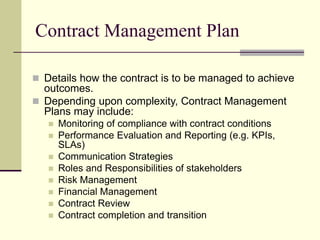
Contract Management Plan
 Details how the contract is to be managed to achieve
outcomes.
 Depending upon complexity, Contract Management
Plans may include:
 Monitoring of compliance with contract conditions
 Performance Evaluation and Reporting (e.g. KPIs,
SLAs)
 Communication Strategies
 Roles and Responsibilities of stakeholders
 Risk Management
 Financial Management
 Contract Review
 Contract completion and transition
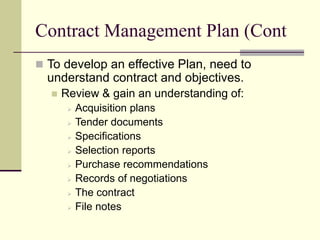
Contract Management Plan (Cont
 To develop an effective Plan, need to
understand contract and objectives.
 Review & gain an understanding of:
 Acquisition plans
 Tender documents
 Specifications
 Selection reports
 Purchase recommendations
 Records of negotiations
 The contract
 File notes
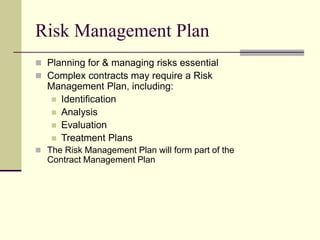
Risk Management Plan
 Planning for & managing risks essential
 Complex contracts may require a Risk
Management Plan, including:
 Identification
 Analysis
 Evaluation
 Treatment Plans
 The Risk Management Plan will form part of the
Contract Management Plan
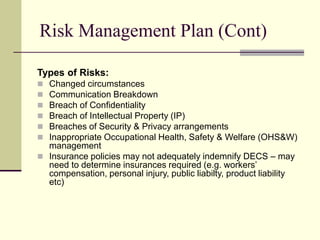
Risk Management Plan (Cont)
Types of Risks:
 Changed circumstances
 Communication Breakdown
 Breach of Confidentiality
 Breach of Intellectual Property (IP)
 Breaches of Security & Privacy arrangements
 Inappropriate Occupational Health, Safety & Welfare (OHS&W)
management
 Insurance policies may not adequately indemnify DECS – may
need to determine insurances required (e.g. workers’
compensation, personal injury, public liabilty, product liability
etc)
Risk Management Plan (Cont)
Types of Risks (Cont):
 Breaches of contract:
 Performance securities / guarantees not received;
 Deliverables not in accordance with the contract;
 Fraud;
 Variations, and;
 Disagreement or disputes.
 Refer DECS Guideline - Managing Risk in
Procurement for further information
Monitoring Performance
 Effective Performance Monitoring requires the
Contract Manager to:
 Establish and monitor formal KPIs and Service Level
Agreements (SLAs)
 Monitor progress
 Conduct random inspections
 Ensure all conditions and clauses are acted upon
Monitoring Performance (Cont)
 Advise Contractor of performance issues
 Develop effective feedback mechanisms
 Keep written records of all dealings with
Contractor and administration of the contract
 Maintain comprehensive documentation
Occupational Health, Safety and
Welfare (OHS&W)
 Contract Managers should:
 Monitor and audit Contractor's workplace
performance
 Ensure Contractor applies appropriate level of
OHS&W management
 See DECS ‘OHS&W and Injury Management Policy’ and
the ‘DECS Code of Practice for Contractors’
(www.decs.sa.gov.au/ohs/)
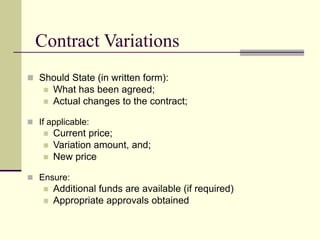
Contract Variations
 Should State (in written form):
 What has been agreed;
 Actual changes to the contract;
 If applicable:
 Current price;
 Variation amount, and;
 New price
 Ensure:
 Additional funds are available (if required)
 Appropriate approvals obtained
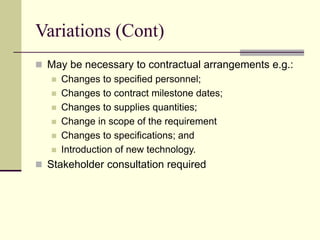
Variations (Cont)
 May be necessary to contractual arrangements e.g.:
 Changes to specified personnel;
 Changes to contract milestone dates;
 Changes to supplies quantities;
 Change in scope of the requirement
 Changes to specifications; and
 Introduction of new technology.
 Stakeholder consultation required
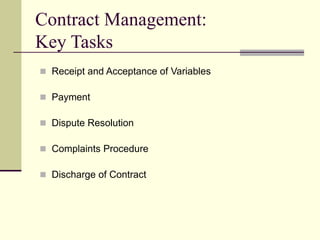
Contract Management:
Key Tasks
 Receipt and Acceptance of Variables
 Payment
 Dispute Resolution
 Complaints Procedure
 Discharge of Contract
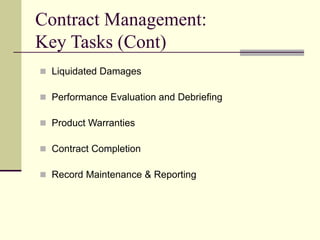
Contract Management:
Key Tasks (Cont)
 Liquidated Damages
 Performance Evaluation and Debriefing
 Product Warranties
 Contract Completion
 Record Maintenance & Reporting
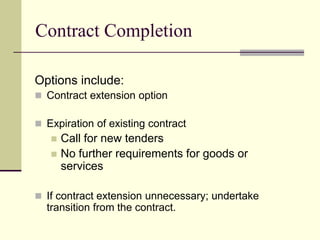
Contract Completion
Options include:
 Contract extension option
 Expiration of existing contract
 Call for new tenders
 No further requirements for goods or
services
 If contract extension unnecessary; undertake
transition from the contract.
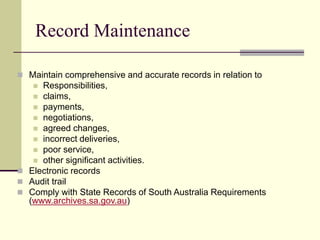
Record Maintenance
 Maintain comprehensive and accurate records in relation to
 Responsibilities,
 claims,
 payments,
 negotiations,
 agreed changes,
 incorrect deliveries,
 poor service,
 other significant activities.
 Electronic records
 Audit trail
 Comply with State Records of South Australia Requirements
(www.archives.sa.gov.au)
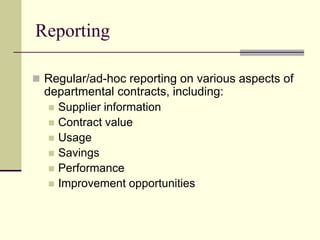
Reporting
 Regular/ad-hoc reporting on various aspects of
departmental contracts, including:
 Supplier information
 Contract value
 Usage
 Savings
 Performance
 Improvement opportunities
Reporting (Cont)
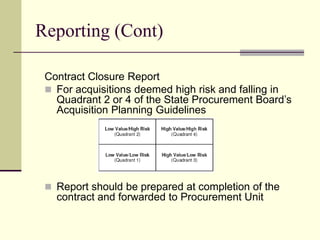
Contract Closure Report
 For acquisitions deemed high risk and falling in
Quadrant 2 or 4 of the State Procurement Board’s
Acquisition Planning Guidelines
 Report should be prepared at completion of the
contract and forwarded to Procurement Unit
DECS Procurement Policies &
Guidelines
Refer to ‘Contract Management Guidelines’
 In.decs (Procurement web pages)
 SSONet (Procurement web pages)
 Or contact Procurement Unit on 8226 1610

Contract management.ppt

  • 1.
  • 2.
    Contents  Introduction toContract Management  Definition  Contract Management Issues  Activities Overview  Contract Manager: DECS  Importance of the role  Responsibilities  Skills  Appointing a Contract Manager  Contract Manager Authority  Implementing a Contract  Contract Management Plan  Risk Management  Monitoring Performance  Occupational Health, Safety & Welfare  Variations  Contract Management: Key Tasks  DECS Procurement Policies & Guidelines
  • 3.
    Introduction to Contract Management Final stage of the tendering and contract cycle.  Includes all administrative activities associated with administering a contract after it is executed.  Level of contract management may vary from contract to contract  Simple to Complex contracts
  • 4.
    Contract Management Definition An administrative process to ensure all parties understand their responsibilities and obligations to a contract, allowing efficient and effective contract performance  Undertaken by DECS worksites
  • 5.
    Contract Management Issues Relationships: buyers, suppliers & end users  Lack of preparation or contingency planning  Requirement changes  Variations to the contract  Failure to consult  Description errors  Pricing errors/omissions  Failure or refusal to perform  Suppliers experiencing financial difficulties  Delivery/transport problems
  • 6.
    Contract Manager: Importance ofthe role  Obtain value for money  Ensure contractual obligations met  Improve communication  Control risks
  • 7.
    Contract Manager: Responsibilities (Variesin Complexity of Contract)  Establish Contract Management Plan  Process reviews inc Post-contract reviews  Liaise between and provide advice/information to internal managers, users & suppliers  Monitor performance  Accurate and timely reporting
  • 8.
    Contract Manager: Responsibilities (cont) (Variesin Complexity of Contract)  Maintain insurance policy(s) & terms and conditions  Ensure certification and specifications are met  Manage contract change procedures  Resolve disputes  Ethical standards  Refer to Code of Ethics for the South Australian Public Sector
  • 9.
    Contract Manager: Skills Skillsrequired include:  Strategic skills  Project Management  Communication and Liaison  People Management  Negotiation  Conflict resolution  Record-keeping and File Management  Decision-making  Research and Analytical  Professionalism
  • 10.
    Appointing a ContractManager  Should occur prior to execution of the contract  Contract management arrangements identified and planned including:  Responsibilities;  Delegations;  Reporting requirements, and;  Relationships  Duties and powers governed by the conditions of contract and general law
  • 11.
    Contract Manager Authority Contract Manager needs a level of authority to ensure project runs smoothly  Limited delegation to approve variations that involve extra cost.
  • 12.
    Implementing the Contract Considerthe following:  The Contract Manager appointed  Notification to unsuccessful suppliers  Joint briefings for all relevant parties  Resources available  Copies of final contract  Initial issues requiring immediate attention
  • 13.
    Contract Management Plan Details how the contract is to be managed to achieve outcomes.  Depending upon complexity, Contract Management Plans may include:  Monitoring of compliance with contract conditions  Performance Evaluation and Reporting (e.g. KPIs, SLAs)  Communication Strategies  Roles and Responsibilities of stakeholders  Risk Management  Financial Management  Contract Review  Contract completion and transition
  • 14.
    Contract Management Plan(Cont  To develop an effective Plan, need to understand contract and objectives.  Review & gain an understanding of:  Acquisition plans  Tender documents  Specifications  Selection reports  Purchase recommendations  Records of negotiations  The contract  File notes
  • 15.
    Risk Management Plan Planning for & managing risks essential  Complex contracts may require a Risk Management Plan, including:  Identification  Analysis  Evaluation  Treatment Plans  The Risk Management Plan will form part of the Contract Management Plan
  • 16.
    Risk Management Plan(Cont) Types of Risks:  Changed circumstances  Communication Breakdown  Breach of Confidentiality  Breach of Intellectual Property (IP)  Breaches of Security & Privacy arrangements  Inappropriate Occupational Health, Safety & Welfare (OHS&W) management  Insurance policies may not adequately indemnify DECS – may need to determine insurances required (e.g. workers’ compensation, personal injury, public liabilty, product liability etc)
  • 17.
    Risk Management Plan(Cont) Types of Risks (Cont):  Breaches of contract:  Performance securities / guarantees not received;  Deliverables not in accordance with the contract;  Fraud;  Variations, and;  Disagreement or disputes.  Refer DECS Guideline - Managing Risk in Procurement for further information
  • 18.
    Monitoring Performance  EffectivePerformance Monitoring requires the Contract Manager to:  Establish and monitor formal KPIs and Service Level Agreements (SLAs)  Monitor progress  Conduct random inspections  Ensure all conditions and clauses are acted upon
  • 19.
    Monitoring Performance (Cont) Advise Contractor of performance issues  Develop effective feedback mechanisms  Keep written records of all dealings with Contractor and administration of the contract  Maintain comprehensive documentation
  • 20.
    Occupational Health, Safetyand Welfare (OHS&W)  Contract Managers should:  Monitor and audit Contractor's workplace performance  Ensure Contractor applies appropriate level of OHS&W management  See DECS ‘OHS&W and Injury Management Policy’ and the ‘DECS Code of Practice for Contractors’ (www.decs.sa.gov.au/ohs/)
  • 21.
    Contract Variations  ShouldState (in written form):  What has been agreed;  Actual changes to the contract;  If applicable:  Current price;  Variation amount, and;  New price  Ensure:  Additional funds are available (if required)  Appropriate approvals obtained
  • 22.
    Variations (Cont)  Maybe necessary to contractual arrangements e.g.:  Changes to specified personnel;  Changes to contract milestone dates;  Changes to supplies quantities;  Change in scope of the requirement  Changes to specifications; and  Introduction of new technology.  Stakeholder consultation required
  • 23.
    Contract Management: Key Tasks Receipt and Acceptance of Variables  Payment  Dispute Resolution  Complaints Procedure  Discharge of Contract
  • 24.
    Contract Management: Key Tasks(Cont)  Liquidated Damages  Performance Evaluation and Debriefing  Product Warranties  Contract Completion  Record Maintenance & Reporting
  • 25.
    Contract Completion Options include: Contract extension option  Expiration of existing contract  Call for new tenders  No further requirements for goods or services  If contract extension unnecessary; undertake transition from the contract.
  • 26.
    Record Maintenance  Maintaincomprehensive and accurate records in relation to  Responsibilities,  claims,  payments,  negotiations,  agreed changes,  incorrect deliveries,  poor service,  other significant activities.  Electronic records  Audit trail  Comply with State Records of South Australia Requirements (www.archives.sa.gov.au)
  • 27.
    Reporting  Regular/ad-hoc reportingon various aspects of departmental contracts, including:  Supplier information  Contract value  Usage  Savings  Performance  Improvement opportunities
  • 28.
    Reporting (Cont) Contract ClosureReport  For acquisitions deemed high risk and falling in Quadrant 2 or 4 of the State Procurement Board’s Acquisition Planning Guidelines  Report should be prepared at completion of the contract and forwarded to Procurement Unit
  • 29.
    DECS Procurement Policies& Guidelines Refer to ‘Contract Management Guidelines’  In.decs (Procurement web pages)  SSONet (Procurement web pages)  Or contact Procurement Unit on 8226 1610