October 21, 2010 Cleveland AIA Presented by:  Carmen Fiorilli, Fiorilli Construction  Craig Miller, Duffy+Duffy Cost Segregation
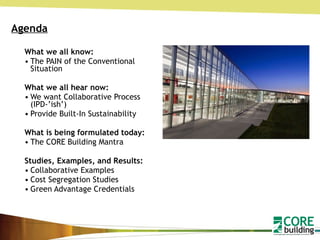
Agenda What we all know: The PAIN of the Conventional Situation What we all hear now: We want Collaborative Process (IPD-’ish’) Provide Built-In Sustainability What is being formulated today: The CORE Building Mantra Studies, Examples, and Results: Collaborative Examples Cost Segregation Studies Green Advantage Credentials
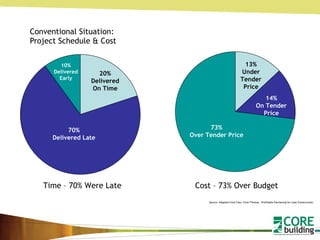
Conventional Situation: Project Schedule & Cost 70% Delivered Late 10% Delivered Early 20% Delivered On Time 73% Over Tender Price 13% Under Tender Price 14% On Tender Price Time – 70% Were Late Cost – 73% Over Budget Source: Adapted from Cain, Clive Thomas.  Profitable Partnering for Lean Construction.
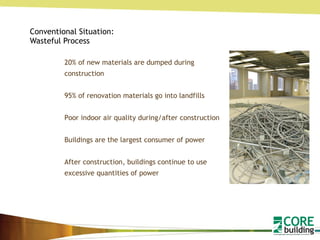
Conventional Situation: Wasteful Process  20% of new materials are dumped during construction 95% of renovation materials go into landfills Poor indoor air quality during/after construction Buildings are the largest consumer of power After construction, buildings continue to use excessive quantities of power
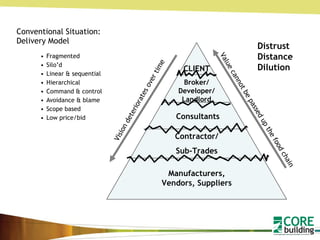
Conventional Situation: Delivery Model Fragmented Silo’d Linear & sequential Hierarchical Command & control Avoidance & blame Scope based Low price/bid CLIENT Broker/ Developer/ Landlord Consultants Contractor/ Sub-Trades Manufacturers, Vendors, Suppliers Vision deteriorates over time Value   cannot be passed up the food chain Distrust Distance Dilution
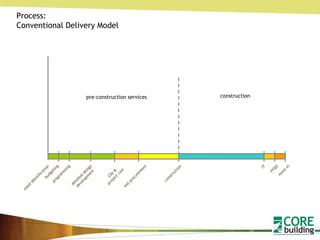
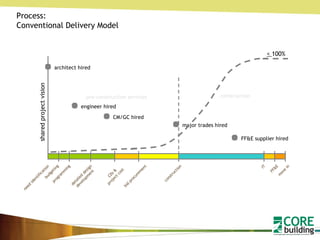
detailed design development budgeting CDs & project cost construction FF&E move in need identification IT programming bid procurement Process: Conventional Delivery Model pre-construction services construction
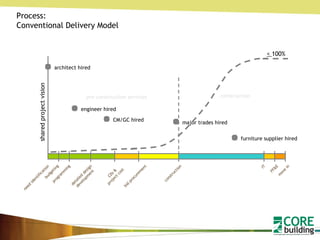
detailed design development budgeting CDs & project cost construction FF&E move in need identification IT programming bid procurement Process: Conventional Delivery Model pre-construction services construction architect hired engineer hired CM/GC hired major trades hired FF&E supplier hired <  100% shared project vision
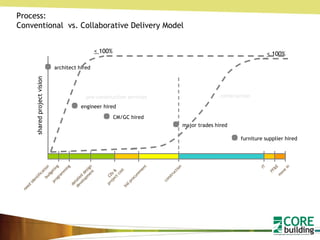
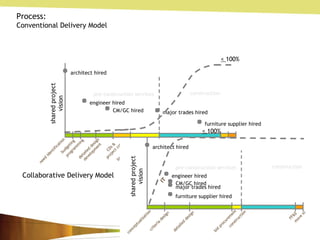
shared project vision detailed design development budgeting CDs & project cost construction FF&E move in need identification IT programming bid procurement Process: Conventional  vs. Collaborative Delivery Model pre-construction services construction architect hired engineer hired CM/GC hired major trades hired furniture supplier hired <  100% <  100%
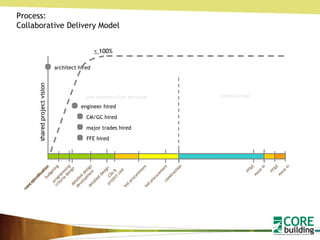
shared project vision Process: Collaborative Delivery Model pre-construction services construction architect hired engineer hired CM/GC hired major trades hired FFE hired <  100% detailed design construction FF&E move in conceptualization criteria design bid procurement detailed design development budgeting CDs & project cost construction FF&E move in need identification programming bid procurement
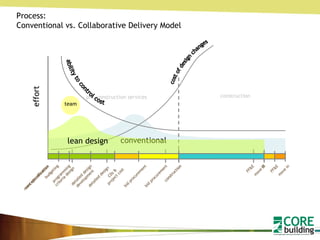
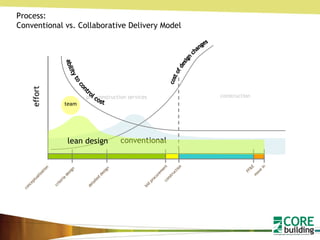
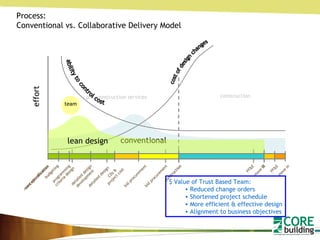
effort Process: Conventional vs. Collaborative Delivery Model conventional pre-construction services construction detailed design construction FF&E move in conceptualization criteria design bid procurement ability to control cost cost of design changes lean design team detailed design development budgeting CDs & project cost construction FF&E move in need identification IT programming bid procurement
effort Process: Conventional vs. Collaborative Delivery Model conventional pre-construction services construction detailed design construction FF&E move in conceptualization criteria design bid procurement ability to control cost cost of design changes lean design team
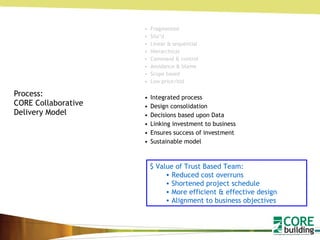
Process: CORE Collaborative Delivery Model Fragmented Silo’d Linear & sequential Hierarchical Command & control Avoidance & blame Scope based Low price/bid Integrated process Design consolidation Decisions based upon Data  Linking investment to business Ensures success of investment Sustainable model $ Value of Trust Based Team: Reduced cost overruns Shortened project schedule More efficient & effective design Alignment to business objectives
detailed design development budgeting CDs & project cost construction FF&E move in need identification IT programming bid procurement Process: Conventional Delivery Model pre-construction services construction architect hired engineer hired CM/GC hired major trades hired furniture supplier hired <  100% shared project vision
Process: Conventional Delivery Model pre-construction services construction architect hired engineer hired CM/GC hired major trades hired furniture supplier hired <  100% shared project vision detailed design development budgeting CDs & project cost construction FF&E move in need identification IT programming bid procurement pre-construction services construction architect hired engineer hired CM/GC hired major trades hired furniture supplier hired shared project vision <  100% IT detailed design construction FF&E move in conceptualization criteria design bid procurement Collaborative Delivery Model
effort Process: Conventional vs. Collaborative Delivery Model $ Value of Trust Based Team: Reduced change orders Shortened project schedule More efficient & effective design Alignment to business objectives conventional pre-construction services construction detailed design construction FF&E move in conceptualization criteria design bid procurement ability to control cost cost of design changes lean design team detailed design development budgeting CDs & project cost construction FF&E move in need identification IT programming bid procurement
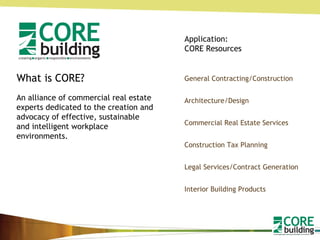
What is CORE? An alliance of commercial real estate experts dedicated to the creation and advocacy of effective, sustainable and intelligent workplace environments.  General Contracting/Construction Architecture/Design Commercial Real Estate Services Construction Tax Planning Legal Services/Contract Generation Interior Building Products Application: CORE Resources
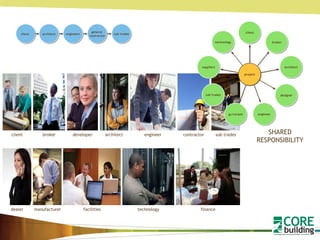
SHARED RESPONSIBILITY technology engineer sub trades facilities developer architect broker client dealer contractor manufacturer finance project technology engineer gc/cm/pm sub trades suppliers designer architect broker client client architect engineers general  contractor sub trades
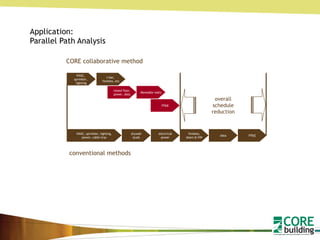
Application: Parallel Path Analysis 70% Delivered Late 10% Delivered Early 73% Over Tender Price 14% On Tender Price conventional methods CORE collaborative method overall schedule reduction finishes, doors & HW data FF&E drywall studs electrical power HVAC, sprinkler, lighting, power, cable tray Moveable walls FF&E HVAC,  sprinkler,  lighting t-bar,  finishes, etc raised floor, power, data
Our Incentives to Change Net cost same or better Better quality space Employee retention Tax incentives Sustainable real estate  User effectiveness Win-win Profitability Alignment to business
Sustainable Approach to Real Estate Trust Based Beginning to End Process Meets Needs of All Stakeholders Repeatable Framework
Measured Performance Accelerate Schedule 20 – 40% Reduce Space Requirements 5 – 20% Reduce Lighting Energy Costs 25% Reduce HVAC operating costs by up to 30% Reduce Total Churn Costs 70 – 90% Client Realizes Income Tax Savings 5-9% NPV
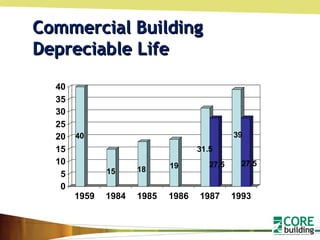
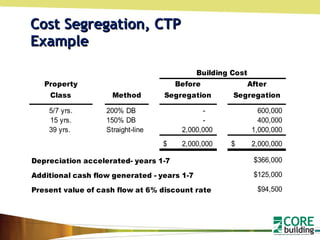
What is Cost Segregation? What is Construction Tax Planning? Cost Segregation is a  tax deferral tool  that identifies building components and tenant paid improvements to be allocated for depreciation purposes between real estate and  personal property  based on  case law and IRS guidance. Takes advantage of the timing of non-cash depreciation expense by classifying assets properly for tax purposes. Portions of the buildings’ cost are reclassified from 39-year asset class to 5, 7 and 15-year classes. Don’t Assume that Client’s CPA or Tax Preparer is aware of CSS or CTP.
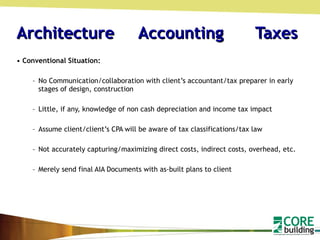
Architecture  Accounting   Taxes Conventional Situation: No Communication/collaboration with client’s accountant/tax preparer in early stages of design, construction Little, if any, knowledge of non cash depreciation and income tax impact Assume client/client’s CPA will be aware of tax classifications/tax law Not accurately capturing/maximizing direct costs, indirect costs, overhead, etc. Merely send final AIA Documents with as-built plans to client
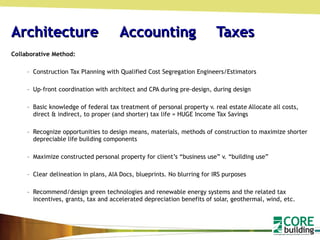
Architecture  Accounting   Taxes Collaborative Method: Construction Tax Planning with Qualified Cost Segregation Engineers/Estimators Up-front coordination with architect and CPA during pre-design, during design Basic knowledge of federal tax treatment of personal property v. real estate Allocate all costs, direct & indirect, to proper (and shorter) tax life = HUGE Income Tax Savings Recognize opportunities to design means, materials, methods of construction to maximize shorter depreciable life building components Maximize constructed personal property for client’s “business use” v. “building use” Clear delineation in plans, AIA Docs, blueprints. No blurring for IRS purposes Recommend/design green technologies and renewable energy systems and the related tax incentives, grants, tax and accelerated depreciation benefits of solar, geothermal, wind, etc.
Construction Tax Planning - CTP Up-front coordination with Architects and builders to identify materials & methods during pre-design and during design, for faster income tax write-off. Identifies opportunities to maximize qualifying personal property and accelerated depreciation in the planning stage.  Add 5-7% of construction costs to personal property and shorter class life components. Produces depreciation forecasts and a discounted cash flow projection and a written Cost Segregation report. Upfront coordination with Cost Segregation Professionals can reduce project costs up to 17%. More than half of the opportunities available may be overlooked by taking this approach after the job is over.
Commercial Building  Depreciable Life
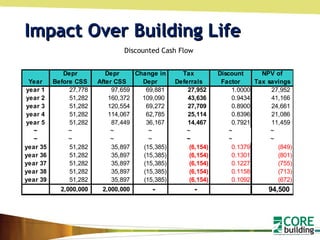
The Benefit to Building Owners Income taxes are reduced in the early years of a building’s life by using accelerated depreciation methods  Improved after-tax cash flow, debt coverage ratio, overall yields (Keys for bankers, lenders, investors) Taxes are repaid later due to lower depreciation deductions but in tomorrow’s less-valuable dollars Savings are measured by the  Net Present Value  of the  cash flows from tax deferral and repayment Tax Deferrals  Cash Flow Generation and Savings  Through the Time Value of Money
Legal Framework Hospital Corporation of America (HCA) v Commissioner, 109 T.C. 21 (1997) established cost segregation allowing shorter lives for certain assets. Tax Court in HCA established link to Investment Tax Credit case law and rulings. Action on Decision (AOD) number CC-1999-008.  The Service acquiesced to the application of ITCC principles, but not  to the particular results in the HCA case. saying that “The use of cost segregation studies must be specifically applied by the taxpayer.” IRS Audit Techniques Guide – 2004 –not authoritative
The IRS Has Set Standards “ A quality cost segregation study is a study that is both accurate and well-documented with regard to the following points:” Classifies assets into property classes (e.g., land, land improvements, building, equipment, furniture and fixtures) Explains the rationale (including legal citations) for classifying assets as either s. 1245 or s.1250 property Substantiates the cost basis of  each asset  and  reconciles total allocated costs to total actual costs Source:  IRS Cost Segregation Audit Techniques Guide
Who Can Benefit from  Cost Segregation/CTP? Any for-profit entity that will own the building/building improvements (including individuals, partners, LLCs, SCorps, CCorps, Trusts, Estates, REITs, TICs, Syndicates) Owner who Constructed a commercial building  Made leasehold improvements Purchased existing commercial building (regardless of building age) Had a tax basis step-up
Types of Properties  That Can Benefit Manufacturing  Distribution Retail Centers Apartments Office Buildings Auto Dealerships Sporting Facilities Hotels Hospitals Funeral Homes Restaurants Airports Golf Courses  Many Others
What is Tangible Personal Property  (Section 1245 Property) Detailed IRS guidance does not exist in any form  - no bright line tests Determination is facts and circumstances assessment.  In HCA Tax Court established linkage to considerable body of cases and rulings for ITC Would the item be personal property under the Investment Tax Credit rules?
Tests to Determine if an Asset is Tangible Personal Property Tangible Personal Property does not include assets that are structural components of a building. (Reg. Sect. 148-1(e)(2) Does an item within the building relate to the operation or maintenance of the building?  (Scott Paper Co. v. Commissioner, 74 T.C. 137 (1980) Can the property be easily moved?  (Whiteco Industries, Inc. v. Commissioner, 65 T.C. 664, 672-673 (1975) Does it play a structural role? (L.L. Bean, Inc. v. Commissioner, T.C. Memo. 1997-175, aff’d. F.3d53 (1 st . Cir. 1998) What is the justification for an item being installed? (Rev Rul 79-83) Does the asset serve a dual function? (Rev Rul 66-299)
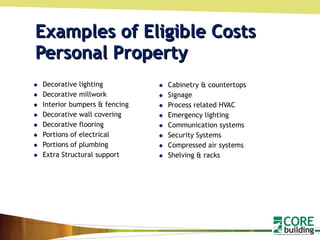
Examples of Eligible Costs  Personal Property Decorative lighting Decorative millwork Interior bumpers & fencing Decorative wall covering Decorative flooring Portions of electrical Portions of plumbing Extra Structural support Cabinetry & countertops Signage Process related HVAC Emergency lighting Communication systems Security Systems Compressed air systems Shelving & racks
Examples of Eligible Costs  Land Improvements Site preparation Driveways & Roads Sidewalks Flag poles Underground utilities Storm sewers Retaining walls Porticos  Detention basins Fencing Landscaping Docks & wharves Exterior lighting Utilities Pavilions
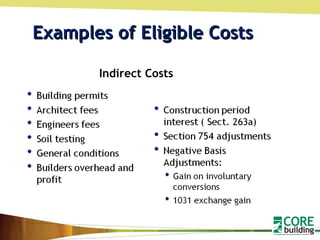
Examples of Eligible Costs Indirect Costs
Add New Niche Service  for Contractors, Architects and Designers  Differentiate Yourself During RFQ Process Bidding advantage over other firms who do not offer this service. Opportunity to reduce project costs, time Earn New Revenue Directly (in bid or bid alternate) or Earn referral fees from Cost Segregation Firm.
Favorable Tax Changes Renewable Energy Investment  Federal Income tax 5-Year class life and accelerated benefit for solar, wind, geothermal. (Instead of 39 Year life). Bonus Depreciation  30% from 9/11/01 to 5/5/03, 50% from 5/6/03 to 12/31/04, and 50% for 2008 and 2009, 2010.  Section 179 Deduction .  Increased from $25,000 in 2002 to $250,000 for 2008 and 2009-10.  Section 481(a).    Section 481(a) deductions not taken in previous years can be taken in the year of change. [Rev. Proc. 2002-19] Automatic Consent  for change the method of accounting.  [Rev Proc 2002-9] 5-year NOL Carryback  available for 2008 and 2009 returns.
Cost Segregation, CTP Example
Impact Over Building Life Discounted Cash Flow
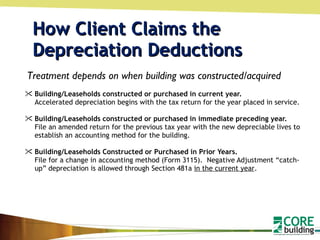
How Client Claims the  Depreciation Deductions Building/Leaseholds constructed or purchased in current year.   Accelerated depreciation begins with the tax return for the year placed in service. Building/Leaseholds constructed or purchased in immediate preceding year.  File an amended return for the previous tax year with the new depreciable lives to establish an accounting method for the building. Building/Leaseholds Constructed or Purchased in Prior Years.   File for a change in accounting method (Form 3115).  Negative Adjustment “catch-up” depreciation is allowed through Section 481a  in the current year .  Treatment depends on when building was constructed/acquired
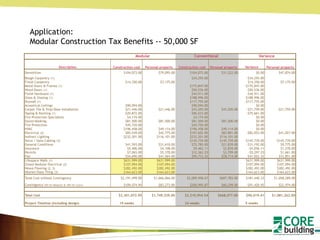
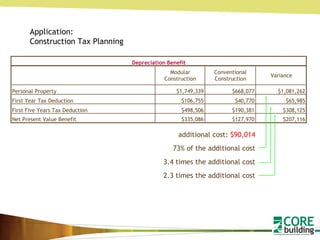
Application: Modular Construction Tax Benefits -- 50,000 SF
Application: Construction Tax Planning additional cost:  $90,014 73% of the additional cost 3.4 times the additional cost 2.3 times the additional cost
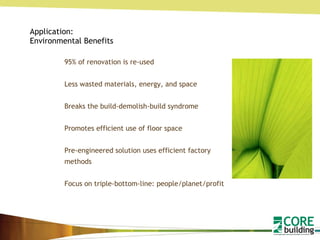
Application: Environmental Benefits 95% of renovation is re-used Less wasted materials, energy, and space Breaks the build-demolish-build syndrome Promotes efficient use of floor space Pre-engineered solution uses efficient factory methods Focus on triple-bottom-line: people/planet/profit
LEED? The United States Green Building Council (USGBC) was founded in 1993 LEED 1.0 1998 LEED 2.0 2000 LEED 2.1 2002 LEED 2.2 2005 LEED v3 2009 To LEED or not to LEED
OTHER ALTERNATIVES: Sustainable Practices Through Green Advantage Certification Define your career and/or business in a changing and challenging market Educate yourself and your employees on current technology, even if you can not afford the investment in LEED Embrace Sustainability Gain the edge over your competitors
What is Green Advantage? Green Advantage started in 1997 with recognition and support from: US Environmental Protection Agency The Nature Conservancy SAIC University of Florida Green Advantage provides a National Certification for: Construction Management Professionals Contractors Trades people Architects Real estate Professionals Field Personnel All other professionals interested in educational credentials supporting their sustainable building knowledge
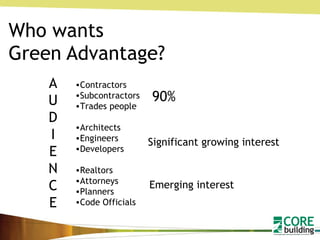
Who wants Green Advantage? AUDIENCE Contractors Subcontractors Trades people Architects Engineers Developers Realtors Attorneys Planners Code Officials Significant growing interest Emerging interest 90%
Why Green Advantage? GA Exam eligible for AIA / CEUs Use the Green Advantage logo /signifier on marketing materials Meet growing consumer/market demand for credentialed ‘green professionals’ Nationally recognized, affordable third-party credential May be utilized by owners/developers as a preference (Innovation in Design) Stay in tune with coming government regulations Respond to sustainable proposal requirements Position for your share of the new sustainable economy Educate your workforce to become aware of LEED/Sustainable requirements Convenient national network and testing Verified through academic research as providing environmental, health, and personnel performance benefits to projects (University of Florida, 2009) Pursuing accreditation by ANSI
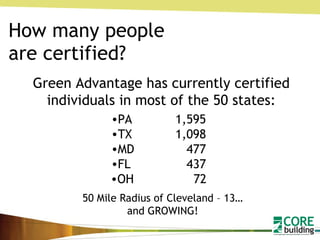
How many people are certified? Green Advantage has currently certified individuals in most of the 50 states: PA 1,595 TX 1,098 MD   477 FL    437 OH   72 50 Mile Radius of Cleveland – 13… and GROWING!
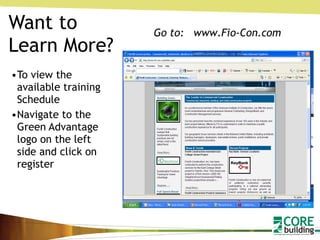
Want to Learn More? To view the available training Schedule Navigate to the Green Advantage logo on the left side and click on register Go to:  www.Fio-Con.com
October 21, 2010 Cleveland AIA Presented by: Carmen Fiorilli, Fiorilli Construction, Craig Miller, Duffy+Duffy Cost Segregation

CORE AIA Presentation

  • 1.
  • 2.
    October 21, 2010Cleveland AIA Presented by: Carmen Fiorilli, Fiorilli Construction Craig Miller, Duffy+Duffy Cost Segregation
  • 3.
    Agenda What weall know: The PAIN of the Conventional Situation What we all hear now: We want Collaborative Process (IPD-’ish’) Provide Built-In Sustainability What is being formulated today: The CORE Building Mantra Studies, Examples, and Results: Collaborative Examples Cost Segregation Studies Green Advantage Credentials
  • 4.
    Conventional Situation: ProjectSchedule & Cost 70% Delivered Late 10% Delivered Early 20% Delivered On Time 73% Over Tender Price 13% Under Tender Price 14% On Tender Price Time – 70% Were Late Cost – 73% Over Budget Source: Adapted from Cain, Clive Thomas. Profitable Partnering for Lean Construction.
  • 5.
    Conventional Situation: WastefulProcess 20% of new materials are dumped during construction 95% of renovation materials go into landfills Poor indoor air quality during/after construction Buildings are the largest consumer of power After construction, buildings continue to use excessive quantities of power
  • 6.
    Conventional Situation: DeliveryModel Fragmented Silo’d Linear & sequential Hierarchical Command & control Avoidance & blame Scope based Low price/bid CLIENT Broker/ Developer/ Landlord Consultants Contractor/ Sub-Trades Manufacturers, Vendors, Suppliers Vision deteriorates over time Value cannot be passed up the food chain Distrust Distance Dilution
  • 7.
    detailed design developmentbudgeting CDs & project cost construction FF&E move in need identification IT programming bid procurement Process: Conventional Delivery Model pre-construction services construction
  • 8.
    detailed design developmentbudgeting CDs & project cost construction FF&E move in need identification IT programming bid procurement Process: Conventional Delivery Model pre-construction services construction architect hired engineer hired CM/GC hired major trades hired FF&E supplier hired < 100% shared project vision
  • 9.
    shared project visiondetailed design development budgeting CDs & project cost construction FF&E move in need identification IT programming bid procurement Process: Conventional vs. Collaborative Delivery Model pre-construction services construction architect hired engineer hired CM/GC hired major trades hired furniture supplier hired < 100% < 100%
  • 10.
    shared project visionProcess: Collaborative Delivery Model pre-construction services construction architect hired engineer hired CM/GC hired major trades hired FFE hired < 100% detailed design construction FF&E move in conceptualization criteria design bid procurement detailed design development budgeting CDs & project cost construction FF&E move in need identification programming bid procurement
  • 11.
    effort Process: Conventionalvs. Collaborative Delivery Model conventional pre-construction services construction detailed design construction FF&E move in conceptualization criteria design bid procurement ability to control cost cost of design changes lean design team detailed design development budgeting CDs & project cost construction FF&E move in need identification IT programming bid procurement
  • 12.
    effort Process: Conventionalvs. Collaborative Delivery Model conventional pre-construction services construction detailed design construction FF&E move in conceptualization criteria design bid procurement ability to control cost cost of design changes lean design team
  • 13.
    Process: CORE CollaborativeDelivery Model Fragmented Silo’d Linear & sequential Hierarchical Command & control Avoidance & blame Scope based Low price/bid Integrated process Design consolidation Decisions based upon Data Linking investment to business Ensures success of investment Sustainable model $ Value of Trust Based Team: Reduced cost overruns Shortened project schedule More efficient & effective design Alignment to business objectives
  • 14.
    detailed design developmentbudgeting CDs & project cost construction FF&E move in need identification IT programming bid procurement Process: Conventional Delivery Model pre-construction services construction architect hired engineer hired CM/GC hired major trades hired furniture supplier hired < 100% shared project vision
  • 15.
    Process: Conventional DeliveryModel pre-construction services construction architect hired engineer hired CM/GC hired major trades hired furniture supplier hired < 100% shared project vision detailed design development budgeting CDs & project cost construction FF&E move in need identification IT programming bid procurement pre-construction services construction architect hired engineer hired CM/GC hired major trades hired furniture supplier hired shared project vision < 100% IT detailed design construction FF&E move in conceptualization criteria design bid procurement Collaborative Delivery Model
  • 16.
    effort Process: Conventionalvs. Collaborative Delivery Model $ Value of Trust Based Team: Reduced change orders Shortened project schedule More efficient & effective design Alignment to business objectives conventional pre-construction services construction detailed design construction FF&E move in conceptualization criteria design bid procurement ability to control cost cost of design changes lean design team detailed design development budgeting CDs & project cost construction FF&E move in need identification IT programming bid procurement
  • 17.
    What is CORE?An alliance of commercial real estate experts dedicated to the creation and advocacy of effective, sustainable and intelligent workplace environments. General Contracting/Construction Architecture/Design Commercial Real Estate Services Construction Tax Planning Legal Services/Contract Generation Interior Building Products Application: CORE Resources
  • 18.
    SHARED RESPONSIBILITY technologyengineer sub trades facilities developer architect broker client dealer contractor manufacturer finance project technology engineer gc/cm/pm sub trades suppliers designer architect broker client client architect engineers general contractor sub trades
  • 19.
    Application: Parallel PathAnalysis 70% Delivered Late 10% Delivered Early 73% Over Tender Price 14% On Tender Price conventional methods CORE collaborative method overall schedule reduction finishes, doors & HW data FF&E drywall studs electrical power HVAC, sprinkler, lighting, power, cable tray Moveable walls FF&E HVAC, sprinkler, lighting t-bar, finishes, etc raised floor, power, data
  • 20.
    Our Incentives toChange Net cost same or better Better quality space Employee retention Tax incentives Sustainable real estate User effectiveness Win-win Profitability Alignment to business
  • 21.
    Sustainable Approach toReal Estate Trust Based Beginning to End Process Meets Needs of All Stakeholders Repeatable Framework
  • 22.
    Measured Performance AccelerateSchedule 20 – 40% Reduce Space Requirements 5 – 20% Reduce Lighting Energy Costs 25% Reduce HVAC operating costs by up to 30% Reduce Total Churn Costs 70 – 90% Client Realizes Income Tax Savings 5-9% NPV
  • 23.
    What is CostSegregation? What is Construction Tax Planning? Cost Segregation is a tax deferral tool that identifies building components and tenant paid improvements to be allocated for depreciation purposes between real estate and personal property based on case law and IRS guidance. Takes advantage of the timing of non-cash depreciation expense by classifying assets properly for tax purposes. Portions of the buildings’ cost are reclassified from 39-year asset class to 5, 7 and 15-year classes. Don’t Assume that Client’s CPA or Tax Preparer is aware of CSS or CTP.
  • 24.
    Architecture Accounting Taxes Conventional Situation: No Communication/collaboration with client’s accountant/tax preparer in early stages of design, construction Little, if any, knowledge of non cash depreciation and income tax impact Assume client/client’s CPA will be aware of tax classifications/tax law Not accurately capturing/maximizing direct costs, indirect costs, overhead, etc. Merely send final AIA Documents with as-built plans to client
  • 25.
    Architecture Accounting Taxes Collaborative Method: Construction Tax Planning with Qualified Cost Segregation Engineers/Estimators Up-front coordination with architect and CPA during pre-design, during design Basic knowledge of federal tax treatment of personal property v. real estate Allocate all costs, direct & indirect, to proper (and shorter) tax life = HUGE Income Tax Savings Recognize opportunities to design means, materials, methods of construction to maximize shorter depreciable life building components Maximize constructed personal property for client’s “business use” v. “building use” Clear delineation in plans, AIA Docs, blueprints. No blurring for IRS purposes Recommend/design green technologies and renewable energy systems and the related tax incentives, grants, tax and accelerated depreciation benefits of solar, geothermal, wind, etc.
  • 26.
    Construction Tax Planning- CTP Up-front coordination with Architects and builders to identify materials & methods during pre-design and during design, for faster income tax write-off. Identifies opportunities to maximize qualifying personal property and accelerated depreciation in the planning stage. Add 5-7% of construction costs to personal property and shorter class life components. Produces depreciation forecasts and a discounted cash flow projection and a written Cost Segregation report. Upfront coordination with Cost Segregation Professionals can reduce project costs up to 17%. More than half of the opportunities available may be overlooked by taking this approach after the job is over.
  • 27.
    Commercial Building Depreciable Life
  • 28.
    The Benefit toBuilding Owners Income taxes are reduced in the early years of a building’s life by using accelerated depreciation methods Improved after-tax cash flow, debt coverage ratio, overall yields (Keys for bankers, lenders, investors) Taxes are repaid later due to lower depreciation deductions but in tomorrow’s less-valuable dollars Savings are measured by the Net Present Value of the cash flows from tax deferral and repayment Tax Deferrals Cash Flow Generation and Savings Through the Time Value of Money
  • 29.
    Legal Framework HospitalCorporation of America (HCA) v Commissioner, 109 T.C. 21 (1997) established cost segregation allowing shorter lives for certain assets. Tax Court in HCA established link to Investment Tax Credit case law and rulings. Action on Decision (AOD) number CC-1999-008. The Service acquiesced to the application of ITCC principles, but not to the particular results in the HCA case. saying that “The use of cost segregation studies must be specifically applied by the taxpayer.” IRS Audit Techniques Guide – 2004 –not authoritative
  • 30.
    The IRS HasSet Standards “ A quality cost segregation study is a study that is both accurate and well-documented with regard to the following points:” Classifies assets into property classes (e.g., land, land improvements, building, equipment, furniture and fixtures) Explains the rationale (including legal citations) for classifying assets as either s. 1245 or s.1250 property Substantiates the cost basis of each asset and reconciles total allocated costs to total actual costs Source: IRS Cost Segregation Audit Techniques Guide
  • 31.
    Who Can Benefitfrom Cost Segregation/CTP? Any for-profit entity that will own the building/building improvements (including individuals, partners, LLCs, SCorps, CCorps, Trusts, Estates, REITs, TICs, Syndicates) Owner who Constructed a commercial building Made leasehold improvements Purchased existing commercial building (regardless of building age) Had a tax basis step-up
  • 32.
    Types of Properties That Can Benefit Manufacturing Distribution Retail Centers Apartments Office Buildings Auto Dealerships Sporting Facilities Hotels Hospitals Funeral Homes Restaurants Airports Golf Courses Many Others
  • 33.
    What is TangiblePersonal Property (Section 1245 Property) Detailed IRS guidance does not exist in any form - no bright line tests Determination is facts and circumstances assessment. In HCA Tax Court established linkage to considerable body of cases and rulings for ITC Would the item be personal property under the Investment Tax Credit rules?
  • 34.
    Tests to Determineif an Asset is Tangible Personal Property Tangible Personal Property does not include assets that are structural components of a building. (Reg. Sect. 148-1(e)(2) Does an item within the building relate to the operation or maintenance of the building? (Scott Paper Co. v. Commissioner, 74 T.C. 137 (1980) Can the property be easily moved? (Whiteco Industries, Inc. v. Commissioner, 65 T.C. 664, 672-673 (1975) Does it play a structural role? (L.L. Bean, Inc. v. Commissioner, T.C. Memo. 1997-175, aff’d. F.3d53 (1 st . Cir. 1998) What is the justification for an item being installed? (Rev Rul 79-83) Does the asset serve a dual function? (Rev Rul 66-299)
  • 35.
    Examples of EligibleCosts Personal Property Decorative lighting Decorative millwork Interior bumpers & fencing Decorative wall covering Decorative flooring Portions of electrical Portions of plumbing Extra Structural support Cabinetry & countertops Signage Process related HVAC Emergency lighting Communication systems Security Systems Compressed air systems Shelving & racks
  • 36.
    Examples of EligibleCosts Land Improvements Site preparation Driveways & Roads Sidewalks Flag poles Underground utilities Storm sewers Retaining walls Porticos Detention basins Fencing Landscaping Docks & wharves Exterior lighting Utilities Pavilions
  • 37.
    Examples of EligibleCosts Indirect Costs
  • 38.
    Add New NicheService for Contractors, Architects and Designers Differentiate Yourself During RFQ Process Bidding advantage over other firms who do not offer this service. Opportunity to reduce project costs, time Earn New Revenue Directly (in bid or bid alternate) or Earn referral fees from Cost Segregation Firm.
  • 39.
    Favorable Tax ChangesRenewable Energy Investment Federal Income tax 5-Year class life and accelerated benefit for solar, wind, geothermal. (Instead of 39 Year life). Bonus Depreciation 30% from 9/11/01 to 5/5/03, 50% from 5/6/03 to 12/31/04, and 50% for 2008 and 2009, 2010. Section 179 Deduction . Increased from $25,000 in 2002 to $250,000 for 2008 and 2009-10. Section 481(a).  Section 481(a) deductions not taken in previous years can be taken in the year of change. [Rev. Proc. 2002-19] Automatic Consent for change the method of accounting. [Rev Proc 2002-9] 5-year NOL Carryback available for 2008 and 2009 returns.
  • 40.
  • 41.
    Impact Over BuildingLife Discounted Cash Flow
  • 42.
    How Client Claimsthe Depreciation Deductions Building/Leaseholds constructed or purchased in current year. Accelerated depreciation begins with the tax return for the year placed in service. Building/Leaseholds constructed or purchased in immediate preceding year. File an amended return for the previous tax year with the new depreciable lives to establish an accounting method for the building. Building/Leaseholds Constructed or Purchased in Prior Years. File for a change in accounting method (Form 3115). Negative Adjustment “catch-up” depreciation is allowed through Section 481a in the current year . Treatment depends on when building was constructed/acquired
  • 43.
    Application: Modular ConstructionTax Benefits -- 50,000 SF
  • 44.
    Application: Construction TaxPlanning additional cost: $90,014 73% of the additional cost 3.4 times the additional cost 2.3 times the additional cost
  • 45.
    Application: Environmental Benefits95% of renovation is re-used Less wasted materials, energy, and space Breaks the build-demolish-build syndrome Promotes efficient use of floor space Pre-engineered solution uses efficient factory methods Focus on triple-bottom-line: people/planet/profit
  • 46.
    LEED? The UnitedStates Green Building Council (USGBC) was founded in 1993 LEED 1.0 1998 LEED 2.0 2000 LEED 2.1 2002 LEED 2.2 2005 LEED v3 2009 To LEED or not to LEED
  • 47.
    OTHER ALTERNATIVES: SustainablePractices Through Green Advantage Certification Define your career and/or business in a changing and challenging market Educate yourself and your employees on current technology, even if you can not afford the investment in LEED Embrace Sustainability Gain the edge over your competitors
  • 48.
    What is GreenAdvantage? Green Advantage started in 1997 with recognition and support from: US Environmental Protection Agency The Nature Conservancy SAIC University of Florida Green Advantage provides a National Certification for: Construction Management Professionals Contractors Trades people Architects Real estate Professionals Field Personnel All other professionals interested in educational credentials supporting their sustainable building knowledge
  • 49.
    Who wants GreenAdvantage? AUDIENCE Contractors Subcontractors Trades people Architects Engineers Developers Realtors Attorneys Planners Code Officials Significant growing interest Emerging interest 90%
  • 50.
    Why Green Advantage?GA Exam eligible for AIA / CEUs Use the Green Advantage logo /signifier on marketing materials Meet growing consumer/market demand for credentialed ‘green professionals’ Nationally recognized, affordable third-party credential May be utilized by owners/developers as a preference (Innovation in Design) Stay in tune with coming government regulations Respond to sustainable proposal requirements Position for your share of the new sustainable economy Educate your workforce to become aware of LEED/Sustainable requirements Convenient national network and testing Verified through academic research as providing environmental, health, and personnel performance benefits to projects (University of Florida, 2009) Pursuing accreditation by ANSI
  • 51.
    How many peopleare certified? Green Advantage has currently certified individuals in most of the 50 states: PA 1,595 TX 1,098 MD 477 FL 437 OH 72 50 Mile Radius of Cleveland – 13… and GROWING!
  • 52.
    Want to LearnMore? To view the available training Schedule Navigate to the Green Advantage logo on the left side and click on register Go to: www.Fio-Con.com
  • 53.
    October 21, 2010Cleveland AIA Presented by: Carmen Fiorilli, Fiorilli Construction, Craig Miller, Duffy+Duffy Cost Segregation

Editor's Notes

  • #7 95% of renovation is re-used less wasted materials, energy, and space breaks the build-demolish-build syndrome promotes efficient use of floor space pre-engineered solution uses efficient factory methods Plus, the model is repeatable…also contributing to sustainability
  • #11 Trust based turnkey team Early collaboration Built in sustainability Leveraging workplace performance Integrated business development Integrated project development Integrated project delivery Efficiency and Effectiveness…”Rockwell Example”.. Standard model that lets them flex and change through years
  • #12 innovative design can save millions of dollars by the time design and development are complete, 85% of capital costs and 100% of operational costs are committed AT THE DESIGN STAGE UP TO 85% OF LIFE CYCLE COSTS HAVE BEEN COMMITTED “ THE CRITICAL POINT BEING IS THAT DESIGN IS CRITICAL AND THE SMALLEST COST COMPONENT OF A BUILDING YET THIS WHERE THE GREATEST OPPORTUNITY EXISTS IN REDUCING CAPITAL AND OPERATION COSTS!
  • #13 innovative design can save millions of dollars by the time design and development are complete, 85% of capital costs and 100% of operational costs are committed AT THE DESIGN STAGE UP TO 85% OF LIFE CYCLE COSTS HAVE BEEN COMMITTED “ THE CRITICAL POINT BEING IS THAT DESIGN IS CRITICAL AND THE SMALLEST COST COMPONENT OF A BUILDING YET THIS WHERE THE GREATEST OPPORTUNITY EXISTS IN REDUCING CAPITAL AND OPERATION COSTS! What is the worst thing you can do??? Go back and ask for more money!!!!
  • #14 95% of renovation is re-used less wasted materials, energy, and space breaks the build-demolish-build syndrome promotes efficient use of floor space pre-engineered solution uses efficient factory methods Plus, the model is repeatable…also contributing to sustainability
  • #16 Trust based turnkey team Early collaboration Built in sustainability Leveraging workplace performance Integrated business development Integrated project development Integrated project delivery Efficiency and Effectiveness…”Rockwell Example”.. Standard model that lets them flex and change through years
  • #17 innovative design can save millions of dollars by the time design and development are complete, 85% of capital costs and 100% of operational costs are committed AT THE DESIGN STAGE UP TO 85% OF LIFE CYCLE COSTS HAVE BEEN COMMITTED “ THE CRITICAL POINT BEING IS THAT DESIGN IS CRITICAL AND THE SMALLEST COST COMPONENT OF A BUILDING YET THIS WHERE THE GREATEST OPPORTUNITY EXISTS IN REDUCING CAPITAL AND OPERATION COSTS!
  • #19 Products alone will not deliver a solution you need, but they are rather a function of the complete solution. What makes us successful is the combination of knowledgeable people (not just us but also all the others involved in a project), innovative products and an improved process that re-structures the way in which we approach interior construction. Motivated People does not only refer to us, but also all of the talented professionals that need to be motivated to make a client’s project successful. You can use this slide to talk a little about how we need to work with each individual profession. The problem is that the delivery cycle or “supply chain” of real estate is comprised of many different disciplines or organizations each one delivering on a different step and influencing the outcome based on their own motivation often to the exclusion of others. END USER – Since end-users are the people who have to live with the workspace, they are often the ones most excited about a new solution that delivers unsurpassed levels of flexibility and performance. REAL ESTATE BROKER – A broker’s job is to assist the end-user in acquiring real estate and “broker” the deal between the tenant and landlord. Their services are based on commissions, total sft and lease term therefore their motivation is rarely on actual components and specific performance issues of the final workspace. Ideas such as less sft/person may in fact be contrary to their business model, but those who care about repeat business will do their best to provide the perfect space for their clients. DEVELOPER – The developer is investing in real estate in order to achieve a certain “return”. More and more developers are realizing that their spaces need to contain many of the features of Constructive Solutions such as flexibility and sustainability in order to meet the demands of customers and be “marketable” in the future. ARCHITECT/DESIGNER – This is a group that sees their fees get smaller and smaller while being asked to provide unique spaces in record time. In the past a manufactured solution would mean fast construction, it was nearly always at the expense of design. We offer the speed of manufacturing with the freedom of unique design. We also provide significant resources and internal experts to assist in developing the project solution with them. CONTRACTOR/SUB-TRADES – Worried about losing workload and volume – Contractors and sub-trades can still retain their margins while learning a new and future application that will set them apart from the competition. With our own roots in construction, we understand their world and their challenges and that we think like a contractor rather than a manufacturer. INFORMATION TECHNOLOGY – IT is often an independent silo within the client’s organization and is also often a scope of work that is dealt with separately from the construction scope. Consequently IT departments are used to a lot of control, independence and high budgets for their work. Since they are the ones who will be on the other end of the “Help Line” after all the other team members have left the job, they may resists these concepts due to the anxiety that comes with such fundamental change. However, once introduced to Structured Zone Cabling IT departments will actually find that their daily challenges will be much less tedious and they can dedicate more time to the company’s future. FACILITIES – This is a department not often consulted or involved early in the decision making process and yet they have to inherit the result. They are the ones who best understand the entire facility and can bring the most insight to the table at the beginning. A flexible space is something that will make them an even more dynamic, productive participant in a company’s bottom-line. FINANCE – A holistic financial picture, including downstream savings, potential tax depreciation, leasing and financing options means that the Finance team cares about the big bottom-line rather than first costs.
  • #44 A parallel schedule is more efficient with time and labor than a linear schedule which relies on every trade and inspector doing their job on time without any delays. The ability to complete a number of different portions of the job at the same time is much more effective and nothing reflects that better than tilt up construction. All we are trying to do is say, “don’t stop at the base building for these savings, but take the solution in to the corporate interior as well”. This type of scheduling can often produce savings of 20 % or greater within the schedule alone.
  • #45 A parallel schedule is more efficient with time and labor than a linear schedule which relies on every trade and inspector doing their job on time without any delays. The ability to complete a number of different portions of the job at the same time is much more effective and nothing reflects that better than tilt up construction. All we are trying to do is say, “don’t stop at the base building for these savings, but take the solution in to the corporate interior as well”. This type of scheduling can often produce savings of 20 % or greater within the schedule alone.
  • #49 Science Applications International Corporation