Unit 4:- Monitoring and Control, Managing
Contracts & Managing People in Software
Environments
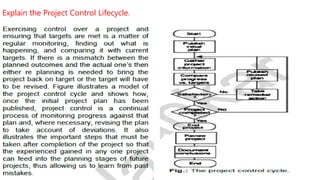
Explain the Project Control Lifecycle.
What are the reasons of Project Termination? Also explain the process of Project
Termination.
 Reasons for Project Termination:-
1. Lack of hardware & software resources
2. Incomplete requirements
3. Key technologies have become obsolete during project execution
4. Change in economics of the project
 Process for Project Termination:-
1. Project survey
2. Collection of Objective Information
3. Debriefing Meeting
4. Final Project Review
5. Result Publication
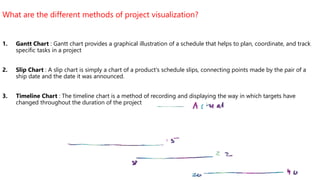
What are the different methods of project visualization?
1. Gantt Chart : Gantt chart provides a graphical illustration of a schedule that helps to plan, coordinate, and track
specific tasks in a project
2. Slip Chart : A slip chart is simply a chart of a product's schedule slips, connecting points made by the pair of a
ship date and the date it was announced.
3. Timeline Chart : The timeline chart is a method of recording and displaying the way in which targets have
changed throughout the duration of the project
What are the different priorities which need to be applied in deciding the levels of
monitoring?
1. Critical path activities
2. Activities with no free float
3. Activities with less than a specified float
4. High risk activities
5. Activities using critical resources
What are the different steps of change control procedures?
A simple change control procedure for operational systems might have the following steps :-
1. One or more users might perceive a need for a modification to a system and ask for a change request to he passed
to the development staff.
2. The user management consider the change request and if they approve it pass it to the development management.
3. The development management delegate a member of staff to look at the request and to report on the practicality
and cost of carrying out the change. They would, as part of this, assess the products that would be affected by the
change.
4. The development management report back to the user management on the findings and the user management
decide whether, in view of the cost quoted, they wish to go ahead.
5. One or more developers are authorized to take copies of the master products that are to be modified.
6. The copies are modified. In the case of software components this would involve modifying the code and
recompiling and testing it.
7. When the development of new versions of the product has been completed the user management will be notified
and copies of the software will be released for user acceptance testing.
8. When the user is satisfied that the products are adequate they will authorize their operational release. The master
copies of configuration items will be replaced.
What is SCM? What is the purpose of SCM? Explain the activities of SCM.
 Software configuration management (SCM) is the task of tracking and controlling changes in the software, part of the
larger cross-disciplinary field of configuration management.
 SCM practices include revision control and the establishment of baselines.
 If something goes wrong, SCM can determine what was changed and who changed it. If a configuration is working
well, SCM can determine how to replicate it across many hosts.
1. Configuration identification: Identifying configurations, configuration items and baselines.
2. Configuration control : Implementing a controlled change process. This is usually achieved by setting up a change
control board whose primary function is to approve or reject all change requests that are sent against any baseline.
3. Configuration status accounting : Recording and reporting all the necessary information on the status of the
development process.
4. Configuration auditing : Ensuring that configurations contain all their intended parts and are sound with respect
to their specifying documents, including requirements, architectural specifications and user manuals.
5. Build management : Managing the process and tools used for builds.
6. Process management : Ensuring adherence to the organization's development process.
7. Environment management : Managing the software and hardware that host the system.
8. Teamwork : Facilitate team interactions related to the process.
9. Defect tracking : Making sure every defect has traceability back to the source.
What are three important categories of stress management techniques?
1. Imagery, relaxation, and meditation
2. Deep breathing, relaxation, physical exercise, guided imagery, yoga, progressive muscle relaxation and massage
therapy. An example of a simple relaxation technique can be rolling the head from side to side
3. Cognitive behavioural approaches
4. Include self-monitoring of stress intensity, thought record-keeping and rewriting, time management, assertiveness
training and increased social interactions
5. Systemic approach
6. Altering the factors which contribute to stress, example: switch a job role
Explain the types of Contracts.
• Fixed Price Contract:-
As the name implies, in this situation a price is fixed when the contract is signed. The customer knows that, if there are no
changes in the contract terms, this is the price to be paid on the completion of the work. In order for this to be effective, the
customer's requirement has to be known and fixed at the outset. In other words, when the contract is to construct a software
system, the detailed requirements analysis must already have been carried out.
Once the development is under way, the customer will not be able to change their requirements without renegotiating the
price of the contract.
The advantages of this method are the following : (a) Known customer expenditure If there are few subsequent changes to the
original requirements, then the customer will have a known outlay. (b) Supplier motivation like supplier has a motivation to
manage the delivery of the system in a cost-effective manner
Advantages to customer :
(a) Known customer expenditure
(b) Supplier motivated to be cost-effective
Disadvantages :
(a) Supplier will increase price to meet contingencies i) Supplier absorbs the risk in the estimates ii) Supplier will add a margin
to price quoted
(b) Difficult to modify requirements
(c) Cost of changes likely to be higher
(d) Threat to system quality
• Time and materials contracts :-
With this type of contract, the customer is charged at a fixed rate per unit of effort, for example, per staff-hour.
At the start of the project, the supplier normally provides an estimate of the overall cost based on their current understanding
of the customer's requirements, but this is not the basis for the final payment.
The advantages of this approach are the following :
(a) Changes to requirements are dealt with easily. Where a project has a research orientation and the direction of the project
changes as options are explored, then this can be an appropriate method of calculating payment.
(b) Tack of price pressure : The lack of price pressure can allow better quality software to be produced.
• Fixed price per delivered unit contracts :-
The size of the system to be delivered might be estimated in lines of code, but FPs can be more easily and reliably derived
from requirements documents. A price per unit is also quoted. The final price is then the unit price multiplied by the number
of units.
The advantages of this approach are as follows :
(a) Customer understanding : The customer can see how the price is calculated and how it will vary with changed
requirements.
(b) Comparability Pricing schedules can be compared.
(c) Emerging functionality : The supplier does not bear the risk of increasing functionality.
(d) Supplier efficiency : The supplier still has an incentive to deliver the required functionality in a cost-effective manner (unlike
with time and materials contracts).
(e) Life cycle range : The requirements do not have to be definitively specified at the outset.
Thus, the development contract can cover both the analysis and design stages of the project.
Explain the stages in Contract Placement.
1. Requirements Analysis
2. Evaluation Plan
3. Invitation to tender :
4. Evaluation of proposals
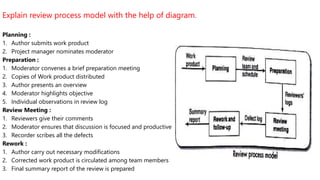
Explain review process model with the help of diagram.
Planning :
1. Author submits work product
2. Project manager nominates moderator
Preparation :
1. Moderator convenes a brief preparation meeting
2. Copies of Work product distributed
3. Author presents an overview
4. Moderator highlights objective
5. Individual observations in review log
Review Meeting :
1. Reviewers give their comments
2. Moderator ensures that discussion is focused and productive
3. Recorder scribes all the defects
Rework :
1. Author carry out necessary modifications
2. Corrected work product is circulated among team members
3. Final summary report of the review is prepared

Unit-4.pptxhhhghbfgvgtghvfgbbghbbhgfccvbtt

  • 1.
    Unit 4:- Monitoringand Control, Managing Contracts & Managing People in Software Environments
  • 2.
    Explain the ProjectControl Lifecycle.
  • 3.
    What are thereasons of Project Termination? Also explain the process of Project Termination.  Reasons for Project Termination:- 1. Lack of hardware & software resources 2. Incomplete requirements 3. Key technologies have become obsolete during project execution 4. Change in economics of the project  Process for Project Termination:- 1. Project survey 2. Collection of Objective Information 3. Debriefing Meeting 4. Final Project Review 5. Result Publication
  • 4.
    What are thedifferent methods of project visualization? 1. Gantt Chart : Gantt chart provides a graphical illustration of a schedule that helps to plan, coordinate, and track specific tasks in a project 2. Slip Chart : A slip chart is simply a chart of a product's schedule slips, connecting points made by the pair of a ship date and the date it was announced. 3. Timeline Chart : The timeline chart is a method of recording and displaying the way in which targets have changed throughout the duration of the project
  • 5.
    What are thedifferent priorities which need to be applied in deciding the levels of monitoring? 1. Critical path activities 2. Activities with no free float 3. Activities with less than a specified float 4. High risk activities 5. Activities using critical resources
  • 6.
    What are thedifferent steps of change control procedures? A simple change control procedure for operational systems might have the following steps :- 1. One or more users might perceive a need for a modification to a system and ask for a change request to he passed to the development staff. 2. The user management consider the change request and if they approve it pass it to the development management. 3. The development management delegate a member of staff to look at the request and to report on the practicality and cost of carrying out the change. They would, as part of this, assess the products that would be affected by the change. 4. The development management report back to the user management on the findings and the user management decide whether, in view of the cost quoted, they wish to go ahead. 5. One or more developers are authorized to take copies of the master products that are to be modified. 6. The copies are modified. In the case of software components this would involve modifying the code and recompiling and testing it. 7. When the development of new versions of the product has been completed the user management will be notified and copies of the software will be released for user acceptance testing. 8. When the user is satisfied that the products are adequate they will authorize their operational release. The master copies of configuration items will be replaced.
  • 7.
    What is SCM?What is the purpose of SCM? Explain the activities of SCM.  Software configuration management (SCM) is the task of tracking and controlling changes in the software, part of the larger cross-disciplinary field of configuration management.  SCM practices include revision control and the establishment of baselines.  If something goes wrong, SCM can determine what was changed and who changed it. If a configuration is working well, SCM can determine how to replicate it across many hosts. 1. Configuration identification: Identifying configurations, configuration items and baselines. 2. Configuration control : Implementing a controlled change process. This is usually achieved by setting up a change control board whose primary function is to approve or reject all change requests that are sent against any baseline. 3. Configuration status accounting : Recording and reporting all the necessary information on the status of the development process. 4. Configuration auditing : Ensuring that configurations contain all their intended parts and are sound with respect to their specifying documents, including requirements, architectural specifications and user manuals. 5. Build management : Managing the process and tools used for builds. 6. Process management : Ensuring adherence to the organization's development process. 7. Environment management : Managing the software and hardware that host the system. 8. Teamwork : Facilitate team interactions related to the process. 9. Defect tracking : Making sure every defect has traceability back to the source.
  • 8.
    What are threeimportant categories of stress management techniques? 1. Imagery, relaxation, and meditation 2. Deep breathing, relaxation, physical exercise, guided imagery, yoga, progressive muscle relaxation and massage therapy. An example of a simple relaxation technique can be rolling the head from side to side 3. Cognitive behavioural approaches 4. Include self-monitoring of stress intensity, thought record-keeping and rewriting, time management, assertiveness training and increased social interactions 5. Systemic approach 6. Altering the factors which contribute to stress, example: switch a job role
  • 9.
    Explain the typesof Contracts. • Fixed Price Contract:- As the name implies, in this situation a price is fixed when the contract is signed. The customer knows that, if there are no changes in the contract terms, this is the price to be paid on the completion of the work. In order for this to be effective, the customer's requirement has to be known and fixed at the outset. In other words, when the contract is to construct a software system, the detailed requirements analysis must already have been carried out. Once the development is under way, the customer will not be able to change their requirements without renegotiating the price of the contract. The advantages of this method are the following : (a) Known customer expenditure If there are few subsequent changes to the original requirements, then the customer will have a known outlay. (b) Supplier motivation like supplier has a motivation to manage the delivery of the system in a cost-effective manner Advantages to customer : (a) Known customer expenditure (b) Supplier motivated to be cost-effective Disadvantages : (a) Supplier will increase price to meet contingencies i) Supplier absorbs the risk in the estimates ii) Supplier will add a margin to price quoted (b) Difficult to modify requirements (c) Cost of changes likely to be higher (d) Threat to system quality
  • 10.
    • Time andmaterials contracts :- With this type of contract, the customer is charged at a fixed rate per unit of effort, for example, per staff-hour. At the start of the project, the supplier normally provides an estimate of the overall cost based on their current understanding of the customer's requirements, but this is not the basis for the final payment. The advantages of this approach are the following : (a) Changes to requirements are dealt with easily. Where a project has a research orientation and the direction of the project changes as options are explored, then this can be an appropriate method of calculating payment. (b) Tack of price pressure : The lack of price pressure can allow better quality software to be produced. • Fixed price per delivered unit contracts :- The size of the system to be delivered might be estimated in lines of code, but FPs can be more easily and reliably derived from requirements documents. A price per unit is also quoted. The final price is then the unit price multiplied by the number of units. The advantages of this approach are as follows : (a) Customer understanding : The customer can see how the price is calculated and how it will vary with changed requirements. (b) Comparability Pricing schedules can be compared. (c) Emerging functionality : The supplier does not bear the risk of increasing functionality. (d) Supplier efficiency : The supplier still has an incentive to deliver the required functionality in a cost-effective manner (unlike with time and materials contracts). (e) Life cycle range : The requirements do not have to be definitively specified at the outset. Thus, the development contract can cover both the analysis and design stages of the project.
  • 11.
    Explain the stagesin Contract Placement. 1. Requirements Analysis 2. Evaluation Plan 3. Invitation to tender : 4. Evaluation of proposals
  • 12.
    Explain review processmodel with the help of diagram. Planning : 1. Author submits work product 2. Project manager nominates moderator Preparation : 1. Moderator convenes a brief preparation meeting 2. Copies of Work product distributed 3. Author presents an overview 4. Moderator highlights objective 5. Individual observations in review log Review Meeting : 1. Reviewers give their comments 2. Moderator ensures that discussion is focused and productive 3. Recorder scribes all the defects Rework : 1. Author carry out necessary modifications 2. Corrected work product is circulated among team members 3. Final summary report of the review is prepared