The elephant and the mice: will web 2.0 change public services? David Osimo, Clara Centeno Institute for Prospective Technological Studies European Commission Joint Research Centre The views expressed in the presentation are those of the authors and do not represent the official position of the EC
The approach scenario building Building on today’s weak signals not to predict the future, but  to structure the thinking and  to develop robust policy options
Positive scenario: opportunities for eGovernment (from IPTS tutorial at EU e-gov ministerial conference,  www.egov2007.gov.pt )   Web 2.0 can help reaching long-awaited objectives of government reform wiki for cross agency collaboration (Intellipedia) user generated content and collaborative rating/filtering for better and faster decision-making (peer to patent) recommendation systems and collaborative filtering for sharing informal/tacit knowledge (allen and overy) citizen ratings/feedback for user-oriented services (Patientopinion) open petitions systems for participation (ePetitions) Necessary to engage, experiment, learn-by-doing  BUT: what can go wrong? -> Developing no impact or negative impact scenarios
No impact scenario
It’s just another hype Web 2.0 business model is not solid, too reliant on advertising Online advertising is highly sensitive to GDP growth: bubble 2.0 in waiting Startups failing to deliver profits: Skype, Vonage Source: IPTS elaboration of U.S Census, IAB
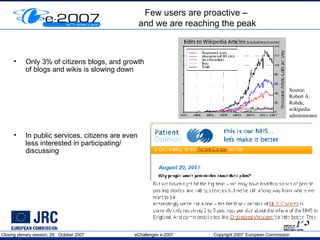
Few users are proactive –  and we are reaching the peak Only 3% of citizens blogs, and growth of blogs and wikis is slowing down In public services, citizens are even less interested in participating/ discussing Source: Robert A. Rohde, wikipedia administrator
It’s doesn’t matter What matters is competence and high-quality services, rather than “conversations”  In busines s, commercial success does not need openness  (e.g. Zune developers blog while I-Pod developers are secretive) In politics, success in the blogosphere does not translate in success in elections (e.g. Howard Dean, Barak Obama), In public services provision, spontaneous cooperation (as “barcamp”) only rarely delivers after the initial enthusiasm (e.g. Italian Tourism Portal).  Bloggers approach is not always constructive: “ the philosophers have only interpreted the world. The point is to complain about it”
Negative impact
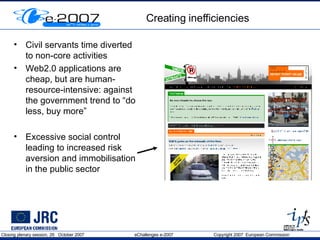
Creating inefficiencies Civil servants time diverted to non-core activities Web2.0 applications are cheap, but are human-resource-intensive: against the government trend to “do less, buy more” Excessive social control leading to increased risk aversion and immobilisation in the public sector
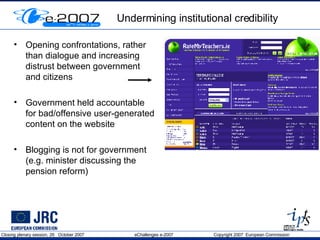
Undermining institutional credibility Opening confrontations, rather than dialogue and increasing distrust between government and citizens  Government held accountable for bad/offensive user-generated content on the website Blogging is not for government (e.g. minister discussing the pension reform)
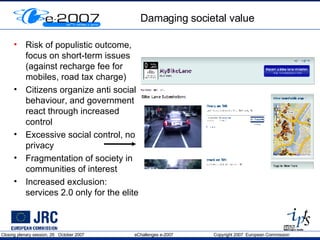
Damaging societal value Risk of populistic outcome, focus on short-term issues (against recharge fee for mobiles, road tax charge) Citizens organize anti social behaviour, and government react through increased control Excessive social control, no privacy Fragmentation of society in communities of interest Increased exclusion: services 2.0 only for the elite
Conclusions
Summing up the potential negatives No impact  long term reform goals  because it doesn’t matter Negative impact on  long term reform goals  because it creates inefficiencies and undermines government credibility Further negative impact on overall societal values such as cohesion, privacy, trust
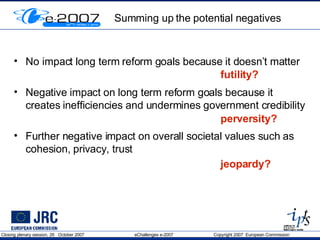
Summing up the potential negatives No impact  long term reform goals  because it doesn’t matter Negative impact on  long term reform goals  because it creates inefficiencies and undermines government credibility Further negative impact on overall societal values such as cohesion, privacy, trust futility? perversity? jeopardy?
Conclusions Web 2.0 offers risks as well as opportunities for eGovernment The risks are not new, but the same than for any important social innovation Public trust is the key determinant of success or failure Government has limited influence on whether the impact of web 2.0 is positive, negative or indifferent Engaging, experimenting, learning by doing (starting from back-office) is the safest option across the scenarios
Open questions for further work Assessing the impact of real-life case studies Monitoring emerging trends Giving weight to the risks and opportunities Learning from experiences how to grasp opportunities and avoid risks Thanks [email_address]
Background slides
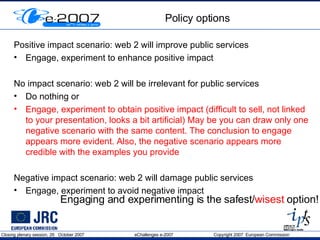
Policy options Positive impact scenario: web 2 will improve public services Engage, experiment to enhance positive impact No impact scenario: web 2 will be irrelevant for public services Do nothing or Engage, experiment to obtain positive impact (difficult to sell, not linked to your presentation, looks a bit artificial) May be you can draw only one negative scenario with the same content. The conclusion to engage appears more evident. Also, the negative scenario appears more credible with the examples you provide Negative impact scenario: web 2 will damage public services Engage, experiment to avoid negative impact Engaging and experimenting is the safest/ wisest  option!
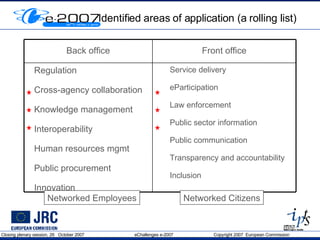
Identified areas of application (a rolling list) Networked Employees Networked Citizens Front office Back office Service delivery eParticipation Law enforcement Public sector information Public communication Transparency and accountability Inclusion Regulation Cross-agency collaboration Knowledge management Interoperability Human resources mgmt Public procurement Innovation
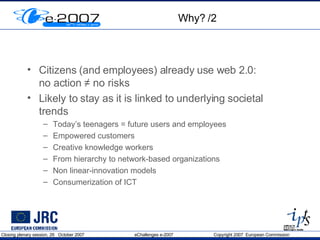
Why? /2 Citizens (and employees) already use web 2.0:  no action  ≠ no risks Likely to stay as it is linked to underlying societal trends Today’s teenagers = future users and employees Empowered customers Creative knowledge workers  From hierarchy to network-based organizations Non linear-innovation models Consumerization of ICT
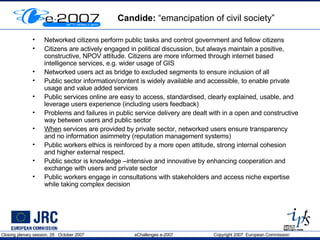
Candide:  “emancipation of civil society”  Networked citizens perform public tasks and control government and fellow citizens Citizens are actively engaged in political discussion, but always maintain a positive, constructive, NPOV attitude. Citizens are more informed through internet based intelligence services, e.g. wider usage of GIS Networked users act as bridge to excluded segments to ensure inclusion of all Public sector information/content is widely available and accessible, to enable private usage and value added services Public services online are easy to access, standardised, clearly explained, usable, and leverage users experience (including users feedback) Problems and failures in public service delivery are dealt with in a open and constructive way between users and public sector When  services are provided by private sector, networked users ensure transparency and no information asimmetry (reputation management systems) Public workers ethics is reinforced by a more open attitude, strong internal cohesion and higher external respect.  Public sector is knowledge –intensive and innovative by enhancing cooperation and exchange with users and private sector Public workers engage in consultations with stakeholders and access niche expertise while taking complex decision
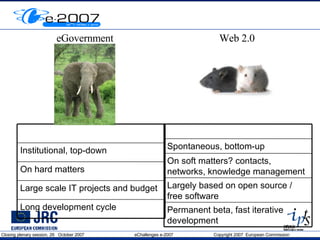
eGovernment Web 2.0 Long development cycle Large scale IT projects and budget On hard matters Institutional, top-down Permanent beta, fast iterative development Largely based on open source / free software On soft matters? contacts, networks, knowledge management Spontaneous, bottom-up

What can go wrong with web2 in public services

  • 1.
    The elephant andthe mice: will web 2.0 change public services? David Osimo, Clara Centeno Institute for Prospective Technological Studies European Commission Joint Research Centre The views expressed in the presentation are those of the authors and do not represent the official position of the EC
  • 2.
    The approach scenariobuilding Building on today’s weak signals not to predict the future, but to structure the thinking and to develop robust policy options
  • 3.
    Positive scenario: opportunitiesfor eGovernment (from IPTS tutorial at EU e-gov ministerial conference, www.egov2007.gov.pt ) Web 2.0 can help reaching long-awaited objectives of government reform wiki for cross agency collaboration (Intellipedia) user generated content and collaborative rating/filtering for better and faster decision-making (peer to patent) recommendation systems and collaborative filtering for sharing informal/tacit knowledge (allen and overy) citizen ratings/feedback for user-oriented services (Patientopinion) open petitions systems for participation (ePetitions) Necessary to engage, experiment, learn-by-doing BUT: what can go wrong? -> Developing no impact or negative impact scenarios
  • 4.
  • 5.
    It’s just anotherhype Web 2.0 business model is not solid, too reliant on advertising Online advertising is highly sensitive to GDP growth: bubble 2.0 in waiting Startups failing to deliver profits: Skype, Vonage Source: IPTS elaboration of U.S Census, IAB
  • 6.
    Few users areproactive – and we are reaching the peak Only 3% of citizens blogs, and growth of blogs and wikis is slowing down In public services, citizens are even less interested in participating/ discussing Source: Robert A. Rohde, wikipedia administrator
  • 7.
    It’s doesn’t matterWhat matters is competence and high-quality services, rather than “conversations” In busines s, commercial success does not need openness (e.g. Zune developers blog while I-Pod developers are secretive) In politics, success in the blogosphere does not translate in success in elections (e.g. Howard Dean, Barak Obama), In public services provision, spontaneous cooperation (as “barcamp”) only rarely delivers after the initial enthusiasm (e.g. Italian Tourism Portal). Bloggers approach is not always constructive: “ the philosophers have only interpreted the world. The point is to complain about it”
  • 8.
  • 9.
    Creating inefficiencies Civilservants time diverted to non-core activities Web2.0 applications are cheap, but are human-resource-intensive: against the government trend to “do less, buy more” Excessive social control leading to increased risk aversion and immobilisation in the public sector
  • 10.
    Undermining institutional credibilityOpening confrontations, rather than dialogue and increasing distrust between government and citizens Government held accountable for bad/offensive user-generated content on the website Blogging is not for government (e.g. minister discussing the pension reform)
  • 11.
    Damaging societal valueRisk of populistic outcome, focus on short-term issues (against recharge fee for mobiles, road tax charge) Citizens organize anti social behaviour, and government react through increased control Excessive social control, no privacy Fragmentation of society in communities of interest Increased exclusion: services 2.0 only for the elite
  • 12.
  • 13.
    Summing up thepotential negatives No impact long term reform goals because it doesn’t matter Negative impact on long term reform goals because it creates inefficiencies and undermines government credibility Further negative impact on overall societal values such as cohesion, privacy, trust
  • 14.
    Summing up thepotential negatives No impact long term reform goals because it doesn’t matter Negative impact on long term reform goals because it creates inefficiencies and undermines government credibility Further negative impact on overall societal values such as cohesion, privacy, trust futility? perversity? jeopardy?
  • 15.
    Conclusions Web 2.0offers risks as well as opportunities for eGovernment The risks are not new, but the same than for any important social innovation Public trust is the key determinant of success or failure Government has limited influence on whether the impact of web 2.0 is positive, negative or indifferent Engaging, experimenting, learning by doing (starting from back-office) is the safest option across the scenarios
  • 16.
    Open questions forfurther work Assessing the impact of real-life case studies Monitoring emerging trends Giving weight to the risks and opportunities Learning from experiences how to grasp opportunities and avoid risks Thanks [email_address]
  • 17.
  • 18.
    Policy options Positiveimpact scenario: web 2 will improve public services Engage, experiment to enhance positive impact No impact scenario: web 2 will be irrelevant for public services Do nothing or Engage, experiment to obtain positive impact (difficult to sell, not linked to your presentation, looks a bit artificial) May be you can draw only one negative scenario with the same content. The conclusion to engage appears more evident. Also, the negative scenario appears more credible with the examples you provide Negative impact scenario: web 2 will damage public services Engage, experiment to avoid negative impact Engaging and experimenting is the safest/ wisest option!
  • 19.
    Identified areas ofapplication (a rolling list) Networked Employees Networked Citizens Front office Back office Service delivery eParticipation Law enforcement Public sector information Public communication Transparency and accountability Inclusion Regulation Cross-agency collaboration Knowledge management Interoperability Human resources mgmt Public procurement Innovation
  • 20.
    Why? /2 Citizens(and employees) already use web 2.0: no action ≠ no risks Likely to stay as it is linked to underlying societal trends Today’s teenagers = future users and employees Empowered customers Creative knowledge workers From hierarchy to network-based organizations Non linear-innovation models Consumerization of ICT
  • 21.
    Candide: “emancipationof civil society” Networked citizens perform public tasks and control government and fellow citizens Citizens are actively engaged in political discussion, but always maintain a positive, constructive, NPOV attitude. Citizens are more informed through internet based intelligence services, e.g. wider usage of GIS Networked users act as bridge to excluded segments to ensure inclusion of all Public sector information/content is widely available and accessible, to enable private usage and value added services Public services online are easy to access, standardised, clearly explained, usable, and leverage users experience (including users feedback) Problems and failures in public service delivery are dealt with in a open and constructive way between users and public sector When services are provided by private sector, networked users ensure transparency and no information asimmetry (reputation management systems) Public workers ethics is reinforced by a more open attitude, strong internal cohesion and higher external respect. Public sector is knowledge –intensive and innovative by enhancing cooperation and exchange with users and private sector Public workers engage in consultations with stakeholders and access niche expertise while taking complex decision
  • 22.
    eGovernment Web 2.0Long development cycle Large scale IT projects and budget On hard matters Institutional, top-down Permanent beta, fast iterative development Largely based on open source / free software On soft matters? contacts, networks, knowledge management Spontaneous, bottom-up