
Self-efficacy as a factor in the evaluation of e‑petitionsPeter CruickshankResearch FellowInternational Teledemocracy Centre
EuroPetition and overview of (e-)petitioningThe role of evaluationSelf-efficacyIntegrating self-efficacy and evaluationOverview7 September 2009EDEM 2009, Vienna2
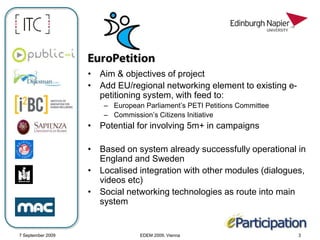
7 September 2009EDEM 2009, Vienna3Aim & objectives of project
Add EU/regional networking element to existing e-petitioning system, with feed to:
European Parliament’s PETI Petitions Committee
Commission’s Citizens Initiative
Potential for involving 5m+ in campaigns
Based on system already successfully operational in England and Sweden
Localised integration with other modules (dialogues, videos etc)
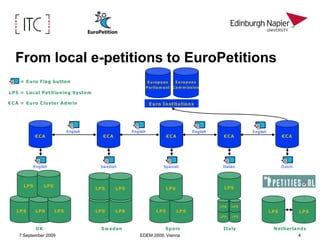
Social networking technologies as route into main systemFrom local e-petitions to EuroPetitions7 September 2009EDEM 2009, Vienna4
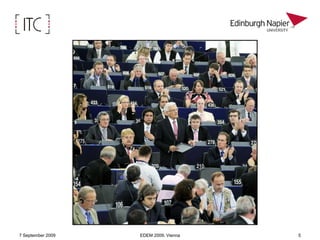
7 September 2009EDEM 2009, Vienna5
“	...e-petitioning by a number of public institutions and is in many ways – compared to most other forms of e-participation – relatively mature.”		Lindner & Rhiem – EDEM 2008E-Petitions overview7 September 2009EDEM 2009, Vienna6
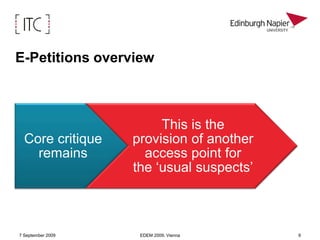
Petitioning exists between pure representative democracy and direct democracy (bypassing representatives altogether) in a third category ‘Advocacy democracy’Carmen 2006Since the policy impact is indirect (mediated by representatives), perceived fairness and openness in the process can be as important as the actual outcome:“	Can anyone name an e-petition to the Prime Minister that has achieved its aims? Each time I have signed one, I have later received an email telling me why the PM cannot agree.” – Letter to Telegraph, 27 May 2009Raised and subsequently disappointed expectations can lead to increased disaffection with the political process.E-Petitions overview7 September 2009EDEM 2009, Vienna7
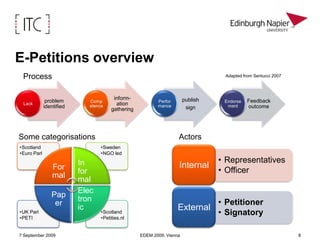
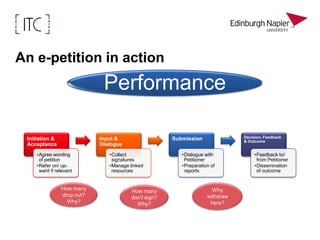
E-Petitions overview7 September 2009EDEM 2009, Vienna8ProcessAdapted from Sentucci 2007ActorsSome categorisations
E-Petitions overview7 September 2009EDEM 2009, Vienna9
7 September 2009EDEM 2009, Vienna10
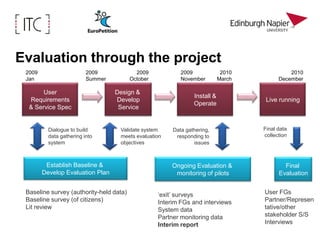
Help identify issues and resolve themMeasure progress against project objectivesAcceptability & uptake: Do stakeholders like it?Impact on democratic processes Viability: Models for sustainabilityThe focus of this paperUptake by external actors (petitioners & non-petitioners)Facing the challenge of getting beyond the usual suspectsHas implications for all three strands of the project’s objectivesEvaluation within EuroPetition7 September 2009EDEM 2009, Vienna11
Evaluating ICT UptakeQualitative approachQualitative here because we’re in a development environmentMoving targetUncertain number of usersThis is a general issue with eParticipation evaluation (Rose & Stanford 2007)Quantitative evaluation could be added post-acceptanceApproaches to evaluation of uptakeDominated by Technology Acceptance Model (TAM)Starts from perceived usefulness and perceived ease of useProblem: TAM does not take account of personal factors and environment when seeking to understand behaviourResponses: Unified Theory of Acceptance and Use of Technology (Venkatesh et al 2003)referred by MOMENTUMAdds some social factors etcThis approach looks at the user from the outside
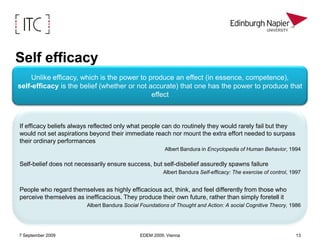
Unlike efficacy, which is the power to produce an effect (in essence, competence), self-efficacy is the belief (whether or not accurate) that one has the power to produce that effectSelf efficacyIf efficacy beliefs always reflected only what people can do routinely they would rarely fail but they would not set aspirations beyond their immediate reach nor mount the extra effort needed to surpass their ordinary performancesAlbert Bandura in Encyclopedia of Human Behavior, 1994Self-belief does not necessarily ensure success, but self-disbelief assuredly spawns failureAlbert BanduraSelf-efficacy: The exercise of control, 1997People who regard themselves as highly efficacious act, think, and feel differently from those who perceive themselves as inefficacious. They produce their own future, rather than simply foretell itAlbert BanduraSocial Foundations of Thought and Action: A social Cognitive Theory, 19867 September 2009EDEM 2009, Vienna13
Turning to wikipedia…Self-efficacy is the belief that one is capable of performing in a certain manner to attain certain goals.It is a belief that one has the capabilities to execute the courses of actions required to manage prospective situations. Unlike efficacy, which is the power to produce an effect (in essence, competence), self-efficacy is the belief (whether or not accurate) that one has the power to produce that effect. For example, a person with high self-efficacy may engage in a more health related activity when an illness occurs, whereas a person with low self-efficacy would harbour feelings of hopelessness.There is a distinction between self-esteem and self-efficacy. Self-efficacy relates to a person’s perception of their ability to reach a goal, whereas self-esteem relates to a person’s sense of self-worth. For example, a person who is a terrible rock climber would probably have poor self-efficacy with regard to rock climbing, but this need not affect that person's self-esteem since most people don’t invest much of their self-esteem in this activity.On the other hand, one might have enormous skill at rock climbing, yet set such a high standard for oneself that self-esteem is low.At the same time, a person who has high self-efficacy in general but is poor at rock climbing might think that he/she is good at rock climbing, or might still believe that he/she could quickly learn.Key ref: Bandura, Albert (1977), Social Learning Theory, Alexandria, VA: Prentice Hall, pp. 247, ISBN 0138167443Background: Self efficacy
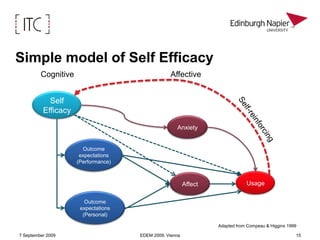
Simple model of Self Efficacy7 September 2009EDEM 2009, Vienna15CognitiveAffectiveSelf EfficacySelf-reinforcingAnxietyOutcome expectations(Performance)UsageAffectOutcome expectations(Personal)Adapted from Compeau & Higgins 1999
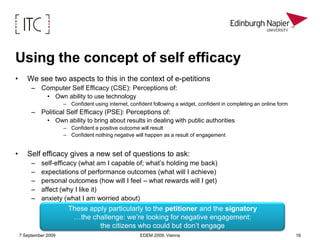
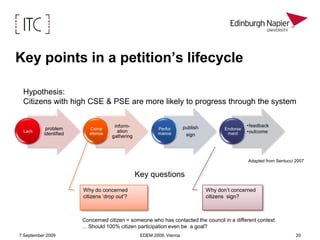
We see two aspects to this in the context of e-petitionsComputer Self Efficacy (CSE): Perceptions of:Own ability to use technology Confident using internet, confident following a widget, confident in completing an online form Political Self Efficacy (PSE): Perceptions of:Own ability to bring about results in dealing with public authoritiesConfident a positive outcome will resultConfident nothing negative will happen as a result of engagementSelf efficacy gives a new set of questions to ask:self-efficacy (what am I capable of; what’s holding me back)expectations of performance outcomes (what will I achieve)personal outcomes (how will I feel – what rewards will I get)affect (why I like it)anxiety (what I am worried about)Using the concept of self efficacy7 September 2009EDEM 2009, Vienna16These apply particularly to the petitioner and the signatory…the challenge: we’re looking for negative engagement:the citizens who could but don’t engage

Self-efficacy as a factor in evaluation of e-petitions

  • 1.
    Self-efficacy as afactor in the evaluation of e‑petitionsPeter CruickshankResearch FellowInternational Teledemocracy Centre
  • 2.
    EuroPetition and overviewof (e-)petitioningThe role of evaluationSelf-efficacyIntegrating self-efficacy and evaluationOverview7 September 2009EDEM 2009, Vienna2
  • 3.
    7 September 2009EDEM2009, Vienna3Aim & objectives of project
  • 4.
    Add EU/regional networkingelement to existing e-petitioning system, with feed to:
  • 5.
    European Parliament’s PETIPetitions Committee
  • 6.
  • 7.
    Potential for involving5m+ in campaigns
  • 8.
    Based on systemalready successfully operational in England and Sweden
  • 9.
    Localised integration withother modules (dialogues, videos etc)
  • 10.
    Social networking technologiesas route into main systemFrom local e-petitions to EuroPetitions7 September 2009EDEM 2009, Vienna4
  • 11.
  • 12.
    “ ...e-petitioning by anumber of public institutions and is in many ways – compared to most other forms of e-participation – relatively mature.” Lindner & Rhiem – EDEM 2008E-Petitions overview7 September 2009EDEM 2009, Vienna6
  • 13.
    Petitioning exists betweenpure representative democracy and direct democracy (bypassing representatives altogether) in a third category ‘Advocacy democracy’Carmen 2006Since the policy impact is indirect (mediated by representatives), perceived fairness and openness in the process can be as important as the actual outcome:“ Can anyone name an e-petition to the Prime Minister that has achieved its aims? Each time I have signed one, I have later received an email telling me why the PM cannot agree.” – Letter to Telegraph, 27 May 2009Raised and subsequently disappointed expectations can lead to increased disaffection with the political process.E-Petitions overview7 September 2009EDEM 2009, Vienna7
  • 14.
    E-Petitions overview7 September2009EDEM 2009, Vienna8ProcessAdapted from Sentucci 2007ActorsSome categorisations
  • 15.
    E-Petitions overview7 September2009EDEM 2009, Vienna9
  • 16.
    7 September 2009EDEM2009, Vienna10
  • 17.
    Help identify issuesand resolve themMeasure progress against project objectivesAcceptability & uptake: Do stakeholders like it?Impact on democratic processes Viability: Models for sustainabilityThe focus of this paperUptake by external actors (petitioners & non-petitioners)Facing the challenge of getting beyond the usual suspectsHas implications for all three strands of the project’s objectivesEvaluation within EuroPetition7 September 2009EDEM 2009, Vienna11
  • 18.
    Evaluating ICT UptakeQualitativeapproachQualitative here because we’re in a development environmentMoving targetUncertain number of usersThis is a general issue with eParticipation evaluation (Rose & Stanford 2007)Quantitative evaluation could be added post-acceptanceApproaches to evaluation of uptakeDominated by Technology Acceptance Model (TAM)Starts from perceived usefulness and perceived ease of useProblem: TAM does not take account of personal factors and environment when seeking to understand behaviourResponses: Unified Theory of Acceptance and Use of Technology (Venkatesh et al 2003)referred by MOMENTUMAdds some social factors etcThis approach looks at the user from the outside
  • 19.
    Unlike efficacy, whichis the power to produce an effect (in essence, competence), self-efficacy is the belief (whether or not accurate) that one has the power to produce that effectSelf efficacyIf efficacy beliefs always reflected only what people can do routinely they would rarely fail but they would not set aspirations beyond their immediate reach nor mount the extra effort needed to surpass their ordinary performancesAlbert Bandura in Encyclopedia of Human Behavior, 1994Self-belief does not necessarily ensure success, but self-disbelief assuredly spawns failureAlbert BanduraSelf-efficacy: The exercise of control, 1997People who regard themselves as highly efficacious act, think, and feel differently from those who perceive themselves as inefficacious. They produce their own future, rather than simply foretell itAlbert BanduraSocial Foundations of Thought and Action: A social Cognitive Theory, 19867 September 2009EDEM 2009, Vienna13
  • 20.
    Turning to wikipedia…Self-efficacyis the belief that one is capable of performing in a certain manner to attain certain goals.It is a belief that one has the capabilities to execute the courses of actions required to manage prospective situations. Unlike efficacy, which is the power to produce an effect (in essence, competence), self-efficacy is the belief (whether or not accurate) that one has the power to produce that effect. For example, a person with high self-efficacy may engage in a more health related activity when an illness occurs, whereas a person with low self-efficacy would harbour feelings of hopelessness.There is a distinction between self-esteem and self-efficacy. Self-efficacy relates to a person’s perception of their ability to reach a goal, whereas self-esteem relates to a person’s sense of self-worth. For example, a person who is a terrible rock climber would probably have poor self-efficacy with regard to rock climbing, but this need not affect that person's self-esteem since most people don’t invest much of their self-esteem in this activity.On the other hand, one might have enormous skill at rock climbing, yet set such a high standard for oneself that self-esteem is low.At the same time, a person who has high self-efficacy in general but is poor at rock climbing might think that he/she is good at rock climbing, or might still believe that he/she could quickly learn.Key ref: Bandura, Albert (1977), Social Learning Theory, Alexandria, VA: Prentice Hall, pp. 247, ISBN 0138167443Background: Self efficacy
  • 21.
    Simple model ofSelf Efficacy7 September 2009EDEM 2009, Vienna15CognitiveAffectiveSelf EfficacySelf-reinforcingAnxietyOutcome expectations(Performance)UsageAffectOutcome expectations(Personal)Adapted from Compeau & Higgins 1999
  • 22.
    We see twoaspects to this in the context of e-petitionsComputer Self Efficacy (CSE): Perceptions of:Own ability to use technology Confident using internet, confident following a widget, confident in completing an online form Political Self Efficacy (PSE): Perceptions of:Own ability to bring about results in dealing with public authoritiesConfident a positive outcome will resultConfident nothing negative will happen as a result of engagementSelf efficacy gives a new set of questions to ask:self-efficacy (what am I capable of; what’s holding me back)expectations of performance outcomes (what will I achieve)personal outcomes (how will I feel – what rewards will I get)affect (why I like it)anxiety (what I am worried about)Using the concept of self efficacy7 September 2009EDEM 2009, Vienna16These apply particularly to the petitioner and the signatory…the challenge: we’re looking for negative engagement:the citizens who could but don’t engage