1
Technology as an enabler in preventing social isolation for older adults in rural districts
Policy Priority: Developing pathways to
meaningful and accessible (non) government
digital services for older adults
1.	Summary
•	 An increase in digital government services can
result in access challenges for older adults.
•	 Meaningful access must focus on the situated
practices (or processes) of access to services.
•	 Information and communication technology can
support existing and enable new pathways to ac-
cessing digital services.
•	 Intermediaries can play an important role in facil-
itating meaningful pathways to access.
2.	Background
Providing accessible digital services to older adults
is a key priority and concern for government. It is
well known that while a wide variety of services are
increasingly provided online, there are some groups
that do not, or cannot participate in the use of tech-
nology to the same extent as others. Older adults
are one such group. Broadly, studies have highlight-
ed that older women, people that live on their own,
and rural older adults have the lowest internet con-
nectivity. ‘Accessibility’ and ‘access’ are widely used
and often contested terms. Within the literature on
digital accessibility and related legislation, the term
‘accessibility’ is most commonly used in the context
of improving the accessibility of devices or the in-
ternet for people who have a disability or difficulties
with certain activities, including those in the older
age group. In this context, accessibility most com-
monly refers to design and accessibility features
guided by common standards such as the Web Con-
tent Accessibility Guidelines. The term ‘access’ how-
ever, is used much more broadly to refer to the ac-
cess and use of services, supported by information
and communication technologies, by a wide range
of people—of which accessibility is clearly one ele-
ment. It is this broader understanding of access that
this policy brief focuses on.
3.	Aspects of access to digital services
Through a review of the literature and a comparison
with the findings emerging from our empirical sites,
we have identified eight key aspects that attend to
this broader view of accessible digital services for
older adults. Importantly, as ‘older people’ are not
a homogenous group and local context can vary,
these aspects can be used as guidelines in studying
and designing accessible services for older adults.
The eight aspects are:
•	 Technological infrastructure and costs: which
include the provision of broadband and mobile
internet access, as well as ownership or access
to computers and mobile devices. Cost is com-
monly cited as a barrier to access.
•	 Socio-economic conditions: which include in-
come, levels of education, employment or work
activity, are very significant in conditioning ac-
cess to digital opportunities. These are impor-
tant because of their structural nature.
•	 Demographic/personal conditions: Demograph-
ic attributes such as gender and marital status
have been found to influence the access and use
of digital technologies by older citizens, but are
only part of broader life experiences and a range
of other mediating elements that may influence
use.
•	 Attitudes/feelings: such as fear, lack of trust,
anxiety and frustration along with confidence
and enjoyment.
•	 Meanings and motivation: to use relevant digital
technology. It is important to understand what
services may be especially meaningful to older
adults in a specific setting. Also to understand
their views on the relevance of technology in
supporting their everyday lives.
•	 Skills and support: are important in increasing
access to digital services. While like any age
group, older adults learn in a variety of different
ways, interventions that include family members
in training and support are especially effective.
•	 Social and political networks: can play an impor-
tant role in aiding older adults to learn about and
Policy Brief : Pathways to Meaningful Access: Accessible
digital services for older adults
2
Technology as an enabler in preventing social isolation for older adults in rural districts
		use new technologies. People who are already
socially isolated may be more excluded from dig-
ital society.
•	 Device design: such as screen size, interactivity
and interface. Such issues are often reflected in
widely adopted standards / guidelines for design
and apply to a wide variety of users (not just old-
er adults).
4.	Practices as pathways to meaningful
access
The conditions of access above highlight that ac-
cessing digital services involves a wide range of
overlapping and interlinking conditions that are per-
son and location specific. Specific pathways of ac-
cess to services need to be identified. The starting
point for identifying such pathways is to understand
the everyday practices of older adults – what they
actually do, and what makes sense for them to do.
One effective way to explore such situated practic-
es is through co-design and co-creation methodolo-
gies. Practice based co-creation works with the ac-
tual local older adult groups and identifies specific
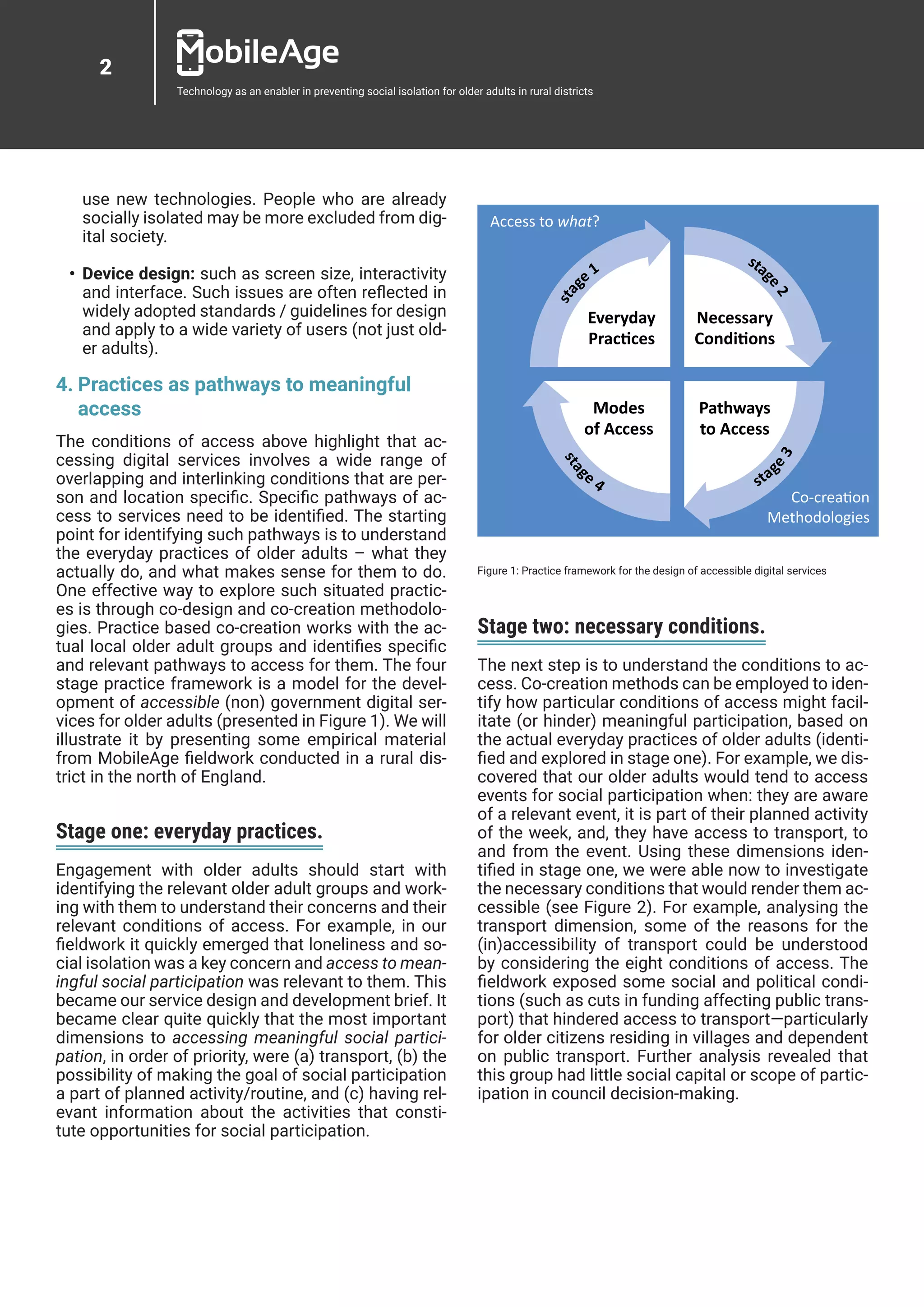
and relevant pathways to access for them. The four
stage practice framework is a model for the devel-
opment of accessible (non) government digital ser-
vices for older adults (presented in Figure 1). We will
illustrate it by presenting some empirical material
from MobileAge fieldwork conducted in a rural dis-
trict in the north of England.
Stage one: everyday practices.
Engagement with older adults should start with
identifying the relevant older adult groups and work-
ing with them to understand their concerns and their
relevant conditions of access. For example, in our
fieldwork it quickly emerged that loneliness and so-
cial isolation was a key concern and access to mean-
ingful social participation was relevant to them. This
became our service design and development brief. It
became clear quite quickly that the most important
dimensions to accessing meaningful social partici-
pation, in order of priority, were (a) transport, (b) the
possibility of making the goal of social participation
a part of planned activity/routine, and (c) having rel-
evant information about the activities that consti-
tute opportunities for social participation.
Access to what?
Co-crea�on
Methodologies
Everyday
Prac�ces
Modes
of Access
Pathways
to Access
Necessary
Condi�ons
stag
e 1
stag
e2
stag
e
3
stag
e
4
Figure 1: Practice framework for the design of accessible digital services
Stage two: necessary conditions.
The next step is to understand the conditions to ac-
cess. Co-creation methods can be employed to iden-
tify how particular conditions of access might facil-
itate (or hinder) meaningful participation, based on
the actual everyday practices of older adults (identi-
fied and explored in stage one). For example, we dis-
covered that our older adults would tend to access
events for social participation when: they are aware
of a relevant event, it is part of their planned activity
of the week, and, they have access to transport, to
and from the event. Using these dimensions iden-
tified in stage one, we were able now to investigate
the necessary conditions that would render them ac-
cessible (see Figure 2). For example, analysing the
transport dimension, some of the reasons for the
(in)accessibility of transport could be understood
by considering the eight conditions of access. The
fieldwork exposed some social and political condi-
tions (such as cuts in funding affecting public trans-
port) that hindered access to transport—particularly
for older citizens residing in villages and dependent
on public transport. Further analysis revealed that
this group had little social capital or scope of partic-
ipation in council decision-making.
3
Technology as an enabler in preventing social isolation for older adults in rural districts
Stage three: digital services as pathways to
access.
Step three is to co-create digital services that ena-
ble relevant pathways of access to such opportuni-
ties. What this step seeks to address is to identify
how ICTs may increase access to meaningful social
participation. Can existing or new information be
opened up and joined up to enable identified path-
ways to access? How might digital services align
to support and extend meaningful pathways to ac-
cess? For example, in South Lakeland, while there
were many events taking place, the information
about events was fragmented, distributed in many
different locations, often not complete, or entire-
ly accurate. This meant that an older adult faced a
significant cognitive task to gather, filter, verify and
organise the information in order to decide wheth-
er they wanted to spend their limited resources
(transport, time, etc.) to attend an event. MobileAge
South Lakeland thus co-created an application gath-
ering event information from a variety of open data
sources, organising, filtering, and making it available
to the older adults in a manner appropriate to them.
Layered onto this basic event information a number
of other connected resources were linked in order
to produce appropriate pathways to access, includ-
ing the relevant public transport routes, the weather
forecast (so they know how to prepare for the event)
and information about facilities on route and at the
event location (such as wheelchair access, toilets,
etc.)
Access to
meaningful
social
par�cipa�on
Info
about
ac�vityPart of
planned
ac�vity
Finances
Independent access Mediated access Absent access
Transport
Support for
intermediary
Provide
informa�on
No
informa�on
Finances
Health
Device/
internet
A�tude to
technology
Ownership of
transport
Social and
poli�cal
Health/
disability
No transport
access
Ability to gather
informa�on
Somebody
provides
transport
Figure 2: Unpacking and understanding pathways to access in South Lakeland
Stage four: Different modes of access to
digital services
As a final step in the process we need to consider
how the digital service will become embedded and
accessible to the majority of the older adults in their
everyday lives. Not all older adults will have access
to technology, nor will they have the same under-
standings about what constitutes meaningful partic-
ipation. Further, pathways to access will change for
specific older adults over time due to their changing
circumstances. This ongoing change is captured in
figure 3. We identified three typologies regarding ac-
cess to digital services:
Absent access: older adults that don’t have resourc-
es, competencies or intentions to access digital ser-
vices.
Mediated access: older adults that rely on others to
provide access.
Independent access: older adults that access digital
services on their own.
Move up to
mediated access
Mediated Access
Independent Access
Absent Access
If need be, move to
mediated access
Figure 3: Making meaningful access possible for the majority
4
Technology as an enabler in preventing social isolation for older adults in rural districts
Although ideal, ‘independent access’ is not achiev-
able to all, all of the time. In attempting to enable
access for the majority, ‘mediated access’ is a more
practical target. This process is represented in the
Figure (3) above. MobileAge fieldwork revealed that
many of those older adults we thought might be ex-
cluded were in fact gaining access to relevant digi-
tal services through intermediaries such as friends,
family or support workers (as highlighted in grey
in figure 2). Individual user profiles can also as-
sist in simplifying access. For example, the South
Lakeland application included a personal profile to
better match information available to the specifici-
ties and preferences of the older adult. Further that
we need to ensure that access is maintained over
time as older adult’s circumstances change (e.g. fi-
nances, bereavement, cognitive decline) we need to
ensure that they are provided with mediated access.
Thus the focus for policy must be on ensuring that
there is continued meaningful access to digital ser-
vices for the majority of older adults.
5.	Conclusion
Issues of access to digital services require a situ-
ated understanding of the pathways of access for
everyone, based on older adult’s everyday practices.
Further, pathways to access are not static, the condi-
tions of access and the mode of access will change
for individual older adults (e.g. declining health or
different financial position) and potentially for dis-
tricts (e.g. new infrastructure / agencies). Policy
thus needs to attend to these changes. Any policy
initiative should consider the following:
•	 Access is a systemic attribute and thus need to
be understood and designed systemically.
•	 The necessary conditions of access are rooted
in the everyday practices of older adults. Any
attempt to develop pathways of access should
start, and be rooted, in these.
•	 Co-creation, focused on the social practice ap-
proach, is a valuable and effective methodology
to unpack and understand the conditions of ac-
cess of older adults.
•	 Digital pathways to access are not ‘general’ solu-
tions but are specific to individual older adults,
or older adult groups. As such, personalisation is
very important.
•	 Intermediaries can be a very effective mode of
access if mediation is facilitated by digital path-
ways developed through a practice approach.
6.	Approach and methods involved in this
briefing
We have conducted in-depth qualitative research
in a rural location in the UK. This has comprised of
in-depth interviews, focus groups, and co-creation
workshops with older adults, NGO staff and volun-
teers, and with government employees. We have
also undertaken reviews of existing policy paper and
literature on accessibility.
## Authors
Professor Niall Hayes, Professor Lucas Introna
and Dr Marcia Tavares Smith – Organisation, Work
and Technology, Lancaster University, Lancaster,
LA14YX, UK.
Title: Mobile Age
Call identifier: H2020-INSO-2015: CNECT
Topic: INSO-1-2015: ICT-enabled open government
Total Budget: €2,923,993.75
Project duration: 36 months
Start Date: February 1st, 2016
Project Coordinator: LANCASTER UNIVERSITY (ULANC)
Consortium: TINGTUN AS (TT), AGE PLATFORM EUROPE
AISBL (AGE), EVANGELISCHE STIFTUNG VOLMARSTEIN
(FTB), GOVERNMENT TO YOU (GOV2U), INSTITUT FUR INFOR-
MATIONSMANAGEMENT BREMEN GMBH (ifib), ARISTOTELIO
PANEPISTIMIO THESSALONIKIS (AUTH), UNIVERSIDAD PO-
LITECNICA DE MADRID (UPM), AYUNTAMIENTO DE ZARAGO-
ZA (ZGZ), REGION OF CENTRAL MACEDONIA (RCM)
This project has received funding from the European Union’s Horizon 2020 research and innovation programme under grant agreement No 693319.
This material reflects only the author's view and the Research Executive Agency (REA) is not responsible for any use that may be made of the
information it contains.

Policy Brief : Pathways to Meaningful Access: Accessible digital services for older adults

  • 1.
    1 Technology as anenabler in preventing social isolation for older adults in rural districts Policy Priority: Developing pathways to meaningful and accessible (non) government digital services for older adults 1. Summary • An increase in digital government services can result in access challenges for older adults. • Meaningful access must focus on the situated practices (or processes) of access to services. • Information and communication technology can support existing and enable new pathways to ac- cessing digital services. • Intermediaries can play an important role in facil- itating meaningful pathways to access. 2. Background Providing accessible digital services to older adults is a key priority and concern for government. It is well known that while a wide variety of services are increasingly provided online, there are some groups that do not, or cannot participate in the use of tech- nology to the same extent as others. Older adults are one such group. Broadly, studies have highlight- ed that older women, people that live on their own, and rural older adults have the lowest internet con- nectivity. ‘Accessibility’ and ‘access’ are widely used and often contested terms. Within the literature on digital accessibility and related legislation, the term ‘accessibility’ is most commonly used in the context of improving the accessibility of devices or the in- ternet for people who have a disability or difficulties with certain activities, including those in the older age group. In this context, accessibility most com- monly refers to design and accessibility features guided by common standards such as the Web Con- tent Accessibility Guidelines. The term ‘access’ how- ever, is used much more broadly to refer to the ac- cess and use of services, supported by information and communication technologies, by a wide range of people—of which accessibility is clearly one ele- ment. It is this broader understanding of access that this policy brief focuses on. 3. Aspects of access to digital services Through a review of the literature and a comparison with the findings emerging from our empirical sites, we have identified eight key aspects that attend to this broader view of accessible digital services for older adults. Importantly, as ‘older people’ are not a homogenous group and local context can vary, these aspects can be used as guidelines in studying and designing accessible services for older adults. The eight aspects are: • Technological infrastructure and costs: which include the provision of broadband and mobile internet access, as well as ownership or access to computers and mobile devices. Cost is com- monly cited as a barrier to access. • Socio-economic conditions: which include in- come, levels of education, employment or work activity, are very significant in conditioning ac- cess to digital opportunities. These are impor- tant because of their structural nature. • Demographic/personal conditions: Demograph- ic attributes such as gender and marital status have been found to influence the access and use of digital technologies by older citizens, but are only part of broader life experiences and a range of other mediating elements that may influence use. • Attitudes/feelings: such as fear, lack of trust, anxiety and frustration along with confidence and enjoyment. • Meanings and motivation: to use relevant digital technology. It is important to understand what services may be especially meaningful to older adults in a specific setting. Also to understand their views on the relevance of technology in supporting their everyday lives. • Skills and support: are important in increasing access to digital services. While like any age group, older adults learn in a variety of different ways, interventions that include family members in training and support are especially effective. • Social and political networks: can play an impor- tant role in aiding older adults to learn about and Policy Brief : Pathways to Meaningful Access: Accessible digital services for older adults
  • 2.
    2 Technology as anenabler in preventing social isolation for older adults in rural districts use new technologies. People who are already socially isolated may be more excluded from dig- ital society. • Device design: such as screen size, interactivity and interface. Such issues are often reflected in widely adopted standards / guidelines for design and apply to a wide variety of users (not just old- er adults). 4. Practices as pathways to meaningful access The conditions of access above highlight that ac- cessing digital services involves a wide range of overlapping and interlinking conditions that are per- son and location specific. Specific pathways of ac- cess to services need to be identified. The starting point for identifying such pathways is to understand the everyday practices of older adults – what they actually do, and what makes sense for them to do. One effective way to explore such situated practic- es is through co-design and co-creation methodolo- gies. Practice based co-creation works with the ac- tual local older adult groups and identifies specific and relevant pathways to access for them. The four stage practice framework is a model for the devel- opment of accessible (non) government digital ser- vices for older adults (presented in Figure 1). We will illustrate it by presenting some empirical material from MobileAge fieldwork conducted in a rural dis- trict in the north of England. Stage one: everyday practices. Engagement with older adults should start with identifying the relevant older adult groups and work- ing with them to understand their concerns and their relevant conditions of access. For example, in our fieldwork it quickly emerged that loneliness and so- cial isolation was a key concern and access to mean- ingful social participation was relevant to them. This became our service design and development brief. It became clear quite quickly that the most important dimensions to accessing meaningful social partici- pation, in order of priority, were (a) transport, (b) the possibility of making the goal of social participation a part of planned activity/routine, and (c) having rel- evant information about the activities that consti- tute opportunities for social participation. Access to what? Co-crea�on Methodologies Everyday Prac�ces Modes of Access Pathways to Access Necessary Condi�ons stag e 1 stag e2 stag e 3 stag e 4 Figure 1: Practice framework for the design of accessible digital services Stage two: necessary conditions. The next step is to understand the conditions to ac- cess. Co-creation methods can be employed to iden- tify how particular conditions of access might facil- itate (or hinder) meaningful participation, based on the actual everyday practices of older adults (identi- fied and explored in stage one). For example, we dis- covered that our older adults would tend to access events for social participation when: they are aware of a relevant event, it is part of their planned activity of the week, and, they have access to transport, to and from the event. Using these dimensions iden- tified in stage one, we were able now to investigate the necessary conditions that would render them ac- cessible (see Figure 2). For example, analysing the transport dimension, some of the reasons for the (in)accessibility of transport could be understood by considering the eight conditions of access. The fieldwork exposed some social and political condi- tions (such as cuts in funding affecting public trans- port) that hindered access to transport—particularly for older citizens residing in villages and dependent on public transport. Further analysis revealed that this group had little social capital or scope of partic- ipation in council decision-making.
  • 3.
    3 Technology as anenabler in preventing social isolation for older adults in rural districts Stage three: digital services as pathways to access. Step three is to co-create digital services that ena- ble relevant pathways of access to such opportuni- ties. What this step seeks to address is to identify how ICTs may increase access to meaningful social participation. Can existing or new information be opened up and joined up to enable identified path- ways to access? How might digital services align to support and extend meaningful pathways to ac- cess? For example, in South Lakeland, while there were many events taking place, the information about events was fragmented, distributed in many different locations, often not complete, or entire- ly accurate. This meant that an older adult faced a significant cognitive task to gather, filter, verify and organise the information in order to decide wheth- er they wanted to spend their limited resources (transport, time, etc.) to attend an event. MobileAge South Lakeland thus co-created an application gath- ering event information from a variety of open data sources, organising, filtering, and making it available to the older adults in a manner appropriate to them. Layered onto this basic event information a number of other connected resources were linked in order to produce appropriate pathways to access, includ- ing the relevant public transport routes, the weather forecast (so they know how to prepare for the event) and information about facilities on route and at the event location (such as wheelchair access, toilets, etc.) Access to meaningful social par�cipa�on Info about ac�vityPart of planned ac�vity Finances Independent access Mediated access Absent access Transport Support for intermediary Provide informa�on No informa�on Finances Health Device/ internet A�tude to technology Ownership of transport Social and poli�cal Health/ disability No transport access Ability to gather informa�on Somebody provides transport Figure 2: Unpacking and understanding pathways to access in South Lakeland Stage four: Different modes of access to digital services As a final step in the process we need to consider how the digital service will become embedded and accessible to the majority of the older adults in their everyday lives. Not all older adults will have access to technology, nor will they have the same under- standings about what constitutes meaningful partic- ipation. Further, pathways to access will change for specific older adults over time due to their changing circumstances. This ongoing change is captured in figure 3. We identified three typologies regarding ac- cess to digital services: Absent access: older adults that don’t have resourc- es, competencies or intentions to access digital ser- vices. Mediated access: older adults that rely on others to provide access. Independent access: older adults that access digital services on their own. Move up to mediated access Mediated Access Independent Access Absent Access If need be, move to mediated access Figure 3: Making meaningful access possible for the majority
  • 4.
    4 Technology as anenabler in preventing social isolation for older adults in rural districts Although ideal, ‘independent access’ is not achiev- able to all, all of the time. In attempting to enable access for the majority, ‘mediated access’ is a more practical target. This process is represented in the Figure (3) above. MobileAge fieldwork revealed that many of those older adults we thought might be ex- cluded were in fact gaining access to relevant digi- tal services through intermediaries such as friends, family or support workers (as highlighted in grey in figure 2). Individual user profiles can also as- sist in simplifying access. For example, the South Lakeland application included a personal profile to better match information available to the specifici- ties and preferences of the older adult. Further that we need to ensure that access is maintained over time as older adult’s circumstances change (e.g. fi- nances, bereavement, cognitive decline) we need to ensure that they are provided with mediated access. Thus the focus for policy must be on ensuring that there is continued meaningful access to digital ser- vices for the majority of older adults. 5. Conclusion Issues of access to digital services require a situ- ated understanding of the pathways of access for everyone, based on older adult’s everyday practices. Further, pathways to access are not static, the condi- tions of access and the mode of access will change for individual older adults (e.g. declining health or different financial position) and potentially for dis- tricts (e.g. new infrastructure / agencies). Policy thus needs to attend to these changes. Any policy initiative should consider the following: • Access is a systemic attribute and thus need to be understood and designed systemically. • The necessary conditions of access are rooted in the everyday practices of older adults. Any attempt to develop pathways of access should start, and be rooted, in these. • Co-creation, focused on the social practice ap- proach, is a valuable and effective methodology to unpack and understand the conditions of ac- cess of older adults. • Digital pathways to access are not ‘general’ solu- tions but are specific to individual older adults, or older adult groups. As such, personalisation is very important. • Intermediaries can be a very effective mode of access if mediation is facilitated by digital path- ways developed through a practice approach. 6. Approach and methods involved in this briefing We have conducted in-depth qualitative research in a rural location in the UK. This has comprised of in-depth interviews, focus groups, and co-creation workshops with older adults, NGO staff and volun- teers, and with government employees. We have also undertaken reviews of existing policy paper and literature on accessibility. ## Authors Professor Niall Hayes, Professor Lucas Introna and Dr Marcia Tavares Smith – Organisation, Work and Technology, Lancaster University, Lancaster, LA14YX, UK. Title: Mobile Age Call identifier: H2020-INSO-2015: CNECT Topic: INSO-1-2015: ICT-enabled open government Total Budget: €2,923,993.75 Project duration: 36 months Start Date: February 1st, 2016 Project Coordinator: LANCASTER UNIVERSITY (ULANC) Consortium: TINGTUN AS (TT), AGE PLATFORM EUROPE AISBL (AGE), EVANGELISCHE STIFTUNG VOLMARSTEIN (FTB), GOVERNMENT TO YOU (GOV2U), INSTITUT FUR INFOR- MATIONSMANAGEMENT BREMEN GMBH (ifib), ARISTOTELIO PANEPISTIMIO THESSALONIKIS (AUTH), UNIVERSIDAD PO- LITECNICA DE MADRID (UPM), AYUNTAMIENTO DE ZARAGO- ZA (ZGZ), REGION OF CENTRAL MACEDONIA (RCM) This project has received funding from the European Union’s Horizon 2020 research and innovation programme under grant agreement No 693319. This material reflects only the author's view and the Research Executive Agency (REA) is not responsible for any use that may be made of the information it contains.