Transparency in government
            2.0: why and how


eGovMon project meeting

David Osimo
Tech4i2 ltd.
Structure of the talk


•   examples of gov2.0 transparency initiative
•   why does it matter?
•   a new vision taking shape?
•   what should government do?


                                                 2
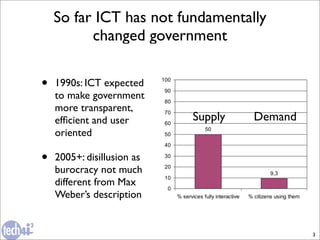
So far ICT has not fundamentally
          changed government


•   1990s: ICT expected
    to make government
    more transparent,
    efficient and user       Supply   Demand
    oriented

•   2005+: disillusion as
    burocracy not much
    different from Max
    Weber’s description


                                              3
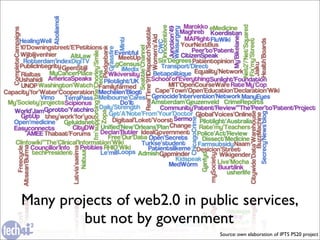
Many projects of web2.0 in public services,
         but not by government
                              Source: own elaboration of IPTS PS20 project
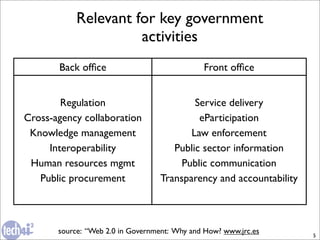
Relevant for key government
                     activities
       Back office                             Front office


        Regulation                        Service delivery
Cross-agency collaboration                 eParticipation
 Knowledge management                    Law enforcement
     Interoperability                Public sector information
 Human resources mgmt                  Public communication
   Public procurement             Transparency and accountability


       source: “Web 2.0 in Government: Why and How? www.jrc.es      5
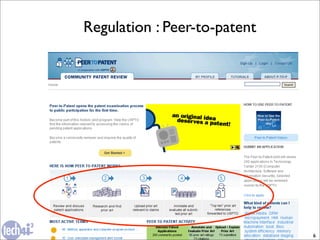
Regulation : Peer-to-patent


                              6
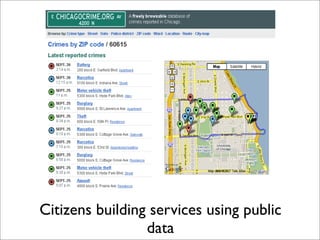
Citizens building services using public
                 data
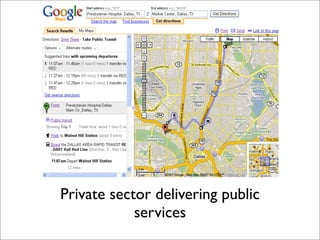
Private sector delivering public
            services
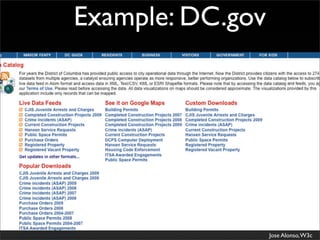
Example: DC.gov


                  Jose Alonso, W3c
Jose Alonso, W3c
Not only spontaneous:
                INCA awards

•   Context in Flanders: very few government 2.0
    project
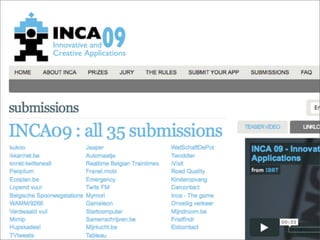
•   INCA prize: 1 month, 20K euros for new
    applications “socially useful”
•   results: 35 brand new applications on: family,
    mobility, culture, environment
•   double dividend: ICT innovation and social
    impact

                                                     12
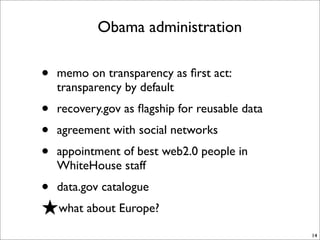
Obama administration

•   memo on transparency as first act:
    transparency by default
•   recovery.gov as flagship for reusable data
•   agreement with social networks
•   appointment of best web2.0 people in
    WhiteHouse staff
• data.gov catalogue
★what about Europe?
                                                14
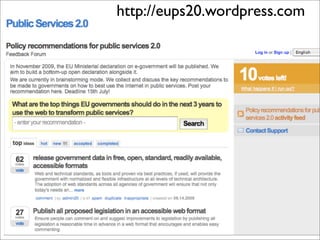
http://eups20.wordpress.com
Why?
•   Citizens and CIVIL SERVANTS already use
    web 2.0: no action ≠ no risks
•   Likely to stay as it is linked to underlying
    societal trends
    -   Today’s teenagers = future users and employees

    -   Empowered customers

    -   Creative knowledge workers

    -   From hierarchy to network-based organizations

    -   Non linear-innovation models

    -   Consumerization of ICT
                                                         16
Why?/2

Because it does not impose change (e-gov 1.0) but
acts on leverages, drivers and incentives:
•   building on unique and specific knowledge of users: the
    “cognitive surplus”
•   the power of visualization
•   reducing information and power asymmetries
•   peer recognition rather than hierarchy
•   reducing the cost of collective action
•   changing the expectations of citizens

                                                             17
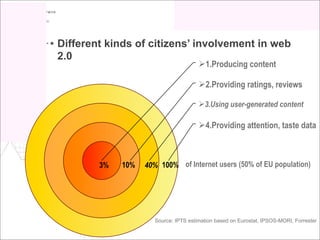
Different kinds of citizens’ involvement in web
2.0
                                      1.Producing content

                                      2.Providing ratings, reviews

                                      3.Using user-generated content

                                      4.Providing attention, taste data


        3%   10%   40% 100% of Internet users (50% of EU population)


                     Source: IPTS estimation based on Eurostat, IPSOS-MORI, Forrester
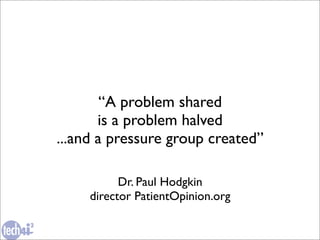
“A problem shared
       is a problem halved
...and a pressure group created”

           Dr. Paul Hodgkin
     director PatientOpinion.org
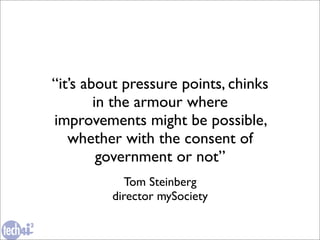
“it’s about pressure points, chinks
        in the armour where
improvements might be possible,
   whether with the consent of
         government or not”
           Tom Steinberg
         director mySociety
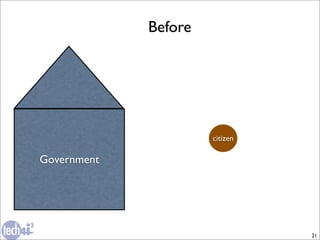
Before


                      citizen

Government


                                21
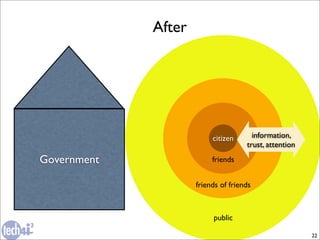
After


                          citizen      information,
                                     trust, attention

Government                friends


                     friends of friends


                          public

                                                        22
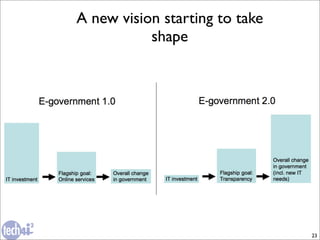
A new vision starting to take
                                      shape


To sum up, transparency, which enhances accountability and choice, can be a powerful driver, a catalyst and
a flagship for “transformational government”, rather than for “eGovernment” only.

6 What is new?                                                                                                23
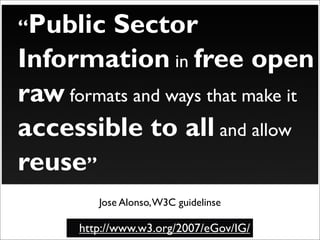
“Public  Sector
Information in free open
raw formats and ways that make it
accessible to all and allow
reuse”
     more Jose Alonso, W3Cthe 8 principles
          specific? see guidelinse
           Thanks and Q&A
       http://www.w3.org/2007/eGov/IG/
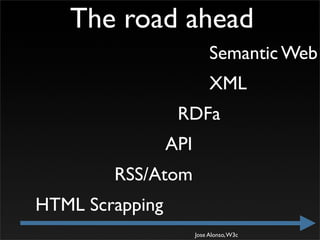
The road ahead
                            Semantic Web
                            XML
                  RDFa
                 API
        RSS/Atom
HTML Scrapping
                       Jose Alonso, W3c
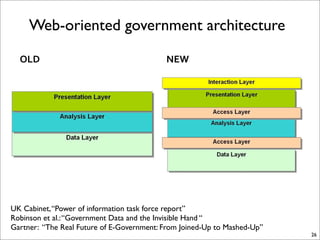
Web-oriented government architecture

  !"#                                      $%&


UK Cabinet, “Power of information task force report”
 '()*+,--.*/0)-*1-231*)+456*3-7489-(*):0-;<*=>-?@30-ABBCD
Robinson et al.: “Government Data and the Invisible Hand “
Gartner: “The Real Future of E-Government: From Joined-Up to Mashed-Up”
                                                                          26
What should
government do?
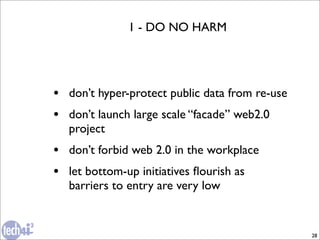
1 - DO NO HARM


• don’t hyper-protect public data from re-use
• don’t launch large scale “facade” web2.0
  project
• don’t forbid web 2.0 in the workplace
• let bottom-up initiatives flourish as
  barriers to entry are very low


                                                28
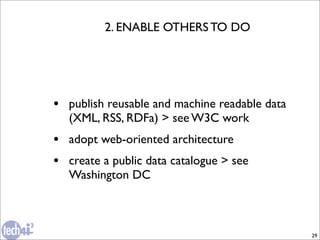
2. ENABLE OTHERS TO DO


• publish reusable and machine readable data
   (XML, RSS, RDFa) > see W3C work
• adopt web-oriented architecture
• create a public data catalogue > see
   Washington DC


                                               29
3. ACTIVELY PROMOTE


•   ensure pervasive broadband
•   create e-skills in and outside government: digital
    literacy, media literacy, web2.0 literacy,
    programming skills
•   fund bottom-up initiatives through public
    procurement, awards
•   reach out trough key intermediaries trusted by
    the community
•   listen, experiment and learn-by-doing
                                                         30
Thank you


                david.osimo@tech4i2.com


                     Further information:
Osimo, 2008. Web2.0 in government: why and how? www.jrc.es

Osimo, 2008. Benchmarking e-government in the web 2.0 era: what to
measure, and how. European Journal of ePractice, August 2008.

http://delicious.com/osimod/visualization

http://egov20.wordpress.com


                                                                     31
Back-up slides


                 32
A new innovation model for
               public services

•     A new WAY to innovate public services
    •    Continuous and incremental,
    •    open and non hyerarchical
    •    not only by government: civil society, citizens, civil
         servants
•     A new effective DRIVER to address the challenges
      of innovating public services
    •    citizens’ ratings and reviews: democratization of
         voice where there is no exit possibility
    •    more openness and transparency expected
    •    wider availability of IT tools for innovation by
         citizens, civil servants, civil society
                                                                  33
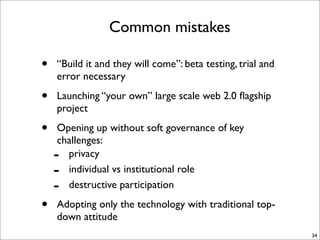
Common mistakes

•   “Build it and they will come”: beta testing, trial and
    error necessary

•   Launching “your own” large scale web 2.0 flagship
    project

•   Opening up without soft governance of key
    challenges:
    - privacy
    - individual vs institutional role
    - destructive participation

•   Adopting only the technology with traditional top-
    down attitude
                                                             34
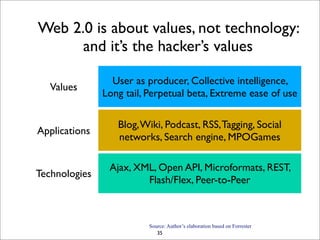
Web 2.0 is about values, not technology:
      and it’s the hacker’s values

                 User as producer, Collective intelligence,
   Values
               Long tail, Perpetual beta, Extreme ease of use

                  Blog, Wiki, Podcast, RSS, Tagging, Social
Applications
                  networks, Search engine, MPOGames

                Ajax, XML, Open API, Microformats, REST,
Technologies
                        Flash/Flex, Peer-to-Peer


                          Source: Author’s elaboration based on Forrester
                             35
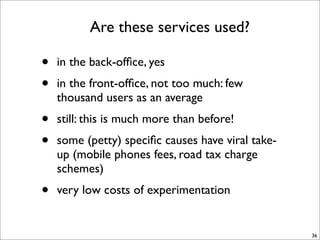
Are these services used?

•   in the back-office, yes
•   in the front-office, not too much: few
    thousand users as an average
•   still: this is much more than before!
•   some (petty) specific causes have viral take-
    up (mobile phones fees, road tax charge
    schemes)
•   very low costs of experimentation


                                                   36
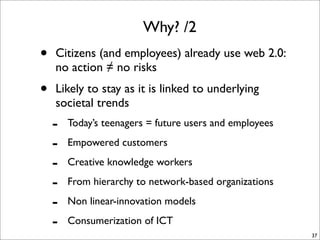
Why? /2
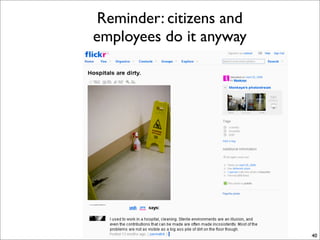
•   Citizens (and employees) already use web 2.0:
    no action ≠ no risks
•   Likely to stay as it is linked to underlying
    societal trends
    -   Today’s teenagers = future users and employees

    -   Empowered customers

    -   Creative knowledge workers

    -   From hierarchy to network-based organizations

    -   Non linear-innovation models

    -   Consumerization of ICT
                                                         37
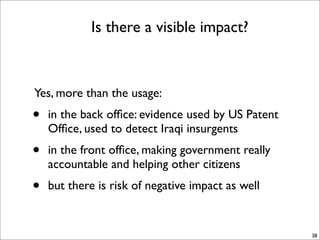
Is there a visible impact?


Yes, more than the usage:
•   in the back office: evidence used by US Patent
    Office, used to detect Iraqi insurgents
•   in the front office, making government really
    accountable and helping other citizens
•   but there is risk of negative impact as well


                                                    38
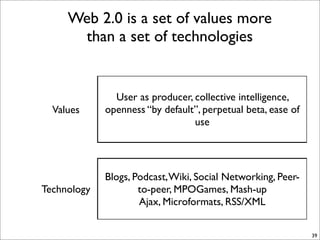
Web 2.0 is a set of values more
      than a set of technologies


               User as producer, collective intelligence,
  Values     openness “by default”, perpetual beta, ease of
                                 use


             Blogs, Podcast, Wiki, Social Networking, Peer-
Technology           to-peer, MPOGames, Mash-up
                     Ajax, Microformats, RSS/XML


                                                              39
Reminder: citizens and
employees do it anyway


                          40

Egovmon

  • 1.
    Transparency in government 2.0: why and how eGovMon project meeting David Osimo Tech4i2 ltd.
  • 2.
    Structure of thetalk • examples of gov2.0 transparency initiative • why does it matter? • a new vision taking shape? • what should government do? 2
  • 3.
    So far ICThas not fundamentally changed government • 1990s: ICT expected to make government more transparent, efficient and user Supply Demand oriented • 2005+: disillusion as burocracy not much different from Max Weber’s description 3
  • 4.
    Many projects ofweb2.0 in public services, but not by government Source: own elaboration of IPTS PS20 project
  • 5.
    Relevant for keygovernment activities Back office Front office Regulation Service delivery Cross-agency collaboration eParticipation Knowledge management Law enforcement Interoperability Public sector information Human resources mgmt Public communication Public procurement Transparency and accountability source: “Web 2.0 in Government: Why and How? www.jrc.es 5
  • 6.
  • 7.
    Citizens building servicesusing public data
  • 8.
  • 10.
    Example: DC.gov Jose Alonso, W3c
  • 11.
  • 12.
    Not only spontaneous: INCA awards • Context in Flanders: very few government 2.0 project • INCA prize: 1 month, 20K euros for new applications “socially useful” • results: 35 brand new applications on: family, mobility, culture, environment • double dividend: ICT innovation and social impact 12
  • 14.
    Obama administration • memo on transparency as first act: transparency by default • recovery.gov as flagship for reusable data • agreement with social networks • appointment of best web2.0 people in WhiteHouse staff • data.gov catalogue ★what about Europe? 14
  • 15.
  • 16.
    Why? • Citizens and CIVIL SERVANTS already use web 2.0: no action ≠ no risks • Likely to stay as it is linked to underlying societal trends - Today’s teenagers = future users and employees - Empowered customers - Creative knowledge workers - From hierarchy to network-based organizations - Non linear-innovation models - Consumerization of ICT 16
  • 17.
    Why?/2 Because it doesnot impose change (e-gov 1.0) but acts on leverages, drivers and incentives: • building on unique and specific knowledge of users: the “cognitive surplus” • the power of visualization • reducing information and power asymmetries • peer recognition rather than hierarchy • reducing the cost of collective action • changing the expectations of citizens 17
  • 18.
    Different kinds ofcitizens’ involvement in web 2.0 1.Producing content 2.Providing ratings, reviews 3.Using user-generated content 4.Providing attention, taste data 3% 10% 40% 100% of Internet users (50% of EU population) Source: IPTS estimation based on Eurostat, IPSOS-MORI, Forrester
  • 19.
    “A problem shared is a problem halved ...and a pressure group created” Dr. Paul Hodgkin director PatientOpinion.org
  • 20.
    “it’s about pressurepoints, chinks in the armour where improvements might be possible, whether with the consent of government or not” Tom Steinberg director mySociety
  • 21.
    Before citizen Government 21
  • 22.
    After citizen information, trust, attention Government friends friends of friends public 22
  • 23.
    A new visionstarting to take shape To sum up, transparency, which enhances accountability and choice, can be a powerful driver, a catalyst and a flagship for “transformational government”, rather than for “eGovernment” only. 6 What is new? 23
  • 24.
    “Public Sector Informationin free open raw formats and ways that make it accessible to all and allow reuse” more Jose Alonso, W3Cthe 8 principles specific? see guidelinse Thanks and Q&A http://www.w3.org/2007/eGov/IG/
  • 25.
    The road ahead Semantic Web XML RDFa API RSS/Atom HTML Scrapping Jose Alonso, W3c
  • 26.
    Web-oriented government architecture !"# $%& UK Cabinet, “Power of information task force report” '()*+,--.*/0)-*1-231*)+456*3-7489-(*):0-;<*=>-?@30-ABBCD Robinson et al.: “Government Data and the Invisible Hand “ Gartner: “The Real Future of E-Government: From Joined-Up to Mashed-Up” 26
  • 27.
  • 28.
    1 - DONO HARM • don’t hyper-protect public data from re-use • don’t launch large scale “facade” web2.0 project • don’t forbid web 2.0 in the workplace • let bottom-up initiatives flourish as barriers to entry are very low 28
  • 29.
    2. ENABLE OTHERSTO DO • publish reusable and machine readable data (XML, RSS, RDFa) > see W3C work • adopt web-oriented architecture • create a public data catalogue > see Washington DC 29
  • 30.
    3. ACTIVELY PROMOTE • ensure pervasive broadband • create e-skills in and outside government: digital literacy, media literacy, web2.0 literacy, programming skills • fund bottom-up initiatives through public procurement, awards • reach out trough key intermediaries trusted by the community • listen, experiment and learn-by-doing 30
  • 31.
    Thank you david.osimo@tech4i2.com Further information: Osimo, 2008. Web2.0 in government: why and how? www.jrc.es Osimo, 2008. Benchmarking e-government in the web 2.0 era: what to measure, and how. European Journal of ePractice, August 2008. http://delicious.com/osimod/visualization http://egov20.wordpress.com 31
  • 32.
  • 33.
    A new innovationmodel for public services • A new WAY to innovate public services • Continuous and incremental, • open and non hyerarchical • not only by government: civil society, citizens, civil servants • A new effective DRIVER to address the challenges of innovating public services • citizens’ ratings and reviews: democratization of voice where there is no exit possibility • more openness and transparency expected • wider availability of IT tools for innovation by citizens, civil servants, civil society 33
  • 34.
    Common mistakes • “Build it and they will come”: beta testing, trial and error necessary • Launching “your own” large scale web 2.0 flagship project • Opening up without soft governance of key challenges: - privacy - individual vs institutional role - destructive participation • Adopting only the technology with traditional top- down attitude 34
  • 35.
    Web 2.0 isabout values, not technology: and it’s the hacker’s values User as producer, Collective intelligence, Values Long tail, Perpetual beta, Extreme ease of use Blog, Wiki, Podcast, RSS, Tagging, Social Applications networks, Search engine, MPOGames Ajax, XML, Open API, Microformats, REST, Technologies Flash/Flex, Peer-to-Peer Source: Author’s elaboration based on Forrester 35
  • 36.
    Are these servicesused? • in the back-office, yes • in the front-office, not too much: few thousand users as an average • still: this is much more than before! • some (petty) specific causes have viral take- up (mobile phones fees, road tax charge schemes) • very low costs of experimentation 36
  • 37.
    Why? /2 • Citizens (and employees) already use web 2.0: no action ≠ no risks • Likely to stay as it is linked to underlying societal trends - Today’s teenagers = future users and employees - Empowered customers - Creative knowledge workers - From hierarchy to network-based organizations - Non linear-innovation models - Consumerization of ICT 37
  • 38.
    Is there avisible impact? Yes, more than the usage: • in the back office: evidence used by US Patent Office, used to detect Iraqi insurgents • in the front office, making government really accountable and helping other citizens • but there is risk of negative impact as well 38
  • 39.
    Web 2.0 isa set of values more than a set of technologies User as producer, collective intelligence, Values openness “by default”, perpetual beta, ease of use Blogs, Podcast, Wiki, Social Networking, Peer- Technology to-peer, MPOGames, Mash-up Ajax, Microformats, RSS/XML 39
  • 40.