Policy 2.0 : a reality check 
David Osimo, IPP2014
Today’s talk 
• Theory of policy 2.0 
• Examples I took part in 
• Lessons learnt from experience 
• Open questions and on-going work: policy 2.0 
evaluation
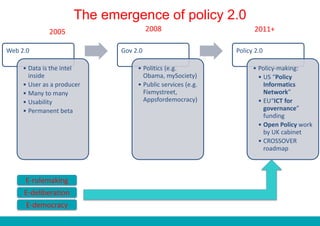
The emergence of policy 2.0 
2005 2008 2011+ 
Web 2.0 
• Data is the intel 
inside 
• User as a producer 
• Many to many 
• Usability 
• Permanent beta 
Gov 2.0 
• Politics (e.g. 
Obama, mySociety) 
• Public services (e.g. 
Fixmystreet, 
Appsfordemocracy) 
Policy 2.0 
• Policy-making: 
• US “Policy 
Informatics 
Network” 
• EU“ICT for 
governance” 
funding 
• Open Policy work 
by UK cabinet 
• CROSSOVER 
roadmap 
E-rulemaking 
E-deliberation 
E-democracy
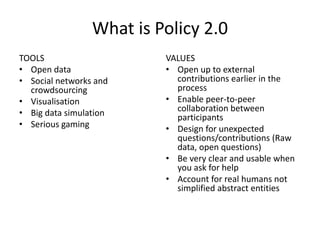
What is Policy 2.0 
TOOLS 
• Open data 
• Social networks and 
crowdsourcing 
• Visualisation 
• Big data simulation 
• Serious gaming 
VALUES 
• Open up to external 
contributions earlier in the 
process 
• Enable peer-to-peer 
collaboration between 
participants 
• Design for unexpected 
questions/contributions (Raw 
data, open questions) 
• Be very clear and usable when 
you ask for help 
• Account for real humans not 
simplified abstract entities
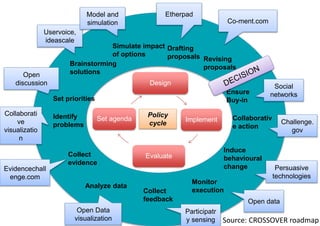
Simulate impact 
of options 
Design 
Implement 
Evaluate 
Brainstorming 
solutions 
Set agenda 
Drafting 
proposals Revising 
proposals 
Ensure 
Buy-in 
Collaborativ 
e action 
Induce 
behavioural 
change 
Monitor 
Collect execution 
feedback 
Set priorities 
Identify 
problems 
Collect 
evidence 
Analyze data 
Uservoice, 
ideascale 
Etherpad 
Co-ment.com 
Social 
networks 
Challenge. 
gov 
Persuasive 
technologies 
Open data 
Participatr 
y sensing 
Open Data 
visualization 
Open 
discussion 
Collaborati 
ve 
visualizatio 
n 
Evidencechall 
enge.com 
Policy 
cycle 
Model and 
simulation 
Source: CROSSOVER roadmap
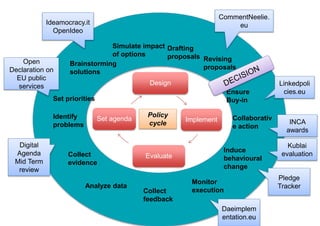
Simulate impact 
of options 
Design 
Implement 
Evaluate 
Ideamocracy.it 
Brainstorming 
solutions 
Set agenda 
Drafting 
proposals Revising 
proposals 
Ensure 
Buy-in 
Collaborativ 
e action 
Induce 
behavioural 
change 
Monitor 
Collect execution 
feedback 
Declaration on 
Set priorities 
Identify 
problems 
Collect 
evidence 
Analyze data 
OpenIdeo 
CommentNeelie. 
eu 
Linkedpoli 
cies.eu 
INCA 
awards 
Daeimplem 
entation.eu 
Open 
EU public 
services 
Digital 
Agenda 
Mid Term 
review 
Policy 
cycle 
Kublai 
evaluation 
Pledge 
Tracker
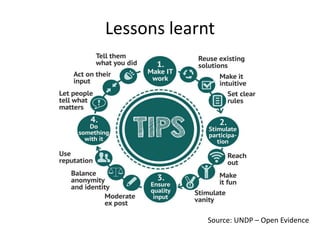
Lessons learnt 
Source: UNDP – Open Evidence
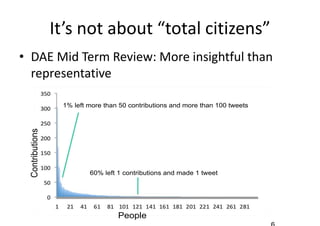
It’s not about “total citizens” 
• DAE Mid Term Review: More insightful than 
representative 
Contributions 
1% left more than 50 contributions and more than 100 tweets 
60% left 1 contributions and made 1 tweet 
People 
6
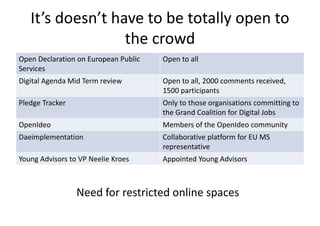
It’s doesn’t have to be totally open to 
the crowd 
Open Declaration on European Public 
Services 
Open to all 
Digital Agenda Mid Term review Open to all, 2000 comments received, 
1500 participants 
Pledge Tracker Only to those organisations committing to 
the Grand Coalition for Digital Jobs 
OpenIdeo Members of the OpenIdeo community 
Daeimplementation Collaborative platform for EU MS 
representative 
Young Advisors to VP Neelie Kroes Appointed Young Advisors 
Need for restricted online spaces
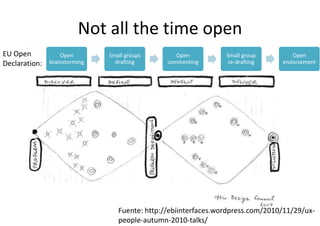
Not all the time open 
Fuente: http://ebiinterfaces.wordpress.com/2010/11/29/ux-people- 
autumn-2010-talks/ 
Open 
brainstorming 
Small groups 
drafting 
Open 
commenting 
Small group 
re-drafting 
Open 
endorsement 
EU Open 
Declaration:
A reality check: policy-making 2.0 still 
more promising than impactful 
• 2050 PATHWAYS : high usage (16K pathways created, 200 
stakeholders involved in the building phase). Higher 
awareness by citizens. Output used by govt to back up the 
Carbon Strategy. 
• GLEAM: adopted by mainstream gov’t agency to anticipate 
disease spread through transportation. Adopted also for 
educational purposes 
• OPINION SPACE 3.0: significant participation (5K individuals) , 
endorsement at top level (Secretary of State Clinton) 
• URBANSIM: High usage by US local gov’t 
Lack of systematic robust evaluation of different policy-methods. 
Initial evidence points to the potential impact, but very far 
from counterfactual / RCT approach available to date.
Open questions 
– Does Policy 2.0 favour the participation of people 
beyond the “usual suspects”? Is it only for the 
elite? 
– Does it bring new relevant ideas useful for policy-making? 
– Does it actually lead to better policies?
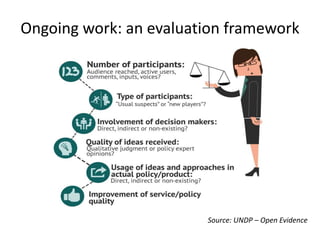
Ongoing work: an evaluation framework 
Source: UNDP – Open Evidence
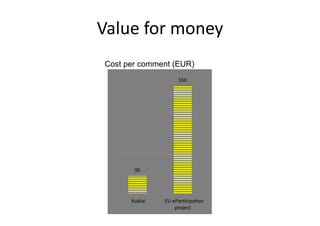
Value for money 
Cost per comment (EUR) 
90	 
550	 
Kublai	 	EU	ePar cipa on	 
project
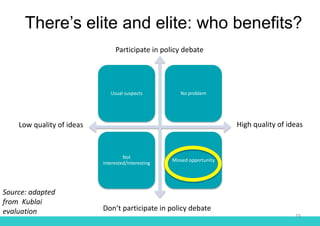
There’s elite and elite: who benefits? 
Participate in policy debate 
Low quality of ideas High quality of ideas 
15 
Usual suspects No problem 
Not 
interested/interesting 
Missed opportunity 
Don’t participate in policy debate 
Source: adapted 
from Kublai 
evaluation
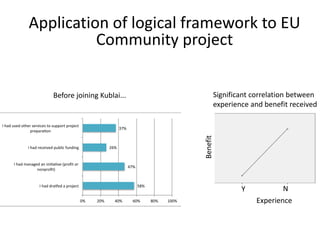
Application of logical framework to EU 
Community project 
Before joining Kublai... Significant correlation between 
37%	 
47%	 
58%	 
26%	 
I	had	used	other	services	to	support	project	 
prepara on	 
I	had	received	public	funding	 
I	had	managed	an	ini a ve	(profit	or	 
I	had	dra ed	a	project	 
0%	 20%	 40%	 60%	 80%	 100%	 
nonprofit)	 
experience and benefit received 
Y N 
Experience 
Benefit
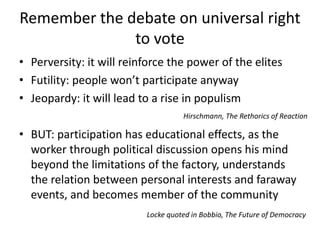
Remember the debate on universal right 
to vote 
• Perversity: it will reinforce the power of the elites 
• Futility: people won’t participate anyway 
• Jeopardy: it will lead to a rise in populism 
Hirschmann, The Rethorics of Reaction 
• BUT: participation has educational effects, as the 
worker through political discussion opens his mind 
beyond the limitations of the factory, understands 
the relation between personal interests and faraway 
events, and becomes member of the community 
Locke quoted in Bobbio, The Future of Democracy
Summing up 
• Policy 2.0 (or whatever we call it) is richer and more 
complex than crowdsourcing 
• It is a growing and promising trend in research and 
practice 
• There are open questions regarding its impact that 
deserve thorough scrutiny 
• Yet we should always remember that public 
involvement in policy-making is a goal in itself and it 
should not be justified by evidence, but by values
Thanks 
• dosimo@open-evidence.com 
• Egov20.wordpress.com 
• @osimod

Ipp2014

  • 1.
    Policy 2.0 :a reality check David Osimo, IPP2014
  • 2.
    Today’s talk •Theory of policy 2.0 • Examples I took part in • Lessons learnt from experience • Open questions and on-going work: policy 2.0 evaluation
  • 3.
    The emergence ofpolicy 2.0 2005 2008 2011+ Web 2.0 • Data is the intel inside • User as a producer • Many to many • Usability • Permanent beta Gov 2.0 • Politics (e.g. Obama, mySociety) • Public services (e.g. Fixmystreet, Appsfordemocracy) Policy 2.0 • Policy-making: • US “Policy Informatics Network” • EU“ICT for governance” funding • Open Policy work by UK cabinet • CROSSOVER roadmap E-rulemaking E-deliberation E-democracy
  • 4.
    What is Policy2.0 TOOLS • Open data • Social networks and crowdsourcing • Visualisation • Big data simulation • Serious gaming VALUES • Open up to external contributions earlier in the process • Enable peer-to-peer collaboration between participants • Design for unexpected questions/contributions (Raw data, open questions) • Be very clear and usable when you ask for help • Account for real humans not simplified abstract entities
  • 5.
    Simulate impact ofoptions Design Implement Evaluate Brainstorming solutions Set agenda Drafting proposals Revising proposals Ensure Buy-in Collaborativ e action Induce behavioural change Monitor Collect execution feedback Set priorities Identify problems Collect evidence Analyze data Uservoice, ideascale Etherpad Co-ment.com Social networks Challenge. gov Persuasive technologies Open data Participatr y sensing Open Data visualization Open discussion Collaborati ve visualizatio n Evidencechall enge.com Policy cycle Model and simulation Source: CROSSOVER roadmap
  • 6.
    Simulate impact ofoptions Design Implement Evaluate Ideamocracy.it Brainstorming solutions Set agenda Drafting proposals Revising proposals Ensure Buy-in Collaborativ e action Induce behavioural change Monitor Collect execution feedback Declaration on Set priorities Identify problems Collect evidence Analyze data OpenIdeo CommentNeelie. eu Linkedpoli cies.eu INCA awards Daeimplem entation.eu Open EU public services Digital Agenda Mid Term review Policy cycle Kublai evaluation Pledge Tracker
  • 7.
    Lessons learnt Source:UNDP – Open Evidence
  • 8.
    It’s not about“total citizens” • DAE Mid Term Review: More insightful than representative Contributions 1% left more than 50 contributions and more than 100 tweets 60% left 1 contributions and made 1 tweet People 6
  • 9.
    It’s doesn’t haveto be totally open to the crowd Open Declaration on European Public Services Open to all Digital Agenda Mid Term review Open to all, 2000 comments received, 1500 participants Pledge Tracker Only to those organisations committing to the Grand Coalition for Digital Jobs OpenIdeo Members of the OpenIdeo community Daeimplementation Collaborative platform for EU MS representative Young Advisors to VP Neelie Kroes Appointed Young Advisors Need for restricted online spaces
  • 10.
    Not all thetime open Fuente: http://ebiinterfaces.wordpress.com/2010/11/29/ux-people- autumn-2010-talks/ Open brainstorming Small groups drafting Open commenting Small group re-drafting Open endorsement EU Open Declaration:
  • 11.
    A reality check:policy-making 2.0 still more promising than impactful • 2050 PATHWAYS : high usage (16K pathways created, 200 stakeholders involved in the building phase). Higher awareness by citizens. Output used by govt to back up the Carbon Strategy. • GLEAM: adopted by mainstream gov’t agency to anticipate disease spread through transportation. Adopted also for educational purposes • OPINION SPACE 3.0: significant participation (5K individuals) , endorsement at top level (Secretary of State Clinton) • URBANSIM: High usage by US local gov’t Lack of systematic robust evaluation of different policy-methods. Initial evidence points to the potential impact, but very far from counterfactual / RCT approach available to date.
  • 12.
    Open questions –Does Policy 2.0 favour the participation of people beyond the “usual suspects”? Is it only for the elite? – Does it bring new relevant ideas useful for policy-making? – Does it actually lead to better policies?
  • 13.
    Ongoing work: anevaluation framework Source: UNDP – Open Evidence
  • 14.
    Value for money Cost per comment (EUR) 90 550 Kublai EU ePar cipa on project
  • 15.
    There’s elite andelite: who benefits? Participate in policy debate Low quality of ideas High quality of ideas 15 Usual suspects No problem Not interested/interesting Missed opportunity Don’t participate in policy debate Source: adapted from Kublai evaluation
  • 16.
    Application of logicalframework to EU Community project Before joining Kublai... Significant correlation between 37% 47% 58% 26% I had used other services to support project prepara on I had received public funding I had managed an ini a ve (profit or I had dra ed a project 0% 20% 40% 60% 80% 100% nonprofit) experience and benefit received Y N Experience Benefit
  • 17.
    Remember the debateon universal right to vote • Perversity: it will reinforce the power of the elites • Futility: people won’t participate anyway • Jeopardy: it will lead to a rise in populism Hirschmann, The Rethorics of Reaction • BUT: participation has educational effects, as the worker through political discussion opens his mind beyond the limitations of the factory, understands the relation between personal interests and faraway events, and becomes member of the community Locke quoted in Bobbio, The Future of Democracy
  • 18.
    Summing up •Policy 2.0 (or whatever we call it) is richer and more complex than crowdsourcing • It is a growing and promising trend in research and practice • There are open questions regarding its impact that deserve thorough scrutiny • Yet we should always remember that public involvement in policy-making is a goal in itself and it should not be justified by evidence, but by values
  • 19.
    Thanks • dosimo@open-evidence.com • Egov20.wordpress.com • @osimod