Joint Research Centre (JRC) User-driven innovation in public services David Osimo, Alexandra Hache, Kirsti Ala-Mutka, Yves Punie Institute for Prospective Technological Studies European Commission - Joint Research Centre NOTES 1. PLACE, DATE AND EVENT NAME 1.1.  Access the slide-set place, date and event name text box beneath the JRC logo from the Slide Master. 1.2.  Do not change the size nor the position of that text box. 1.3.   Replace the mock-up texts for the place (“Place”), the date (“dd Month YYYY”) and the event name (“Event Name”) with your own texts. 1.4.  Set it in MetaPlus Book Roman, if you own the typeface. Otherwise, keep the original typeface – Arial.  1.5.  Keep the original flush-left justification.  1.6.  Keep the original font colour (white).  1.7.  Keep the original font body size (7 pt) and the text on one single line. 2. SLIDE NUMBER 2.1.  The slide number on the banner’s lower right-hand side is automatically generated. 3. SLIDES 3.1.  Duplicate the first slide as needed. 3.2.  Do not change the size nor the position of the slide’s text box. 3.3.  Try not to place more text on each slide than will fit in the given text box. 3.4.  Replace the mock-up heading text (“Joint Research Centre (JRC)”) with your own text heading. 3.5.  Set it in Eurostile Bold Extended Two or in Helvetica Rounded Bold Condensed, if you own one of these typefaces. Otherwise, keep the original typeface – Arial.  3.6.  Keep the original flush-left justification.  3.7.  Keep the original font colour (100c 80m 0y 0k).  3.8.  Keep the original font body size (28 pt) and the heading on one single line whenever possible. Reduce the font body size if needed. 3.9.  Replace the mock-up text (“The European Commission’s Research-Based Policy Support Organisation)”) with your own text. 3.10.  Set it in MetaPlus Book Roman, if you own the typeface. Otherwise, keep the original typeface – Arial.  3.11.  Keep the original flush-left justification.  3.12.  Keep the original font colour (100c 80m 0y 0k). Use black if you need a second colour.  3.13.  Keep the original font body size (22 pt) or reduce it if unavoidable. 3.14.  Replace the EU-27 map mock-up illustration with your own illustration(s). 3.13.  Try to keep your illustration(s) right- and top- or bottom-aligned with the main text box whenever possible.
Outline The context and scope Analysis of cases in public services  Conclusions and next steps
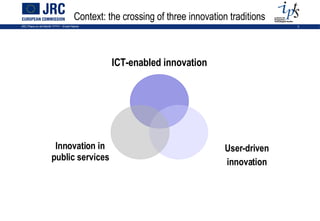
Context: the crossing of three innovation traditions User-driven  innovation  Innovation in public services ICT-enabled innovation
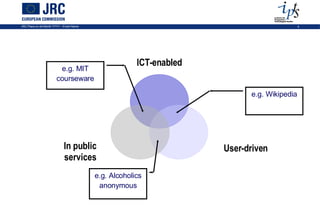
User-driven  In public services e.g. Alcoholics anonymous e.g. Wikipedia e.g. MIT courseware ICT-enabled
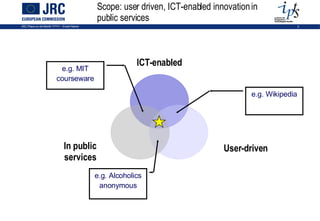
Scope: user driven, ICT-enabled innovation in public services User-driven  In public services e.g. Alcoholics anonymous e.g. Wikipedia e.g. MIT courseware ICT-enabled
Analysis of cases in public services
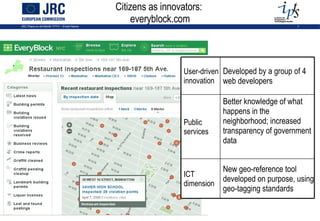
Citizens as innovators:  everyblock.com New geo-reference tool developed on purpose, using geo-tagging standards ICT dimension Better knowledge of what happens in the neighborhood; increased transparency of government data Public services Developed by a group of 4 web developers User-driven innovation
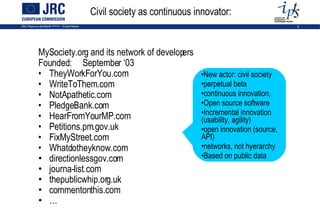
Civil society as continuous innovator: MySociety.org and its network of developers Founded: September ‘03 TheyWorkForYou.com WriteToThem.com NotApathetic.com PledgeBank.com HearFromYourMP.com Petitions.pm.gov.uk  FixMyStreet.com Whatdotheyknow.com directionlessgov.com  journa-list.com  thepublicwhip.org.uk  commentonthis.com … New actor: civil society perpetual beta  continuous innovation,  Open source software Incremental innovation (usability, agility) open innovation (source, API) networks, not hyerarchy Based on public data
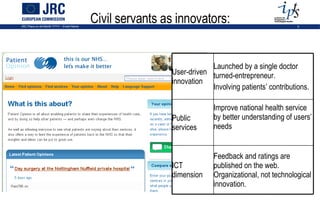
Civil servants as innovators: Feedback and ratings are published on the web. Organizational, not technological innovation. ICT dimension Improve national health service by better understanding of users’ needs Public services Launched by a single doctor turned-entrepreneur. Involving patients’ contributions.  User-driven innovation
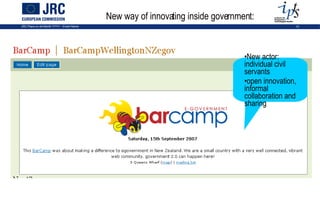
New way of innovating inside government: New actor: individual civil servants open innovation, informal collaboration and sharing
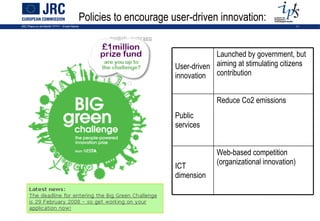
Policies to encourage user-driven innovation:  Web-based competition (organizational innovation)‏ ICT dimension Reduce Co2 emissions Public services Launched by government, but aiming at stimulating citizens contribution User-driven innovation
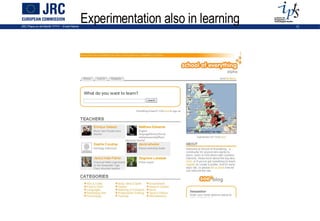
Experimentation also in learning
Implications for public services A new WAY to innovate public services Exploiting the unique knowledge and skills of networked individual users: learners, teachers, parents, employees… Continuous and incremental, Open and non hierarchical, difficult to control Lowering costs of failure and of trial and error Building on voluntary engagement and free tools Not only by government: civil society, citizens, civil servants
Implications for public services /2 A new effective DRIVER to address the challenges of innovating public services citizens’ ratings and reviews: reducing information asymmetries, exposing inefficiencies through citizen-to-citizen exchanges of information easier creation of pressure groups to make new needs emerge Because of: a wider availability of free IT tools for citizens, civil servants, civil society (blogs, collaboration tools, geographical applications…)  a culture of public speaking, and increased expectations of openness and transparency In education: wider openness of learning materials, exchange of learning experiences, more public discussions between learners and teachers Possibility for better informed learning, teaching, selection of learning provider and topics
It might work only for the elite, or in exceptional/specific circumstances It works better for incremental innovation than for radical Not always it is sustainable and up-scalable Universality of service is a challenge Risks of destructive behavior BUT…
In conclusion User-driven innovation in public services Long tradition, but new developments Already applied in many different contexts Very difficult to control or to stop, part of a long-term societal  change Necessary to take it into account in order to grasp opportunities and avoid risks Open questions What is the real significance and impact? What are the risks? What are the enabling factors? What can government and educational institution do?  Which new forms of governance and certification are needed?

user driven innovation in public services

  • 1.
    Joint Research Centre(JRC) User-driven innovation in public services David Osimo, Alexandra Hache, Kirsti Ala-Mutka, Yves Punie Institute for Prospective Technological Studies European Commission - Joint Research Centre NOTES 1. PLACE, DATE AND EVENT NAME 1.1. Access the slide-set place, date and event name text box beneath the JRC logo from the Slide Master. 1.2. Do not change the size nor the position of that text box. 1.3. Replace the mock-up texts for the place (“Place”), the date (“dd Month YYYY”) and the event name (“Event Name”) with your own texts. 1.4. Set it in MetaPlus Book Roman, if you own the typeface. Otherwise, keep the original typeface – Arial. 1.5. Keep the original flush-left justification. 1.6. Keep the original font colour (white). 1.7. Keep the original font body size (7 pt) and the text on one single line. 2. SLIDE NUMBER 2.1. The slide number on the banner’s lower right-hand side is automatically generated. 3. SLIDES 3.1. Duplicate the first slide as needed. 3.2. Do not change the size nor the position of the slide’s text box. 3.3. Try not to place more text on each slide than will fit in the given text box. 3.4. Replace the mock-up heading text (“Joint Research Centre (JRC)”) with your own text heading. 3.5. Set it in Eurostile Bold Extended Two or in Helvetica Rounded Bold Condensed, if you own one of these typefaces. Otherwise, keep the original typeface – Arial. 3.6. Keep the original flush-left justification. 3.7. Keep the original font colour (100c 80m 0y 0k). 3.8. Keep the original font body size (28 pt) and the heading on one single line whenever possible. Reduce the font body size if needed. 3.9. Replace the mock-up text (“The European Commission’s Research-Based Policy Support Organisation)”) with your own text. 3.10. Set it in MetaPlus Book Roman, if you own the typeface. Otherwise, keep the original typeface – Arial. 3.11. Keep the original flush-left justification. 3.12. Keep the original font colour (100c 80m 0y 0k). Use black if you need a second colour. 3.13. Keep the original font body size (22 pt) or reduce it if unavoidable. 3.14. Replace the EU-27 map mock-up illustration with your own illustration(s). 3.13. Try to keep your illustration(s) right- and top- or bottom-aligned with the main text box whenever possible.
  • 2.
    Outline The contextand scope Analysis of cases in public services Conclusions and next steps
  • 3.
    Context: the crossingof three innovation traditions User-driven innovation Innovation in public services ICT-enabled innovation
  • 4.
    User-driven Inpublic services e.g. Alcoholics anonymous e.g. Wikipedia e.g. MIT courseware ICT-enabled
  • 5.
    Scope: user driven,ICT-enabled innovation in public services User-driven In public services e.g. Alcoholics anonymous e.g. Wikipedia e.g. MIT courseware ICT-enabled
  • 6.
    Analysis of casesin public services
  • 7.
    Citizens as innovators: everyblock.com New geo-reference tool developed on purpose, using geo-tagging standards ICT dimension Better knowledge of what happens in the neighborhood; increased transparency of government data Public services Developed by a group of 4 web developers User-driven innovation
  • 8.
    Civil society ascontinuous innovator: MySociety.org and its network of developers Founded: September ‘03 TheyWorkForYou.com WriteToThem.com NotApathetic.com PledgeBank.com HearFromYourMP.com Petitions.pm.gov.uk FixMyStreet.com Whatdotheyknow.com directionlessgov.com journa-list.com thepublicwhip.org.uk commentonthis.com … New actor: civil society perpetual beta continuous innovation, Open source software Incremental innovation (usability, agility) open innovation (source, API) networks, not hyerarchy Based on public data
  • 9.
    Civil servants asinnovators: Feedback and ratings are published on the web. Organizational, not technological innovation. ICT dimension Improve national health service by better understanding of users’ needs Public services Launched by a single doctor turned-entrepreneur. Involving patients’ contributions. User-driven innovation
  • 10.
    New way ofinnovating inside government: New actor: individual civil servants open innovation, informal collaboration and sharing
  • 11.
    Policies to encourageuser-driven innovation: Web-based competition (organizational innovation)‏ ICT dimension Reduce Co2 emissions Public services Launched by government, but aiming at stimulating citizens contribution User-driven innovation
  • 12.
  • 13.
    Implications for publicservices A new WAY to innovate public services Exploiting the unique knowledge and skills of networked individual users: learners, teachers, parents, employees… Continuous and incremental, Open and non hierarchical, difficult to control Lowering costs of failure and of trial and error Building on voluntary engagement and free tools Not only by government: civil society, citizens, civil servants
  • 14.
    Implications for publicservices /2 A new effective DRIVER to address the challenges of innovating public services citizens’ ratings and reviews: reducing information asymmetries, exposing inefficiencies through citizen-to-citizen exchanges of information easier creation of pressure groups to make new needs emerge Because of: a wider availability of free IT tools for citizens, civil servants, civil society (blogs, collaboration tools, geographical applications…) a culture of public speaking, and increased expectations of openness and transparency In education: wider openness of learning materials, exchange of learning experiences, more public discussions between learners and teachers Possibility for better informed learning, teaching, selection of learning provider and topics
  • 15.
    It might workonly for the elite, or in exceptional/specific circumstances It works better for incremental innovation than for radical Not always it is sustainable and up-scalable Universality of service is a challenge Risks of destructive behavior BUT…
  • 16.
    In conclusion User-driveninnovation in public services Long tradition, but new developments Already applied in many different contexts Very difficult to control or to stop, part of a long-term societal change Necessary to take it into account in order to grasp opportunities and avoid risks Open questions What is the real significance and impact? What are the risks? What are the enabling factors? What can government and educational institution do? Which new forms of governance and certification are needed?

Editor's Notes

  • #2 NOTES 1. PLACE, DATE AND EVENT NAME 1.1. Access the slide-set place, date and event name text box beneath the JRC logo from the Slide Master. 1.2. Do not change the size nor the position of that text box. 1.3. Replace the mock-up texts for the place (“Place”), the date (“dd Month YYYY”) and the event name (“Event Name”) with your own texts. 1.4. Set it in MetaPlus Book Roman, if you own the typeface. Otherwise, keep the original typeface – Arial. 1.5. Keep the original flush-left justification. 1.6. Keep the original font colour (white). 1.7. Keep the original font body size (7 pt) and the text on one single line. 2. SLIDE NUMBER 2.1. The slide number on the banner’s lower right-hand side is automatically generated. 3. SLIDES 3.1. Duplicate the first slide as needed. 3.2. Do not change the size nor the position of the slide’s text box. 3.3. Try not to place more text on each slide than will fit in the given text box. 3.4. Replace the mock-up heading text (“Joint Research Centre (JRC)”) with your own text heading. 3.5. Set it in Eurostile Bold Extended Two or in Helvetica Rounded Bold Condensed, if you own one of these typefaces. Otherwise, keep the original typeface – Arial. 3.6. Keep the original flush-left justification. 3.7. Keep the original font colour (100c 80m 0y 0k). 3.8. Keep the original font body size (28 pt) and the heading on one single line whenever possible. Reduce the font body size if needed. 3.9. Replace the mock-up text (“The European Commission’s Research-Based Policy Support Organisation)”) with your own text. 3.10. Set it in MetaPlus Book Roman, if you own the typeface. Otherwise, keep the original typeface – Arial. 3.11. Keep the original flush-left justification. 3.12. Keep the original font colour (100c 80m 0y 0k). Use black if you need a second colour. 3.13. Keep the original font body size (22 pt) or reduce it if unavoidable. 3.14. Replace the EU-27 map mock-up illustration with your own illustration(s). 3.13. Try to keep your illustration(s) right- and top- or bottom-aligned with the main text box whenever possible.