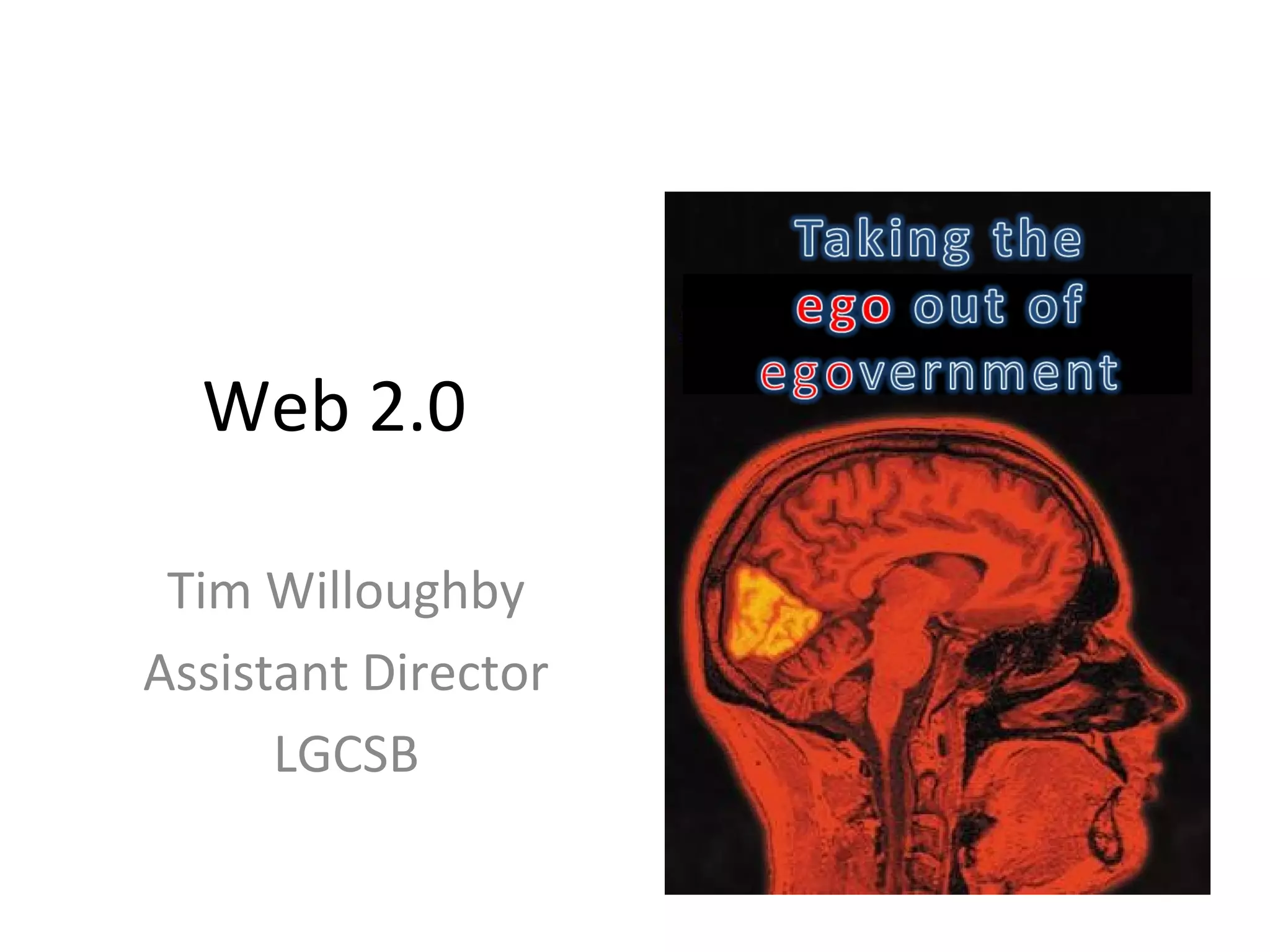
Web 2.0

 Tim Willoughby
Assistant Director
      LGCSB
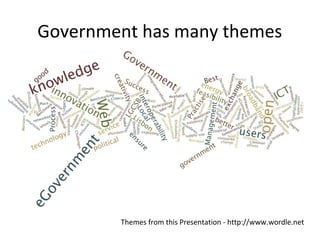
Government has many themes


        Themes from this Presentation - http://www.wordle.net
LGCSB
• Shared Service for Local Government
  – Business
     • Governance, Process Improvement, Process
       Management, Project Management
  – ICT
     • Web, Hosting, Standard Platform, Support
  – Research & Architecture
     • OSS, Cloud, Development Methodologies, Standards,
       SOA
Local Government
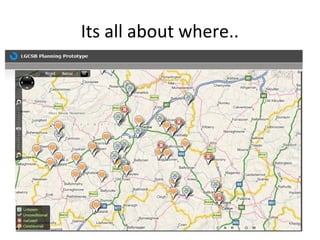
Its all about where..
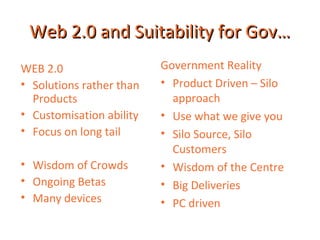
Web 2.0 and Suitability for Gov…
WEB 2.0                   Government Reality
• Solutions rather than   • Product Driven – Silo
  Products                  approach
• Customisation ability   • Use what we give you
• Focus on long tail      • Silo Source, Silo
                            Customers
• Wisdom of Crowds        • Wisdom of the Centre
• Ongoing Betas           • Big Deliveries
• Many devices            • PC driven
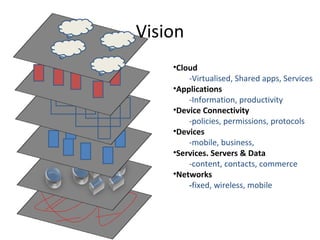
Vision
    •Cloud
        -Virtualised, Shared apps, Services
    •Applications
        -Information, productivity
    •Device Connectivity
        -policies, permissions, protocols
    •Devices
        -mobile, business,
    •Services. Servers & Data
        -content, contacts, commerce
    •Networks
        -fixed, wireless, mobile
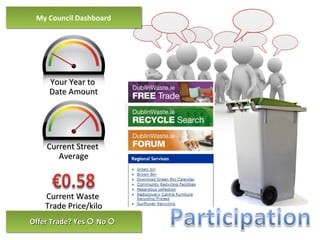
My Council Dashboard
 My Council Dashboard


     Your Year to
     Date Amount


    Current Street
       Average


    Current Waste
    Trade Price/kilo
Offer Trade? Yes  No 
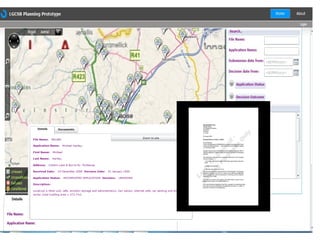
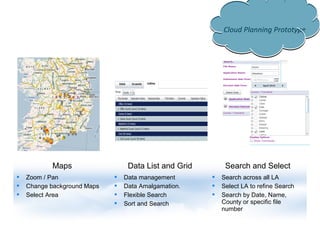
Cloud Planning Prototype


           Maps                   Data List and Grid        Search and Select
   Zoom / Pan                  Data management          Search across all LA
   Change background Maps      Data Amalgamation.       Select LA to refine Search
   Select Area                 Flexible Search          Search by Date, Name,
                                Sort and Search           County or specific file
                                                           number
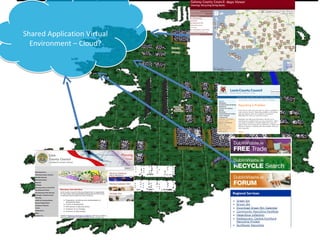
Shared Application Virtual
  Environment – Cloud?
Modernisation
•   Simple and user-oriented
•   Participative and inclusive
•   Transparent and accountable
•   Joined-up and networked
•   Efficient and innovative

ICT a strategic instrument to achieve this?
Challenges for Public Servants
•   Vertical institutional structures
•   Perverse incentives
•   Misuse of capital/labour substitution
•   Outsourcing v. integration/reform
•   Customer service strategies
Logic?
• Democracy, equality
• Security/privacy
• System feasibility, interoperability, adaptability,
  standardisation
• Administrative and political feasibility
• Agency autonomy and flexibility
• Economics (resources, budgeting)
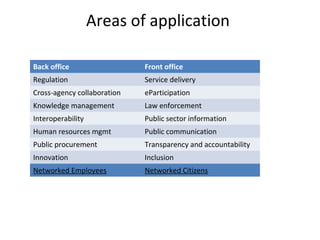
Areas of application

Back office                  Front office
Regulation                   Service delivery
Cross-agency collaboration   eParticipation
Knowledge management         Law enforcement
Interoperability             Public sector information
Human resources mgmt         Public communication
Public procurement           Transparency and accountability
Innovation                   Inclusion
Networked Employees          Networked Citizens
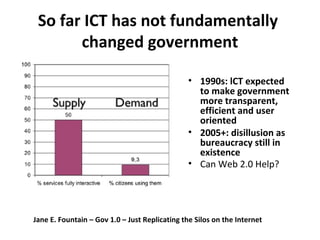
So far ICT has not fundamentally
       changed government

                                                • 1990s: lCT expected
                                                  to make government
                                                  more transparent,
                                                  efficient and user
                                                  oriented
                                                • 2005+: disillusion as
                                                  bureaucracy still in
                                                  existence
                                                • Can Web 2.0 Help?


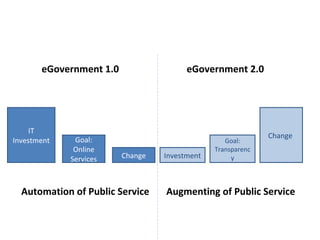
Jane E. Fountain – Gov 1.0 – Just Replicating the Silos on the Internet
eGovernment 1.0                  eGovernment 2.0


     IT
                                                             Change
Investment    Goal:                               Goal:
              Online                           Transparenc
             Services    Change   Investment        y


  Automation of Public Service    Augmenting of Public Service
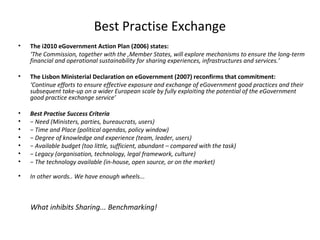
Best Practise Exchange
•   The i2010 eGovernment Action Plan (2006) states:
    ‘The Commission, together with the ,Member States, will explore mechanisms to ensure the long-term
    financial and operational sustainability for sharing experiences, infrastructures and services.’

•   The Lisbon Ministerial Declaration on eGovernment (2007) reconfirms that commitment:
    ‘Continue efforts to ensure effective exposure and exchange of eGovernment good practices and their
    subsequent take-up on a wider European scale by fully exploiting the potential of the eGovernment
    good practice exchange service’

•   Best Practise Success Criteria
•   − Need (Ministers, parties, bureaucrats, users)
•   − Time and Place (political agendas, policy window)
•   − Degree of knowledge and experience (team, leader, users)
•   − Available budget (too little, sufficient, abundant – compared with the task)
•   − Legacy (organisation, technology, legal framework, culture)
•   − The technology available (in-house, open source, or on the market)

•   In other words.. We have enough wheels...


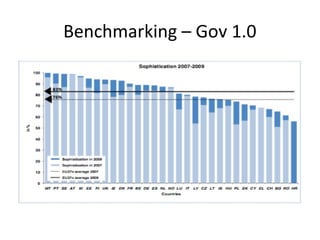
    What inhibits Sharing... Benchmarking!
Benchmarking – Gov 1.0
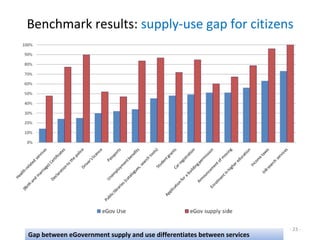
Benchmark results: supply-use gap for citizens


                                                                         - 23 -
Gap between eGovernment supply and use differentiates between services
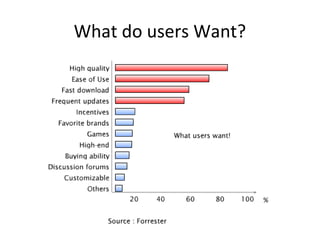
What do users Want?
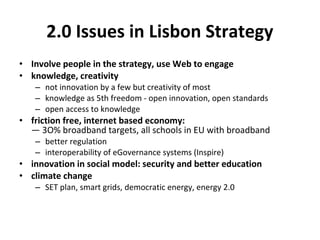
2.0 Issues in Lisbon Strategy
• Involve people in the strategy, use Web to engage
• knowledge, creativity
   – not innovation by a few but creativity of most
   – knowledge as 5th freedom - open innovation, open standards
   – open access to knowledge
• friction free, internet based economy:
  — 3O% broadband targets, all schools in EU with broadband
   – better regulation
   – interoperability of eGovernance systems (Inspire)
• innovation in social model: security and better education
• climate change
   – SET plan, smart grids, democratic energy, energy 2.0
Local Government Success
• eProcurement / eCommerce
• Tax Collection
• Online Payments
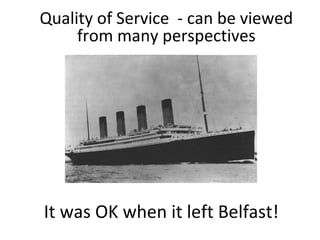
Quality of Service - can be viewed
     from many perspectives


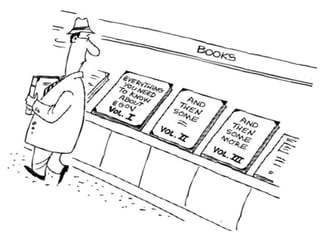
It was OK when it left Belfast!
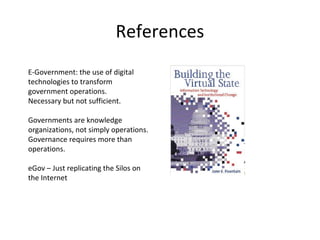
References
E-Government: the use of digital
technologies to transform
government operations.
Necessary but not sufficient.

Governments are knowledge
organizations, not simply operations.
Governance requires more than
operations.

eGov – Just replicating the Silos on
the Internet
Tim Willoughby Presentation on web 2.0

Tim Willoughby Presentation on web 2.0

  • 1.
    Web 2.0 TimWilloughby Assistant Director LGCSB
  • 2.
    Government has manythemes Themes from this Presentation - http://www.wordle.net
  • 3.
    LGCSB • Shared Servicefor Local Government – Business • Governance, Process Improvement, Process Management, Project Management – ICT • Web, Hosting, Standard Platform, Support – Research & Architecture • OSS, Cloud, Development Methodologies, Standards, SOA
  • 4.
  • 5.
  • 6.
    Web 2.0 andSuitability for Gov… WEB 2.0 Government Reality • Solutions rather than • Product Driven – Silo Products approach • Customisation ability • Use what we give you • Focus on long tail • Silo Source, Silo Customers • Wisdom of Crowds • Wisdom of the Centre • Ongoing Betas • Big Deliveries • Many devices • PC driven
  • 7.
    Vision •Cloud -Virtualised, Shared apps, Services •Applications -Information, productivity •Device Connectivity -policies, permissions, protocols •Devices -mobile, business, •Services. Servers & Data -content, contacts, commerce •Networks -fixed, wireless, mobile
  • 9.
    My Council Dashboard My Council Dashboard Your Year to Date Amount Current Street Average Current Waste Trade Price/kilo Offer Trade? Yes  No  Offer Trade? Yes  No 
  • 12.
    Cloud Planning Prototype Maps Data List and Grid Search and Select  Zoom / Pan  Data management  Search across all LA  Change background Maps  Data Amalgamation.  Select LA to refine Search  Select Area  Flexible Search  Search by Date, Name,  Sort and Search County or specific file number
  • 13.
    Shared Application Virtual Environment – Cloud?
  • 14.
    Modernisation • Simple and user-oriented • Participative and inclusive • Transparent and accountable • Joined-up and networked • Efficient and innovative ICT a strategic instrument to achieve this?
  • 15.
    Challenges for PublicServants • Vertical institutional structures • Perverse incentives • Misuse of capital/labour substitution • Outsourcing v. integration/reform • Customer service strategies
  • 16.
    Logic? • Democracy, equality •Security/privacy • System feasibility, interoperability, adaptability, standardisation • Administrative and political feasibility • Agency autonomy and flexibility • Economics (resources, budgeting)
  • 17.
    Areas of application Backoffice Front office Regulation Service delivery Cross-agency collaboration eParticipation Knowledge management Law enforcement Interoperability Public sector information Human resources mgmt Public communication Public procurement Transparency and accountability Innovation Inclusion Networked Employees Networked Citizens
  • 18.
    So far ICThas not fundamentally changed government • 1990s: lCT expected to make government more transparent, efficient and user oriented • 2005+: disillusion as bureaucracy still in existence • Can Web 2.0 Help? Jane E. Fountain – Gov 1.0 – Just Replicating the Silos on the Internet
  • 20.
    eGovernment 1.0 eGovernment 2.0 IT Change Investment Goal: Goal: Online Transparenc Services Change Investment y Automation of Public Service Augmenting of Public Service
  • 21.
    Best Practise Exchange • The i2010 eGovernment Action Plan (2006) states: ‘The Commission, together with the ,Member States, will explore mechanisms to ensure the long-term financial and operational sustainability for sharing experiences, infrastructures and services.’ • The Lisbon Ministerial Declaration on eGovernment (2007) reconfirms that commitment: ‘Continue efforts to ensure effective exposure and exchange of eGovernment good practices and their subsequent take-up on a wider European scale by fully exploiting the potential of the eGovernment good practice exchange service’ • Best Practise Success Criteria • − Need (Ministers, parties, bureaucrats, users) • − Time and Place (political agendas, policy window) • − Degree of knowledge and experience (team, leader, users) • − Available budget (too little, sufficient, abundant – compared with the task) • − Legacy (organisation, technology, legal framework, culture) • − The technology available (in-house, open source, or on the market) • In other words.. We have enough wheels... What inhibits Sharing... Benchmarking!
  • 22.
  • 23.
    Benchmark results: supply-usegap for citizens - 23 - Gap between eGovernment supply and use differentiates between services
  • 24.
  • 25.
    2.0 Issues inLisbon Strategy • Involve people in the strategy, use Web to engage • knowledge, creativity – not innovation by a few but creativity of most – knowledge as 5th freedom - open innovation, open standards – open access to knowledge • friction free, internet based economy: — 3O% broadband targets, all schools in EU with broadband – better regulation – interoperability of eGovernance systems (Inspire) • innovation in social model: security and better education • climate change – SET plan, smart grids, democratic energy, energy 2.0
  • 26.
    Local Government Success •eProcurement / eCommerce • Tax Collection • Online Payments
  • 27.
    Quality of Service- can be viewed from many perspectives It was OK when it left Belfast!
  • 28.
    References E-Government: the useof digital technologies to transform government operations. Necessary but not sufficient. Governments are knowledge organizations, not simply operations. Governance requires more than operations. eGov – Just replicating the Silos on the Internet

Editor's Notes

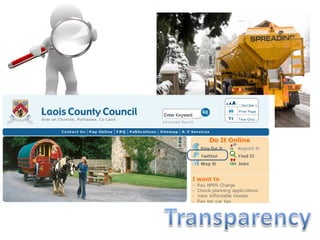
  • #9 Picture © koun (iStockPhoto) Transparency is 2 things: Snooping Innovative Multiplier
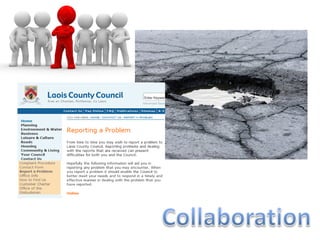
  • #10 Picture © koun (iStockPhoto)
  • #11 Picture © koun (iStockPhoto)