Engage: Getting on with Government 2.0 or  Getting to ABC 2.0 Nicholas Gruen  2 nd  Sept 2010, Southbank
 
Outline Web 2.0/Government 2.0– it’s not the technology Web 2.0 platforms as public goods Responses to Web 2.0 Why Web 2.0 matters Organisation without organisations Turbocharging the ecology of ideas Information from the periphery The Government 2.0 Taskforce report What we did What we said  ABC 2.0 Conclusion
What is web 2.0 Web 1.0 was  Point to point – e-mail  Broadcast – firm to customer (and back) - websites Web 2.0 is collaborative web Google 1998 – a collaborative site Wikipedia 2001 – the community writes an encyclopaedia Blogs early 2000s – self-publishing and discussion Facebook 2004 – social networking Twitter 2006 – new communications platform
What characterises Web 2.0? Web 2.0 isn’t fancy technology  The technology is simple and ubiquitous Web 2.0 is a culture change  Collaborate don’t control  Improvise, share, play Users build value, the technology can let them in Be modular: use others’ stuff, let them use yours Build for user value - monetise later The winner of the Taskforce’s best local council at Government 2.0 was Mosman Council It’s Government 2.0 activities are not run by their IT department. But by their public library
What characterises Government 2.0? Government finds Web 2.0 even harder than firms Collaborate don’t control  Improvise, share, play – perpetual beta Users build value, the technology can let them in Be modular: use others’ stuff, let them use yours Build for user value ABC isn’t government, but is a large organisation, and subject to some of constraints of governments.
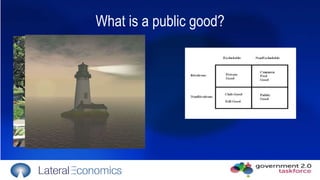
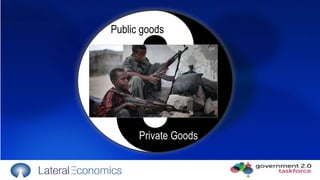
What is a public good? Public goods – goods that no-one will supply if the government doesn’t
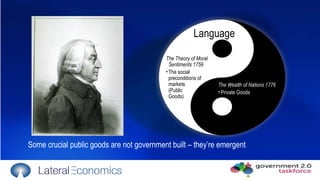
The Wealth of Nations 1776 Private Goods The Theory of Moral Sentiments 1759 The social preconditions of markets  (Public  Goods) Language Some crucial public goods are not government built – they’re emergent
Public goods Private Goods
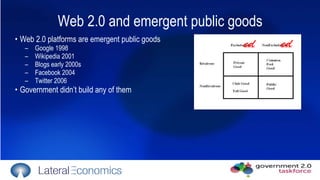
Web 2.0 and emergent public goods Web 2.0 platforms are emergent public goods Google 1998 Wikipedia 2001 Blogs early 2000s Facebook 2004 Twitter 2006 Government didn’t build any of them
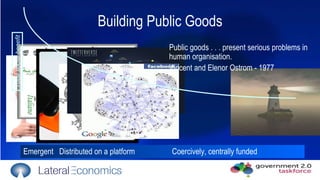
Building Public Goods Emergent  Distributed on a platform   Coercively, centrally funded Public goods . . . present serious problems in human organisation. Vincent and Elenor Ostrom - 1977 Total social benefit
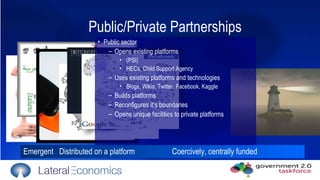
Emergent  Distributed on a platform   Coercively, centrally funded Public sector  Opens existing platforms  (PSI) HECs, Child Support Agency Uses existing platforms and technologies Blogs, Wikis, Twitter, Facebook, Kaggle  Builds platforms Reconfigures it’s boundaries Opens unique facilities to private platforms Public/Private Partnerships
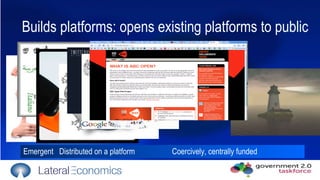
Emergent  Distributed on a platform   Coercively, centrally funded Builds platforms: opens existing platforms to public
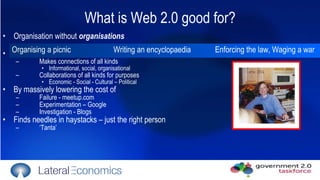
What is Web 2.0 good for? Organisation without  organisations Slashes cost of new social formations Makes connections of all kinds  Informational, social, organisational Collaborations of all kinds for purposes Economic - Social - Cultural – Political By massively lowering the cost of  Failure - meetup.com Experimentation – Google Investigation - Blogs Finds needles in haystacks – just the right person ‘ Tanta’ Organising a picnic Writing an encyclopaedia Enforcing the law, Waging a war
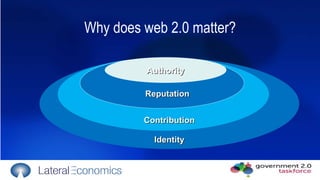
Identity Contribution Reputation   Authority Why does web 2.0 matter?
What is Web 2.0 good for? It can give us participatory democracy As could Web 1.0  But do we want it? Top two items on Obama’s brainstorming site Legalise marijuana  Release Barack Obama’s birth certificate Web 2.0 can be ‘ghettoised’ as special projects But lots of Web 2.0 is most useful as an adjunct to existing projects
How can large organisations respond? You don’t need to be revolutionary You don’t need to take big risks to great things Adapt within (expanding) core of competence You learn to speak by speaking Adapt the new tools – like many large firms Eg Dell Computer and Ideas Storm Explore the potential for openness to optimise mission You’re sitting on platforms of huge social value – PSI Help build new platforms/public goods
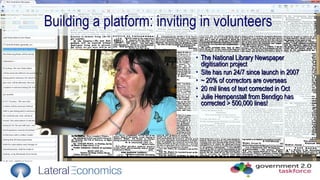
Building a platform: inviting in volunteers  The National Library Newspaper digitisation project Site has run 24/7 since launch in 2007 ~ 20% of correctors are overseas 20 mil lines of text corrected in Oct Julie Hempenstall from Bendigo has corrected > 500,000 lines!
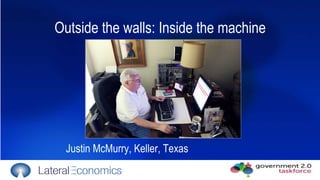
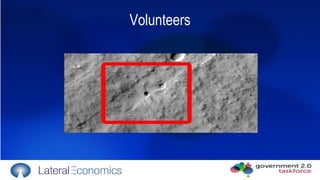
Outside the walls: Inside the machine Justin McMurry, Keller, Texas
Volunteers If Justin McMurray will work 25 hours a week for Verizon Who might be prepared to volunteer for  The GLAM and broader cultural sectors? The research sector? Helping  the aged,  the sick,  the disadvantaged? the environment? Could volunteers come from those helped?
Volunteers
Find, Play, Share 1. If it can’t be spidered or indexed, it doesn’t exist; 2. If it isn’t available in open and machine readable format, it can’t engage; 3. If a legal framework doesn’t allow it to be repurposed, it doesn’t empower.
Play, show, tell
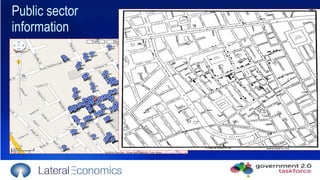
Public sector  information
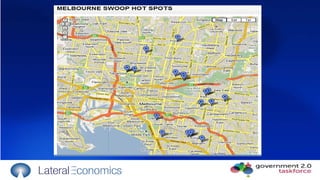
http://specials-leader.whereilive.com.au/maps/Melbourne-swoop-hot-spots.php
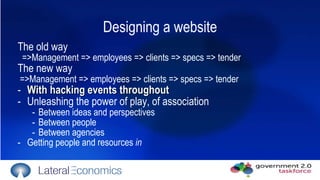
Designing a website The old way =>Management => employees => clients => specs => tender  The new way =>Management => employees => clients => specs => tender  With hacking events throughout Unleashing the power of play, of association Between ideas and perspectives  Between people Between agencies Getting people and resources  in
Central finding Australia has some of the world’s best examples of Government 2.0 Sydney’s Powerhouse Museum first to use Flikr Future Melbourne Wiki was a world leader But other countries are taking whole of government action to transform their policies and their institutions UK US  New Zealand
A  Declaration on Open Government   Online engagement by public servants should be enabled and encouraged.  Robust professional discussion benefits their agencies, their professional development, and the Australian public;  Public sector information is a national resource releasing as much of it on as permissive terms as possible maximises its value and reinforces democracy; Open engagement at all levels of government is integral to promoting an informed, connected and democratic community, to public sector reform, innovation and best use of the national investment in broadband.
Other recommendations  Establish a lead agency to coach, enable, advocate and co-ordinate effort Use Information Commissioner to deliver accountability to the open government policy  Encourage Agencies to engage and innovate online  Encourage public servants to engage online
Government response Our recommendations essentially accepted  Declaration of open Government now made So now over to  The lead agency The Information Commissioner  You The community
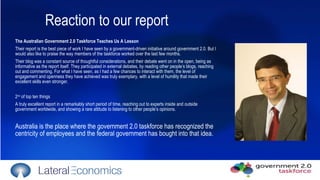
Reaction to our report The Australian Government 2.0 Taskforce Teaches Us A Lesson  Their report is the best piece of work I have seen by a government-driven initiative around government 2.0. But I would also like to praise the way members of the taskforce worked over the last few months. Their blog was a constant source of thoughtful considerations, and their debate went on in the open, being as informative as the report itself. They participated in external debates, by reading other people’s blogs, reaching out and commenting. For what I have seen, as I had a few chances to interact with them, the level of engagement and openness they have achieved was truly exemplary, with a level of humility that made their excellent skills even stronger. 2 nd  of top ten things  A truly excellent report in a remarkably short period of time, reaching out to experts inside and outside government worldwide, and showing a rare attitude to listening to other people’s opinions. Australia is the place where the government 2.0 taskforce has recognized the centricity of employees and the federal government has bought into that idea.
Citizen collaboration in policy and service delivery design will enhance the processes of government and improve the outcomes sought. Collaboration with citizens is to be enabled and encouraged. Agencies are to  reduce barriers to online engagement , undertake social networking, crowd sourcing and online collaboration projects and  support online engagement by employees , in accordance with the Australian Public Service Commission Guidelines. The possibilities for open government depend on the innovative use of new internet-based technologies. Agencies are to develop policies that  support employee-initiated, innovative Government 2.0-based proposals . Lindsay Tanner Minister for Finance and Deregulation 16 th  July 2010 Declaration of Open Government
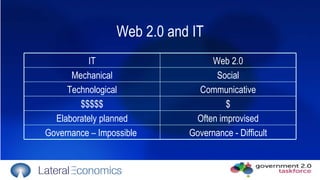
Web 2.0 and IT Often improvised Elaborately planned Communicative Technological Governance - Difficult Governance – Impossible  $ $$$$$ Social Mechanical Web 2.0 IT
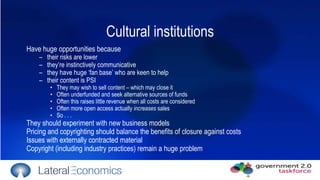
Cultural institutions Have huge opportunities because  their risks are lower  they’re instinctively communicative they have huge ‘fan base’ who are keen to help their content is PSI They may wish to sell content – which may close it Often underfunded and seek alternative sources of funds Often this raises little revenue when all costs are considered Often more open access actually  increases  sales So . . .  They should experiment with new business models Pricing and copyrighting should balance the benefits of closure against costs Issues with externally contracted material Copyright (including industry practices) remain a huge problem
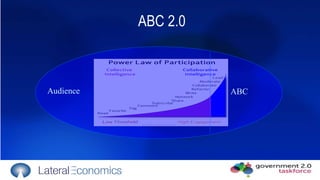
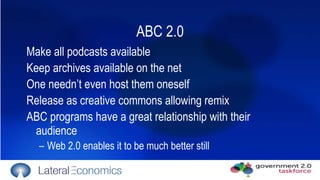
ABC 2.0 Make all podcasts available  Keep archives available on the net  One needn’t even host them oneself Release as creative commons allowing remix ABC programs have a great relationship with their audience Web 2.0 enables it to be much better still
ABC 2.0:  The program as platform  For a wider conversation For a community The ABC does this, but its an adjunct to the program You could plan programs on the net ‘ Guestbooks’ could become real blogs Each program could have a ‘friends of’ group Moderating the blog Helping discuss future programs and talent for them Helping host crowd-sourcing of transcript correction Suggesting pre-reading for programs a la RN’s book club Helping make the programs
ABC 2.0 Get community content in ie ABC Open should be Australia wide Best of community programs  Greater international exchange of ‘best of’ programs
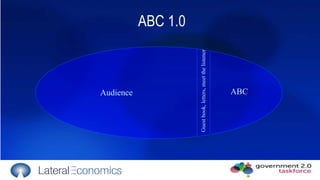
ABC 1.0 ABC Audience Guest book, letters, meet the listener
ABC 2.0 ABC Audience
Some takeouts Enthusiasm counts – empower your doers Complacency isn’t an option – don’t bother being complacent Experience matters – get as much as you can You don’t need to take big risks – and you shouldn’t
 
 
Any questions or comments?

Abc gov2 presentation melb

  • 1.
    Engage: Getting onwith Government 2.0 or Getting to ABC 2.0 Nicholas Gruen 2 nd Sept 2010, Southbank
  • 2.
  • 3.
    Outline Web 2.0/Government2.0– it’s not the technology Web 2.0 platforms as public goods Responses to Web 2.0 Why Web 2.0 matters Organisation without organisations Turbocharging the ecology of ideas Information from the periphery The Government 2.0 Taskforce report What we did What we said ABC 2.0 Conclusion
  • 4.
    What is web2.0 Web 1.0 was Point to point – e-mail Broadcast – firm to customer (and back) - websites Web 2.0 is collaborative web Google 1998 – a collaborative site Wikipedia 2001 – the community writes an encyclopaedia Blogs early 2000s – self-publishing and discussion Facebook 2004 – social networking Twitter 2006 – new communications platform
  • 5.
    What characterises Web2.0? Web 2.0 isn’t fancy technology The technology is simple and ubiquitous Web 2.0 is a culture change Collaborate don’t control Improvise, share, play Users build value, the technology can let them in Be modular: use others’ stuff, let them use yours Build for user value - monetise later The winner of the Taskforce’s best local council at Government 2.0 was Mosman Council It’s Government 2.0 activities are not run by their IT department. But by their public library
  • 6.
    What characterises Government2.0? Government finds Web 2.0 even harder than firms Collaborate don’t control Improvise, share, play – perpetual beta Users build value, the technology can let them in Be modular: use others’ stuff, let them use yours Build for user value ABC isn’t government, but is a large organisation, and subject to some of constraints of governments.
  • 7.
    What is apublic good? Public goods – goods that no-one will supply if the government doesn’t
  • 8.
    The Wealth ofNations 1776 Private Goods The Theory of Moral Sentiments 1759 The social preconditions of markets (Public Goods) Language Some crucial public goods are not government built – they’re emergent
  • 9.
  • 10.
    Web 2.0 andemergent public goods Web 2.0 platforms are emergent public goods Google 1998 Wikipedia 2001 Blogs early 2000s Facebook 2004 Twitter 2006 Government didn’t build any of them
  • 11.
    Building Public GoodsEmergent Distributed on a platform Coercively, centrally funded Public goods . . . present serious problems in human organisation. Vincent and Elenor Ostrom - 1977 Total social benefit
  • 12.
    Emergent Distributedon a platform Coercively, centrally funded Public sector Opens existing platforms (PSI) HECs, Child Support Agency Uses existing platforms and technologies Blogs, Wikis, Twitter, Facebook, Kaggle Builds platforms Reconfigures it’s boundaries Opens unique facilities to private platforms Public/Private Partnerships
  • 13.
    Emergent Distributedon a platform Coercively, centrally funded Builds platforms: opens existing platforms to public
  • 14.
    What is Web2.0 good for? Organisation without organisations Slashes cost of new social formations Makes connections of all kinds Informational, social, organisational Collaborations of all kinds for purposes Economic - Social - Cultural – Political By massively lowering the cost of Failure - meetup.com Experimentation – Google Investigation - Blogs Finds needles in haystacks – just the right person ‘ Tanta’ Organising a picnic Writing an encyclopaedia Enforcing the law, Waging a war
  • 15.
    Identity Contribution Reputation Authority Why does web 2.0 matter?
  • 17.
    What is Web2.0 good for? It can give us participatory democracy As could Web 1.0 But do we want it? Top two items on Obama’s brainstorming site Legalise marijuana Release Barack Obama’s birth certificate Web 2.0 can be ‘ghettoised’ as special projects But lots of Web 2.0 is most useful as an adjunct to existing projects
  • 18.
    How can largeorganisations respond? You don’t need to be revolutionary You don’t need to take big risks to great things Adapt within (expanding) core of competence You learn to speak by speaking Adapt the new tools – like many large firms Eg Dell Computer and Ideas Storm Explore the potential for openness to optimise mission You’re sitting on platforms of huge social value – PSI Help build new platforms/public goods
  • 19.
    Building a platform:inviting in volunteers The National Library Newspaper digitisation project Site has run 24/7 since launch in 2007 ~ 20% of correctors are overseas 20 mil lines of text corrected in Oct Julie Hempenstall from Bendigo has corrected > 500,000 lines!
  • 20.
    Outside the walls:Inside the machine Justin McMurry, Keller, Texas
  • 21.
    Volunteers If JustinMcMurray will work 25 hours a week for Verizon Who might be prepared to volunteer for The GLAM and broader cultural sectors? The research sector? Helping the aged, the sick, the disadvantaged? the environment? Could volunteers come from those helped?
  • 22.
  • 23.
    Find, Play, Share1. If it can’t be spidered or indexed, it doesn’t exist; 2. If it isn’t available in open and machine readable format, it can’t engage; 3. If a legal framework doesn’t allow it to be repurposed, it doesn’t empower.
  • 24.
  • 26.
    Public sector information
  • 27.
  • 28.
    Designing a websiteThe old way =>Management => employees => clients => specs => tender The new way =>Management => employees => clients => specs => tender With hacking events throughout Unleashing the power of play, of association Between ideas and perspectives Between people Between agencies Getting people and resources in
  • 30.
    Central finding Australiahas some of the world’s best examples of Government 2.0 Sydney’s Powerhouse Museum first to use Flikr Future Melbourne Wiki was a world leader But other countries are taking whole of government action to transform their policies and their institutions UK US New Zealand
  • 31.
    A Declarationon Open Government Online engagement by public servants should be enabled and encouraged. Robust professional discussion benefits their agencies, their professional development, and the Australian public; Public sector information is a national resource releasing as much of it on as permissive terms as possible maximises its value and reinforces democracy; Open engagement at all levels of government is integral to promoting an informed, connected and democratic community, to public sector reform, innovation and best use of the national investment in broadband.
  • 32.
    Other recommendations Establish a lead agency to coach, enable, advocate and co-ordinate effort Use Information Commissioner to deliver accountability to the open government policy Encourage Agencies to engage and innovate online Encourage public servants to engage online
  • 33.
    Government response Ourrecommendations essentially accepted Declaration of open Government now made So now over to The lead agency The Information Commissioner You The community
  • 34.
    Reaction to ourreport The Australian Government 2.0 Taskforce Teaches Us A Lesson Their report is the best piece of work I have seen by a government-driven initiative around government 2.0. But I would also like to praise the way members of the taskforce worked over the last few months. Their blog was a constant source of thoughtful considerations, and their debate went on in the open, being as informative as the report itself. They participated in external debates, by reading other people’s blogs, reaching out and commenting. For what I have seen, as I had a few chances to interact with them, the level of engagement and openness they have achieved was truly exemplary, with a level of humility that made their excellent skills even stronger. 2 nd of top ten things A truly excellent report in a remarkably short period of time, reaching out to experts inside and outside government worldwide, and showing a rare attitude to listening to other people’s opinions. Australia is the place where the government 2.0 taskforce has recognized the centricity of employees and the federal government has bought into that idea.
  • 35.
    Citizen collaboration inpolicy and service delivery design will enhance the processes of government and improve the outcomes sought. Collaboration with citizens is to be enabled and encouraged. Agencies are to reduce barriers to online engagement , undertake social networking, crowd sourcing and online collaboration projects and support online engagement by employees , in accordance with the Australian Public Service Commission Guidelines. The possibilities for open government depend on the innovative use of new internet-based technologies. Agencies are to develop policies that support employee-initiated, innovative Government 2.0-based proposals . Lindsay Tanner Minister for Finance and Deregulation 16 th July 2010 Declaration of Open Government
  • 36.
    Web 2.0 andIT Often improvised Elaborately planned Communicative Technological Governance - Difficult Governance – Impossible $ $$$$$ Social Mechanical Web 2.0 IT
  • 37.
    Cultural institutions Havehuge opportunities because their risks are lower they’re instinctively communicative they have huge ‘fan base’ who are keen to help their content is PSI They may wish to sell content – which may close it Often underfunded and seek alternative sources of funds Often this raises little revenue when all costs are considered Often more open access actually increases sales So . . . They should experiment with new business models Pricing and copyrighting should balance the benefits of closure against costs Issues with externally contracted material Copyright (including industry practices) remain a huge problem
  • 38.
    ABC 2.0 Makeall podcasts available Keep archives available on the net One needn’t even host them oneself Release as creative commons allowing remix ABC programs have a great relationship with their audience Web 2.0 enables it to be much better still
  • 39.
    ABC 2.0: The program as platform For a wider conversation For a community The ABC does this, but its an adjunct to the program You could plan programs on the net ‘ Guestbooks’ could become real blogs Each program could have a ‘friends of’ group Moderating the blog Helping discuss future programs and talent for them Helping host crowd-sourcing of transcript correction Suggesting pre-reading for programs a la RN’s book club Helping make the programs
  • 40.
    ABC 2.0 Getcommunity content in ie ABC Open should be Australia wide Best of community programs Greater international exchange of ‘best of’ programs
  • 41.
    ABC 1.0 ABCAudience Guest book, letters, meet the listener
  • 42.
    ABC 2.0 ABCAudience
  • 43.
    Some takeouts Enthusiasmcounts – empower your doers Complacency isn’t an option – don’t bother being complacent Experience matters – get as much as you can You don’t need to take big risks – and you shouldn’t
  • 44.
  • 45.
  • 46.