The document is a PowerPoint presentation on industrial automation submitted by Tamanna Taneja. It discusses key concepts of automation including what automation is, why it is required in industry, and its history. It also covers components used in automation like sensors, transmitters, PLCs, and actuators. Specific automation tools covered are PLCs, SCADA, and HMIs. The presentation provides details on what constitutes a PLC, its programming, inputs and outputs, power supply and memory. It also discusses SCADA features, architecture, trending and applications in various plants.
A Power PointPresentation
on “Industrial Automation”
Submitted By:-
Tamanna Taneja
EEE-VII SEM
Submitted To:-
Er. Balram kasniya
HOD-EEE
2.
What is Automation?
•Asthe name suggests ‘Automation’ means to
perform automatic operations by means of
different kinds of machines.
•Automation is the use of control systems and
information technologies to reduce the need for
human work in the production of goods and
services.
•It is used to reduce human interference and and
efforts
3.
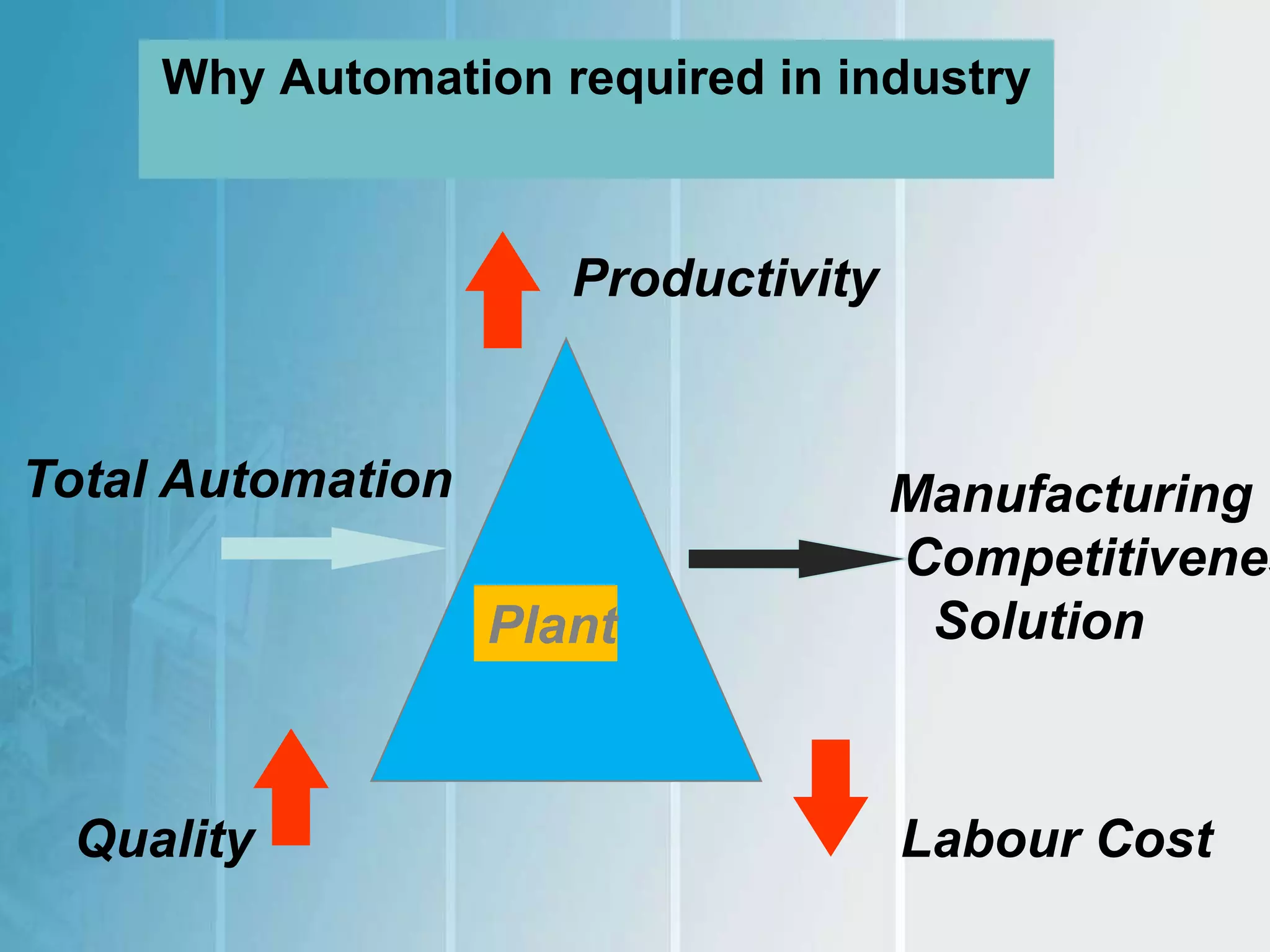
Why Automation requiredin industry
Productivity
Quality Labour Cost
Plant
Total Automation Manufacturing
Competitivenes
Solution
4.
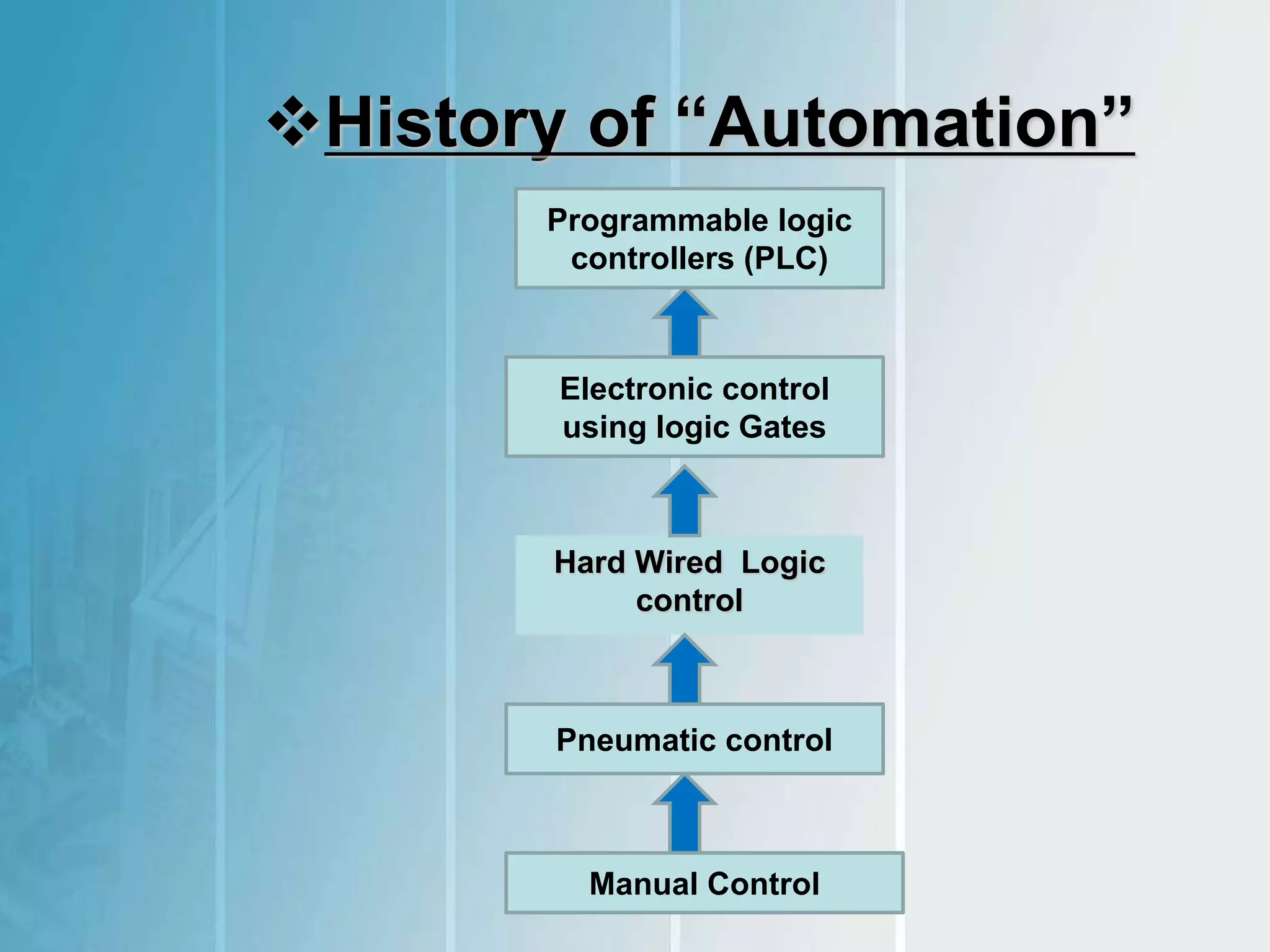
History of “Automation”
ManualControl
Hard Wired Logic
control
Pneumatic control
Electronic control
using logic Gates
Programmable logic
controllers (PLC)
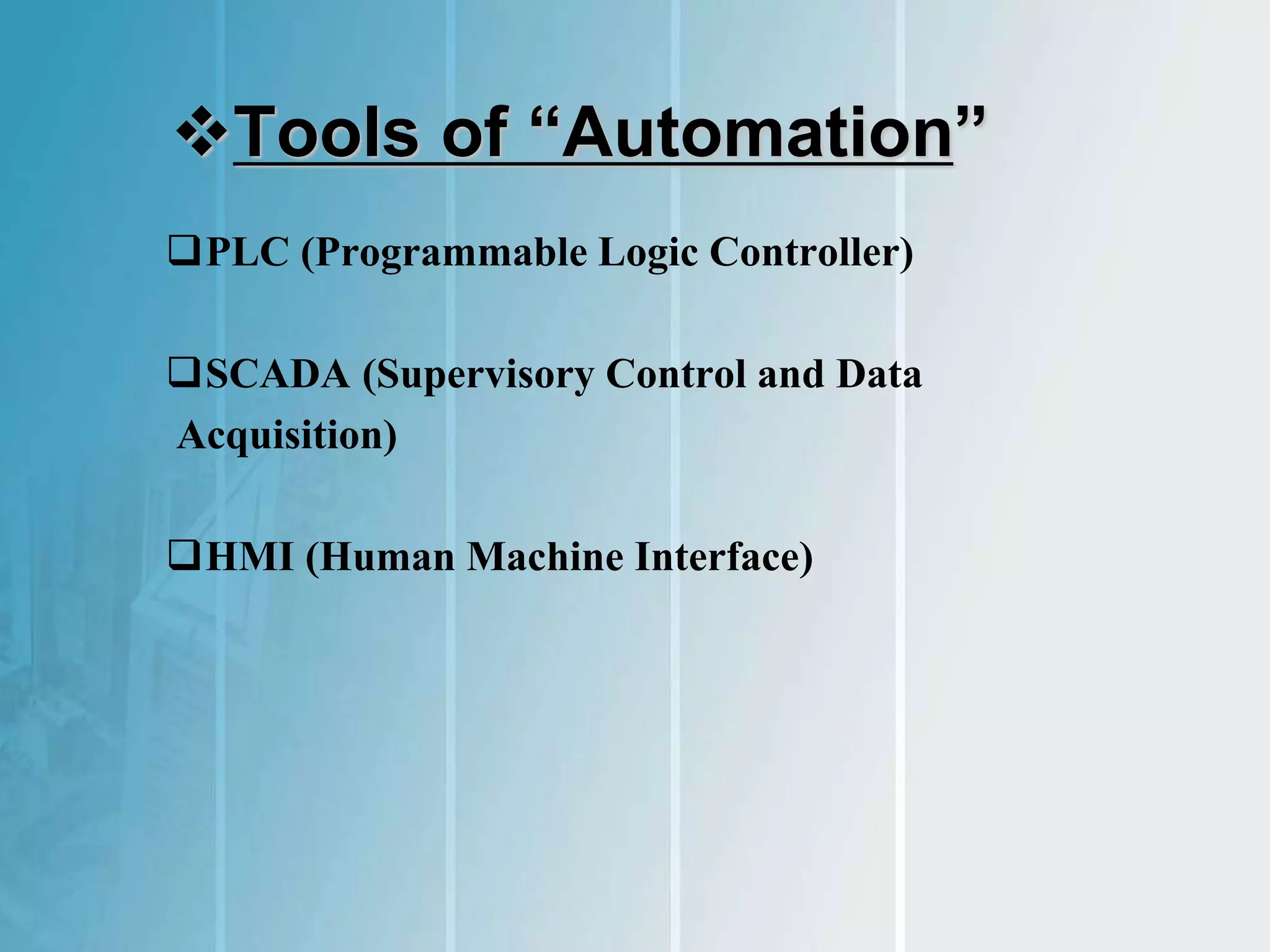
Tools of “Automation”
PLC(Programmable Logic Controller)
SCADA (Supervisory Control and Data
Acquisition)
HMI (Human Machine Interface)
7.
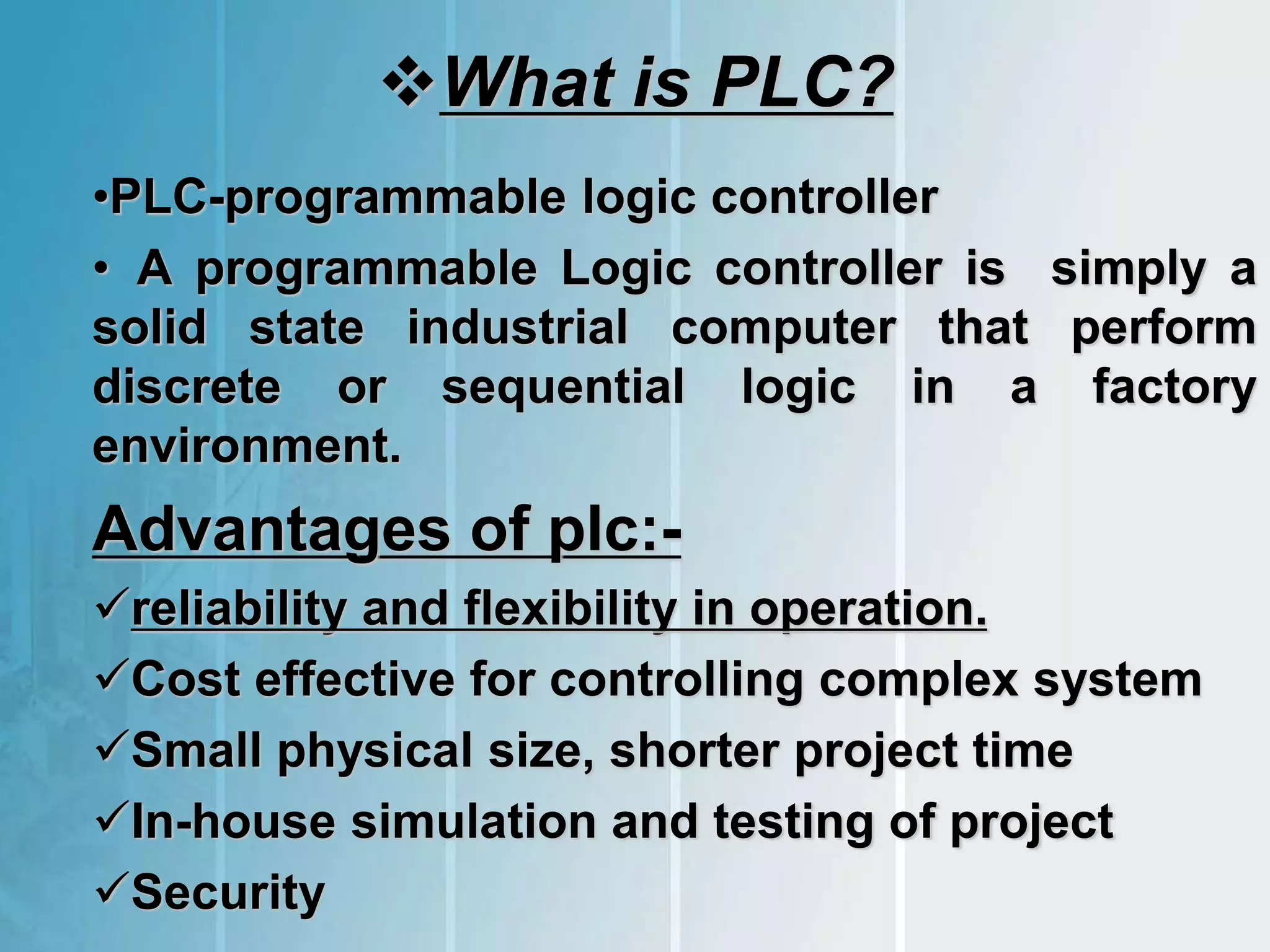
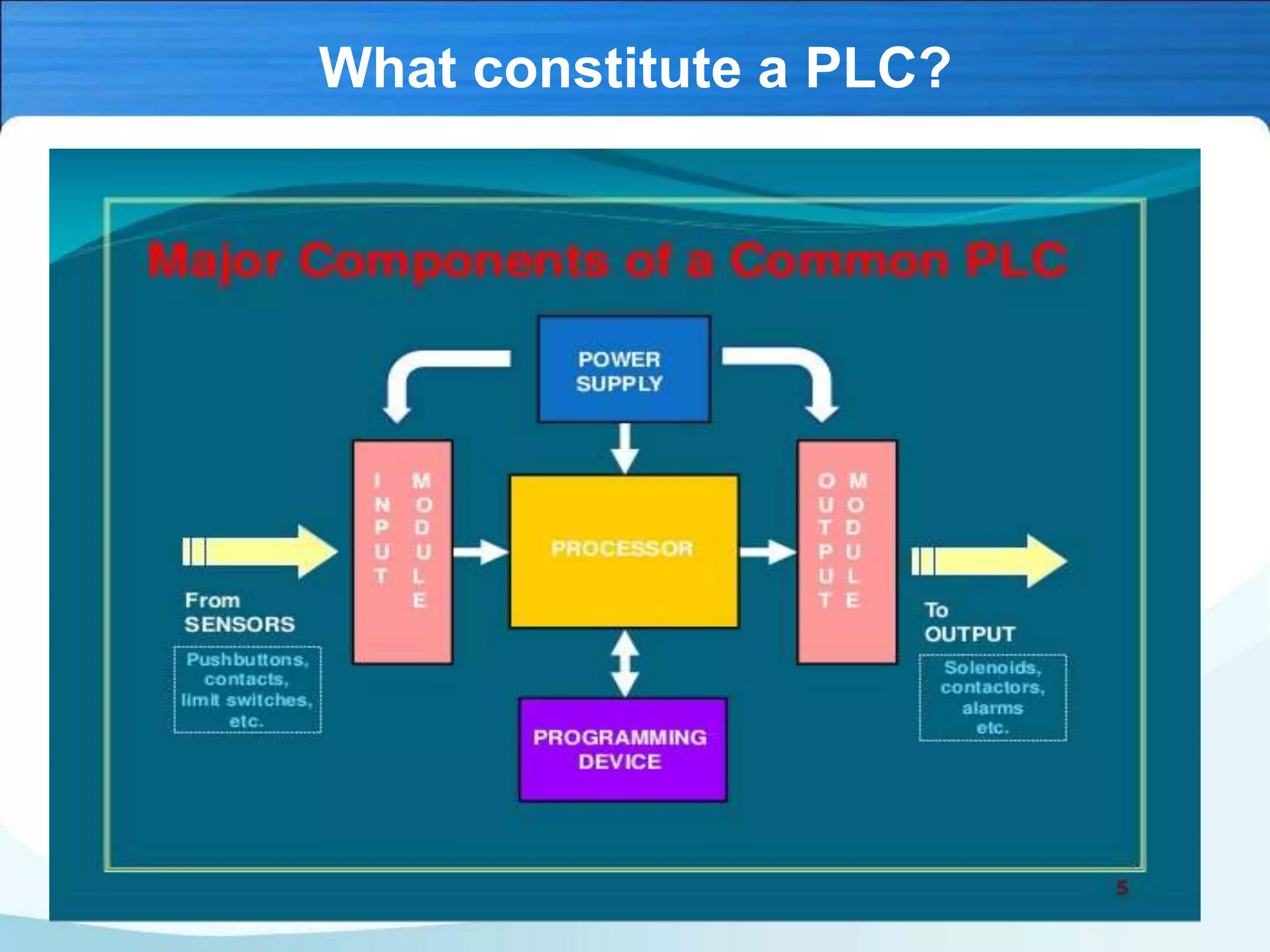
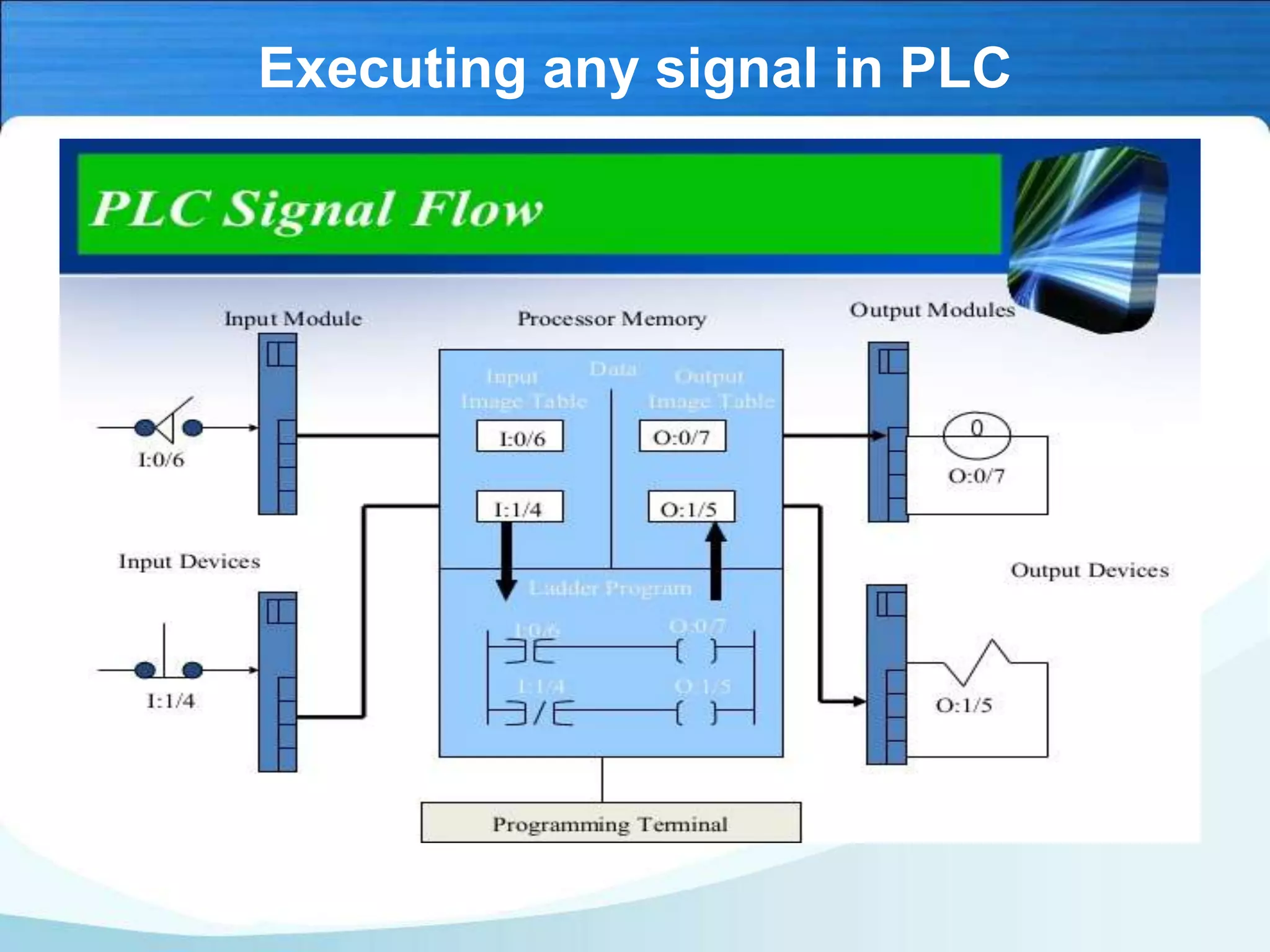
What is PLC?
•PLC-programmablelogic controller
• A programmable Logic controller is simply a
solid state industrial computer that perform
discrete or sequential logic in a factory
environment.
Advantages of plc:-
reliability and flexibility in operation.
Cost effective for controlling complex system
Small physical size, shorter project time
In-house simulation and testing of project
Security
8.
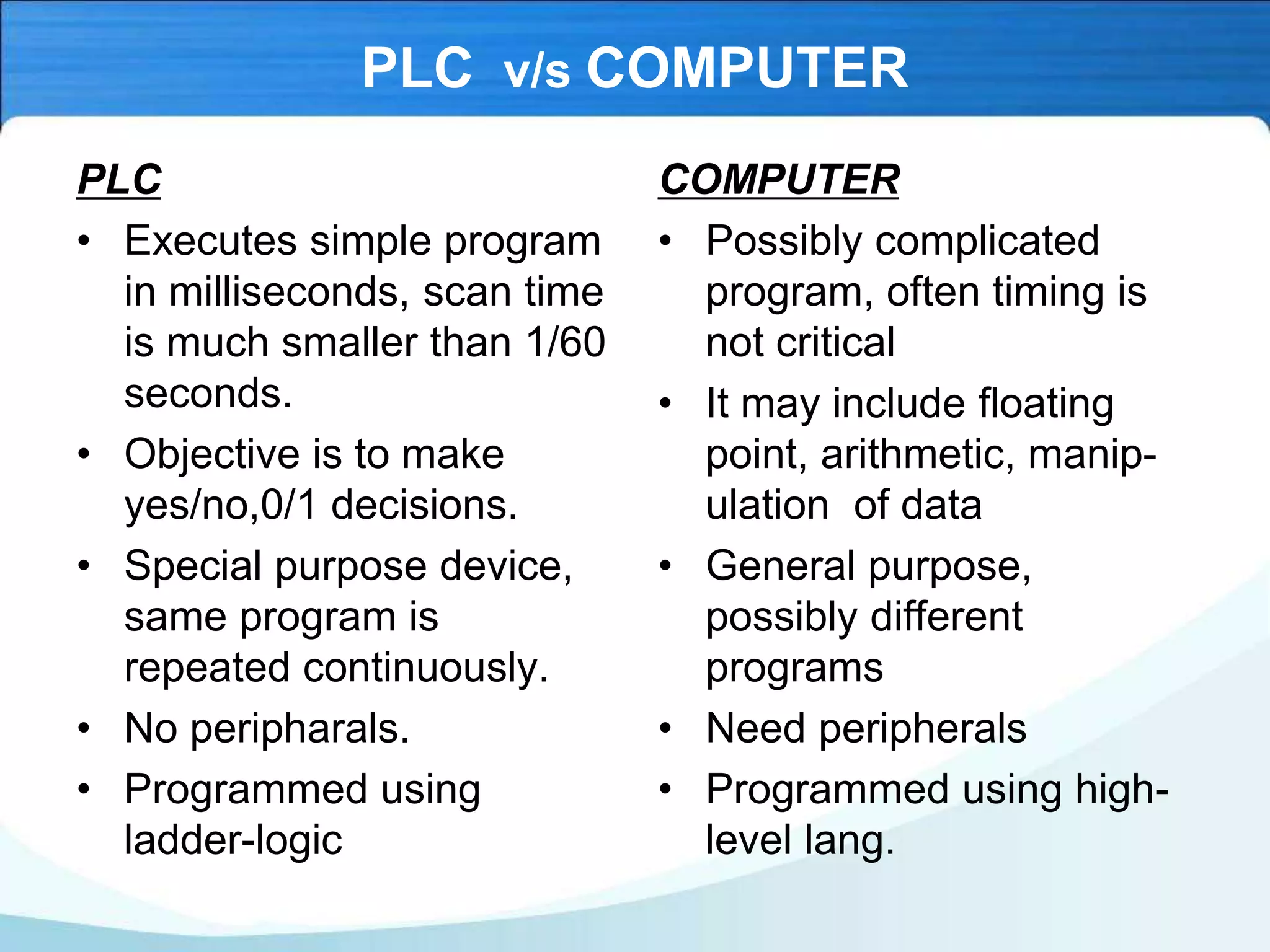
PLC v/s COMPUTER
PLC
•Executes simple program
in milliseconds, scan time
is much smaller than 1/60
seconds.
• Objective is to make
yes/no,0/1 decisions.
• Special purpose device,
same program is
repeated continuously.
• No peripharals.
• Programmed using
ladder-logic
COMPUTER
• Possibly complicated
program, often timing is
not critical
• It may include floating
point, arithmetic, manip-
ulation of data
• General purpose,
possibly different
programs
• Need peripherals
• Programmed using high-
level lang.
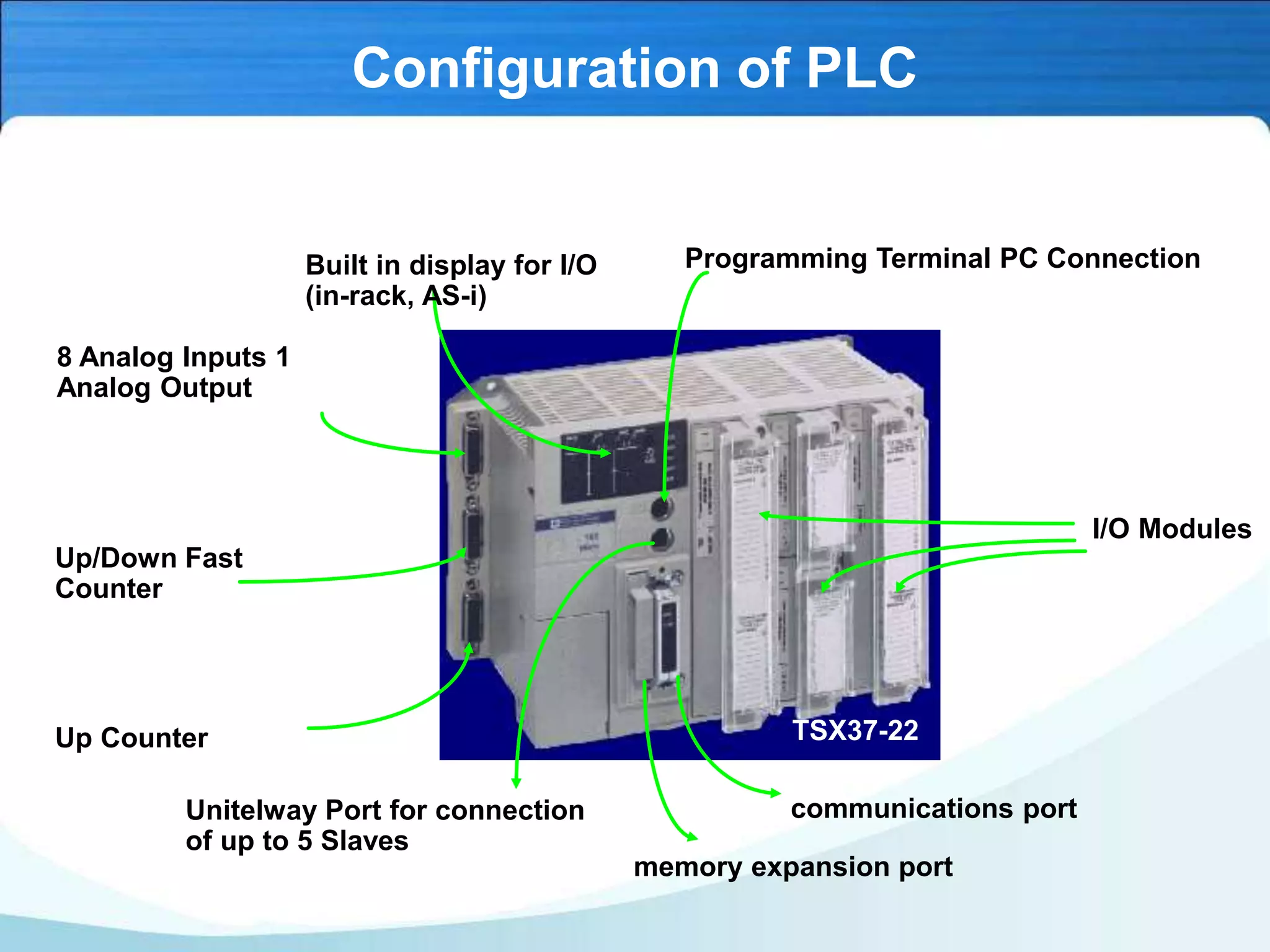
Configuration of PLC
8Analog Inputs 1
Analog Output
Up/Down Fast
Counter
Up Counter
Programming Terminal PC Connection
Unitelway Port for connection
of up to 5 Slaves
memory expansion port
communications port
TSX37-22
Built in display for I/O
(in-rack, AS-i)
I/O Modules
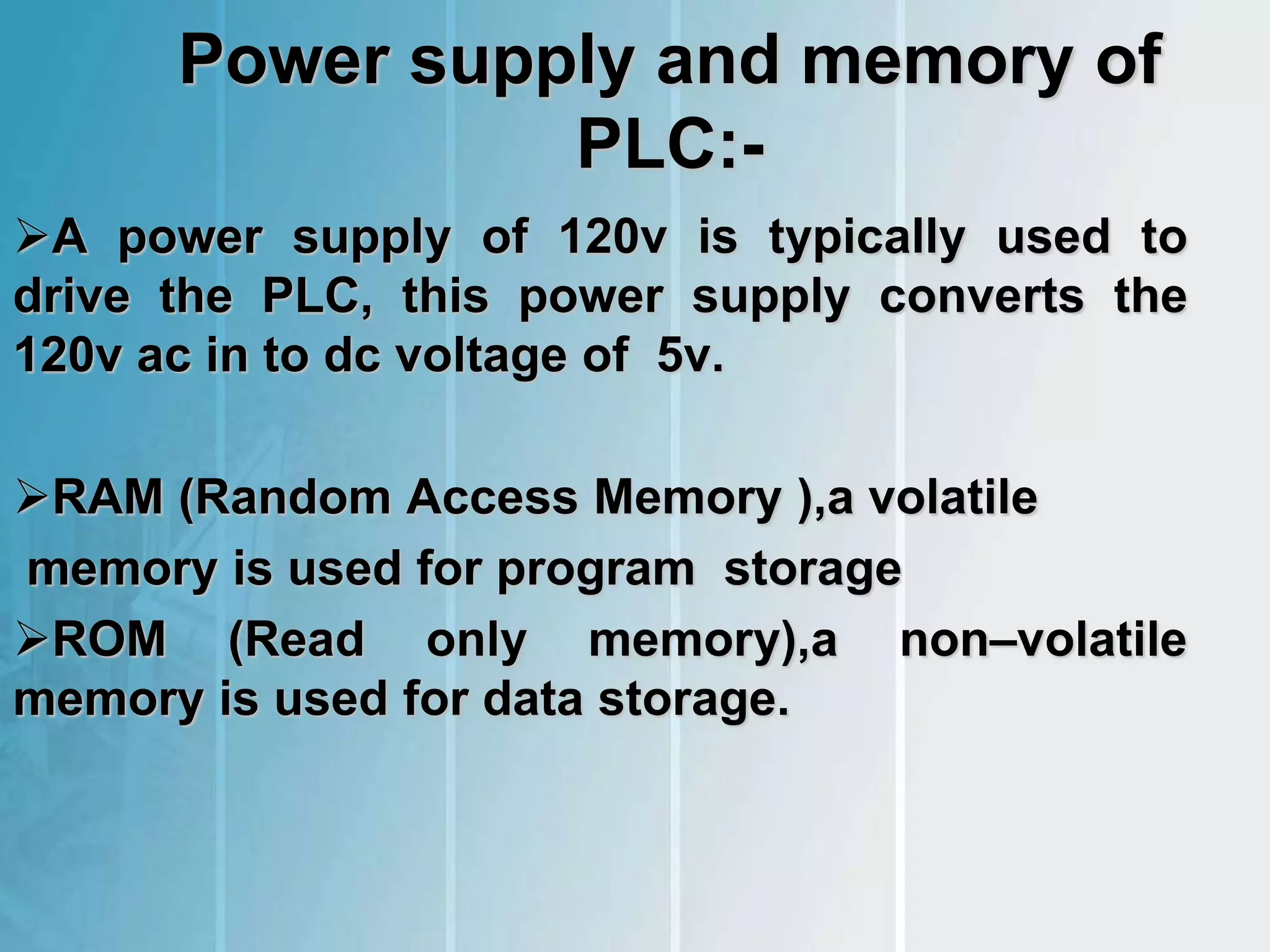
Power supply andmemory of
PLC:-
A power supply of 120v is typically used to
drive the PLC, this power supply converts the
120v ac in to dc voltage of 5v.
RAM (Random Access Memory ),a volatile
memory is used for program storage
ROM (Read only memory),a non–volatile
memory is used for data storage.
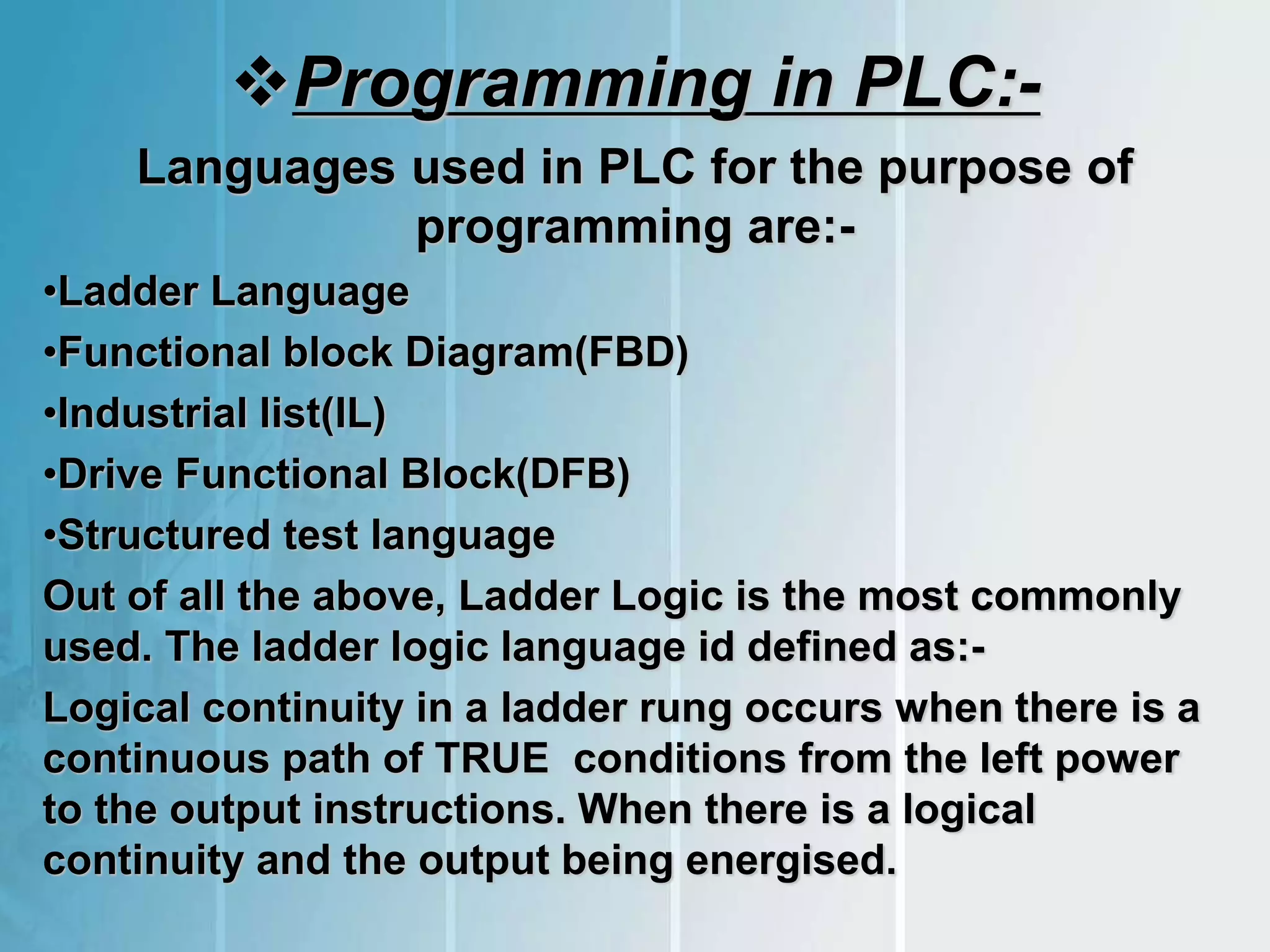
Programming in PLC:-
Languagesused in PLC for the purpose of
programming are:-
•Ladder Language
•Functional block Diagram(FBD)
•Industrial list(IL)
•Drive Functional Block(DFB)
•Structured test language
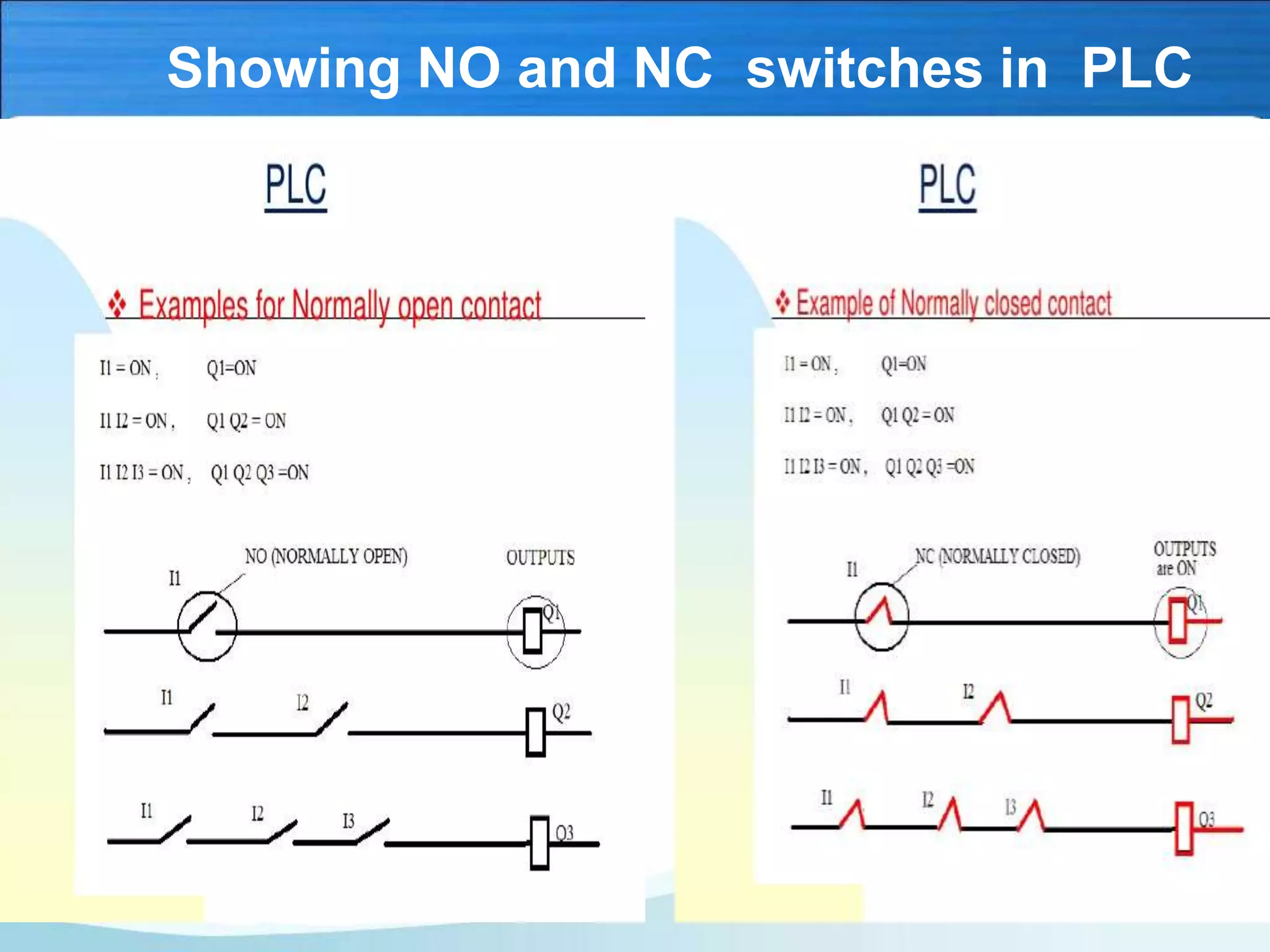
Out of all the above, Ladder Logic is the most commonly
used. The ladder logic language id defined as:-
Logical continuity in a ladder rung occurs when there is a
continuous path of TRUE conditions from the left power
to the output instructions. When there is a logical
continuity and the output being energised.
SCADA(Supervisory control
and DataAcquisition)
•SCADA is real time industrial process control
systems used to centrally remote or local
industrial equipment such as motors, valves,
pumps, relays, etc
•It generally refers to an industrial system
(ICS).
•It is a production automation and control
system based on PCs.
18.
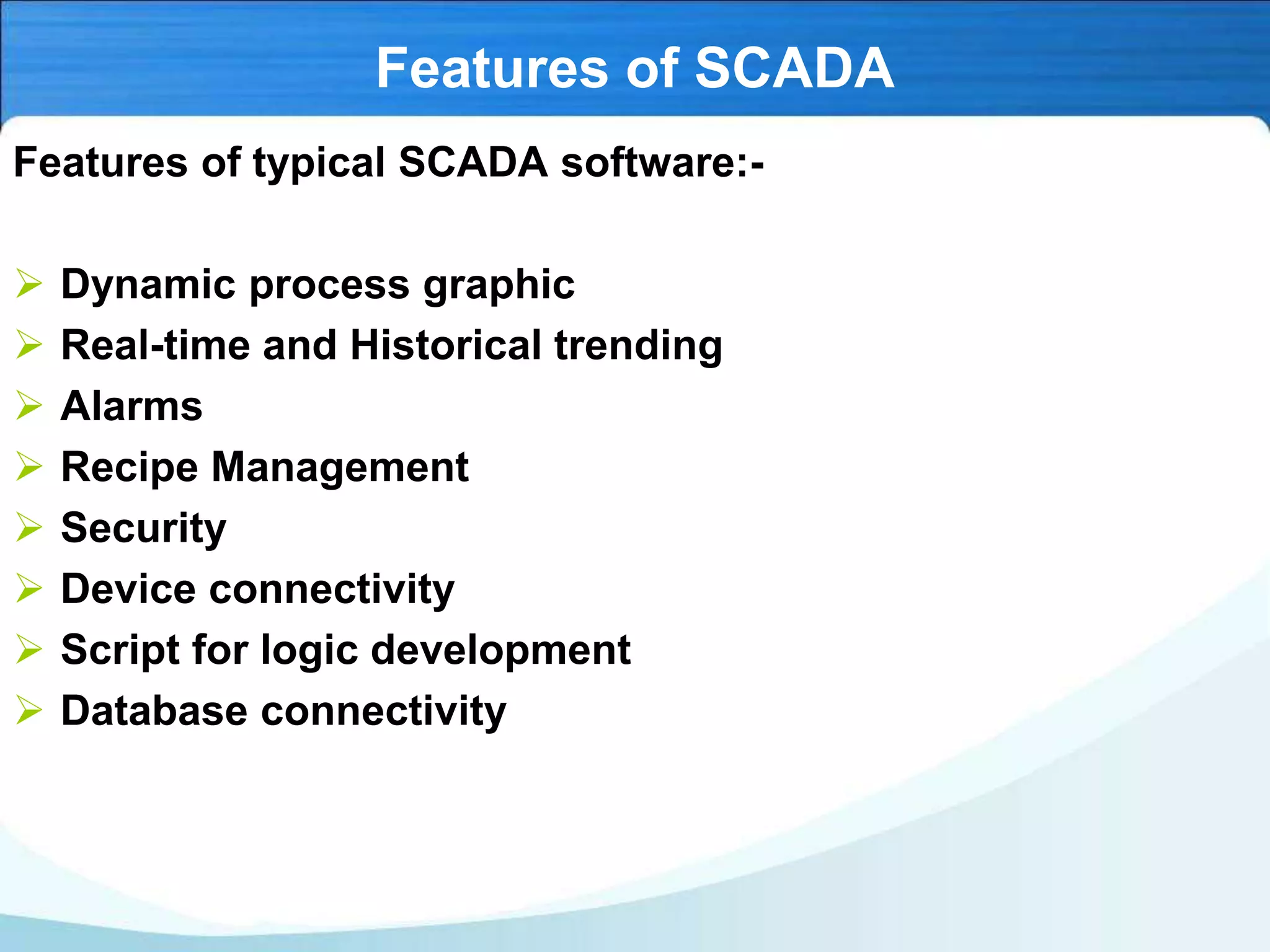
Features of SCADA
Featuresof typical SCADA software:-
Dynamic process graphic
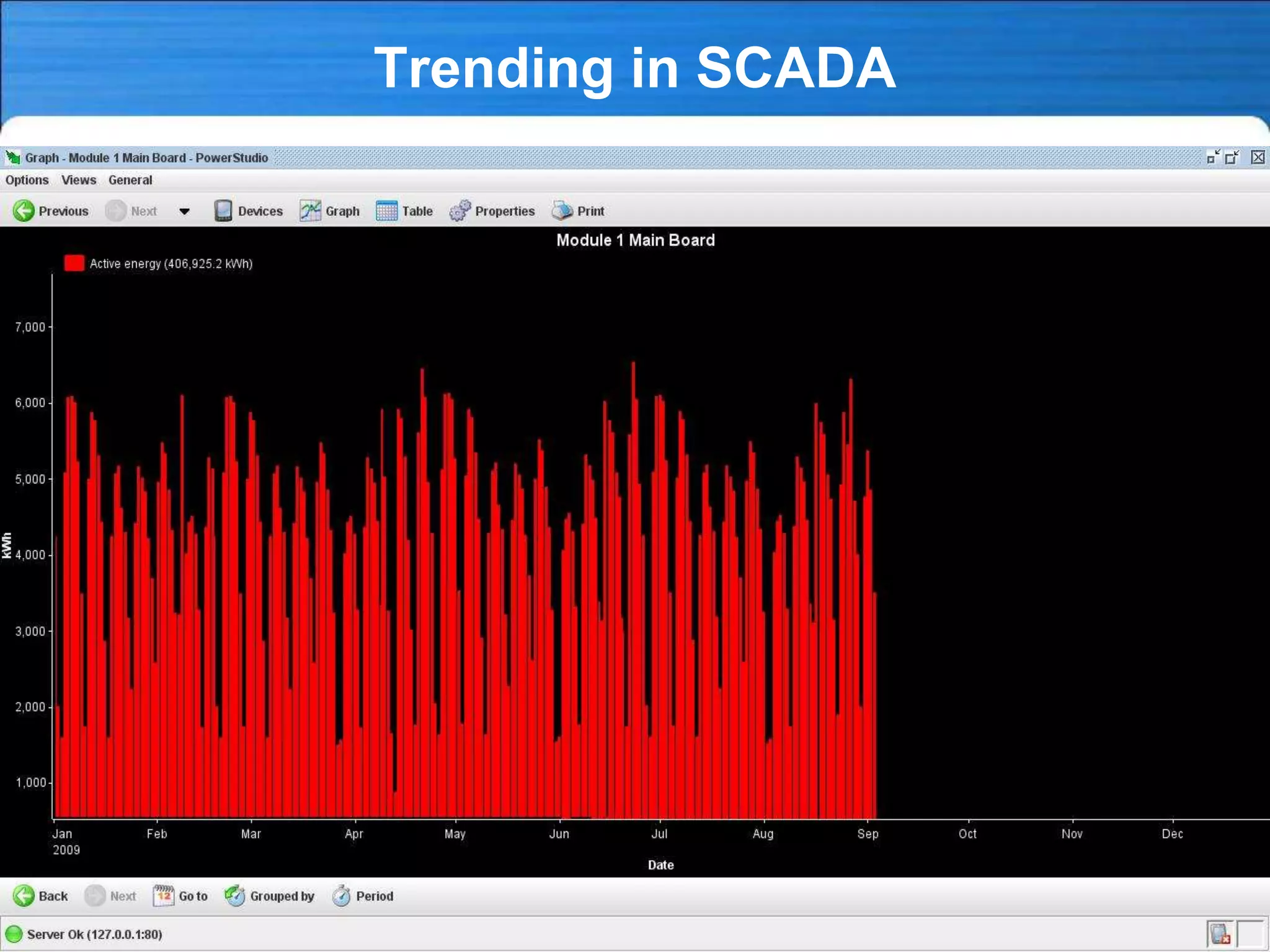
Real-time and Historical trending
Alarms
Recipe Management
Security
Device connectivity
Script for logic development
Database connectivity
Applications of SCADA
•Productiondepartment
•Quality department
•Maintenance department
•Enterprise information
•Engineering department
•Manufacturing department