A PRESENTATION ON SCADA
SYSTEM
(SUPERVISORY CONTROL AND DATA
ACQUISITION)
PREPARED BY
PUNEET SINGH THAKUR
M.E.(DIGITAL INSTRUMENTATION)
Overview of Industrial Control Systems
• Industrial control system (ICS) is a general term that has several types
of control systems, including
 Supervisory Control And Data Acquisition (SCADA) systems
 Distributed Control Systems (DCS)
Other smaller control system configurations such as skid-mounted
Programmable Logic Controllers (PLC)
2
WHAT IS SCADA ?
SCADA (SUPERVISORY CONTROL AND DATA ACQUISITION) is a system that is used for
monitoring, analysing and controlling an industrial process . A
SCADA system is capable of real time monitoring and management
of physical asset dispersed over very large geographical area.
3
4
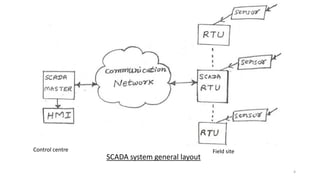
SCADA system general layout
Control centre Field site
• A SCADA system performs four functions:
• 1. Data acquisition
• 2. Networked data communication
• 3. Data presentation
• 4. Control
5
COMPONENTS OF SCADA
• Programmable logic controller(PLCs) connect to sensors in the
process and converting sensor signals to digital data. PLCs have more
embedded control capabilities than RTUs. PLCs are sometimes used in
place of RTUs as field devices because they are more economical,
versatile, flexible, and configurable.
• Or/And
• Remote terminal units (RTUs) connect to sensors in the process and
convert sensor signals to digital data. They have telemetry hardware
capable of sending digital data to the supervisory system, as well as
receiving digital commands from the supervisory system.
6
7
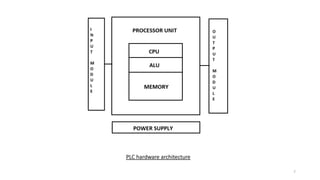
PLC hardware architecture
COMPONENTS OF SCADA
A telemetry system is typically used to connect PLCs and RTUs with control
centers , data ware houses, and the enterprise. Examples of wired telemetry
media used in SCADA systems include leased telephone lines and WAN
circuits. Examples of wireless telemetry media used in SCADA systems
include cellular and microwave and other communication medium.
A data acquisition server is a software service which uses industrial
protocols to connect software services via telemetry with field device such as
RTUs and PLCs. It allows clients to access data from these field devices using
standard protocols.
• A human–machine interface or HMI is the apparatus or device which
presents processed data to a human operator, and through this, the human
operator monitors and interacts with the process. The HMI is a client that
requests data from a data acquisition on server.
8
COMPONENTS OF SCADA
A Historian is a software service which accumulates time-stamped
data, Boolean events, and Boolean alarms in a data base which can be
queried or used to populate graphic trends in the HMI.The historian is a
client that requests data from a data acquisiti on server.
A supervisory(computer) system, gathering(acquiring) data on the
process and sending commands(control) to the SCADA system.
Communication in frastructure connecting the supervisory system to
the remote terminal units.Various process and analytical
instrumentation.
9
SCADA Architecture
First generation: "Monolithi “
Se ond generation: "Distri uted“
Third generation: "Networked"
10
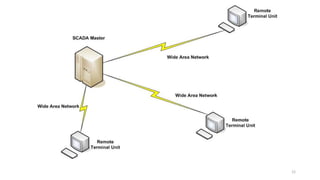
Monolithic SCADA Systems
Minicomputers are used earlier for computing the SCADA
systems. In earlier times, during the time of first generation,
monolithic SCADA systems were developed wherein the
common network services were not available. Hence, these
are independent systems without having any connectivity to
other systems.
11
12
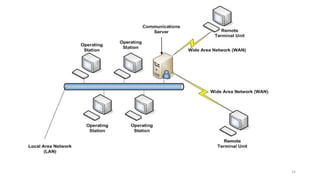
Distributed SCADA Systems
The processing was distributed across multiple stations which were
connected through a LAN and they shared information in real time.
Each station was responsible for a particular task thus making the size
and cost of each station less than the one used in First Generation.
13
14
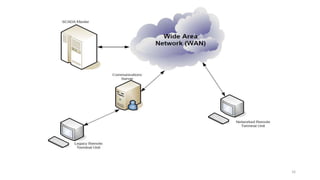
Networked SCADA Systems
Open system architecture
Multiple networked systems, sharing master station
functions
Utilizing open standards and protocols
Distribute SCADA functionality across a WAN
Open standards eliminate multiple limitations
Easier to connect to third party peripheral devices to the
system or the network
Disaster survivability
15
16
Application of SCADA system
 Electric power generation, transmission and distribution
 Water treatment plant
 Oil and Gas Trans & Distributions
 Food processing industry
 Traffic signals
 A d a y ore………
17
Potential benefits of SCADA
• The benefits one can expect from adopting a SCADA system for
the control of
• experimental physics facilities can be summarised as follows:
a rich functionality and extensive development facilities.
reliability and robustness.
technical support and maintenance by the vendor.
18
REFERENCES
http://nptel.ac.in/courses
Practical SCADA for Industry by David Bailey
19

A presentation on scada system

  • 1.
    A PRESENTATION ONSCADA SYSTEM (SUPERVISORY CONTROL AND DATA ACQUISITION) PREPARED BY PUNEET SINGH THAKUR M.E.(DIGITAL INSTRUMENTATION)
  • 2.
    Overview of IndustrialControl Systems • Industrial control system (ICS) is a general term that has several types of control systems, including  Supervisory Control And Data Acquisition (SCADA) systems  Distributed Control Systems (DCS) Other smaller control system configurations such as skid-mounted Programmable Logic Controllers (PLC) 2
  • 3.
    WHAT IS SCADA? SCADA (SUPERVISORY CONTROL AND DATA ACQUISITION) is a system that is used for monitoring, analysing and controlling an industrial process . A SCADA system is capable of real time monitoring and management of physical asset dispersed over very large geographical area. 3
  • 4.
    4 SCADA system generallayout Control centre Field site
  • 5.
    • A SCADAsystem performs four functions: • 1. Data acquisition • 2. Networked data communication • 3. Data presentation • 4. Control 5
  • 6.
    COMPONENTS OF SCADA •Programmable logic controller(PLCs) connect to sensors in the process and converting sensor signals to digital data. PLCs have more embedded control capabilities than RTUs. PLCs are sometimes used in place of RTUs as field devices because they are more economical, versatile, flexible, and configurable. • Or/And • Remote terminal units (RTUs) connect to sensors in the process and convert sensor signals to digital data. They have telemetry hardware capable of sending digital data to the supervisory system, as well as receiving digital commands from the supervisory system. 6
  • 7.
  • 8.
    COMPONENTS OF SCADA Atelemetry system is typically used to connect PLCs and RTUs with control centers , data ware houses, and the enterprise. Examples of wired telemetry media used in SCADA systems include leased telephone lines and WAN circuits. Examples of wireless telemetry media used in SCADA systems include cellular and microwave and other communication medium. A data acquisition server is a software service which uses industrial protocols to connect software services via telemetry with field device such as RTUs and PLCs. It allows clients to access data from these field devices using standard protocols. • A human–machine interface or HMI is the apparatus or device which presents processed data to a human operator, and through this, the human operator monitors and interacts with the process. The HMI is a client that requests data from a data acquisition on server. 8
  • 9.
    COMPONENTS OF SCADA AHistorian is a software service which accumulates time-stamped data, Boolean events, and Boolean alarms in a data base which can be queried or used to populate graphic trends in the HMI.The historian is a client that requests data from a data acquisiti on server. A supervisory(computer) system, gathering(acquiring) data on the process and sending commands(control) to the SCADA system. Communication in frastructure connecting the supervisory system to the remote terminal units.Various process and analytical instrumentation. 9
  • 10.
    SCADA Architecture First generation:"Monolithi “ Se ond generation: "Distri uted“ Third generation: "Networked" 10
  • 11.
    Monolithic SCADA Systems Minicomputersare used earlier for computing the SCADA systems. In earlier times, during the time of first generation, monolithic SCADA systems were developed wherein the common network services were not available. Hence, these are independent systems without having any connectivity to other systems. 11
  • 12.
  • 13.
    Distributed SCADA Systems Theprocessing was distributed across multiple stations which were connected through a LAN and they shared information in real time. Each station was responsible for a particular task thus making the size and cost of each station less than the one used in First Generation. 13
  • 14.
  • 15.
    Networked SCADA Systems Opensystem architecture Multiple networked systems, sharing master station functions Utilizing open standards and protocols Distribute SCADA functionality across a WAN Open standards eliminate multiple limitations Easier to connect to third party peripheral devices to the system or the network Disaster survivability 15
  • 16.
  • 17.
    Application of SCADAsystem  Electric power generation, transmission and distribution  Water treatment plant  Oil and Gas Trans & Distributions  Food processing industry  Traffic signals  A d a y ore……… 17
  • 18.
    Potential benefits ofSCADA • The benefits one can expect from adopting a SCADA system for the control of • experimental physics facilities can be summarised as follows: a rich functionality and extensive development facilities. reliability and robustness. technical support and maintenance by the vendor. 18
  • 19.