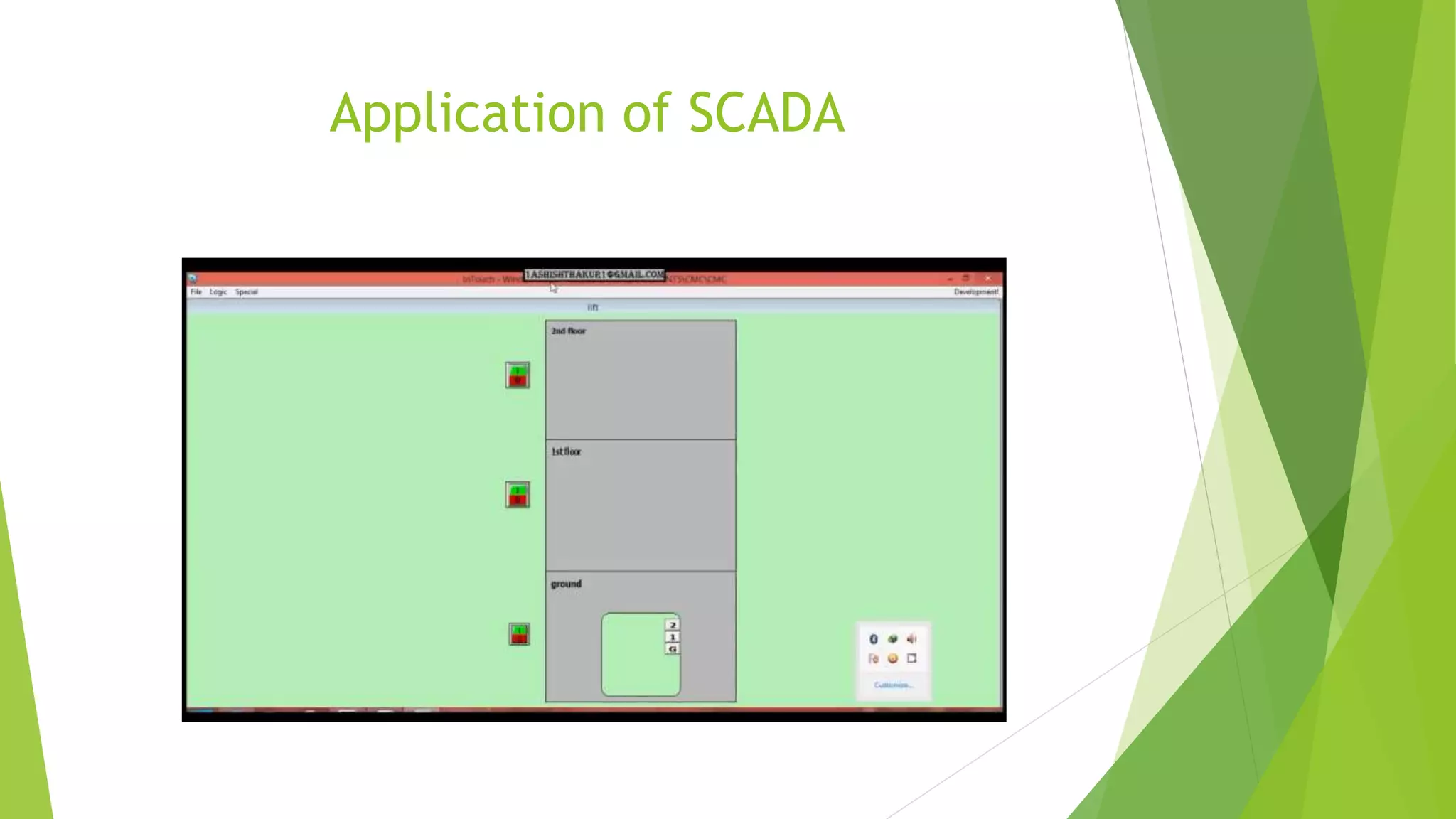
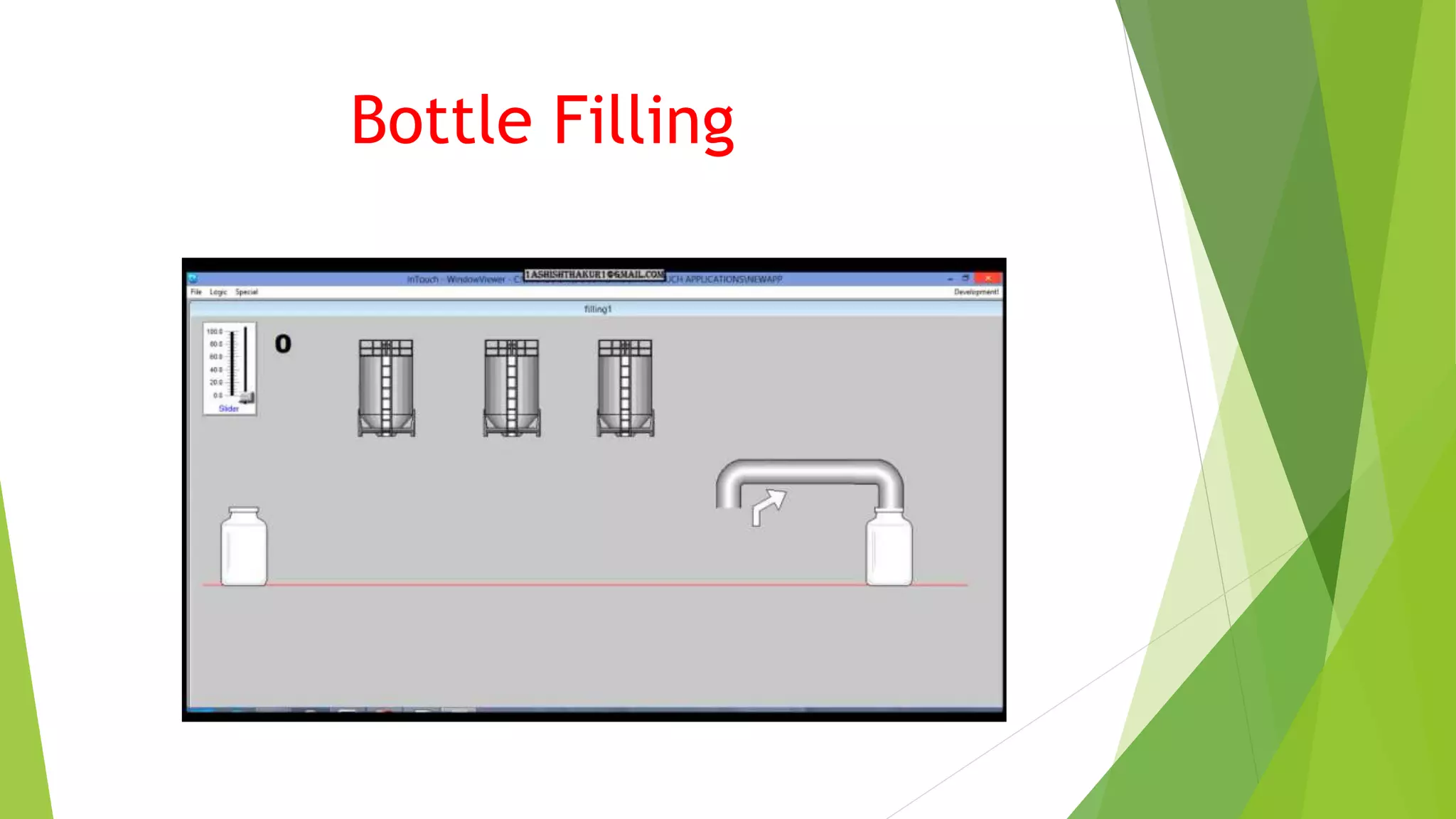
This document discusses programmable logic controllers (PLCs) and supervisory control and data acquisition (SCADA) systems used in industrial automation. It defines automation and describes how PLCs and SCADA systems are commonly used to automate industrial processes. The document outlines the basic components and programming of PLCs, provides examples of PLC brands and types, and describes some common applications of PLCs and SCADA systems in industries like manufacturing, food and beverage, and water treatment.
What isAUTOMATION
• Makingproducts under the control of computers and
programmable controllers is known as automation.
• Manufacturing assembly lines as well as stand alone machine
tools and robotic devices fall into this category.
• It is delegation of human control functions to technical
equipment for increasing the productivity, quality, and increasing
the safety in working conditions thereby reducing the manpower
and cost.
3.
INSUSTRIALAUTOMATION
• Now adays, every small and large industry employ automation.
• In manual control, an operator periodically reads the process and
adjusts the input accordingly. Quite hectic!
• In automation control, measurements and adjustments are done
automatically on a continuous basis. Quite convenient!
4.
Types of ControlSystems usedin
INDUSTRIALAUTOMATION
• PID controller based control system
• PLC based control system
• DCS based control system
• PC based control system
5.
PLC(Programmable LogicController)
• Itis microprocessor based solid state/industrial computer that
perform discrete or sequential logic.
• It was developed to replace mechanical relays, timers, counters.
• The early PLC’s were used to reduce the changeover time,
wiring/re-wiring.
• PLC works on 24V DC and I/O devices that are directly connected
to PLC also works on 24V DC.
• To connect it withAC devices we use relay and transistor
6.
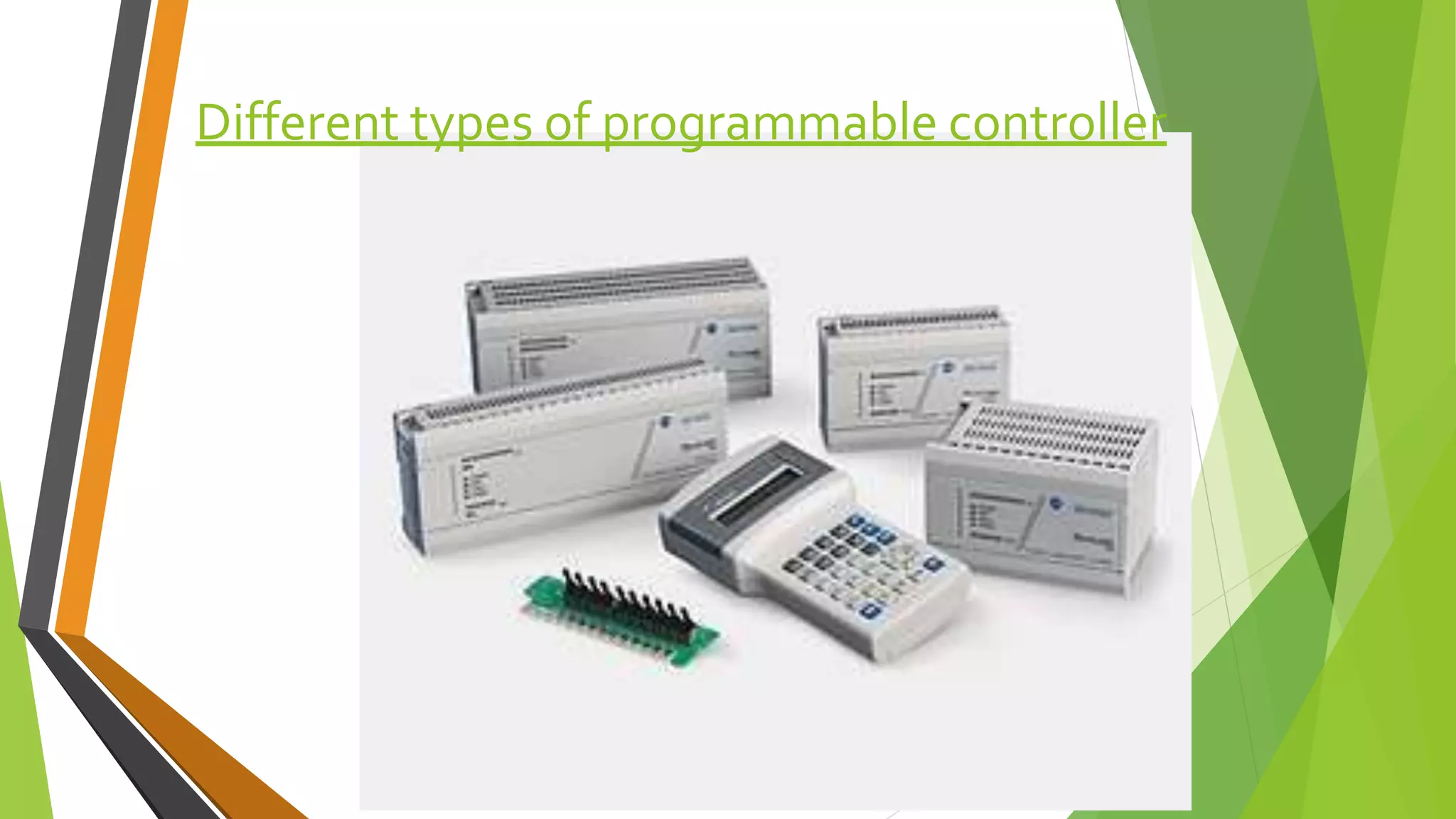
Brands of PLC’s
Panasonic
Allen Bradley
Delta
Omron
Siemense
Keyence
Schnieder
Mitshubishi
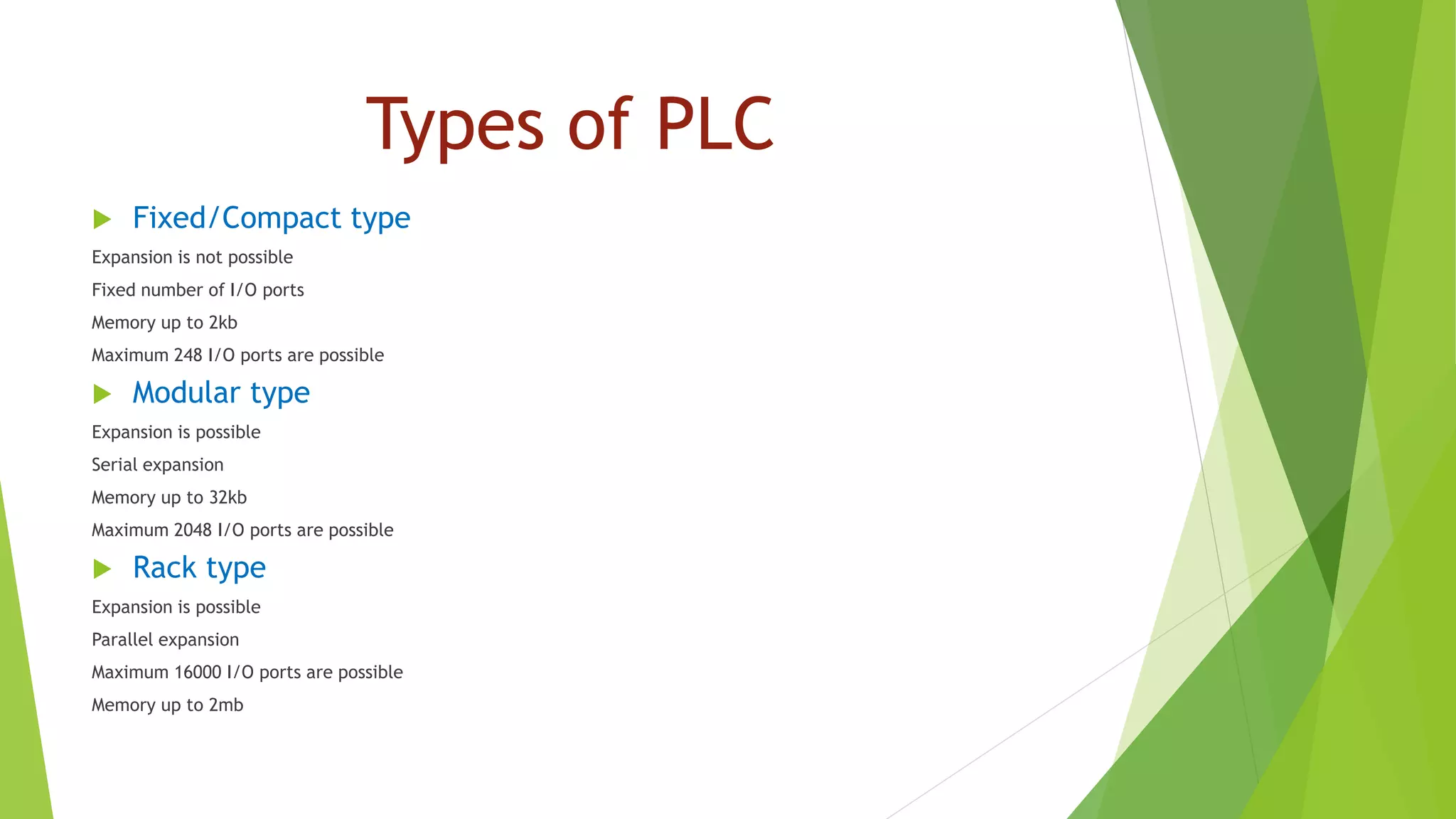
Types of PLC
Fixed/Compact type
Expansion is not possible
Fixed number of I/O ports
Memory up to 2kb
Maximum 248 I/O ports are possible
Modular type
Expansion is possible
Serial expansion
Memory up to 32kb
Maximum 2048 I/O ports are possible
Rack type
Expansion is possible
Parallel expansion
Maximum 16000 I/O ports are possible
Memory up to 2mb
9.
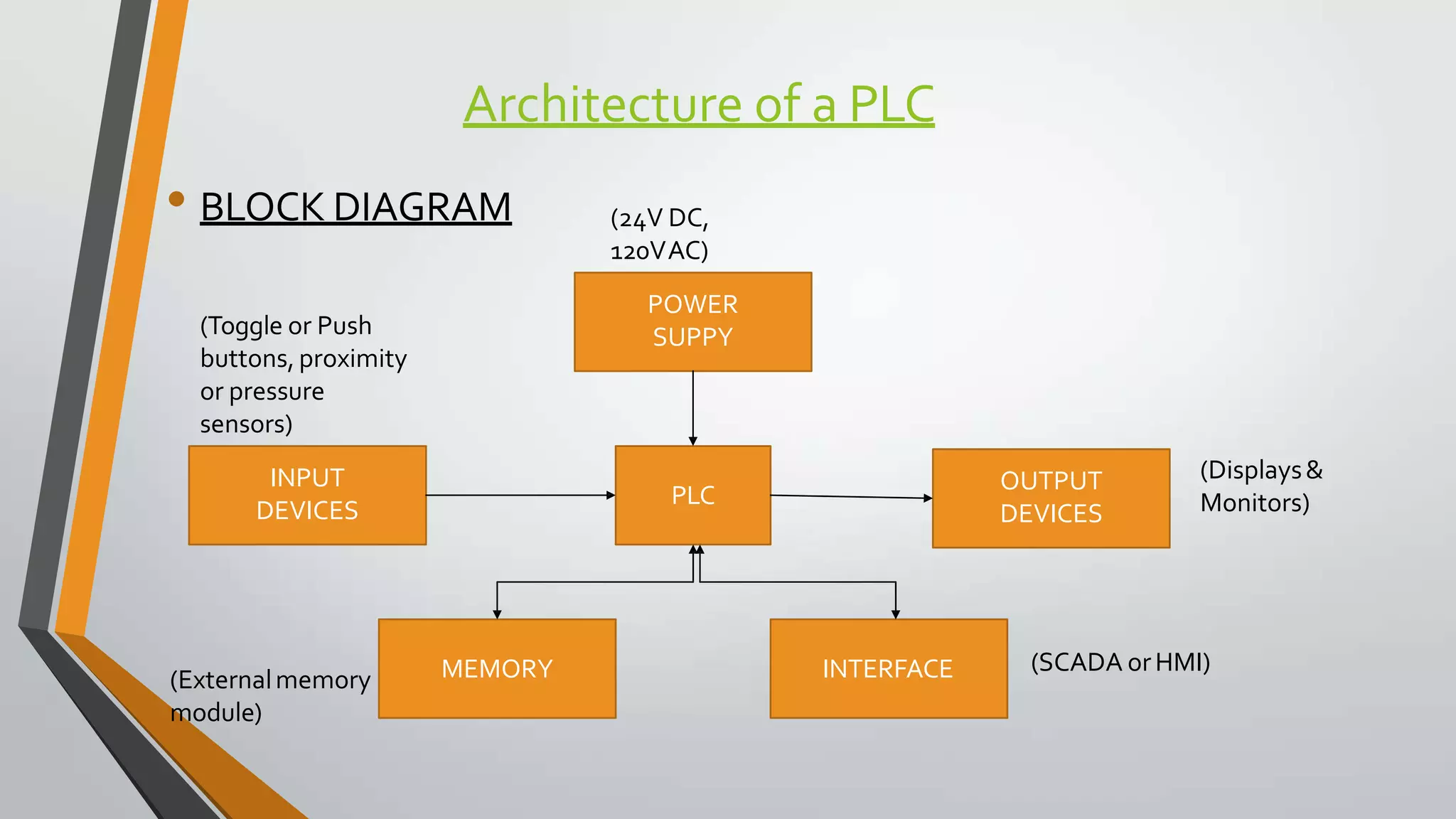
Architecture of aPLC
• BLOCK DIAGRAM
INPUT
DEVICES
PLC
OUTPUT
DEVICES
POWER
SUPPY
MEMORY INTERFACE
(24V DC,
120VAC)
(Toggle or Push
buttons, proximity
or pressure
sensors)
(Displays&
Monitors)
(Externalmemory
module)
(SCADA orHMI)
10.
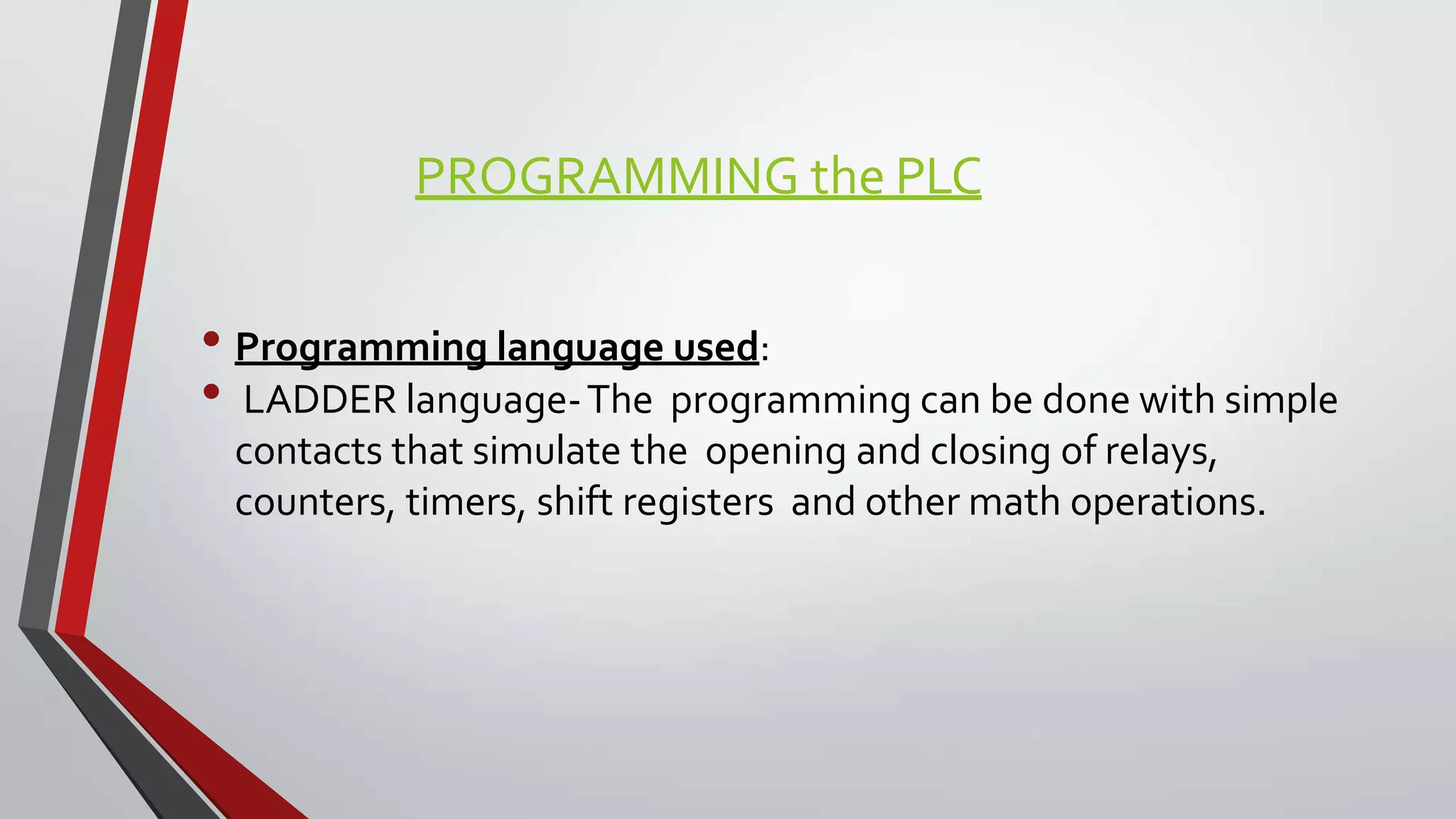
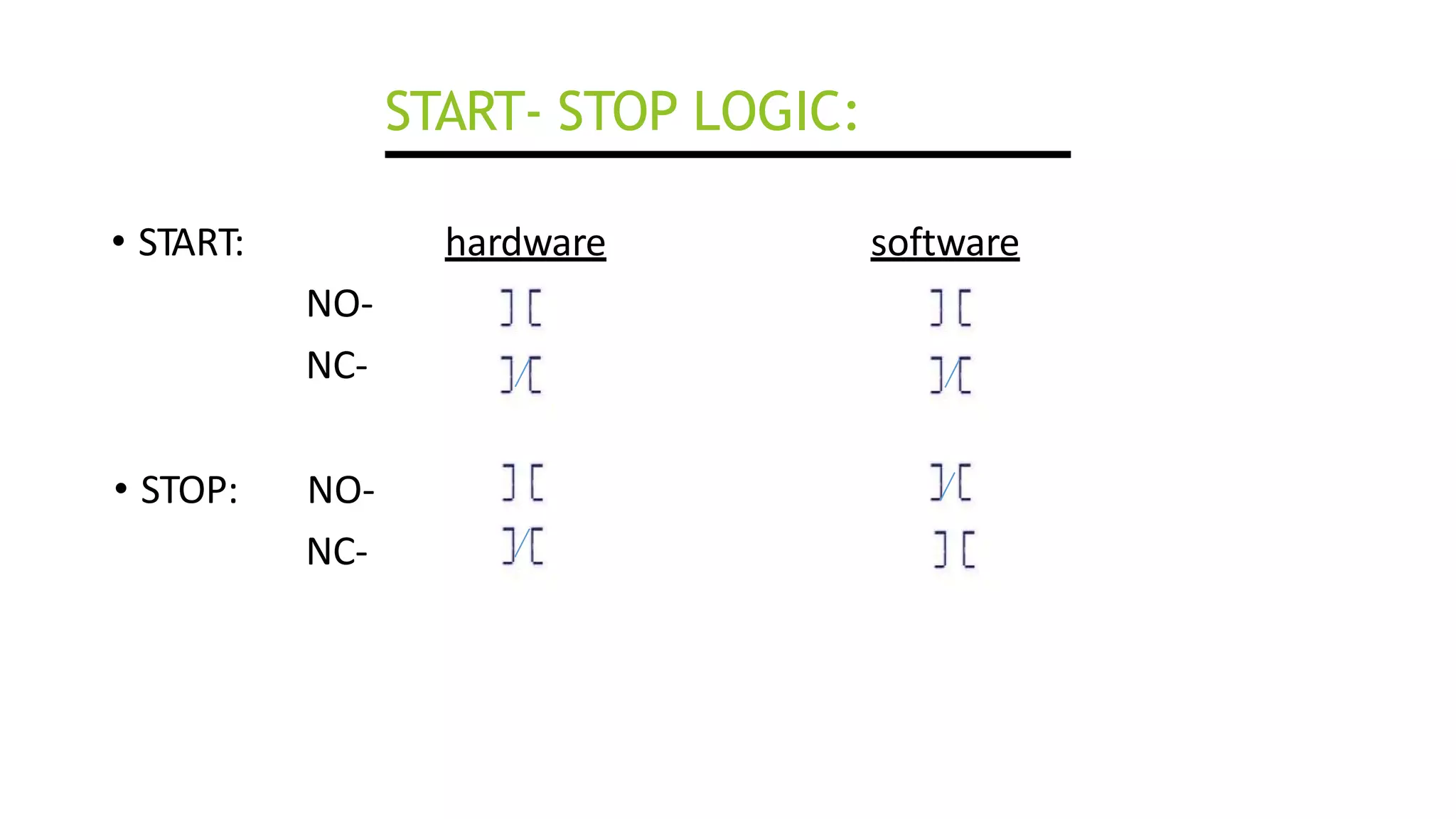
PROGRAMMING the PLC
•Programming language used:
• LADDER language-The programming can be done with simple
contacts that simulate the opening and closing of relays,
counters, timers, shift registers and other math operations.
Software for thePrograming of
Allen Bradley PLC
RSLinx Classic( Driver Software)
RSLogix 500 English(Programing Software)
RS Logix Emulate 500(Simulation Software)
13.
Advantages
• Reliability inoperation.
• Flexibility in control and programming techniques.
• Online offline modifications.
• Small physical size, shorter project time.
• In house simulation and testing of project.
• Speed of operation.
• Ease of maintenance and troubleshooting.
• Ability to communicate and networking with computer system in plant.
• Documentation and security.
• Designed to work in all types of industrial conditions.
14.
Applications
• Material Handling
•PackagingApplications
• General Industrial Machinery
• Printing
• Food and Beverage
• Pharmaceutical
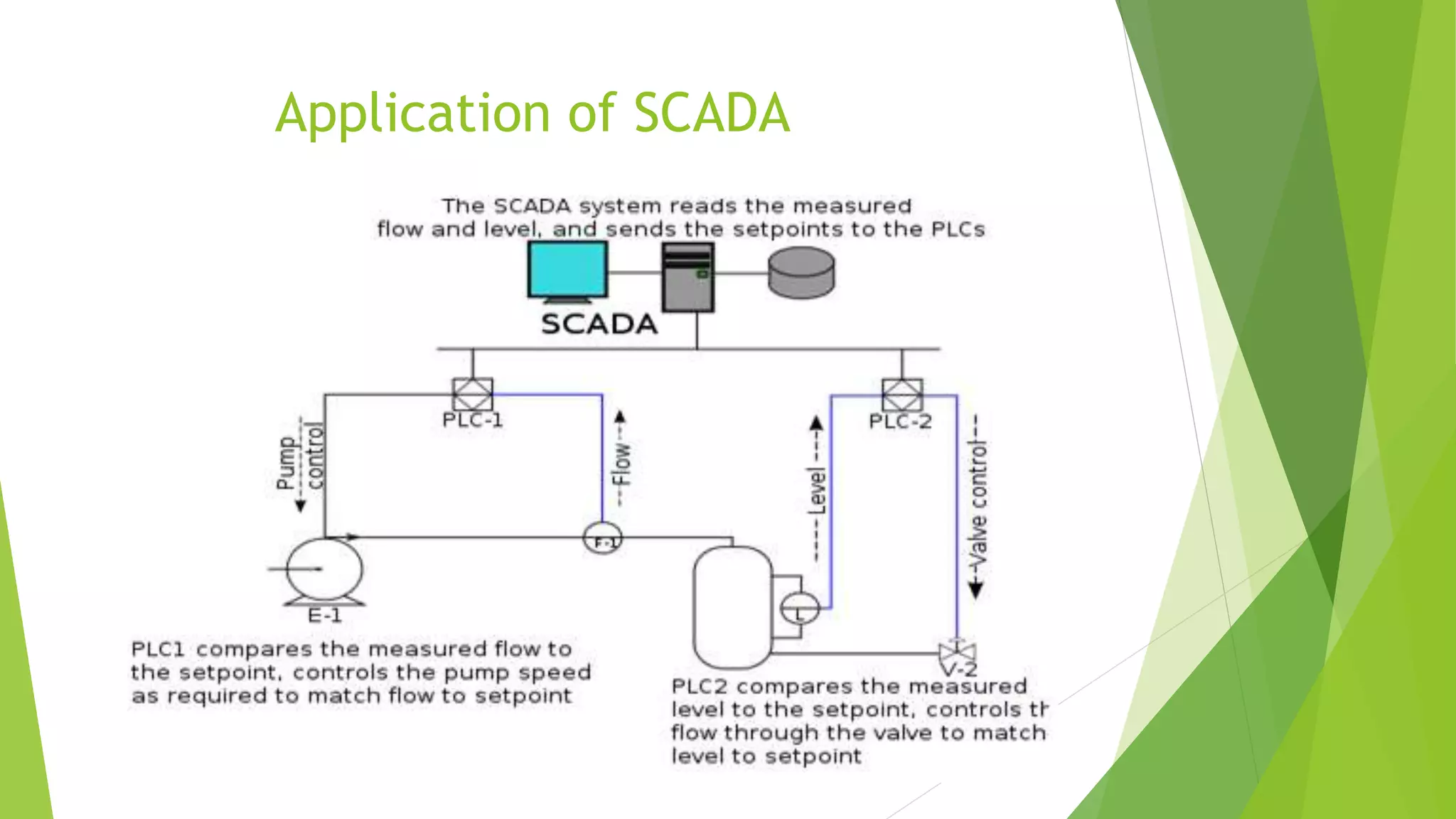
• WaterWastewater /SCADA
• Clutch/Brake control
• Position Control - Pick-and-place /Conveyor
15.
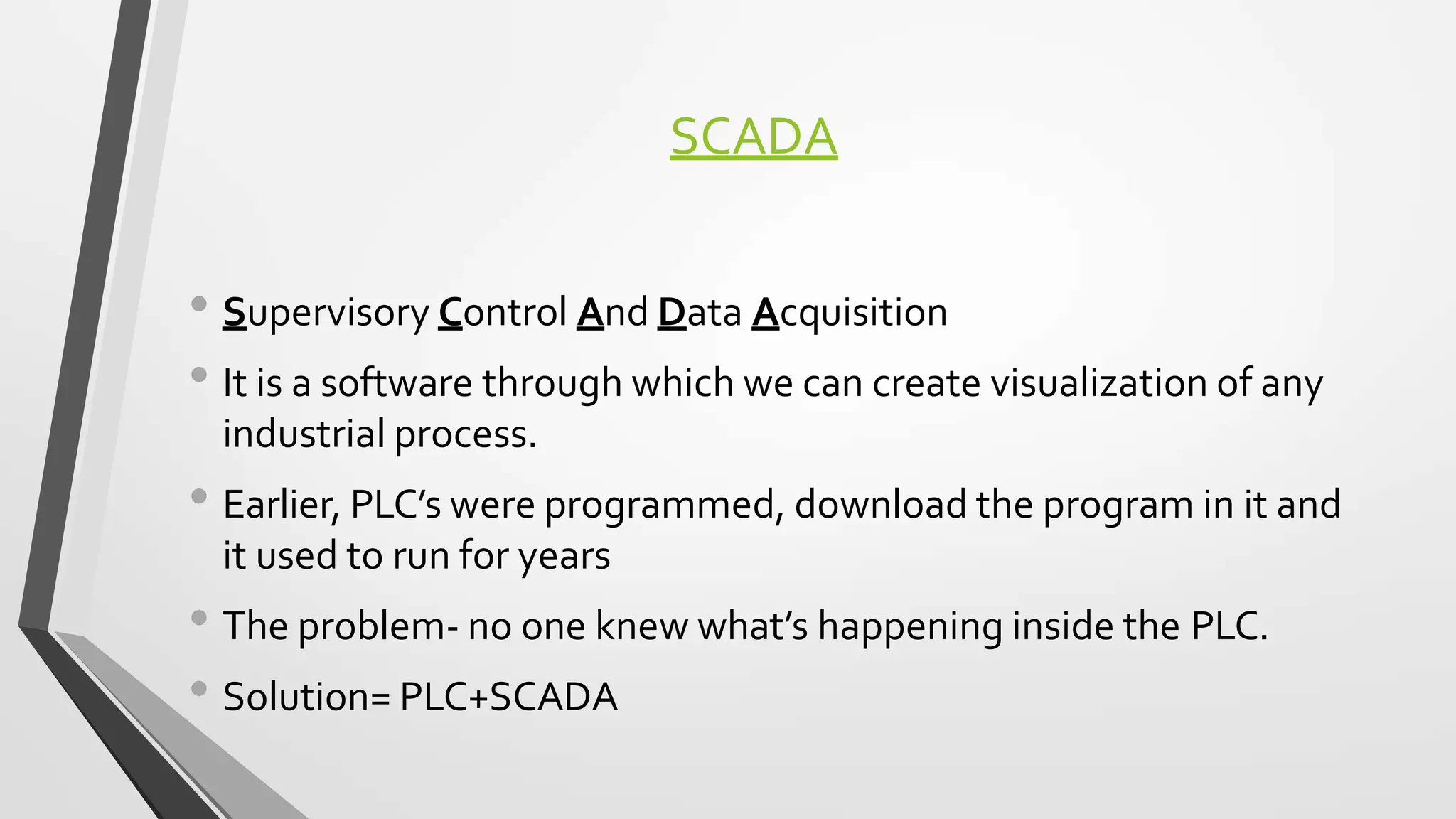
SCADA
• Supervisory ControlAnd Data Acquisition
• It is a software through which we can create visualization of any
industrial process.
• Earlier, PLC’s were programmed, download the program in it and
it used to run for years
• The problem- no one knew what’s happening inside the PLC.
• Solution= PLC+SCADA