Creating
Playable Design
Wei-Fan Chen
CEO @ Fourdesire
Wei-Fan Chen
Founder, Producer, and Designer of Fourdesire
Taipei, Taiwan
Motivate Everything
Make Everything Playable
We make apps!
Bestof2014/2015
Bestof2017
Bestof2013
23,000,000/global
It’s almost the population of Taiwan
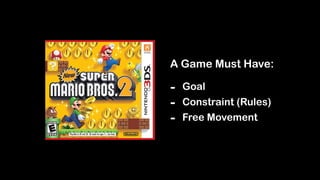
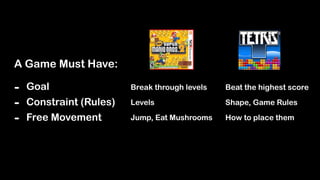
A Game Must Have:
- Goal
- Constraint (Rules)
- Free Movement
A Game Must Have:
- Goal
- Constraint (Rules)
- Free Movement
Break through levels
Levels
Jump, Eat Mushrooms
Beat the highest score
Shape, Game Rules
How to place them
A Game Must Have:
- Goal
- Constraint (Rules)
- Free Movement
Break through levels
Levels
Jump, Eat Mushrooms
Beat the highest score
Shape, Game Rules
How to place them
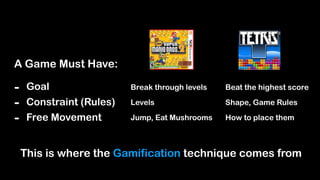
This is where the Gamification technique comes from
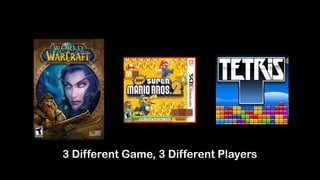
3 Different Game, 3 Different Players
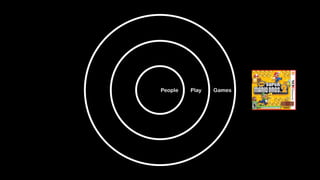
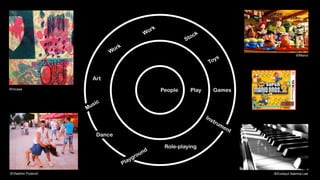
People Play Games
Instrument
Toys
Play GamesPeople
Playground
Role-playing
StockWork
Art
Music
Dance
Work
@Marco
@Eunbyul Sabrina Lee@Vladimir Pustovit
@Incase
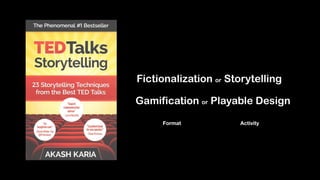
Fictionalization or Storytelling
Gamification or Playable Design
Format Activity
A More Activity-Centered Method
Playable Design
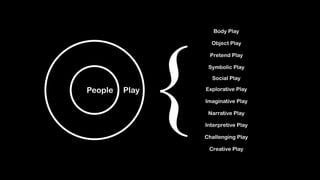
Play is the way to Explore the world
Body Play
Object Play
Pretend Play
Symbolic Play
Explorative Play
Imaginative Play
Narrative Play
Social Play
Challenging Play
Interpretive Play
Creative Play
People Play
{
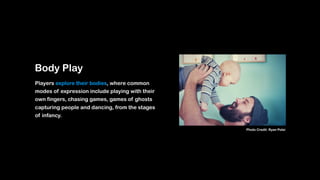
Body Play
Players explore their bodies, where common
modes of expression include playing with their
own fingers, chasing games, games of ghosts
capturing people and dancing, from the stages
of infancy.
Photo Credit: Ryan Polei
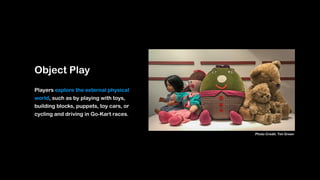
Object Play
Players explore the external physical
world, such as by playing with toys,
building blocks, puppets, toy cars, or
cycling and driving in Go-Kart races.
Photo Credit: Tim Green
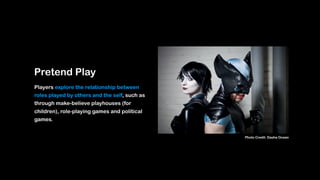
Pretend Play
Players explore the relationship between
roles played by others and the self, such as
through make-believe playhouses (for
children), role-playing games and political
games.
Photo Credit: Dasha Ocean
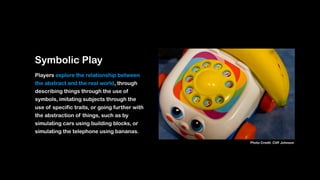
Symbolic Play
Players explore the relationship between
the abstract and the real world, through
describing things through the use of
symbols, imitating subjects through the
use of specific traits, or going further with
the abstraction of things, such as by
simulating cars using building blocks, or
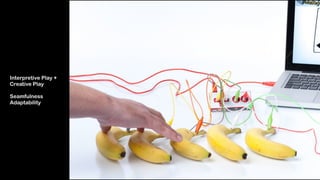
simulating the telephone using bananas.
Photo Credit: Cliff Johnson
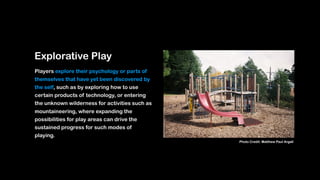
Explorative Play
Players explore their psychology or parts of
themselves that have yet been discovered by
the self, such as by exploring how to use
certain products of technology, or entering
the unknown wilderness for activities such as
mountaineering, where expanding the
possibilities for play areas can drive the
sustained progress for such modes of
playing.
Photo Credit: Matthew Paul Argall
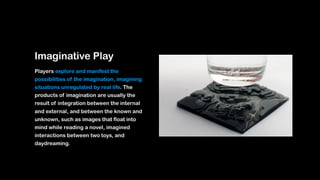
Imaginative Play
Players explore and manifest the
possibilities of the imagination, imagining
situations unregulated by real life. The
products of imagination are usually the
result of integration between the internal
and external, and between the known and
unknown, such as images that float into
mind while reading a novel, imagined
interactions between two toys, and
daydreaming.
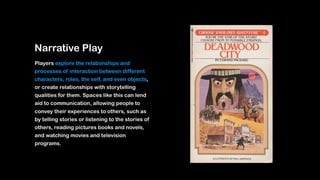
Narrative Play
Players explore the relationships and
processes of interaction between different
characters, roles, the self, and even objects,
or create relationships with storytelling
qualities for them. Spaces like this can lend
aid to communication, allowing people to
convey their experiences to others, such as
by telling stories or listening to the stories of
others, reading pictures books and novels,
and watching movies and television
programs.
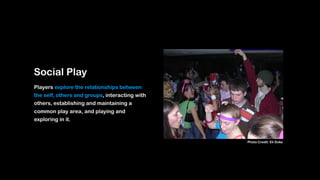
Social Play
Players explore the relationships between
the self, others and groups, interacting with
others, establishing and maintaining a
common play area, and playing and
exploring in it.
Photo Credit: Eli Duke
Challenging Play
Players explore their own cognitive or
behavioral abilities, where they explore the
possibilities of making breakthroughs
through appropriate external or internal
constraints, such as practicing musical
instruments, challenging video games (such
as Dark Souls) and the challenges and sense
of accomplishment derived from work.
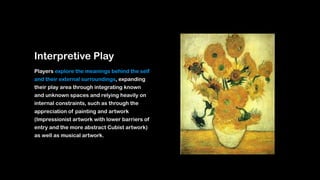
Interpretive Play
Players explore the meanings behind the self
and their external surroundings, expanding
their play area through integrating known
and unknown spaces and relying heavily on
internal constraints, such as through the
appreciation of painting and artwork
(Impressionist artwork with lower barriers of
entry and the more abstract Cubist artwork)
as well as musical artwork.
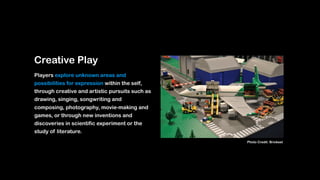
Creative Play
Players explore unknown areas and
possibilities for expression within the self,
through creative and artistic pursuits such as
drawing, singing, songwriting and
composing, photography, movie-making and
games, or through new inventions and
discoveries in scientific experiment or the
study of literature.
Photo Credit: Brickset
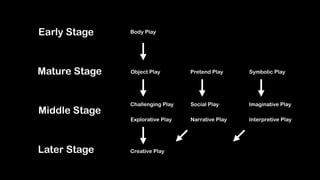
Body Play
Object Play Pretend Play Symbolic Play
Explorative Play
Imaginative Play
Narrative Play
Social PlayChallenging Play
Interpretive Play
Creative Play
Early Stage
Mature Stage
Middle Stage
Later Stage
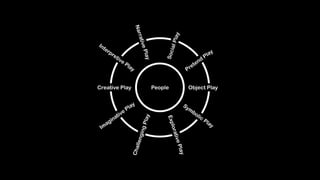
People Object Play
Pretend
Play
Sym
bolic Play
ExplorativePlay
Im
aginative Play
NarrativePlay
SocialPlay
ChallengingPlay
Interpretive Play
Creative Play
People Object Play
Pretend
Play
SymbolicPlay
Explorative PlayIm
aginative Play
NarrativePlay
SocialPlay
ChallengingPlay
Interpretive Play
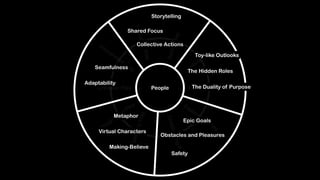
Creative Play The Duality of Purpose
The Hidden Roles
Epic Goals
Obstacles and Pleasures
Safety
Metaphor
Virtual Characters
Making-Believe
Storytelling
Shared Focus
Collective Actions
Seamfulness
Adaptability
Toy-like Outlooks
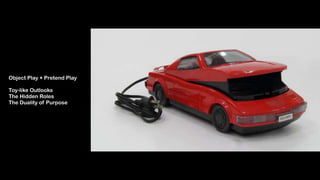
Object Play + Pretend Play


Toy-like Outlooks

The Hidden Roles
The Duality of Purpose
Object Play + Pretend Play


Toy-like Outlooks

The Hidden Roles
The Duality of Purpose
Object Play + Pretend Play


Toy-like Outlooks

The Hidden Roles
The Duality of Purpose
Object Play + Pretend Play


Toy-like Outlooks

The Hidden Roles
The Duality of Purpose
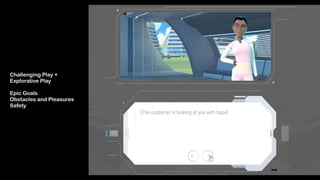
Challenging Play + 

Explorative Play


Epic Goals

Obstacles and Pleasures
Safety
Challenging Play + 

Explorative Play


Epic Goals

Obstacles and Pleasures
Safety
Challenging Play + 

Explorative Play


Epic Goals

Obstacles and Pleasures
Safety
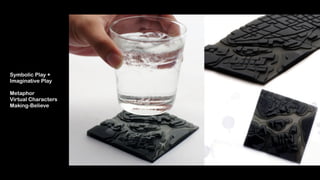
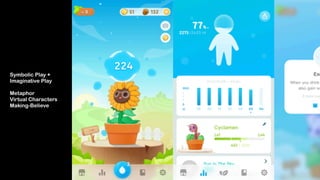
Symbolic Play + 

Imaginative Play


Metaphor

Virtual Characters
Making-Believe
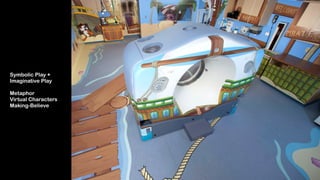
Symbolic Play + 

Imaginative Play


Metaphor

Virtual Characters
Making-Believe
Symbolic Play + 

Imaginative Play


Metaphor

Virtual Characters
Making-Believe
Symbolic Play + 

Imaginative Play


Metaphor

Virtual Characters
Making-Believe
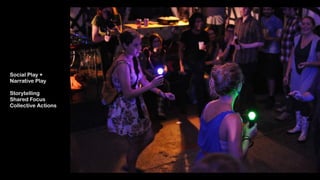
Social Play + 

Narrative Play


Storytelling

Shared Focus
Collective Actions
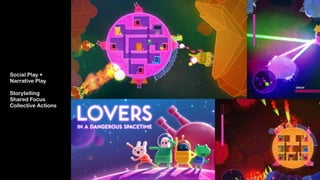
Social Play + 

Narrative Play


Storytelling

Shared Focus
Collective Actions
Social Play + 

Narrative Play


Storytelling

Shared Focus
Collective Actions
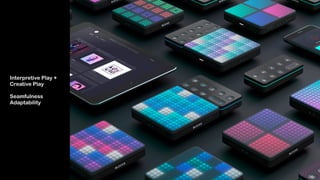
Interpretive Play + 

Creative Play


Seamfulness

Adaptability
Interpretive Play + 

Creative Play


Seamfulness

Adaptability
Interpretive Play + 

Creative Play


Seamfulness

Adaptability
People Play Anything
Thanks
Wei-Fan Chen
CEO @ Fourdesire

Playable Design

  • 1.
  • 2.
    Wei-Fan Chen Founder, Producer,and Designer of Fourdesire Taipei, Taiwan
  • 3.
  • 4.
  • 5.
  • 8.
    A Game MustHave: - Goal - Constraint (Rules) - Free Movement
  • 9.
    A Game MustHave: - Goal - Constraint (Rules) - Free Movement Break through levels Levels Jump, Eat Mushrooms Beat the highest score Shape, Game Rules How to place them
  • 10.
    A Game MustHave: - Goal - Constraint (Rules) - Free Movement Break through levels Levels Jump, Eat Mushrooms Beat the highest score Shape, Game Rules How to place them This is where the Gamification technique comes from
  • 11.
    3 Different Game,3 Different Players
  • 12.
  • 13.
  • 14.
    Fictionalization or Storytelling Gamificationor Playable Design Format Activity
  • 15.
    A More Activity-CenteredMethod Playable Design
  • 16.
    Play is theway to Explore the world
  • 17.
    Body Play Object Play PretendPlay Symbolic Play Explorative Play Imaginative Play Narrative Play Social Play Challenging Play Interpretive Play Creative Play People Play {
  • 18.
    Body Play Players exploretheir bodies, where common modes of expression include playing with their own fingers, chasing games, games of ghosts capturing people and dancing, from the stages of infancy. Photo Credit: Ryan Polei
  • 19.
    Object Play Players explorethe external physical world, such as by playing with toys, building blocks, puppets, toy cars, or cycling and driving in Go-Kart races. Photo Credit: Tim Green
  • 20.
    Pretend Play Players explorethe relationship between roles played by others and the self, such as through make-believe playhouses (for children), role-playing games and political games. Photo Credit: Dasha Ocean
  • 21.
    Symbolic Play Players explorethe relationship between the abstract and the real world, through describing things through the use of symbols, imitating subjects through the use of specific traits, or going further with the abstraction of things, such as by simulating cars using building blocks, or simulating the telephone using bananas. Photo Credit: Cliff Johnson
  • 22.
    Explorative Play Players exploretheir psychology or parts of themselves that have yet been discovered by the self, such as by exploring how to use certain products of technology, or entering the unknown wilderness for activities such as mountaineering, where expanding the possibilities for play areas can drive the sustained progress for such modes of playing. Photo Credit: Matthew Paul Argall
  • 23.
    Imaginative Play Players exploreand manifest the possibilities of the imagination, imagining situations unregulated by real life. The products of imagination are usually the result of integration between the internal and external, and between the known and unknown, such as images that float into mind while reading a novel, imagined interactions between two toys, and daydreaming.
  • 24.
    Narrative Play Players explorethe relationships and processes of interaction between different characters, roles, the self, and even objects, or create relationships with storytelling qualities for them. Spaces like this can lend aid to communication, allowing people to convey their experiences to others, such as by telling stories or listening to the stories of others, reading pictures books and novels, and watching movies and television programs.
  • 25.
    Social Play Players explorethe relationships between the self, others and groups, interacting with others, establishing and maintaining a common play area, and playing and exploring in it. Photo Credit: Eli Duke
  • 26.
    Challenging Play Players exploretheir own cognitive or behavioral abilities, where they explore the possibilities of making breakthroughs through appropriate external or internal constraints, such as practicing musical instruments, challenging video games (such as Dark Souls) and the challenges and sense of accomplishment derived from work.
  • 27.
    Interpretive Play Players explorethe meanings behind the self and their external surroundings, expanding their play area through integrating known and unknown spaces and relying heavily on internal constraints, such as through the appreciation of painting and artwork (Impressionist artwork with lower barriers of entry and the more abstract Cubist artwork) as well as musical artwork.
  • 28.
    Creative Play Players exploreunknown areas and possibilities for expression within the self, through creative and artistic pursuits such as drawing, singing, songwriting and composing, photography, movie-making and games, or through new inventions and discoveries in scientific experiment or the study of literature. Photo Credit: Brickset
  • 29.
    Body Play Object PlayPretend Play Symbolic Play Explorative Play Imaginative Play Narrative Play Social PlayChallenging Play Interpretive Play Creative Play Early Stage Mature Stage Middle Stage Later Stage
  • 30.
    People Object Play Pretend Play Sym bolicPlay ExplorativePlay Im aginative Play NarrativePlay SocialPlay ChallengingPlay Interpretive Play Creative Play
  • 31.
    People Object Play Pretend Play SymbolicPlay ExplorativePlayIm aginative Play NarrativePlay SocialPlay ChallengingPlay Interpretive Play Creative Play The Duality of Purpose The Hidden Roles Epic Goals Obstacles and Pleasures Safety Metaphor Virtual Characters Making-Believe Storytelling Shared Focus Collective Actions Seamfulness Adaptability Toy-like Outlooks
  • 32.
    Object Play +Pretend Play
 
 Toy-like Outlooks
 The Hidden Roles The Duality of Purpose
  • 33.
    Object Play +Pretend Play
 
 Toy-like Outlooks
 The Hidden Roles The Duality of Purpose
  • 34.
    Object Play +Pretend Play
 
 Toy-like Outlooks
 The Hidden Roles The Duality of Purpose
  • 35.
    Object Play +Pretend Play
 
 Toy-like Outlooks
 The Hidden Roles The Duality of Purpose
  • 36.
    Challenging Play +
 Explorative Play
 
 Epic Goals
 Obstacles and Pleasures Safety
  • 37.
    Challenging Play +
 Explorative Play
 
 Epic Goals
 Obstacles and Pleasures Safety
  • 38.
    Challenging Play +
 Explorative Play
 
 Epic Goals
 Obstacles and Pleasures Safety
  • 39.
    Symbolic Play +
 Imaginative Play
 
 Metaphor
 Virtual Characters Making-Believe
  • 40.
    Symbolic Play +
 Imaginative Play
 
 Metaphor
 Virtual Characters Making-Believe
  • 41.
    Symbolic Play +
 Imaginative Play
 
 Metaphor
 Virtual Characters Making-Believe
  • 42.
    Symbolic Play +
 Imaginative Play
 
 Metaphor
 Virtual Characters Making-Believe
  • 43.
    Social Play +
 Narrative Play
 
 Storytelling
 Shared Focus Collective Actions
  • 44.
    Social Play +
 Narrative Play
 
 Storytelling
 Shared Focus Collective Actions
  • 45.
    Social Play +
 Narrative Play
 
 Storytelling
 Shared Focus Collective Actions
  • 46.
    Interpretive Play +
 Creative Play
 
 Seamfulness
 Adaptability
  • 47.
    Interpretive Play +
 Creative Play
 
 Seamfulness
 Adaptability
  • 48.
    Interpretive Play +
 Creative Play
 
 Seamfulness
 Adaptability
  • 49.
  • 50.