Developing Low Cost Simulation
Immersions
Thursday July 25, 2019
The “birth” of an idea!
●Private | Nonprofit | Regionally
Accredited
• Historically challenging to students.
• Accelerated course delivery.
• Developing ability to apply learned
content.
• Limited clinical exposure.
• Student anxiety surrounding
specialty.
• Documented value of high-fidelity
simulation to undergraduate
students.
Immersion Goals
●Private | Nonprofit | Regionally
Accredited
• To expose students to low volume high-risk client care
scenarios that capture frequently tested concepts on
NCLEX RN in a controlled replicable environment.
• To provide experiences that would enable students to
apply learned concepts towards clinical reasoning for
selected essential concepts.
• To improve student outcomes related to selected
essential concepts measured through summative
assessments.
Private | Nonprofit | Regionally Accredited
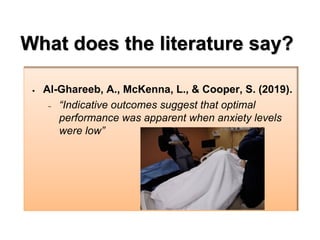
• Al-Ghareeb, A., McKenna, L., & Cooper, S. (2019).
– “Indicative outcomes suggest that optimal
performance was apparent when anxiety levels
were low”
What does the literature say?
Private | Nonprofit | Regionally Accredited
• Andersen, P., Downer, T., O’Brien, S., & Cox, K. (2019).
• Bortolato-Major, C., Perez Arhur, J., Taís Mattei daSilva, Â., de Fátima
Mantovani, M., Cestari Felix, J. V., & Boostel, R. (2018).
– Recognized the potential of simulation for teaching undergraduate
nursing courses, with opportunities to offer students practical and
theoretical knowledge in a controlled environment and close to real,
with minimizing risks to patients.
• Cant, R. P., & Cooper, S. J. (n.d.).
– Highlights: Simulation education statistically improves nursing students'
knowledge.
– Studies report improvements to students' confidence, competence and
self-efficacy.
– Programs demonstrate innovation and excellence, teaching a wide-
range of topics.
– Programs should be shared across the discipline to facilitate
development of multimodal learning.
●Private | Nonprofit | Regionally
Accredited
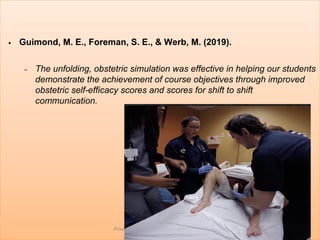
• Guimond, M. E., Foreman, S. E., & Werb, M. (2019).
– The unfolding, obstetric simulation was effective in helping our students
demonstrate the achievement of course objectives through improved
obstetric self-efficacy scores and scores for shift to shift
communication.
Private | Nonprofit | Regionally Accredited
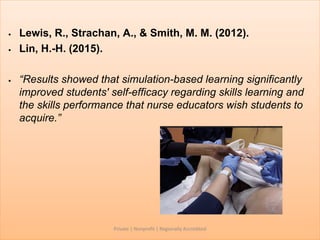
• Lewis, R., Strachan, A., & Smith, M. M. (2012).
• Lin, H.-H. (2015).
• “Results showed that simulation-based learning significantly
improved students' self-efficacy regarding skills learning and
the skills performance that nurse educators wish students to
acquire.”
Private | Nonprofit | Regionally Accredited
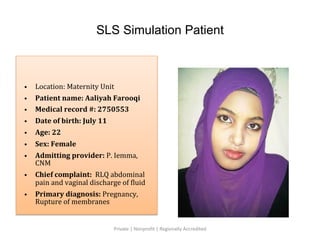
SLS Simulation Patient
• Location:	Maternity	Unit
• Patient	name:	Aaliyah	Farooqi
• Medical	record	#:	2750553
• Date	of	birth:	July	11
• Age:	22
• Sex:	Female		
• Admitting	provider: P.	Iemma,	
CNM
• Chief	complaint: RLQ	abdominal	
pain	and	vaginal	discharge	of	fluid
• Primary	diagnosis: Pregnancy,	
Rupture	of	membranes
Private | Nonprofit | Regionally Accredited
Roberts, S., Warda, M., Garbutt, S., & Curry, K., Associate
Professor, Associate Director, Department of Nursing. (2014).
The use of high-fidelity simulation to teach cultural
competence in the nursing curriculum. Journal of
Professional Nursing, 30(3), 259-265.
doi:10.1016/j.profnurs.2013.09.012
• “With the increasing demands of the nursing
curriculum and the limited time frame to prepare
competent clinicians, the search continues for
innovative strategies that will produce culturally
competent providers. Patient simulation is a
technique that replicates real-world scenarios in a
controlled and nonthreatening environment. “
Private | Nonprofit | Regionally Accredited
●Private | Nonprofit | Regionally
Accredited
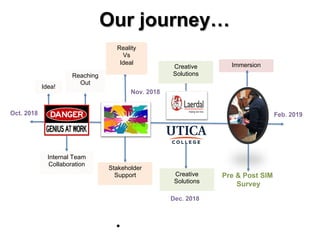
Our journey…
Idea!
Internal Team
Collaboration
Reaching
Out
Stakeholder
Support
Reality
Vs
Ideal Immersion
Creative
Solutions
Creative
Solutions
Private | Nonprofit | Regionally Accredited
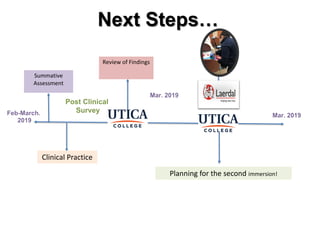
Next Steps…
Summative
Assessment
Clinical Practice
Planning for the second immersion!
Review of Findings
Private | Nonprofit | Regionally Accredited
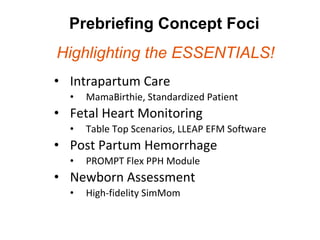
Prebriefing Concept Foci
Highlighting the ESSENTIALS!
• Intrapartum Care
• MamaBirthie, Standardized Patient
• Fetal Heart Monitoring
• Table Top Scenarios, LLEAP EFM Software
• Post Partum Hemorrhage
• PROMPT Flex PPH Module
• Newborn Assessment
• High-fidelity SimMom
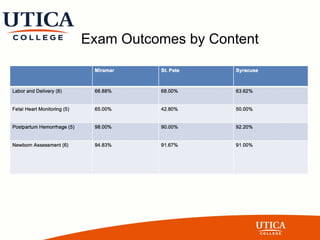
Exam Outcomes by Content
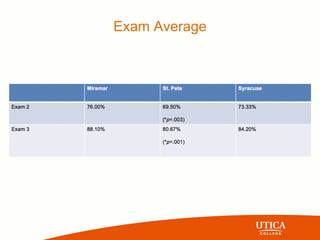
Exam Average
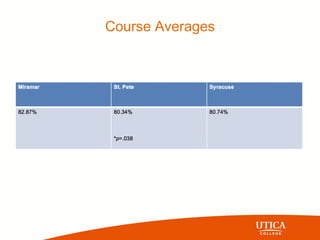
Course Averages
Private | Nonprofit | Regionally Accredited
Debriefing of Concepts
• Nursing Process Framework
• Plus/Delta
• Maslow’s Hierarchy of Needs
• Jeopardy Game
• Teach back
Getting to the AH – HA moment!
Creative Staffing
Berro & Knoesel (2016)
– Utilizing recent graduates
– Exposure to the teaching role
– Maintaining and enhancing newly acquired nursing
skills
– Giving back to their alma mater
– Strengthening their own novice clinical expertise
Simulation for Specialty Areas
Curl, Smith, Chisholm, McGee, & Das (2016)
– STRIPES group had clinical and simulation
– Control group only simulation
– Pre and post testing completed
– The experimental group scored the same or
higher than the control group.
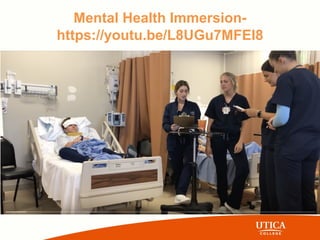
Mental Health Immersion-
https://youtu.be/L8UGu7MFEI8
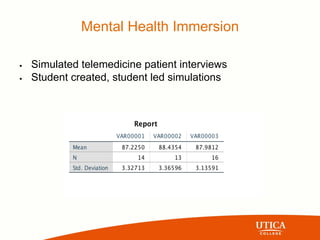
Mental Health Immersion
• Simulated telemedicine patient interviews
• Student created, student led simulations
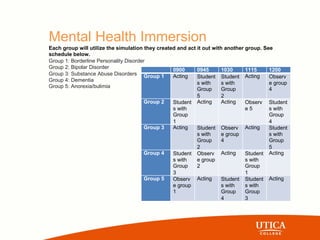
Mental Health Immersion
Each group will utilize the simulation they created and act it out with another group. See
schedule below.
Group 1: Borderline Personality Disorder
Group 2: Bipolar Disorder
Group 3: Substance Abuse Disorders
Group 4: Dementia
Group 5: Anorexia/bulimia
0900 0945 1030 1115 1200
Group 1 Acting Student
s with
Group
5
Student
s with
Group
2
Acting Observ
e group
4
Group 2 Student
s with
Group
1
Acting Acting Observ
e 5
Student
s with
Group
4
Group 3 Acting Student
s with
Group
2
Observ
e group
4
Acting Student
s with
Group
5
Group 4 Student
s with
Group
3
Observ
e group
2
Acting Student
s with
Group
1
Acting
Group 5 Observ
e group
1
Acting Student
s with
Group
4
Student
s with
Group
3
Acting
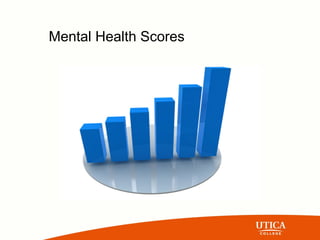
Mental Health Scores
Expanding the Model
• Replicate at all 3
sites
• Obstetrics
• Pediatrics
• Psychiatric
population
• Standardized
patients This Photo by Unknown Author is licensed under CC BY-SA-NC
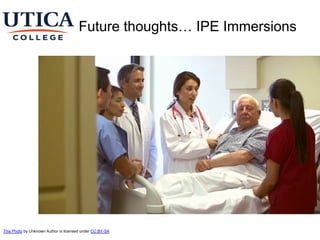
Future thoughts… IPE Immersions
This Photo by Unknown Author is licensed under CC BY-SA
Lab Fees Alumni donations
and fundraising
Grant Funding
Money, Money, Money!
How can this integrate into your
curriculum?
What other ideas do you have?
Do you currently have shortages in
clinical placement or experiences?
Faculty Presenters
Dr. Pasquale Iemma- paiemma@utica.edu
Dr. Wendy Moore- wlmoore@utica.edu
Professor Katie Pawloski-
kmpawloski@utica.edu
Professor Kellany Noland-
kscadoga@utica.edu
Professor Marie Lumbart-
malumbar@utica.edu
References
Al-Ghareeb, A., McKenna, L., & Cooper, S. (2019). The influence of anxiety on student nurse
performance in a simulated clinical setting: A mixed methods design. International Journal
of Nursing Studies, 98, 57–66. https://doi.org/10.1016/j.ijnurstu.2019.06.006
Andersen, P., Downer, T., O’Brien, S., & Cox, K. (2019). Wearable simulated maternity model:
Making simulation encounters real in midwifery. Clinical Simulation in Nursing, 33, 1–6.
https://doi.org/10.1016/j.ecns.2019.04.007
Berroo, E & Knoesel, J. (2016). An Innovative Approach to Staffing a Simulation Center in a
College of Health Professions. Journal of Nursing Education. 55(1), 53-55.
doi:10.3928/01484834-20151214-13
Bortolato-Major, C., Perez Arhur, J., Taís Mattei daSilva, Â., de Fátima Mantovani, M., Cestari Felix,
J. V., & Boostel, R. (2018). Contributions of the Simulation for Undergraduate Nursing
Students. Journal of Nursing UFPE / Revista de Enfermagem UFPE, 12(6), 1751–1762.
https://doi.org/10.5205/1981-8963-v12i6a230633p1751-1762-2018
Cant, R. P., & Cooper, S. J. (n.d.). The value of simulation-based learning in pre-licensure nurse
education: A state-of-the-art review and meta-analysis. Nurse Education in Practice, 27,
45–62. https://doi.org/10.1016/j.nepr.2017.08.012
References
Curl, E. D., Smith, S., Chisholm, L. A., McGee, L. A., & Das, K. (2016). Effectiveness of
Integrated Simulation and Clinical Experiences Compared to Traditional Clinical
Experiences for Nursing Students. Nursing Education Perspectives (National League for
Nursing), 37(2), 72–77. https://doi-org.library.capella.edu/10.5480/15-1647
Guimond, M. E., Foreman, S. E., & Werb, M. (2019). Evaluation of an unfolding obstetric experience
simulation in an undergraduate nursing program. Nurse Education Today, 79, 124–128.
https://doi.org/10.1016/j.nedt.2019.05.003
Lewis, R., Strachan, A., & Smith, M. M. (2012). Is high fidelity simulation the most effective method
for the development of non-technical skills in nursing? A review of the current
evidence. The Open Nursing Journal, 6, 82–89. doi:10.2174/1874434601206010082
Lin, H.-H. (2015). Effectiveness of simulation-based learning on student nurses’ self-efficacy and
performance while learning fundamental nursing skills. Technology and Health Care:
Official Journal of the European Society for Engineering and Medicine, 24 Suppl 1, S369–
S375.
References
MacKinnon, K., Marcellus, L., Rivers, J., Gordon, C., Ryan, M. & Butcher, D. (2015). Student and
educator experiences of maternal-child simulation-based learning: a systematic review of
qualitative evidence protocol. JBI Database of Systematic Reviews & Implementation
Reports, 13(1), 14-26. doi: 10.11124/jbisrir-2015-1694
MacKinnon, K., Marcellus, L., Rivers, J., Gordon, C., Ryan, M. & Butcher, D. (2017). Student and
educator experiences of maternal-child simulation-based learning: a systematic review of
qualitative evidence. JBI Database of Systematic Reviews and Implementation Reports,
15(11):2666–2706, DOI: 10.11124/JBISRIR-2016-003147
Ogard-Repal, A., De Presno, A. K., & Fossum, M. (2018). Simulation with standardized patients to
prepare undergraduate nursing students for mental health clinical practice: An integrative
literature review. Nurse Education Today. doi: 10.1016/j.nedt.2018.04.018

Developing Low Cost Simulation Immersions

  • 1.
    Developing Low CostSimulation Immersions Thursday July 25, 2019
  • 2.
    The “birth” ofan idea! ●Private | Nonprofit | Regionally Accredited • Historically challenging to students. • Accelerated course delivery. • Developing ability to apply learned content. • Limited clinical exposure. • Student anxiety surrounding specialty. • Documented value of high-fidelity simulation to undergraduate students.
  • 3.
    Immersion Goals ●Private |Nonprofit | Regionally Accredited • To expose students to low volume high-risk client care scenarios that capture frequently tested concepts on NCLEX RN in a controlled replicable environment. • To provide experiences that would enable students to apply learned concepts towards clinical reasoning for selected essential concepts. • To improve student outcomes related to selected essential concepts measured through summative assessments.
  • 4.
    Private | Nonprofit| Regionally Accredited • Al-Ghareeb, A., McKenna, L., & Cooper, S. (2019). – “Indicative outcomes suggest that optimal performance was apparent when anxiety levels were low” What does the literature say?
  • 5.
    Private | Nonprofit| Regionally Accredited • Andersen, P., Downer, T., O’Brien, S., & Cox, K. (2019). • Bortolato-Major, C., Perez Arhur, J., Taís Mattei daSilva, Â., de Fátima Mantovani, M., Cestari Felix, J. V., & Boostel, R. (2018). – Recognized the potential of simulation for teaching undergraduate nursing courses, with opportunities to offer students practical and theoretical knowledge in a controlled environment and close to real, with minimizing risks to patients.
  • 6.
    • Cant, R.P., & Cooper, S. J. (n.d.). – Highlights: Simulation education statistically improves nursing students' knowledge. – Studies report improvements to students' confidence, competence and self-efficacy. – Programs demonstrate innovation and excellence, teaching a wide- range of topics. – Programs should be shared across the discipline to facilitate development of multimodal learning. ●Private | Nonprofit | Regionally Accredited
  • 7.
    • Guimond, M.E., Foreman, S. E., & Werb, M. (2019). – The unfolding, obstetric simulation was effective in helping our students demonstrate the achievement of course objectives through improved obstetric self-efficacy scores and scores for shift to shift communication. Private | Nonprofit | Regionally Accredited
  • 8.
    • Lewis, R.,Strachan, A., & Smith, M. M. (2012). • Lin, H.-H. (2015). • “Results showed that simulation-based learning significantly improved students' self-efficacy regarding skills learning and the skills performance that nurse educators wish students to acquire.” Private | Nonprofit | Regionally Accredited
  • 9.
    SLS Simulation Patient •Location: Maternity Unit • Patient name: Aaliyah Farooqi • Medical record #: 2750553 • Date of birth: July 11 • Age: 22 • Sex: Female • Admitting provider: P. Iemma, CNM • Chief complaint: RLQ abdominal pain and vaginal discharge of fluid • Primary diagnosis: Pregnancy, Rupture of membranes Private | Nonprofit | Regionally Accredited
  • 10.
    Roberts, S., Warda,M., Garbutt, S., & Curry, K., Associate Professor, Associate Director, Department of Nursing. (2014). The use of high-fidelity simulation to teach cultural competence in the nursing curriculum. Journal of Professional Nursing, 30(3), 259-265. doi:10.1016/j.profnurs.2013.09.012 • “With the increasing demands of the nursing curriculum and the limited time frame to prepare competent clinicians, the search continues for innovative strategies that will produce culturally competent providers. Patient simulation is a technique that replicates real-world scenarios in a controlled and nonthreatening environment. “ Private | Nonprofit | Regionally Accredited
  • 11.
    ●Private | Nonprofit| Regionally Accredited Our journey… Idea! Internal Team Collaboration Reaching Out Stakeholder Support Reality Vs Ideal Immersion Creative Solutions Creative Solutions
  • 12.
    Private | Nonprofit| Regionally Accredited Next Steps… Summative Assessment Clinical Practice Planning for the second immersion! Review of Findings
  • 13.
    Private | Nonprofit| Regionally Accredited Prebriefing Concept Foci Highlighting the ESSENTIALS! • Intrapartum Care • MamaBirthie, Standardized Patient • Fetal Heart Monitoring • Table Top Scenarios, LLEAP EFM Software • Post Partum Hemorrhage • PROMPT Flex PPH Module • Newborn Assessment • High-fidelity SimMom
  • 14.
  • 15.
  • 16.
  • 17.
    Private | Nonprofit| Regionally Accredited Debriefing of Concepts • Nursing Process Framework • Plus/Delta • Maslow’s Hierarchy of Needs • Jeopardy Game • Teach back Getting to the AH – HA moment!
  • 18.
    Creative Staffing Berro &Knoesel (2016) – Utilizing recent graduates – Exposure to the teaching role – Maintaining and enhancing newly acquired nursing skills – Giving back to their alma mater – Strengthening their own novice clinical expertise
  • 19.
    Simulation for SpecialtyAreas Curl, Smith, Chisholm, McGee, & Das (2016) – STRIPES group had clinical and simulation – Control group only simulation – Pre and post testing completed – The experimental group scored the same or higher than the control group.
  • 20.
  • 21.
    Mental Health Immersion •Simulated telemedicine patient interviews • Student created, student led simulations
  • 22.
    Mental Health Immersion Eachgroup will utilize the simulation they created and act it out with another group. See schedule below. Group 1: Borderline Personality Disorder Group 2: Bipolar Disorder Group 3: Substance Abuse Disorders Group 4: Dementia Group 5: Anorexia/bulimia 0900 0945 1030 1115 1200 Group 1 Acting Student s with Group 5 Student s with Group 2 Acting Observ e group 4 Group 2 Student s with Group 1 Acting Acting Observ e 5 Student s with Group 4 Group 3 Acting Student s with Group 2 Observ e group 4 Acting Student s with Group 5 Group 4 Student s with Group 3 Observ e group 2 Acting Student s with Group 1 Acting Group 5 Observ e group 1 Acting Student s with Group 4 Student s with Group 3 Acting
  • 23.
  • 24.
    Expanding the Model •Replicate at all 3 sites • Obstetrics • Pediatrics • Psychiatric population • Standardized patients This Photo by Unknown Author is licensed under CC BY-SA-NC
  • 25.
    Future thoughts… IPEImmersions This Photo by Unknown Author is licensed under CC BY-SA
  • 26.
    Lab Fees Alumnidonations and fundraising Grant Funding Money, Money, Money!
  • 27.
    How can thisintegrate into your curriculum? What other ideas do you have? Do you currently have shortages in clinical placement or experiences?
  • 28.
    Faculty Presenters Dr. PasqualeIemma- paiemma@utica.edu Dr. Wendy Moore- wlmoore@utica.edu Professor Katie Pawloski- kmpawloski@utica.edu Professor Kellany Noland- kscadoga@utica.edu Professor Marie Lumbart- malumbar@utica.edu
  • 29.
    References Al-Ghareeb, A., McKenna,L., & Cooper, S. (2019). The influence of anxiety on student nurse performance in a simulated clinical setting: A mixed methods design. International Journal of Nursing Studies, 98, 57–66. https://doi.org/10.1016/j.ijnurstu.2019.06.006 Andersen, P., Downer, T., O’Brien, S., & Cox, K. (2019). Wearable simulated maternity model: Making simulation encounters real in midwifery. Clinical Simulation in Nursing, 33, 1–6. https://doi.org/10.1016/j.ecns.2019.04.007 Berroo, E & Knoesel, J. (2016). An Innovative Approach to Staffing a Simulation Center in a College of Health Professions. Journal of Nursing Education. 55(1), 53-55. doi:10.3928/01484834-20151214-13 Bortolato-Major, C., Perez Arhur, J., Taís Mattei daSilva, Â., de Fátima Mantovani, M., Cestari Felix, J. V., & Boostel, R. (2018). Contributions of the Simulation for Undergraduate Nursing Students. Journal of Nursing UFPE / Revista de Enfermagem UFPE, 12(6), 1751–1762. https://doi.org/10.5205/1981-8963-v12i6a230633p1751-1762-2018 Cant, R. P., & Cooper, S. J. (n.d.). The value of simulation-based learning in pre-licensure nurse education: A state-of-the-art review and meta-analysis. Nurse Education in Practice, 27, 45–62. https://doi.org/10.1016/j.nepr.2017.08.012
  • 30.
    References Curl, E. D.,Smith, S., Chisholm, L. A., McGee, L. A., & Das, K. (2016). Effectiveness of Integrated Simulation and Clinical Experiences Compared to Traditional Clinical Experiences for Nursing Students. Nursing Education Perspectives (National League for Nursing), 37(2), 72–77. https://doi-org.library.capella.edu/10.5480/15-1647 Guimond, M. E., Foreman, S. E., & Werb, M. (2019). Evaluation of an unfolding obstetric experience simulation in an undergraduate nursing program. Nurse Education Today, 79, 124–128. https://doi.org/10.1016/j.nedt.2019.05.003 Lewis, R., Strachan, A., & Smith, M. M. (2012). Is high fidelity simulation the most effective method for the development of non-technical skills in nursing? A review of the current evidence. The Open Nursing Journal, 6, 82–89. doi:10.2174/1874434601206010082 Lin, H.-H. (2015). Effectiveness of simulation-based learning on student nurses’ self-efficacy and performance while learning fundamental nursing skills. Technology and Health Care: Official Journal of the European Society for Engineering and Medicine, 24 Suppl 1, S369– S375.
  • 31.
    References MacKinnon, K., Marcellus,L., Rivers, J., Gordon, C., Ryan, M. & Butcher, D. (2015). Student and educator experiences of maternal-child simulation-based learning: a systematic review of qualitative evidence protocol. JBI Database of Systematic Reviews & Implementation Reports, 13(1), 14-26. doi: 10.11124/jbisrir-2015-1694 MacKinnon, K., Marcellus, L., Rivers, J., Gordon, C., Ryan, M. & Butcher, D. (2017). Student and educator experiences of maternal-child simulation-based learning: a systematic review of qualitative evidence. JBI Database of Systematic Reviews and Implementation Reports, 15(11):2666–2706, DOI: 10.11124/JBISRIR-2016-003147 Ogard-Repal, A., De Presno, A. K., & Fossum, M. (2018). Simulation with standardized patients to prepare undergraduate nursing students for mental health clinical practice: An integrative literature review. Nurse Education Today. doi: 10.1016/j.nedt.2018.04.018