MAN… IS ONLY FULLY A HUMAN BEING WHEN HE PLAYS | F. SHILLER
DESIGN
and
What makes truly good design?
—— Comprehensive and functional
—— Nice UI / Look
—— Super Easy to
—— Engaging, Pleasurable and Valuable
What is the state of human mind that makes us
engaged, happy and brings us a sense of meaning?
… a free activity standing quite
consciously outside 'ordinary' life as
being 'not serious’, but at the same time
absorbing the player intensely and utterly.
Johan Huizinga
(1872 –1945)
HOMO
LUDENS
1938
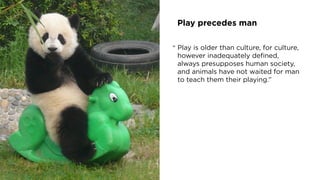
Play precedes man
Play is older than culture, for culture,
however inadequately defined,
always presupposes human society,
and animals have not waited for man
to teach them their playing.”
“
The spirit of playful competition is, as
a social impulse, older than culture
itself and pervades all life like a
veritable ferment.....We have to
conclude, therefore, that civilisation
is, in its earliest phases, played. It
does not come from play...it arises in
and as play, and never leaves it.”
Play is formative element of
human civilisation
“
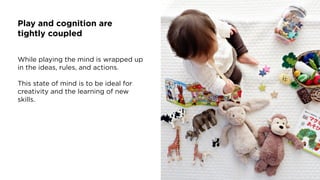
Play and cognition are
tightly coupled
While playing the mind is wrapped up
in the ideas, rules, and actions.
This state of mind is to be ideal for
creativity and the learning of new
skills.
Play is a nature’s mean to ensure that
young mammals including children
acquire the skills they have to.
All young mammals play to
practice different skills
Knowing is directly related to the cosmic order.
For archaic man knowledge is magical power and a
mean to achieve superiority
Competitions in esoteric knowledge rooted in the rituals of archaic man.
The medieval university was gamified
In the medieval university to beat your opponent by reason or the force of
the word becomes a sport comparable with the profession of arms.
Characteristics of play
Play Is Self-Chosen and Self-Directed
Play, first and foremost, is what one wants to do, as opposed to what
one feels obliged to do.
Players choose not only to play, but how to play, and that is the
meaning of the statement that play is self-directed.
The most basic freedom in play is the freedom to quit.
The freedom to quit ensures that all of the players are doing what
they want to do, and it prevents leaders from enforcing rules.
Play is intrinsically motivated
Play is done for its own sake more than for some reward
outside of the activity itself.
Play often has goals, but the goals are experienced as part of
the activity, not as the primary reason for the activity.
Competition can turn play into non-play if rewards for
winning extend beyond the game itself. “Players” who are
motivated primarily by trophies, praise, or increased status
outside of the game are not fully playing but competing.
Play is guided by rules, but the rules
leave room for creativity
Play is freely chosen activity, but not freeform activity.
Play always has structure, and that structure derives from
rules in the players’ minds. In social play, the rules must be
shared, or at least partially shared, by all of the players.
Play is imaginative
Play always involves mental removal of oneself from
the present real world.
In formal games with explicit rules, the players must
accept an already established fictional situation that
provides the foundation for the rules.
Play is conducted in an alert, active, but
relatively non-stressed frame of mind
Play an active and alert mind.
Play is not a response to external demands so the
person at play is relatively free from pressure or
stress.
The mind is wrapped up in the ideas, rules, and
actions of the game and relatively impervious to
outside distractions. This state of mind is ideal for
creativity and the learning of new skills.
Creating the play experience
Key mental abilities
The only way our minds are able to get by at all is by
simplifying reality so that we can make some sense of it.
Correspondingly, our minds do not deal with reality itself,
but instead with models of reality.
Many existing UI patterns follow models of reality(e.g.
shopping carts, music players).
If you are designing an innovative feature or product find
a good existing model to refer to.
Keep UI patterns consistent across your design.
Create a good and recognisable model
One crucial technique our brains use to make sense of
the world is the ability to focus its attention selectively,
ignoring some things, and devoting more mental power
to others.
Put the user mind into a flow
Clear goals
How to put the user into a flow state
No distractions Direct feedback
The most common
and straightforward
use of indirect control
in is through goals.
Distractions steal
focus from our task.
When feedback is
immediate, we can
easily stay focused.
Progress dynamics
Human beings love a
challenge. But it must
be a challenge we
think we can achieve.
Boredom
Anxiety Flow
channel
Make the user feel empathy
Self
Friends
Strangers
Gamification is about problem solving, and empathic
projection is a useful method of problem solving.
From visual design perspective products and websites
have a personality - know better your target audience
and make your design in a way they can easily feel
empathy.
Motivate
Any activity that connects you
with other people, lets you feel a
sense of accomplishment, and
lets you build and create things
that let you express yourself
fulfils needs on the third, fourth,
and fifth levels.
Create communities.
Enable users learn and be
creative if possible.
Self-Esteem
Self-
Actualisation
Belonging-Love
Safety
Physiological
PURSUE TALENT
CREATIVITY
ACHIEVMENT
MASTERY
RECOGNITION
RESPECT
+
EmptyFlow
Take the challenge!
The most crucial design question - what brings a true
value to man?
Man cannot stand a meaningless life…
We need more understanding of human
nature…
And we are pitifully unaware of it. We
know nothing of man, far too little.”
Carl Jung
(1875 –1961)
1959
“
Jung’s understanding of Self
How to design better experiences using Jung’s idea of Shadow content transformation.
Find the hidden aspects of human nature and bring them to light, as to design
the experiences of tomorrow we need to better understand human nature first.
@Ina011235
THANK YOU!

Play & Design

  • 1.
    MAN… IS ONLYFULLY A HUMAN BEING WHEN HE PLAYS | F. SHILLER DESIGN and
  • 2.
    What makes trulygood design?
  • 3.
    —— Comprehensive andfunctional —— Nice UI / Look —— Super Easy to —— Engaging, Pleasurable and Valuable
  • 4.
    What is thestate of human mind that makes us engaged, happy and brings us a sense of meaning?
  • 5.
    … a freeactivity standing quite consciously outside 'ordinary' life as being 'not serious’, but at the same time absorbing the player intensely and utterly.
  • 7.
  • 8.
    Play precedes man Playis older than culture, for culture, however inadequately defined, always presupposes human society, and animals have not waited for man to teach them their playing.” “
  • 9.
    The spirit ofplayful competition is, as a social impulse, older than culture itself and pervades all life like a veritable ferment.....We have to conclude, therefore, that civilisation is, in its earliest phases, played. It does not come from play...it arises in and as play, and never leaves it.” Play is formative element of human civilisation “
  • 10.
    Play and cognitionare tightly coupled While playing the mind is wrapped up in the ideas, rules, and actions. This state of mind is to be ideal for creativity and the learning of new skills.
  • 11.
    Play is anature’s mean to ensure that young mammals including children acquire the skills they have to. All young mammals play to practice different skills
  • 12.
    Knowing is directlyrelated to the cosmic order. For archaic man knowledge is magical power and a mean to achieve superiority Competitions in esoteric knowledge rooted in the rituals of archaic man.
  • 13.
    The medieval universitywas gamified In the medieval university to beat your opponent by reason or the force of the word becomes a sport comparable with the profession of arms.
  • 14.
  • 15.
    Play Is Self-Chosenand Self-Directed Play, first and foremost, is what one wants to do, as opposed to what one feels obliged to do. Players choose not only to play, but how to play, and that is the meaning of the statement that play is self-directed. The most basic freedom in play is the freedom to quit. The freedom to quit ensures that all of the players are doing what they want to do, and it prevents leaders from enforcing rules.
  • 16.
    Play is intrinsicallymotivated Play is done for its own sake more than for some reward outside of the activity itself. Play often has goals, but the goals are experienced as part of the activity, not as the primary reason for the activity. Competition can turn play into non-play if rewards for winning extend beyond the game itself. “Players” who are motivated primarily by trophies, praise, or increased status outside of the game are not fully playing but competing.
  • 17.
    Play is guidedby rules, but the rules leave room for creativity Play is freely chosen activity, but not freeform activity. Play always has structure, and that structure derives from rules in the players’ minds. In social play, the rules must be shared, or at least partially shared, by all of the players.
  • 18.
    Play is imaginative Playalways involves mental removal of oneself from the present real world. In formal games with explicit rules, the players must accept an already established fictional situation that provides the foundation for the rules.
  • 19.
    Play is conductedin an alert, active, but relatively non-stressed frame of mind Play an active and alert mind. Play is not a response to external demands so the person at play is relatively free from pressure or stress. The mind is wrapped up in the ideas, rules, and actions of the game and relatively impervious to outside distractions. This state of mind is ideal for creativity and the learning of new skills.
  • 20.
    Creating the playexperience Key mental abilities
  • 21.
    The only wayour minds are able to get by at all is by simplifying reality so that we can make some sense of it. Correspondingly, our minds do not deal with reality itself, but instead with models of reality. Many existing UI patterns follow models of reality(e.g. shopping carts, music players). If you are designing an innovative feature or product find a good existing model to refer to. Keep UI patterns consistent across your design. Create a good and recognisable model
  • 22.
    One crucial techniqueour brains use to make sense of the world is the ability to focus its attention selectively, ignoring some things, and devoting more mental power to others. Put the user mind into a flow
  • 23.
    Clear goals How toput the user into a flow state No distractions Direct feedback The most common and straightforward use of indirect control in is through goals. Distractions steal focus from our task. When feedback is immediate, we can easily stay focused. Progress dynamics Human beings love a challenge. But it must be a challenge we think we can achieve. Boredom Anxiety Flow channel
  • 24.
    Make the userfeel empathy Self Friends Strangers Gamification is about problem solving, and empathic projection is a useful method of problem solving. From visual design perspective products and websites have a personality - know better your target audience and make your design in a way they can easily feel empathy.
  • 25.
    Motivate Any activity thatconnects you with other people, lets you feel a sense of accomplishment, and lets you build and create things that let you express yourself fulfils needs on the third, fourth, and fifth levels. Create communities. Enable users learn and be creative if possible. Self-Esteem Self- Actualisation Belonging-Love Safety Physiological PURSUE TALENT CREATIVITY ACHIEVMENT MASTERY RECOGNITION RESPECT
  • 27.
  • 36.
  • 37.
    The most crucialdesign question - what brings a true value to man?
  • 38.
    Man cannot standa meaningless life… We need more understanding of human nature… And we are pitifully unaware of it. We know nothing of man, far too little.” Carl Jung (1875 –1961) 1959 “
  • 39.
    Jung’s understanding ofSelf How to design better experiences using Jung’s idea of Shadow content transformation.
  • 40.
    Find the hiddenaspects of human nature and bring them to light, as to design the experiences of tomorrow we need to better understand human nature first.
  • 41.