PLAY AND CHILD
DEVELOPMENT
PRESENTED BY:
J. SUPREJA
I YEAR B.Ed.,
OXFORD COLLEGE OF EDUCATION,
PIRATTIYUR,
TRICHY-09.
TCP PRESENTO 2020, THIAGARAJAR COLLEGE OF PRECEPTORS,
OBJECTIVES:
Introduction
Play
Characteristics of play
Types of play
Role of play in child
development
Kinds of play
Factors affecting child’s play
Importance of play
Conclusion
TCP PRESENTO 2020, THIAGARAJAR COLLEGE OF PRECEPTORS, MADURAI.
 INTRODUCTION:
Childhood is a playful period of human life. Small
physical acts like jerky walking, stretching hands, shying
away from unfamiliar persons and things, gentle smile
and such other acts and the progress noticed now and
then is a thing of joy to behold and rejoice on
recollecting in memory for parents and other kith and
kin.
Play serves as the beginning for the physical
development of the child, sharpening its senses and
making it grow intellectually and socially.
Play is the most natural of childhood activities and
one of the most frequently observed.
TCP PRESENTO 2020, THIAGARAJAR COLLEGE OF PRECEPTORS, MADURAI.
TCP PRESENTO 2020, THIAGARAJAR COLLEGE OF PRECEPTORS,
MADURAI.
 PLAY:
Play means “unstructured, without having any
rules and regulations and not requiring any specific
tools and place but consists of spontaneous
activities”.
It pleasurable and enjoyable aspect of child’s
life and essential to promote growth and
development.
In psychology, play is range of voluntary,
intrinsically motivated activities, normally
associated with recreational pleasure and enjoyment.
TCP PRESENTO 2020, THIAGARAJAR COLLEGE OF PRECEPTORS,
MADURAI.
 CHARACTERISTICS OF PLAY:
* Play is selected by the child itself.
* It is subjective; directed by the child itself.
* Acting according to one’s own rules.
* Play is imaginative.
* It involves actions, involving full awareness
but does not produce any mental stress.
* Child’s play depends upon its physical and
intellectual development and is a spontaneous
activity.
* Child’s play has neither any definite rules
and regulations nor an instructor to teach.
TCP PRESENTO 2020, THIAGARAJAR COLLEGE OF PRECEPTORS, MADURAI.
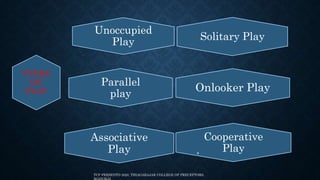
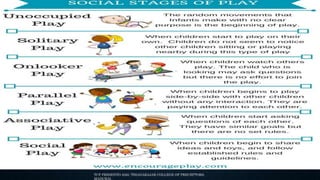
Solitary Play
Unoccupied
Play
Parallel
play
Onlooker Play
Cooperative
Play
Associative
Play
TYPES
OF
PLAY
TCP PRESENTO 2020, THIAGARAJAR COLLEGE OF PRECEPTORS,
MADURAI.
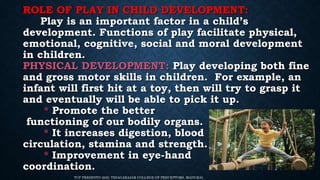
ROLE OF PLAY IN CHILD DEVELOPMENT:
Play is an important factor in a child’s
development. Functions of play facilitate physical,
emotional, cognitive, social and moral development
in children.
PHYSICAL DEVELOPMENT: Play developing both fine
and gross motor skills in children. For example, an
infant will first hit at a toy, then will try to grasp it
and eventually will be able to pick it up.
* Promote the better
functioning of our bodily organs.
* It increases digestion, blood
circulation, stamina and strength.
* Improvement in eye-hand
coordination.
TCP PRESENTO 2020, THIAGARAJAR COLLEGE OF PRECEPTORS, MADURAI.
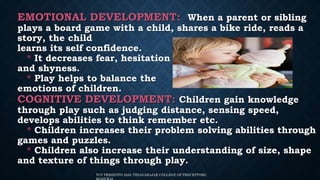
EMOTIONAL DEVELOPMENT: When a parent or sibling
plays a board game with a child, shares a bike ride, reads a
story, the child
learns its self confidence.
* It decreases fear, hesitation
and shyness.
* Play helps to balance the
emotions of children.
COGNITIVE DEVELOPMENT: Children gain knowledge
through play such as judging distance, sensing speed,
develops abilities to think remember etc.
* Children increases their problem solving abilities through
games and puzzles.
* Children also increase their understanding of size, shape
and texture of things through play.
TCP PRESENTO 2020, THIAGARAJAR COLLEGE OF PRECEPTORS,
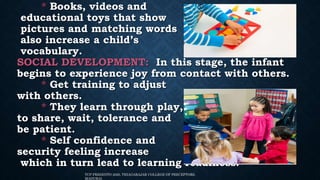
* Books, videos and
educational toys that show
pictures and matching words
also increase a child’s
vocabulary.
SOCIAL DEVELOPMENT: In this stage, the infant
begins to experience joy from contact with others.
* Get training to adjust
with others.
* They learn through play,
to share, wait, tolerance and
be patient.
* Self confidence and
security feeling increase
which in turn lead to learning readiness.
TCP PRESENTO 2020, THIAGARAJAR COLLEGE OF PRECEPTORS,
MADURAI.
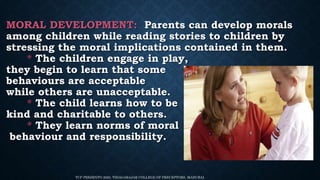
MORAL DEVELOPMENT: Parents can develop morals
among children while reading stories to children by
stressing the moral implications contained in them.
* The children engage in play,
they begin to learn that some
behaviours are acceptable
while others are unacceptable.
* The child learns how to be
kind and charitable to others.
* They learn norms of moral
behaviour and responsibility.
TCP PRESENTO 2020, THIAGARAJAR COLLEGE OF PRECEPTORS, MADURAI.
TCP PRESENTO 2020,THIAGARAJAR COLLEGE OF PRECEPTORS,
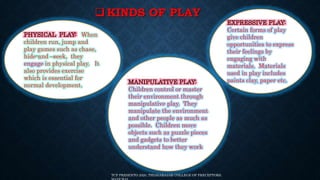
 KINDS OF PLAY
When
children run, jump and
play games such as chase,
hide-and –seek, they
engage in physical play. It
also provides exercise
which is essential for
normal development.
Certain forms of play
give children
opportunities to express
their feelings by
engaging with
materials. Materials
used in play includes
paints clay, paper etc.
Children control or master
their environment through
manipulative play. They
manipulate the environment
and other people as much as
possible. Children move
objects such as puzzle pieces
and gadgets to better
understand how they work
TCP PRESENTO 2020, THIAGARAJAR COLLEGE OF PRECEPTORS,
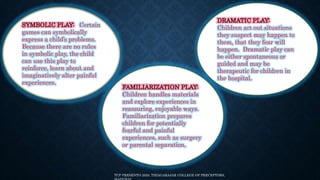
Certain
games can symbolically
express a child’s problems.
Because there are no rules
in symbolic play, the child
can use this play to
reinforce, learn about and
imaginatively alter painful
experiences.
Children act out situations
they suspect may happen to
them, that they fear will
happen. Dramatic play can
be either spontaneous or
guided and may be
therapeutic for children in
the hospital.
Children handles materials
and explore experiences in
reassuring, enjoyable ways.
Familiarization prepares
children for potentially
fearful and painful
experiences, such as surgery
or parental separation.
TCP PRESENTO 2020, THIAGARAJAR COLLEGE OF PRECEPTORS,
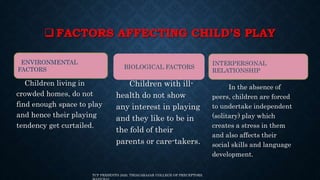
 FACTORS AFFECTING CHILD’S PLAY
Children living in
crowded homes, do not
find enough space to play
and hence their playing
tendency get curtailed.
Children with ill-
health do not show
any interest in playing
and they like to be in
the fold of their
parents or care-takers.
In the absence of
peers, children are forced
to undertake independent
(solitary) play which
creates a stress in them
and also affects their
social skills and language
development.
ENVIRONMENTAL
FACTORS BIOLOGICAL FACTORS
INTERPERSONAL
RELATIONSHIP
TCP PRESENTO 2020, THIAGARAJAR COLLEGE OF PRECEPTORS,
 WHY IS PLAY IMPORTANT ?
* Play is important to healthy brain development.
* Play allows children to use their creativity while developing their
imagination, dexterity, and physical, cognitive and emotional
development.
* Through play children can gain a sense of achievement, thereby
developing self-esteem.
* Play activities that develop children’s cognitive ability.
* Play encourage children to develop communication and language
development.
* Children learn to control emotions, respecting rules and regulations,
sharing with others, respecting others etc., through play activities.
* Absence of play in childhood, affects the later achievements in life.
TCP PRESENTO 2020, THIAGARAJAR COLLEGE OF PRECEPTORS, MADURAI.
 CONCLUSION:
Because of attraction in the mobile games,
most of the children not know what is playing, they
don’t know how to play the easy outdoor games.
So make ourselves to involve in all the sports
activities wherever it possible. It is must to play to
keep ourselves young and healthy.
kindly allows the children to play outside
with their friends. It makes them more energetic and
healthy.
It is clear that, all our developments depends
upon how much we play in the childhood period.
TCP PRESENTO 2020, THIAGARAJAR COLLEGE OF PRECEPTORS, MADURAI.
 SUMMARY:
In this presentation, the meaning of
play, characteristics of play, types of play,
different kinds of play, role of play in child
development such as physical, cognitive,
emotional, social and moral development
in children, three factors affecting child’s
play, importance of play are well discussed
in detail.
TCP PRESENTO 2020, THIAGARAJAR COLLEGE OF PRECEPTORS,
 REFERENCES:
1. Prof. Nagarajan,K., Dr. Natarajan,s.,
Childhood and growing up, Sriram
publishers(2017).
2. website-www.encourageplay.com
3. RaisingLifelongLearners.com
TCP PRESENTO 2020,THIAGARAJAR COLLEGE OF PRECEPTORS, MADURAI.
THANK YOU
TCP PRESENTO 2020, THIAGARAJAR COLLEGE OF PRECEPTORS,
MADURAI.

PLAY AND CHILD DEVELOPMENT

  • 1.
    PLAY AND CHILD DEVELOPMENT PRESENTEDBY: J. SUPREJA I YEAR B.Ed., OXFORD COLLEGE OF EDUCATION, PIRATTIYUR, TRICHY-09. TCP PRESENTO 2020, THIAGARAJAR COLLEGE OF PRECEPTORS,
  • 2.
    OBJECTIVES: Introduction Play Characteristics of play Typesof play Role of play in child development Kinds of play Factors affecting child’s play Importance of play Conclusion TCP PRESENTO 2020, THIAGARAJAR COLLEGE OF PRECEPTORS, MADURAI.
  • 3.
     INTRODUCTION: Childhood isa playful period of human life. Small physical acts like jerky walking, stretching hands, shying away from unfamiliar persons and things, gentle smile and such other acts and the progress noticed now and then is a thing of joy to behold and rejoice on recollecting in memory for parents and other kith and kin. Play serves as the beginning for the physical development of the child, sharpening its senses and making it grow intellectually and socially. Play is the most natural of childhood activities and one of the most frequently observed. TCP PRESENTO 2020, THIAGARAJAR COLLEGE OF PRECEPTORS, MADURAI.
  • 4.
    TCP PRESENTO 2020,THIAGARAJAR COLLEGE OF PRECEPTORS, MADURAI.
  • 5.
     PLAY: Play means“unstructured, without having any rules and regulations and not requiring any specific tools and place but consists of spontaneous activities”. It pleasurable and enjoyable aspect of child’s life and essential to promote growth and development. In psychology, play is range of voluntary, intrinsically motivated activities, normally associated with recreational pleasure and enjoyment. TCP PRESENTO 2020, THIAGARAJAR COLLEGE OF PRECEPTORS, MADURAI.
  • 6.
     CHARACTERISTICS OFPLAY: * Play is selected by the child itself. * It is subjective; directed by the child itself. * Acting according to one’s own rules. * Play is imaginative. * It involves actions, involving full awareness but does not produce any mental stress. * Child’s play depends upon its physical and intellectual development and is a spontaneous activity. * Child’s play has neither any definite rules and regulations nor an instructor to teach. TCP PRESENTO 2020, THIAGARAJAR COLLEGE OF PRECEPTORS, MADURAI.
  • 7.
  • 8.
    TCP PRESENTO 2020,THIAGARAJAR COLLEGE OF PRECEPTORS, MADURAI.
  • 9.
    ROLE OF PLAYIN CHILD DEVELOPMENT: Play is an important factor in a child’s development. Functions of play facilitate physical, emotional, cognitive, social and moral development in children. PHYSICAL DEVELOPMENT: Play developing both fine and gross motor skills in children. For example, an infant will first hit at a toy, then will try to grasp it and eventually will be able to pick it up. * Promote the better functioning of our bodily organs. * It increases digestion, blood circulation, stamina and strength. * Improvement in eye-hand coordination. TCP PRESENTO 2020, THIAGARAJAR COLLEGE OF PRECEPTORS, MADURAI.
  • 10.
    EMOTIONAL DEVELOPMENT: Whena parent or sibling plays a board game with a child, shares a bike ride, reads a story, the child learns its self confidence. * It decreases fear, hesitation and shyness. * Play helps to balance the emotions of children. COGNITIVE DEVELOPMENT: Children gain knowledge through play such as judging distance, sensing speed, develops abilities to think remember etc. * Children increases their problem solving abilities through games and puzzles. * Children also increase their understanding of size, shape and texture of things through play. TCP PRESENTO 2020, THIAGARAJAR COLLEGE OF PRECEPTORS,
  • 11.
    * Books, videosand educational toys that show pictures and matching words also increase a child’s vocabulary. SOCIAL DEVELOPMENT: In this stage, the infant begins to experience joy from contact with others. * Get training to adjust with others. * They learn through play, to share, wait, tolerance and be patient. * Self confidence and security feeling increase which in turn lead to learning readiness. TCP PRESENTO 2020, THIAGARAJAR COLLEGE OF PRECEPTORS, MADURAI.
  • 12.
    MORAL DEVELOPMENT: Parentscan develop morals among children while reading stories to children by stressing the moral implications contained in them. * The children engage in play, they begin to learn that some behaviours are acceptable while others are unacceptable. * The child learns how to be kind and charitable to others. * They learn norms of moral behaviour and responsibility. TCP PRESENTO 2020, THIAGARAJAR COLLEGE OF PRECEPTORS, MADURAI.
  • 13.
    TCP PRESENTO 2020,THIAGARAJARCOLLEGE OF PRECEPTORS,
  • 14.
     KINDS OFPLAY When children run, jump and play games such as chase, hide-and –seek, they engage in physical play. It also provides exercise which is essential for normal development. Certain forms of play give children opportunities to express their feelings by engaging with materials. Materials used in play includes paints clay, paper etc. Children control or master their environment through manipulative play. They manipulate the environment and other people as much as possible. Children move objects such as puzzle pieces and gadgets to better understand how they work TCP PRESENTO 2020, THIAGARAJAR COLLEGE OF PRECEPTORS,
  • 15.
    Certain games can symbolically expressa child’s problems. Because there are no rules in symbolic play, the child can use this play to reinforce, learn about and imaginatively alter painful experiences. Children act out situations they suspect may happen to them, that they fear will happen. Dramatic play can be either spontaneous or guided and may be therapeutic for children in the hospital. Children handles materials and explore experiences in reassuring, enjoyable ways. Familiarization prepares children for potentially fearful and painful experiences, such as surgery or parental separation. TCP PRESENTO 2020, THIAGARAJAR COLLEGE OF PRECEPTORS,
  • 16.
     FACTORS AFFECTINGCHILD’S PLAY Children living in crowded homes, do not find enough space to play and hence their playing tendency get curtailed. Children with ill- health do not show any interest in playing and they like to be in the fold of their parents or care-takers. In the absence of peers, children are forced to undertake independent (solitary) play which creates a stress in them and also affects their social skills and language development. ENVIRONMENTAL FACTORS BIOLOGICAL FACTORS INTERPERSONAL RELATIONSHIP TCP PRESENTO 2020, THIAGARAJAR COLLEGE OF PRECEPTORS,
  • 17.
    TCP PRESENTO 2020,THIAGARAJAR COLLEGE OF PRECEPTORS,
  • 18.
     WHY ISPLAY IMPORTANT ? * Play is important to healthy brain development. * Play allows children to use their creativity while developing their imagination, dexterity, and physical, cognitive and emotional development. * Through play children can gain a sense of achievement, thereby developing self-esteem. * Play activities that develop children’s cognitive ability. * Play encourage children to develop communication and language development. * Children learn to control emotions, respecting rules and regulations, sharing with others, respecting others etc., through play activities. * Absence of play in childhood, affects the later achievements in life. TCP PRESENTO 2020, THIAGARAJAR COLLEGE OF PRECEPTORS, MADURAI.
  • 19.
     CONCLUSION: Because ofattraction in the mobile games, most of the children not know what is playing, they don’t know how to play the easy outdoor games. So make ourselves to involve in all the sports activities wherever it possible. It is must to play to keep ourselves young and healthy. kindly allows the children to play outside with their friends. It makes them more energetic and healthy. It is clear that, all our developments depends upon how much we play in the childhood period. TCP PRESENTO 2020, THIAGARAJAR COLLEGE OF PRECEPTORS, MADURAI.
  • 20.
     SUMMARY: In thispresentation, the meaning of play, characteristics of play, types of play, different kinds of play, role of play in child development such as physical, cognitive, emotional, social and moral development in children, three factors affecting child’s play, importance of play are well discussed in detail. TCP PRESENTO 2020, THIAGARAJAR COLLEGE OF PRECEPTORS,
  • 21.
     REFERENCES: 1. Prof.Nagarajan,K., Dr. Natarajan,s., Childhood and growing up, Sriram publishers(2017). 2. website-www.encourageplay.com 3. RaisingLifelongLearners.com TCP PRESENTO 2020,THIAGARAJAR COLLEGE OF PRECEPTORS, MADURAI.
  • 22.
    THANK YOU TCP PRESENTO2020, THIAGARAJAR COLLEGE OF PRECEPTORS, MADURAI.