Synopsis presentation
Nursing research
Back ground of the study
• “Play is a window through which
we come to understand the child
from both inside and outside.”
Sheridon, Foley And
Radlinski
Cont….
• Children are the future hope of man kind. Todays
children will be the masters of future world. As the
saying goes,” health is wealth” .Hence if children are
healthy, the future generation will be healthy,
resulting in a healthy nation.
• Play is an important medium for children for several
reasons. Play is a natural language from which
children express themselves. Developmentally, play
bridges the gap between concrete experience and
abstract thought. Child gains a sense of control
through play and also learns coping skills. It is
through play that children at a very early age engage
and interact in the world around them.
Cont
• According to Axline (1974) play is a “child’s
natural medium of self- expression”.
• Mothers love should be constant,
unconditional and openly expressesd, even,
when the child is misbehaving. This enables
the toddlers to reach for mature goals. The
frustration can be handled in a mature way.
Toddlers give their primary caregiver. Hence
educating mothers increase the toddler
development in all dimensions with the help
of play therapy.
Cont..
• Experts in child development and behaviour
have said repeatedly that “play is the work of
child”. In play, children continually practice and
complicated, stressful processes of living,
communicating and achieving satisfactory
relationships with other people.
• Shonkoff and Phillips (2000) says that modern
findings in neuroscience suggest that play
promotes flexibility of mind, including adaptive
practices.
Cont..
• Research shows that play has many
benefits for children, families and the
wider community, as well as
improving health and quality of life.
Recent research suggests that
children's access to good play
provision can:
Cont..
• Increase Their Self-Awareness, Self-Esteem, And Self-Respect.
• Improve And Maintain Their Physical And Mental Health
• Give Them The Opportunity To Mix With Other Children
• Allow Them To Increase Their Confidence Through Developing
New Skills
• Promote Their Imagination, Independence And Creativity
• Offer Opportunities For Children Of All Abilities And
Backgrounds To Play Together
• Provide Opportunities For Developing Social Skills And Learning
• Build Resilience Through Risk Taking And Challenge, Problem
Solving, And Dealing With New And Novel Situations
• Provide Opportunities To Learn About Their Environment And
The Wider Community
Cont..
• According to Parte and Newhall (1943) play
behavior can be described as unoccupied,
solitary, onlooking, parallel, associative and co-
operative. Unoccupied , child is not involved in
play activity but may move around randomly.
Onlooker, when the child watch others play but
does not become engaged in their play. Solitary,
the child plays alone independently. Parallel, it
is an independent play activity. Child play
alongside other children but not with them. As
the child grows, the way of play will change.
Cont..
• Importance of play includes physical,
emotional, cognitive, intellectual, social and
moral development. Through play, children
are able to test their abilities, to assume and
try out various roles and to learn the effect
the behavior has on others. In physical
development, children develop the muscular
and sensory abilities through play. At the time
of running, climbing, riding, cycle and in other
active play.
Contt..
• In emotional development, play improve
emotional development children express their
fear, anxiety, anger, joy during play. In
cognitive development, Children gain
knowledge through the play. They learn the
difference in size, shape, colors, textures.
numbers and name of the objects. In social
development, as children grow, they enjoy
playful interaction with other children.
Children learn right from wrong.
Cont..
• In moral development, when children engage
in play with their peers and families, they
began to learn some behaviors are acceptable
while others are unacceptable.
• Here are some list of play associated with
specific play groups.
Cont..
• Terrikyle (2013) states that, in newborn,
prefers interacting with the parents to toys.
Play is critical to infant development, as it give
infants the opportunity to explore their
environment, practice new skills and solve
problems. As infants become older, toys may
be geared toward the motor skills and
language skills that the child developing.
Cont…
• Toddlers need at least 30 mts of structured
physical activity and anywhere from one to
several hours of unstructured physical activity
per day.
Cont….
• Selection of play materials and toys depends
upon age, abilities, interest, likes and dislike,
culture experience, personality and level of
intelligence of the play. The play materials
should have the following the characteristics:
Safe, washable, light weight, simple, durable,
easy to handle and non-breakable, realistic,
attractive, constructive and offer problem
solving opportunities and no sharp points that
can cut on puncture children should not be
allowed to play with adult darts or other
equipment having sharp points.
Cont…
• The variety of toys listed for infant,
toddler, pre-school of any age is based
on the assumption of normal and
development. Infant learns motor skill,
bodily control and co-ordination by
various means they need stimulation
with toys for visual, auditory and tactile
sensation.
Cont…
• AAP (2012) states that play is a natural
tool for children to develop resiliency as
they learn to co-operative, over come
changes and legotiate with others. Play
also allows children to be creative.
Cont…
• The population of India is estimated at1,369,566,180
as of Tuesday, September 24 2019. As per the details
from census 2011, the total number of children in
the age-group of 1-3 years are 15,87,89,287 of the
total population in India. The total population of
madhya pradesh as per 2011 census is72,626,809.
The total child population (age 1-3) was 7,423,832.
According to government of India 2011 census, The
actual population of INDORE district is 3,458,873.
The child population between the age of 1-3 years
were 403,996 of total population.
NEED FOR STUDY
• Children are growing up in a rapidly changing
world characterized by dramatic shifts in
what all children are expected to know and
be able to do. Higher and tougher standards
of learning for all populations of students are
focusing on a narrow view of learning.
Consequently, students have less time and
opportunity to play than children of previous
generations.
Cont…
• United Nations (1959) adopted the
rights of the child. According to the
decelaration the development of
children has been considered an integral
part of national development.
Cont…
• The American Academy of Pediatrics (AAP)
published a study in 2006 entitled: "The
importance of play in promoting healthy
child development and maintaining strong
parent-child bonds". The report states: "Free
and unstructured play is healthy and - in fact
essential for helping children reach important
social, emotional, and cognitive
developmental milestones as well as helping
them to manage stress and become
resilient".
Cont…..
• The 17th
International Play Association ( IPA)
World Conference 2008 will be held in Hong
Kong. Its main focus is on what play is,
alarming trends affecting childhood. IPA is
deeply concerned by a number of alarming
trends and their negative impact on
children's all round development such as
society’s indifference to the importance of
play, overemphasis on theoretical and
academic studies in schools,
Cont…
• AAP (2012) states that play provides
time for parents to be fully engaged
with their children, to bond with their
children, and to see the world from the
perspective of their child. So, mothers
should encourage physical activity in
children.
Cont..
• Gaining an understanding of play
through the above definitions
leads the researcher to belief
that play can fulfill many roles for
a child. It can aid in learning and
development, on a physical,
mental and emotional level.
Cont….
• Researcher have a own interest in engaging
to do research on play therapy to the
toddlers . during community visit reseracher
has found that there is lack of knowledge
regarding play among mothers and other
primary care givers of childrens which
include lack of appropiate toys selection,
how to provide toys according to age, what
are the impact of play on child.
Cont….
• During contact with mothers found that they
do not always follow appropiate toys
selection, timely play and age wise material
selection. In recent observation researcher
has found that due to increase updation of
information technology mostly womens have
mobile phones and their children use it as a
play media. Which has significant harmful
effects on health of children and have a bad
impact for them.
Cont…
• The researcher own experience as a nurse
practitioner at tertiary care hospital has
found that developmental delay in child
occures due to lack of play intervention and
mother is primary care giver to child.
• The researcher also found that the mothers
donot have proper understanding of play to
be followed during span of childhood. It is
found that many children suffer due to lack
of appropiate play materials .
Cont…..
• Hence it is very important to creat awareness
and understanding among the mothers to
follow appropiate play tharapy during
childhood. So that child can grow as and
when needed.
• Therefore researcher felt need to educate
mothers and improve practice among them.
So that child may grow pandimensionally and
chances of developmental delay can be
reduced.
The Statement Of The Problem
• A Study To Assess The Effectiveness Of
Vedio Assissted Teaching Programme On
Knowledge And Practice Regarding Play
Therapy Among Mothers Of Toddlers In
Selected (West Zone) Urban Area In
Indore In The Year 2020-21.
OBJECTIVES
• To assess the pretest knowledge regarding
importance of play therapy among
mothers of toddlers.
• To assess the pretest practice regarding
play therapy among mothers of toddlers.
• To evaluate the effectiveness of vedio
assissted teaching programme on play
therapy among mothers of toddlers.
Cont..
• To correlate the knowledge and practice
regarding play therapy among among
mothers toddlers.
• To find the association between the post test
knowledge and practice regarding play
therapy among mothers of toddlers with the
selected demographic variables.
HYPOTHESIS
• Null hypothesis (H01 )- There will be no significant
difference between mean pre test knowledge and
mean post test knowledge score after administration
of vedio assissted teaching programme on play
therapy among mothers of toddler.
• Null hypothesis (H02 )- There will be no significant
difference between mean pre test practice score and
mean post test practice score after administration of
vedio assissted teaching programme on play therapy
among mothers of toddler
Cont..
• Research hypothesis (H11) -There is significant
improvement between pretest and post test
knowledge and practice scores on play therapy
among mothers of toddlers.it will be significant
improvement at the level of significance. p≤ 0.05.
• Research hypothesis (H22) -There is significant
association between the post test knowledge and
practice score with demographic variables. It will
be significant association at the level of
significance. p≤ 0.05.
OPERATIONAL DEFINITIONs
• ASSESS
In this study it refers to assess the
level of knowledge and practice
regarding play therapy among
mothers of toddlers.
Cont..
• EFFECTIVENESS
In this study it refers to significant
gain in knowledge and practice as
determined by significant difference
between pre and post test
knowledge and practice score.
Cont….
• VEDIO ASSISSTED TEACHING
PROGRAMME
It this study it refers to the systematically
arranged information regarding the
definition, importance, types,
development with play, varieties of play
materials according to the age group and
the toys designed to teach with self
prepared vedio regarding play therapy for
toddlers.
Cont….
• KNOWLEDGE
It refers to the information acquired
through the education regarding play
therapy. They measured in terms of
knowledge questionnaire as elicited by
vedio assissted teaching programme.
Cont..
• Practice
It refers to the instructions or
measures followed by the
mothers of toddlers
regarding play therapy with
the help of checklist.
Cont..
• PLAY THERAPY
Play is an enthusiastic activity of each
and every children, spending time with
toys, games at natural setting. That helps
the child to develop creativity,
intellectual activities and more helps in
their physical and psychological
development.
Cont…
• TODDLERS –
In this study it refers to the
child with an age group of 1-3
years which includes
newborn, infant, and toddler.
ASSUMPTIONs
•Mothers of toddlers may have
inadequate knowledge on play
therapy.
•Mothers of toddlers need education
regarding play therapy.
•Vedio assisted teaching program
will improve the knowledge and
practice regarding play therapy.
DELIMITATIONS
The study was delimited to -
• The mothers who have children under
age of 1-3year and are available during
period of study and are willing to
participate in the study.
• Administration of vedio assissted
teaching programme once after the pre
test.
Cont..
• Assessment of knowledge and practice
score of mothers were made only once
after the administration of vedio
assissted teaching programme.
CONCEPTUAL FRAME WORK
• Coneptualization is a process of forming
ideas, design and plans .
• The word conceptual framework represents a
less formal attempt at organizing a
phenomenon. Conceptual model deals with
concepts that are used as building blocks
and provide a conceptual perspective
regarding inter related phenomena which are
closely structured.
Cont..
• According to polit and hungler (2008) a
conceptual frame work deals with the concepts
assembled together by virtue of their relevance
to the research problem which provides a
certain frame work of reference for clinical
practice, research and education.
• Conceptual frame work is a theoritical approach
to the study of problems that scientifically based
and emphesize the selection, arrangement and
classification of its concepts.
Cont….
• The study was aimed at assessing the
knowledge and practice on play therapy
before and after vedio asissted
teaching .The conceptual Framework for
this study was derived from the
concepts of “Stuffle Beam Model” .It is a
comprehensive framework for
evaluating programmes.
Cont..
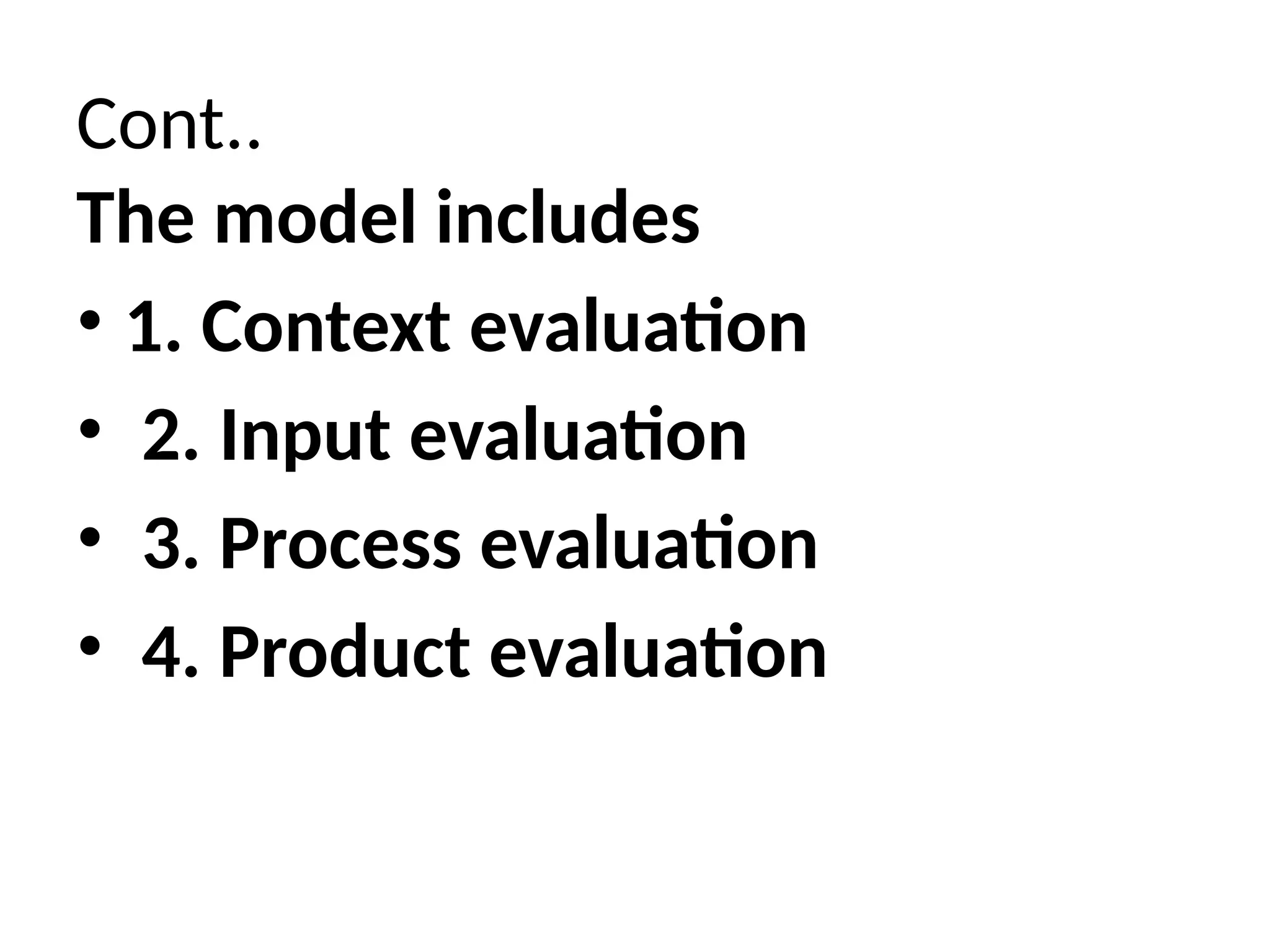
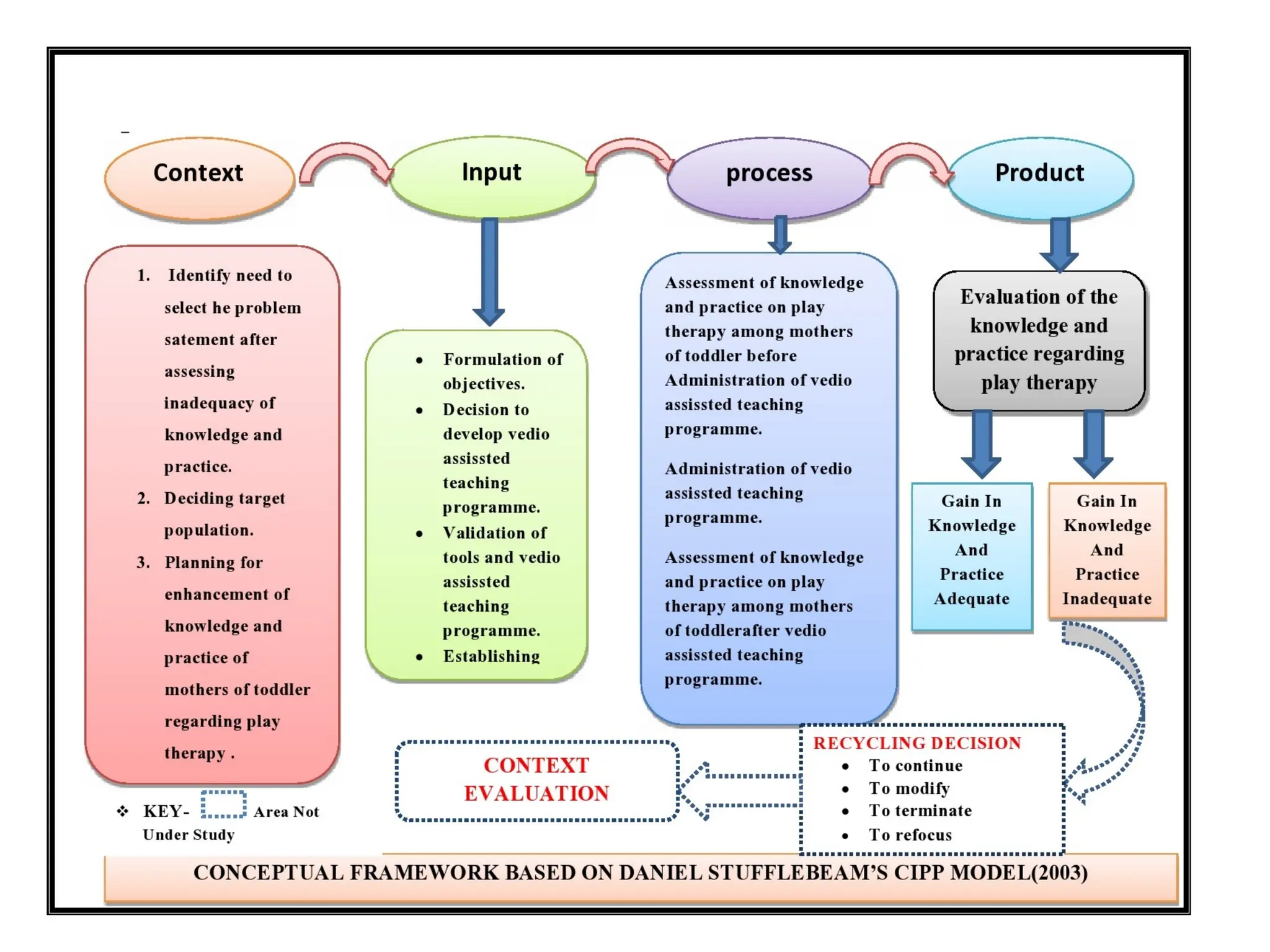
The model includes
• 1. Context evaluation
• 2. Input evaluation
• 3. Process evaluation
• 4. Product evaluation
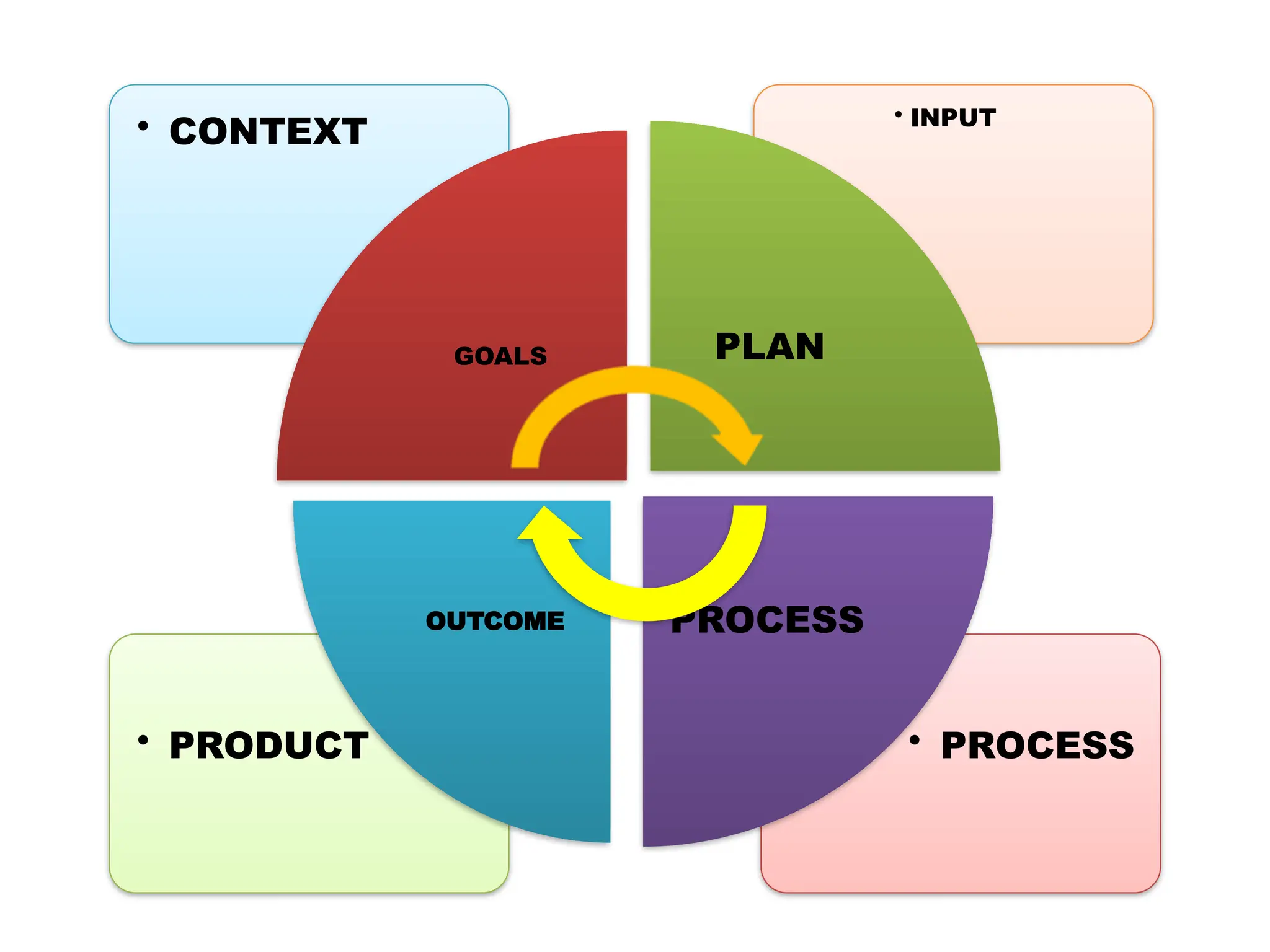
• PROCESS
• PRODUCT
• INPUT
• CONTEXT
GOALS PLAN
PROCESS
OUTCOME
Context evaluation
• IT is referred to as needs assessment . it helps to assess
problems, assets and oppoutunity within a defined
community and environmental context. Highlights the
environment in which the proposed programme exists
describes the plan for decisions and collection of data
apart from providing rationale for determination of
objectives. In this study it refers to Age, Religion,
Education, Occupation of the mother, Family income,
Type of family, Number of childrens. children, play
therapy advice is sought by, uses of toys and practices for
play therapy.
input evaluation
Includes such as description of the program
input and resources.It serves as a basis for
structuring decision and evaluate different
approach. In the present study it refers to –
• Development of vedio assissted teaching
programme.
• Development of structured knowledge
questionnaire and practice non observational
Cont…
• checklist regarding play therapy.
• Validation of tools and vedio assissted
teaching programme.
• Establishing reliability of the tools and
• Pilot study
Process evaluation
• Process evaluation include examining how a
programme is being implemented,monitoring
how the program is performing and
identifying defects in the procedural design
or in the implementation of the programme.
Process evaluation means Implementation of
plan. In this study it refers to –
Cont..
• Final study
• Assessing the knowledge and practice regarding play
therapy among mothers of toddlers.
• Administration of vedio assisted teaching programme
regarding knowledge and practice of play therapy like
definition, types of play,uses of different toys and
importance according to age group, methods of
selections of toys.
• Assessing the knowledge and practice regarding play
therapy among mothers of toddlers after
administration of vedio assissted teaching programme.
Product evaluation
• It refers to energy, information or matter that is
transferred to environment and
• enables recycling of decision as it relates to goals and
objectives of input information and process
information. In this study it refers to
• Gain in knowledge and practice regarding play therapy
• Adequate or inadequate knowledge or practice
• Product evaluation leads to recycling decision and
reinitiating phase of context evaluation not included.
ETHICAL AND LEGAL ASPECTS OF THE STUDY :-
• Researcher followed the ethical and legal
aspects related to nursing research.
Permission was taken from the concerning
authorities and consent was taken from the
participants. This research was undertaken for
study purpose. Researcher has maintained the
confidentiality. All the financial expenses
related with this research will be bearded by
the investigator.
Outline of the report
The chapter in the thesis are:
Chapter I
• Dealt with background of the study, need of the
study, statement of the
problem,objectives,hypothesis,and operational
definitions and delimitations, conceptual frame
work and outline of the report.
Chapter II
• Review of literature
Outline of the report
Chapter III
• Research methodology
Chapter IV
• Data analysis and interpretation
Chapter V
• Discussion ,summary,
concusion,recommendation,implications,limit
ations.

Synopsis presentation.pptx presentation

  • 1.
  • 2.
    Back ground ofthe study • “Play is a window through which we come to understand the child from both inside and outside.” Sheridon, Foley And Radlinski
  • 3.
    Cont…. • Children arethe future hope of man kind. Todays children will be the masters of future world. As the saying goes,” health is wealth” .Hence if children are healthy, the future generation will be healthy, resulting in a healthy nation. • Play is an important medium for children for several reasons. Play is a natural language from which children express themselves. Developmentally, play bridges the gap between concrete experience and abstract thought. Child gains a sense of control through play and also learns coping skills. It is through play that children at a very early age engage and interact in the world around them.
  • 4.
    Cont • According toAxline (1974) play is a “child’s natural medium of self- expression”. • Mothers love should be constant, unconditional and openly expressesd, even, when the child is misbehaving. This enables the toddlers to reach for mature goals. The frustration can be handled in a mature way. Toddlers give their primary caregiver. Hence educating mothers increase the toddler development in all dimensions with the help of play therapy.
  • 5.
    Cont.. • Experts inchild development and behaviour have said repeatedly that “play is the work of child”. In play, children continually practice and complicated, stressful processes of living, communicating and achieving satisfactory relationships with other people. • Shonkoff and Phillips (2000) says that modern findings in neuroscience suggest that play promotes flexibility of mind, including adaptive practices.
  • 6.
    Cont.. • Research showsthat play has many benefits for children, families and the wider community, as well as improving health and quality of life. Recent research suggests that children's access to good play provision can:
  • 7.
    Cont.. • Increase TheirSelf-Awareness, Self-Esteem, And Self-Respect. • Improve And Maintain Their Physical And Mental Health • Give Them The Opportunity To Mix With Other Children • Allow Them To Increase Their Confidence Through Developing New Skills • Promote Their Imagination, Independence And Creativity • Offer Opportunities For Children Of All Abilities And Backgrounds To Play Together • Provide Opportunities For Developing Social Skills And Learning • Build Resilience Through Risk Taking And Challenge, Problem Solving, And Dealing With New And Novel Situations • Provide Opportunities To Learn About Their Environment And The Wider Community
  • 8.
    Cont.. • According toParte and Newhall (1943) play behavior can be described as unoccupied, solitary, onlooking, parallel, associative and co- operative. Unoccupied , child is not involved in play activity but may move around randomly. Onlooker, when the child watch others play but does not become engaged in their play. Solitary, the child plays alone independently. Parallel, it is an independent play activity. Child play alongside other children but not with them. As the child grows, the way of play will change.
  • 9.
    Cont.. • Importance ofplay includes physical, emotional, cognitive, intellectual, social and moral development. Through play, children are able to test their abilities, to assume and try out various roles and to learn the effect the behavior has on others. In physical development, children develop the muscular and sensory abilities through play. At the time of running, climbing, riding, cycle and in other active play.
  • 10.
    Contt.. • In emotionaldevelopment, play improve emotional development children express their fear, anxiety, anger, joy during play. In cognitive development, Children gain knowledge through the play. They learn the difference in size, shape, colors, textures. numbers and name of the objects. In social development, as children grow, they enjoy playful interaction with other children. Children learn right from wrong.
  • 11.
    Cont.. • In moraldevelopment, when children engage in play with their peers and families, they began to learn some behaviors are acceptable while others are unacceptable. • Here are some list of play associated with specific play groups.
  • 12.
    Cont.. • Terrikyle (2013)states that, in newborn, prefers interacting with the parents to toys. Play is critical to infant development, as it give infants the opportunity to explore their environment, practice new skills and solve problems. As infants become older, toys may be geared toward the motor skills and language skills that the child developing.
  • 13.
    Cont… • Toddlers needat least 30 mts of structured physical activity and anywhere from one to several hours of unstructured physical activity per day.
  • 14.
    Cont…. • Selection ofplay materials and toys depends upon age, abilities, interest, likes and dislike, culture experience, personality and level of intelligence of the play. The play materials should have the following the characteristics: Safe, washable, light weight, simple, durable, easy to handle and non-breakable, realistic, attractive, constructive and offer problem solving opportunities and no sharp points that can cut on puncture children should not be allowed to play with adult darts or other equipment having sharp points.
  • 15.
    Cont… • The varietyof toys listed for infant, toddler, pre-school of any age is based on the assumption of normal and development. Infant learns motor skill, bodily control and co-ordination by various means they need stimulation with toys for visual, auditory and tactile sensation.
  • 16.
    Cont… • AAP (2012)states that play is a natural tool for children to develop resiliency as they learn to co-operative, over come changes and legotiate with others. Play also allows children to be creative.
  • 17.
    Cont… • The populationof India is estimated at1,369,566,180 as of Tuesday, September 24 2019. As per the details from census 2011, the total number of children in the age-group of 1-3 years are 15,87,89,287 of the total population in India. The total population of madhya pradesh as per 2011 census is72,626,809. The total child population (age 1-3) was 7,423,832. According to government of India 2011 census, The actual population of INDORE district is 3,458,873. The child population between the age of 1-3 years were 403,996 of total population.
  • 18.
    NEED FOR STUDY •Children are growing up in a rapidly changing world characterized by dramatic shifts in what all children are expected to know and be able to do. Higher and tougher standards of learning for all populations of students are focusing on a narrow view of learning. Consequently, students have less time and opportunity to play than children of previous generations.
  • 19.
    Cont… • United Nations(1959) adopted the rights of the child. According to the decelaration the development of children has been considered an integral part of national development.
  • 20.
    Cont… • The AmericanAcademy of Pediatrics (AAP) published a study in 2006 entitled: "The importance of play in promoting healthy child development and maintaining strong parent-child bonds". The report states: "Free and unstructured play is healthy and - in fact essential for helping children reach important social, emotional, and cognitive developmental milestones as well as helping them to manage stress and become resilient".
  • 21.
    Cont….. • The 17th InternationalPlay Association ( IPA) World Conference 2008 will be held in Hong Kong. Its main focus is on what play is, alarming trends affecting childhood. IPA is deeply concerned by a number of alarming trends and their negative impact on children's all round development such as society’s indifference to the importance of play, overemphasis on theoretical and academic studies in schools,
  • 22.
    Cont… • AAP (2012)states that play provides time for parents to be fully engaged with their children, to bond with their children, and to see the world from the perspective of their child. So, mothers should encourage physical activity in children.
  • 23.
    Cont.. • Gaining anunderstanding of play through the above definitions leads the researcher to belief that play can fulfill many roles for a child. It can aid in learning and development, on a physical, mental and emotional level.
  • 24.
    Cont…. • Researcher havea own interest in engaging to do research on play therapy to the toddlers . during community visit reseracher has found that there is lack of knowledge regarding play among mothers and other primary care givers of childrens which include lack of appropiate toys selection, how to provide toys according to age, what are the impact of play on child.
  • 25.
    Cont…. • During contactwith mothers found that they do not always follow appropiate toys selection, timely play and age wise material selection. In recent observation researcher has found that due to increase updation of information technology mostly womens have mobile phones and their children use it as a play media. Which has significant harmful effects on health of children and have a bad impact for them.
  • 26.
    Cont… • The researcherown experience as a nurse practitioner at tertiary care hospital has found that developmental delay in child occures due to lack of play intervention and mother is primary care giver to child. • The researcher also found that the mothers donot have proper understanding of play to be followed during span of childhood. It is found that many children suffer due to lack of appropiate play materials .
  • 27.
    Cont….. • Hence itis very important to creat awareness and understanding among the mothers to follow appropiate play tharapy during childhood. So that child can grow as and when needed. • Therefore researcher felt need to educate mothers and improve practice among them. So that child may grow pandimensionally and chances of developmental delay can be reduced.
  • 28.
    The Statement OfThe Problem • A Study To Assess The Effectiveness Of Vedio Assissted Teaching Programme On Knowledge And Practice Regarding Play Therapy Among Mothers Of Toddlers In Selected (West Zone) Urban Area In Indore In The Year 2020-21.
  • 29.
    OBJECTIVES • To assessthe pretest knowledge regarding importance of play therapy among mothers of toddlers. • To assess the pretest practice regarding play therapy among mothers of toddlers. • To evaluate the effectiveness of vedio assissted teaching programme on play therapy among mothers of toddlers.
  • 30.
    Cont.. • To correlatethe knowledge and practice regarding play therapy among among mothers toddlers. • To find the association between the post test knowledge and practice regarding play therapy among mothers of toddlers with the selected demographic variables.
  • 31.
    HYPOTHESIS • Null hypothesis(H01 )- There will be no significant difference between mean pre test knowledge and mean post test knowledge score after administration of vedio assissted teaching programme on play therapy among mothers of toddler. • Null hypothesis (H02 )- There will be no significant difference between mean pre test practice score and mean post test practice score after administration of vedio assissted teaching programme on play therapy among mothers of toddler
  • 32.
    Cont.. • Research hypothesis(H11) -There is significant improvement between pretest and post test knowledge and practice scores on play therapy among mothers of toddlers.it will be significant improvement at the level of significance. p≤ 0.05. • Research hypothesis (H22) -There is significant association between the post test knowledge and practice score with demographic variables. It will be significant association at the level of significance. p≤ 0.05.
  • 33.
    OPERATIONAL DEFINITIONs • ASSESS Inthis study it refers to assess the level of knowledge and practice regarding play therapy among mothers of toddlers.
  • 34.
    Cont.. • EFFECTIVENESS In thisstudy it refers to significant gain in knowledge and practice as determined by significant difference between pre and post test knowledge and practice score.
  • 35.
    Cont…. • VEDIO ASSISSTEDTEACHING PROGRAMME It this study it refers to the systematically arranged information regarding the definition, importance, types, development with play, varieties of play materials according to the age group and the toys designed to teach with self prepared vedio regarding play therapy for toddlers.
  • 36.
    Cont…. • KNOWLEDGE It refersto the information acquired through the education regarding play therapy. They measured in terms of knowledge questionnaire as elicited by vedio assissted teaching programme.
  • 37.
    Cont.. • Practice It refersto the instructions or measures followed by the mothers of toddlers regarding play therapy with the help of checklist.
  • 38.
    Cont.. • PLAY THERAPY Playis an enthusiastic activity of each and every children, spending time with toys, games at natural setting. That helps the child to develop creativity, intellectual activities and more helps in their physical and psychological development.
  • 39.
    Cont… • TODDLERS – Inthis study it refers to the child with an age group of 1-3 years which includes newborn, infant, and toddler.
  • 40.
    ASSUMPTIONs •Mothers of toddlersmay have inadequate knowledge on play therapy. •Mothers of toddlers need education regarding play therapy. •Vedio assisted teaching program will improve the knowledge and practice regarding play therapy.
  • 41.
    DELIMITATIONS The study wasdelimited to - • The mothers who have children under age of 1-3year and are available during period of study and are willing to participate in the study. • Administration of vedio assissted teaching programme once after the pre test.
  • 42.
    Cont.. • Assessment ofknowledge and practice score of mothers were made only once after the administration of vedio assissted teaching programme.
  • 43.
    CONCEPTUAL FRAME WORK •Coneptualization is a process of forming ideas, design and plans . • The word conceptual framework represents a less formal attempt at organizing a phenomenon. Conceptual model deals with concepts that are used as building blocks and provide a conceptual perspective regarding inter related phenomena which are closely structured.
  • 44.
    Cont.. • According topolit and hungler (2008) a conceptual frame work deals with the concepts assembled together by virtue of their relevance to the research problem which provides a certain frame work of reference for clinical practice, research and education. • Conceptual frame work is a theoritical approach to the study of problems that scientifically based and emphesize the selection, arrangement and classification of its concepts.
  • 45.
    Cont…. • The studywas aimed at assessing the knowledge and practice on play therapy before and after vedio asissted teaching .The conceptual Framework for this study was derived from the concepts of “Stuffle Beam Model” .It is a comprehensive framework for evaluating programmes.
  • 46.
    Cont.. The model includes •1. Context evaluation • 2. Input evaluation • 3. Process evaluation • 4. Product evaluation
  • 47.
    • PROCESS • PRODUCT •INPUT • CONTEXT GOALS PLAN PROCESS OUTCOME
  • 48.
    Context evaluation • ITis referred to as needs assessment . it helps to assess problems, assets and oppoutunity within a defined community and environmental context. Highlights the environment in which the proposed programme exists describes the plan for decisions and collection of data apart from providing rationale for determination of objectives. In this study it refers to Age, Religion, Education, Occupation of the mother, Family income, Type of family, Number of childrens. children, play therapy advice is sought by, uses of toys and practices for play therapy.
  • 49.
    input evaluation Includes suchas description of the program input and resources.It serves as a basis for structuring decision and evaluate different approach. In the present study it refers to – • Development of vedio assissted teaching programme. • Development of structured knowledge questionnaire and practice non observational
  • 50.
    Cont… • checklist regardingplay therapy. • Validation of tools and vedio assissted teaching programme. • Establishing reliability of the tools and • Pilot study
  • 51.
    Process evaluation • Processevaluation include examining how a programme is being implemented,monitoring how the program is performing and identifying defects in the procedural design or in the implementation of the programme. Process evaluation means Implementation of plan. In this study it refers to –
  • 52.
    Cont.. • Final study •Assessing the knowledge and practice regarding play therapy among mothers of toddlers. • Administration of vedio assisted teaching programme regarding knowledge and practice of play therapy like definition, types of play,uses of different toys and importance according to age group, methods of selections of toys. • Assessing the knowledge and practice regarding play therapy among mothers of toddlers after administration of vedio assissted teaching programme.
  • 53.
    Product evaluation • Itrefers to energy, information or matter that is transferred to environment and • enables recycling of decision as it relates to goals and objectives of input information and process information. In this study it refers to • Gain in knowledge and practice regarding play therapy • Adequate or inadequate knowledge or practice • Product evaluation leads to recycling decision and reinitiating phase of context evaluation not included.
  • 55.
    ETHICAL AND LEGALASPECTS OF THE STUDY :- • Researcher followed the ethical and legal aspects related to nursing research. Permission was taken from the concerning authorities and consent was taken from the participants. This research was undertaken for study purpose. Researcher has maintained the confidentiality. All the financial expenses related with this research will be bearded by the investigator.
  • 56.
    Outline of thereport The chapter in the thesis are: Chapter I • Dealt with background of the study, need of the study, statement of the problem,objectives,hypothesis,and operational definitions and delimitations, conceptual frame work and outline of the report. Chapter II • Review of literature
  • 57.
    Outline of thereport Chapter III • Research methodology Chapter IV • Data analysis and interpretation Chapter V • Discussion ,summary, concusion,recommendation,implications,limit ations.