

Name:K.S.Manjulaa
Topic:Play and child development
College:Vellalar college of education
For women,Thindal.
SYNOPSIS
Introduction
Definition of play
Kinds of play
Play proposed by national institute
for play
Play activities of childhood
Cognitive development levels
and child’s development
Benefits of children through play
Role of play in child development
Factors affecting children’s play
Age-related plays in childhood
Cognitive Ability
Play that develops children’s cognitive ability
Conclusion
References and Acknowledgment
TCP PRESENTO 2020, THIAGARAJAR COLLEGE OF PRECEPTORS, MADURAI.
INTRODUCTION
The childhood is a playfull period of human life.
Play serves as the beginning for the physical
development and also the develops the cognitive
development and social skill.The play is the range of
voluntary,intrinsically motivated activities,normally
associated with recreational pleasure and enjoyment. It
made the child to sharpening its sense and make it growth
intellectually and socially .It also acts as a stepping into
the world integration.
DEFINITION OF PLAY
Jean Piaget stated,
The child by handling the objects
around it,tries to understand its immediate
environment.such as intrinsically motivated activities
are knowns as “PLAY”.
Generally play means “unstructed,without
having any rules and regulations and not requiring
any specific tools and place but consists of the
spontaneous activities”.
TCP PRESENTO 2020, THIAGARAJAR COLLEGE OF PRECEPTORS, MADURAI.
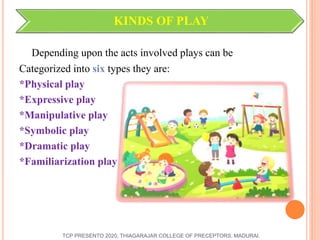
KINDS OF PLAY
Depending upon the acts involved plays can be
Categorized into six types they are:
*Physical play
*Expressive play
*Manipulative play
*Symbolic play
*Dramatic play
*Familiarization play
TCP PRESENTO 2020, THIAGARAJAR COLLEGE OF PRECEPTORS, MADURAI.
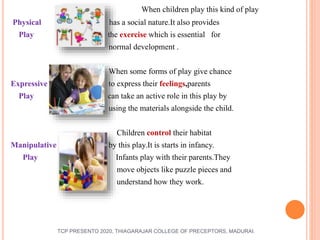
When children play this kind of play
Physical has a social nature.It also provides
Play the exercise which is essential for
normal development .
When some forms of play give chance
Expressive s to express their feelings,parents
Play can take an active role in this play by
using the materials alongside the child.
Children control their habitat
Manipulative by this play.It is starts in infancy.
Play Infants play with their parents.They
move objects like puzzle pieces and
understand how they work.
TCP PRESENTO 2020, THIAGARAJAR COLLEGE OF PRECEPTORS, MADURAI.
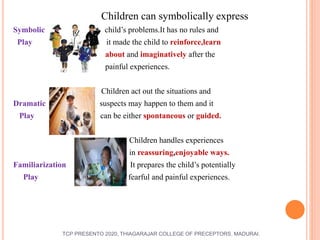
Children can symbolically express
Symbolic child’s problems.It has no rules and
Play it made the child to reinforce,learn
about and imaginatively after the
painful experiences.
Children act out the situations and
Dramatic suspects may happen to them and it
Play can be either spontaneous or guided.
Children handles experiences
in reassuring,enjoyable ways.
Familiarization It prepares the child’s potentially
Play fearful and painful experiences.
TCP PRESENTO 2020, THIAGARAJAR COLLEGE OF PRECEPTORS, MADURAI.
PLAY PROPOSED BY NATIONAL
INSTITUTE FOR PLAY
America’s california –based National Institute for play
gives seven play pattern they are:
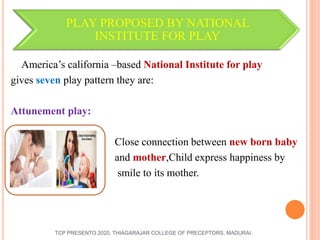
Attunement play:
Close connection between new born baby
and mother,Child express happiness by
smile to its mother.
TCP PRESENTO 2020, THIAGARAJAR COLLEGE OF PRECEPTORS, MADURAI.
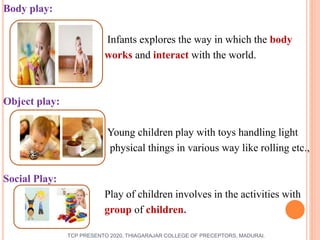
Body play:
Infants explores the way in which the body
works and interact with the world.
Object play:
Young children play with toys handling light
physical things in various way like rolling etc.,
Social Play:
Play of children involves in the activities with
group of children.
TCP PRESENTO 2020, THIAGARAJAR COLLEGE OF PRECEPTORS, MADURAI.
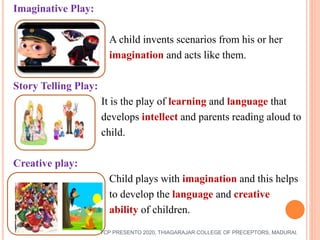
Imaginative Play:
A child invents scenarios from his or her
imagination and acts like them.
Story Telling Play:
It is the play of learning and language that
develops intellect and parents reading aloud to
child.
Creative play:
Child plays with imagination and this helps
to develop the language and creative
ability of children.
TCP PRESENTO 2020, THIAGARAJAR COLLEGE OF PRECEPTORS, MADURAI.
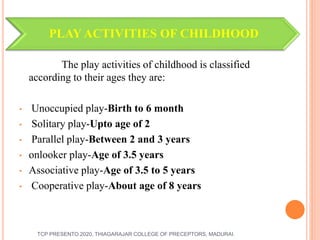
PLAY ACTIVITIES OF CHILDHOOD
The play activities of childhood is classified
according to their ages they are:
• Unoccupied play-Birth to 6 month
• Solitary play-Upto age of 2
• Parallel play-Between 2 and 3 years
• onlooker play-Age of 3.5 years
• Associative play-Age of 3.5 to 5 years
• Cooperative play-About age of 8 years
TCP PRESENTO 2020, THIAGARAJAR COLLEGE OF PRECEPTORS, MADURAI.
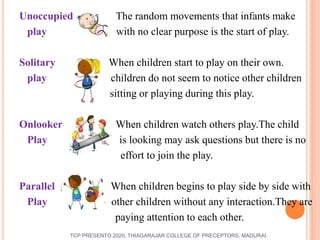
Unoccupied The random movements that infants make
play with no clear purpose is the start of play.
Solitary When children start to play on their own.
play children do not seem to notice other children
sitting or playing during this play.
Onlooker When children watch others play.The child
Play is looking may ask questions but there is no
effort to join the play.
Parallel When children begins to play side by side with
Play other children without any interaction.They are
paying attention to each other.
TCP PRESENTO 2020, THIAGARAJAR COLLEGE OF PRECEPTORS, MADURAI.
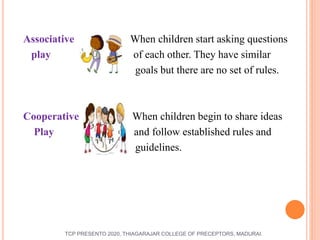
Associative When children start asking questions
play of each other. They have similar
goals but there are no set of rules.
Cooperative When children begin to share ideas
Play and follow established rules and
guidelines.
TCP PRESENTO 2020, THIAGARAJAR COLLEGE OF PRECEPTORS, MADURAI.
COGNITIVE DEVELOPMENT LEVELS
AND CHILD’S PLAY
According to Jean Piaget’s Theory they are four
stages of cognitive development:
*Sensory motor stage-age 0 to 2 years
*Pre operational stage-age 2 to 7 years
*Concrete operational stage-age 7 to 11 years
*Formal operational stage-age 11 onwards
TCP PRESENTO 2020, THIAGARAJAR COLLEGE OF PRECEPTORS, MADURAI.
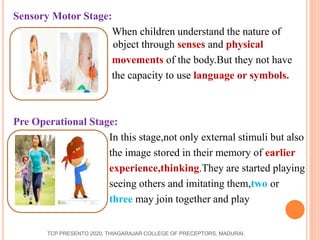
Sensory Motor Stage:
When children understand the nature of
object object through senses and physical
movements of the body.But they not have
the capacity to use language or symbols.
Pre Operational Stage:
In this stage,not only external stimuli but also
the image stored in their memory of earlier
experience,thinking.They are started playing
seeing others and imitating them,two or
three may join together and play
TCP PRESENTO 2020, THIAGARAJAR COLLEGE OF PRECEPTORS, MADURAI.
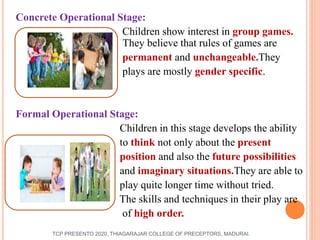
Concrete Operational Stage:
Children show interest in group games.
Game They believe that rules of games are
permanent and unchangeable.They
plays are mostly gender specific.
Formal Operational Stage:
Children in this stage develops the ability
to think not only about the present
position and also the future possibilities
and imaginary situations.They are able to
play quite longer time without tried.
The skills and techniques in their play are
of high order.
TCP PRESENTO 2020, THIAGARAJAR COLLEGE OF PRECEPTORS, MADURAI.
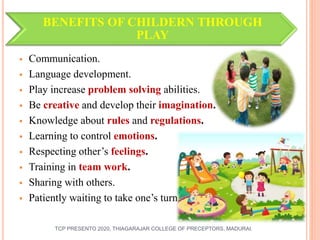
BENEFITS OF CHILDERN THROUGH
PLAY
 Communication.
 Language development.
 Play increase problem solving abilities.
 Be creative and develop their imagination.
 Knowledge about rules and regulations.
 Learning to control emotions.
 Respecting other’s feelings.
 Training in team work.
 Sharing with others.
 Patiently waiting to take one’s turn.
TCP PRESENTO 2020, THIAGARAJAR COLLEGE OF PRECEPTORS, MADURAI.
ROLE OF PLAY IN CHILD DEVELOPMENT
Play reinforces the child’s growth and the
development.Children are curious to do something or the
other and always remains active.they have the ability to
spontaneously choose their own activities.
Some of the common role of play in child developments
are:
Physical development -Fine and gross motor skills
Emotional development -Anxiety
Cognitive development -Gain knowledge
Social development -Self absorbed
Moral development -play with their peers and family
members.
TCP PRESENTO 2020, THIAGARAJAR COLLEGE OF PRECEPTORS, MADURAI.
FACTORS AFFECTING CHILDREN’S PLAY
Factors affecting children’s play have been categorized
Into four major heads by researchers Shankar(2008),Blair and
Diamond(2008).They are:
*Environmental factors
*Biological factors
*Factors related to interpersonal relationships
*Early childhood environment and experiences.
TCP PRESENTO 2020, THIAGARAJAR COLLEGE OF PRECEPTORS, MADURAI.
AGE- RELATED PLAYS IN CHILDHOOD
Infancy(0 to 2 years)
Play with physical
Movements.
Early childhood(2 to 5 years)
Play such as singing,story telling,role
playing etc.,
Later childhood(5 to 11 years)
play and games mixed with rules like
kabadi,kummi,yoga,chess,kolattam etc.,
TCP PRESENTO 2020, THIAGARAJAR COLLEGE OF PRECEPTORS, MADURAI.
COGNITIVE ABILITY
According to Neysa,information received through sense
organs while interacting with one’s environment are
processed by various mental ablities like storing,
Preceiving,expanding,reccalling,classifying,compiling
etc.This ability to process information through mental
activities is called “Cognitive Ability”.
TCP PRESENTO 2020, THIAGARAJAR COLLEGE OF PRECEPTORS, MADURAI.
PLAYS THAT DEVELOPS CHILDREN’S
COGNITIVE ABILITY
 Spelling out the letters repeatedly
e.g:a-apple,b-book,c-cat etc.
 Making the child identify the letters
letters cut out from cardboard orplywoods.
 Providing opportunities to choose
provide chance to choose colour,ball,musical
song of their choice.
 Developing numaracy
Training in numaracy by count fingers in hands
and so on.
 Playing with things of daily utilities
Things used in daily life as a play materials.
 Opportunities to take part in different kings of play
TCP PRESENTO 2020, THIAGARAJAR COLLEGE OF PRECEPTORS, MADURAI.
CONCLUSION
Play is commonly associated with childern and juvenile-
level activities,but play occurs at any stage of life.Play is an
activity undertaken by children which they enjoy and feel
pleasurable.
“A child loves his play,not because it’s easy,
but because it’s hard “.
-Benjamin Spock
TCP PRESENTO 2020, THIAGARAJAR COLLEGE OF PRECEPTORS, MADURAI.
REFERENCES & ACKNOWLEDGMENT
References:
• prof.k.Nagarajan,M.Sc.,(phy)M.A.,(psy)M.Ed.,ph.d
• All image downloader app
• https://www.museumofplay.org/education/education-and
play-resources/play -quotes.
Acknowledgment:
My humble and grateful thanks to the organizers of the
Thagarajar College of Preceptors who give plateform to submit my
Presentation in the TCP PRESENTO 2020.My heart is smiling to
Endowed the thank you for giving this wonderful opportunities.
TCP PRESENTO 2020, THIAGARAJAR COLLEGE OF PRECEPTORS, MADURAI.

PLAY AND CHILD DEVELOPMENT

  • 1.
    Name:K.S.Manjulaa Topic:Play and childdevelopment College:Vellalar college of education For women,Thindal.
  • 2.
    SYNOPSIS Introduction Definition of play Kindsof play Play proposed by national institute for play Play activities of childhood Cognitive development levels and child’s development Benefits of children through play Role of play in child development Factors affecting children’s play Age-related plays in childhood Cognitive Ability Play that develops children’s cognitive ability Conclusion References and Acknowledgment TCP PRESENTO 2020, THIAGARAJAR COLLEGE OF PRECEPTORS, MADURAI.
  • 3.
    INTRODUCTION The childhood isa playfull period of human life. Play serves as the beginning for the physical development and also the develops the cognitive development and social skill.The play is the range of voluntary,intrinsically motivated activities,normally associated with recreational pleasure and enjoyment. It made the child to sharpening its sense and make it growth intellectually and socially .It also acts as a stepping into the world integration.
  • 4.
    DEFINITION OF PLAY JeanPiaget stated, The child by handling the objects around it,tries to understand its immediate environment.such as intrinsically motivated activities are knowns as “PLAY”. Generally play means “unstructed,without having any rules and regulations and not requiring any specific tools and place but consists of the spontaneous activities”. TCP PRESENTO 2020, THIAGARAJAR COLLEGE OF PRECEPTORS, MADURAI.
  • 5.
    KINDS OF PLAY Dependingupon the acts involved plays can be Categorized into six types they are: *Physical play *Expressive play *Manipulative play *Symbolic play *Dramatic play *Familiarization play TCP PRESENTO 2020, THIAGARAJAR COLLEGE OF PRECEPTORS, MADURAI.
  • 6.
    When children playthis kind of play Physical has a social nature.It also provides Play the exercise which is essential for normal development . When some forms of play give chance Expressive s to express their feelings,parents Play can take an active role in this play by using the materials alongside the child. Children control their habitat Manipulative by this play.It is starts in infancy. Play Infants play with their parents.They move objects like puzzle pieces and understand how they work. TCP PRESENTO 2020, THIAGARAJAR COLLEGE OF PRECEPTORS, MADURAI.
  • 7.
    Children can symbolicallyexpress Symbolic child’s problems.It has no rules and Play it made the child to reinforce,learn about and imaginatively after the painful experiences. Children act out the situations and Dramatic suspects may happen to them and it Play can be either spontaneous or guided. Children handles experiences in reassuring,enjoyable ways. Familiarization It prepares the child’s potentially Play fearful and painful experiences. TCP PRESENTO 2020, THIAGARAJAR COLLEGE OF PRECEPTORS, MADURAI.
  • 8.
    PLAY PROPOSED BYNATIONAL INSTITUTE FOR PLAY America’s california –based National Institute for play gives seven play pattern they are: Attunement play: Close connection between new born baby and mother,Child express happiness by smile to its mother. TCP PRESENTO 2020, THIAGARAJAR COLLEGE OF PRECEPTORS, MADURAI.
  • 9.
    Body play: Infants exploresthe way in which the body works and interact with the world. Object play: Young children play with toys handling light physical things in various way like rolling etc., Social Play: Play of children involves in the activities with group of children. TCP PRESENTO 2020, THIAGARAJAR COLLEGE OF PRECEPTORS, MADURAI.
  • 10.
    Imaginative Play: A childinvents scenarios from his or her imagination and acts like them. Story Telling Play: It is the play of learning and language that develops intellect and parents reading aloud to child. Creative play: Child plays with imagination and this helps to develop the language and creative ability of children. TCP PRESENTO 2020, THIAGARAJAR COLLEGE OF PRECEPTORS, MADURAI.
  • 11.
    PLAY ACTIVITIES OFCHILDHOOD The play activities of childhood is classified according to their ages they are: • Unoccupied play-Birth to 6 month • Solitary play-Upto age of 2 • Parallel play-Between 2 and 3 years • onlooker play-Age of 3.5 years • Associative play-Age of 3.5 to 5 years • Cooperative play-About age of 8 years TCP PRESENTO 2020, THIAGARAJAR COLLEGE OF PRECEPTORS, MADURAI.
  • 12.
    Unoccupied The randommovements that infants make play with no clear purpose is the start of play. Solitary When children start to play on their own. play children do not seem to notice other children sitting or playing during this play. Onlooker When children watch others play.The child Play is looking may ask questions but there is no effort to join the play. Parallel When children begins to play side by side with Play other children without any interaction.They are paying attention to each other. TCP PRESENTO 2020, THIAGARAJAR COLLEGE OF PRECEPTORS, MADURAI.
  • 13.
    Associative When childrenstart asking questions play of each other. They have similar goals but there are no set of rules. Cooperative When children begin to share ideas Play and follow established rules and guidelines. TCP PRESENTO 2020, THIAGARAJAR COLLEGE OF PRECEPTORS, MADURAI.
  • 14.
    COGNITIVE DEVELOPMENT LEVELS ANDCHILD’S PLAY According to Jean Piaget’s Theory they are four stages of cognitive development: *Sensory motor stage-age 0 to 2 years *Pre operational stage-age 2 to 7 years *Concrete operational stage-age 7 to 11 years *Formal operational stage-age 11 onwards TCP PRESENTO 2020, THIAGARAJAR COLLEGE OF PRECEPTORS, MADURAI.
  • 15.
    Sensory Motor Stage: Whenchildren understand the nature of object object through senses and physical movements of the body.But they not have the capacity to use language or symbols. Pre Operational Stage: In this stage,not only external stimuli but also the image stored in their memory of earlier experience,thinking.They are started playing seeing others and imitating them,two or three may join together and play TCP PRESENTO 2020, THIAGARAJAR COLLEGE OF PRECEPTORS, MADURAI.
  • 16.
    Concrete Operational Stage: Childrenshow interest in group games. Game They believe that rules of games are permanent and unchangeable.They plays are mostly gender specific. Formal Operational Stage: Children in this stage develops the ability to think not only about the present position and also the future possibilities and imaginary situations.They are able to play quite longer time without tried. The skills and techniques in their play are of high order. TCP PRESENTO 2020, THIAGARAJAR COLLEGE OF PRECEPTORS, MADURAI.
  • 17.
    BENEFITS OF CHILDERNTHROUGH PLAY  Communication.  Language development.  Play increase problem solving abilities.  Be creative and develop their imagination.  Knowledge about rules and regulations.  Learning to control emotions.  Respecting other’s feelings.  Training in team work.  Sharing with others.  Patiently waiting to take one’s turn. TCP PRESENTO 2020, THIAGARAJAR COLLEGE OF PRECEPTORS, MADURAI.
  • 18.
    ROLE OF PLAYIN CHILD DEVELOPMENT Play reinforces the child’s growth and the development.Children are curious to do something or the other and always remains active.they have the ability to spontaneously choose their own activities. Some of the common role of play in child developments are: Physical development -Fine and gross motor skills Emotional development -Anxiety Cognitive development -Gain knowledge Social development -Self absorbed Moral development -play with their peers and family members. TCP PRESENTO 2020, THIAGARAJAR COLLEGE OF PRECEPTORS, MADURAI.
  • 19.
    FACTORS AFFECTING CHILDREN’SPLAY Factors affecting children’s play have been categorized Into four major heads by researchers Shankar(2008),Blair and Diamond(2008).They are: *Environmental factors *Biological factors *Factors related to interpersonal relationships *Early childhood environment and experiences. TCP PRESENTO 2020, THIAGARAJAR COLLEGE OF PRECEPTORS, MADURAI.
  • 20.
    AGE- RELATED PLAYSIN CHILDHOOD Infancy(0 to 2 years) Play with physical Movements. Early childhood(2 to 5 years) Play such as singing,story telling,role playing etc., Later childhood(5 to 11 years) play and games mixed with rules like kabadi,kummi,yoga,chess,kolattam etc., TCP PRESENTO 2020, THIAGARAJAR COLLEGE OF PRECEPTORS, MADURAI.
  • 21.
    COGNITIVE ABILITY According toNeysa,information received through sense organs while interacting with one’s environment are processed by various mental ablities like storing, Preceiving,expanding,reccalling,classifying,compiling etc.This ability to process information through mental activities is called “Cognitive Ability”. TCP PRESENTO 2020, THIAGARAJAR COLLEGE OF PRECEPTORS, MADURAI.
  • 22.
    PLAYS THAT DEVELOPSCHILDREN’S COGNITIVE ABILITY  Spelling out the letters repeatedly e.g:a-apple,b-book,c-cat etc.  Making the child identify the letters letters cut out from cardboard orplywoods.  Providing opportunities to choose provide chance to choose colour,ball,musical song of their choice.  Developing numaracy Training in numaracy by count fingers in hands and so on.  Playing with things of daily utilities Things used in daily life as a play materials.  Opportunities to take part in different kings of play TCP PRESENTO 2020, THIAGARAJAR COLLEGE OF PRECEPTORS, MADURAI.
  • 23.
    CONCLUSION Play is commonlyassociated with childern and juvenile- level activities,but play occurs at any stage of life.Play is an activity undertaken by children which they enjoy and feel pleasurable. “A child loves his play,not because it’s easy, but because it’s hard “. -Benjamin Spock TCP PRESENTO 2020, THIAGARAJAR COLLEGE OF PRECEPTORS, MADURAI.
  • 24.
    REFERENCES & ACKNOWLEDGMENT References: •prof.k.Nagarajan,M.Sc.,(phy)M.A.,(psy)M.Ed.,ph.d • All image downloader app • https://www.museumofplay.org/education/education-and play-resources/play -quotes. Acknowledgment: My humble and grateful thanks to the organizers of the Thagarajar College of Preceptors who give plateform to submit my Presentation in the TCP PRESENTO 2020.My heart is smiling to Endowed the thank you for giving this wonderful opportunities. TCP PRESENTO 2020, THIAGARAJAR COLLEGE OF PRECEPTORS, MADURAI.
  • 25.
    TCP PRESENTO 2020,THIAGARAJAR COLLEGE OF PRECEPTORS, MADURAI.