PLASTIC MOULDING
METHODS
ME 405 - UNIT 111
ME 405 - UNIT 111
 Moulding of plastics comprises forming an
article to the desired shape by application
of heat and pressure to the moulding
compound in a suitable mould and
hardening the material in the mould.
 There are two types of material generally
used : 1.Thermosetting Plastic
2.Thermo Plastic
COMPRESSION MOULDING
TRANSFER MOULDING
TRANSFER MOULDING
INJECTION MOULDING
EXTRUSION MOULDING
THERMOSETTING material are generally
processed by Compression Moulding
and Transfer Moulding.
THERMOPLASTIC material are generally
processed by Injection moulding and
Extrusion Moulding.
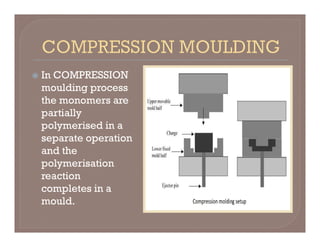
 In COMPRESSION
moulding process
the monomers are
partially
polymerised in a
polymerised in a
separate operation
and the
polymerisation
reaction
completes in a
mould.
 Partially polymerized material is prepared as
pallets for COMPRESSION moulding.
 It is placed in heated mould.
 After the compound is softened and becomes
plastic, the upper part of the die moves
downwards, compressing the materials to the
plastic, the upper part of the die moves
downwards, compressing the materials to the
required shape and density.
 Continuous heat and pressure produce the
chemical reaction, leading to cross linking
between the molecule chains, that hardens the
thermosetting material.
 The mould remains closed until the curing is
complete.
 COMPRESSION moulding is suitable for
large, bulk parts of both Thermosetting and
Thermoplastic materials.
 COMPRESSION moulding is also suitable for
making small parts of Thermosetting
materials.
 Moulding large size parts by
COMPRESSION moulding might be a
problem.
 The moulding Temperature of
thermosetting materials ranges from 150°C
to 180°C.
 The moulding Pressure ranges from 135 -
535 kgf/cm².
 The Time required to harden the mould
piece ranges from 1 to 15 minutes
depending upon the maximum thickness
of the moulded article and the cooling
facilities of the die.
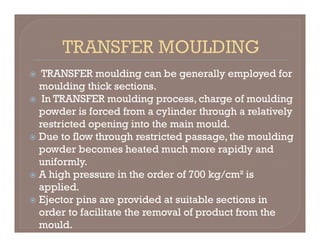
 TRANSFER moulding can be generally employed for
moulding thick sections.
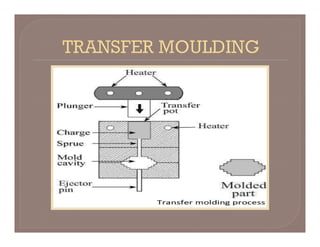
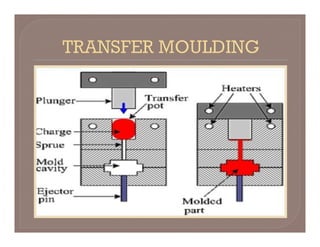
 In TRANSFER moulding process, charge of moulding
powder is forced from a cylinder through a relatively
restricted opening into the main mould.
 Due to flow through restricted passage, the moulding
powder becomes heated much more rapidly and
uniformly.
 A high pressure in the order of 700 kg/cm² is
applied.
 Ejector pins are provided at suitable sections in
order to facilitate the removal of product from the
mould.
 In TRANSFER moulding, the THERMOSETTING
moulding powder is prepared by mixing filler with
resin which is only partly condensed and makes it
capable of being softened on re-heating.
 The resin and the filler is mixed together and heated
until the desired characteristics of the moulding
poeder is attained.The most commonly used fillers
are wood, flour, nylon and glass.
In TRANSFER moulding, the following points are to
be kept in mind:
 Material should flow easily in the mould to take the
required shape.
 All parts of the charge must be heated so as to
harden
 When the sections are thick, it become necessary to
pre-heat the charge of material before placing it in
mould.
 Usually ejector pins are provided at suitable sections
in order to facilitate the removal of product from the
mould.
 In INJECTION moulding process the granular moulding
material is loaded into a hopper from where it is
metered out by a heating cylinder by a feeding device.
 The exact amount of material is delivered to the
material which is required to melt completely.
The injection ram pushes the material into the heating
 The injection ram pushes the material into the heating
cylinder and in doing so pushes a small amount of
heated material out of the other end of the cylinder
through the nozzle and screw bushing and into the
cavities of the closed mould.
 The material is cooled to a rigid state in the mould.
 The mould is then opened and the piece is ejected out.
 The temperature to which the
material is raised in Injection
moulding in the heating cylinder
is usually between 180 - 280°C.
 The higher the temperature the
lower the viscocity and more
readily it can be pushed into the
die.
 INJECTION moulding process
makes use of heating softening
characteristics of Thermosetting
plastics.
 These material soften when
heated and hardens when cools.
 EXTRUSION moulding process is a continuous operation in
which powdered polymer or monomer is fed by a screw
along a cylindrical chamber.
 As the powder moves towards the die, it is heated and melts.
 The molten plastic is forced through a die opening of
desired shape.
 The material in granular form together with necessary
additives is placed into a feed hopper which feeds the
cylinder of the extruding machine.
 A rotating screw is used for carrying and mixing of material
through cylinder and forcing it through a die of required
shape.
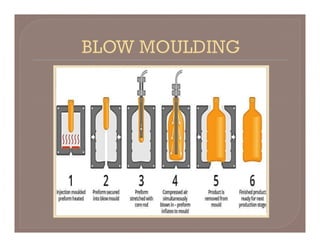
The BLOW moulding process is applied
to only thermoplastics which are used for
producing hollow objects such as bottle
by applying air pressure.
The air under pressure is blown into the
tube, which causes the tube to expand to
the walls of cavity.
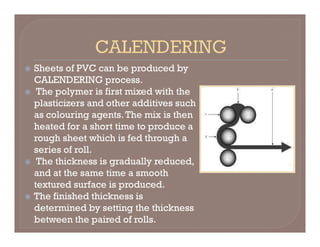
 Sheets of PVC can be produced by
CALENDERING process.
 The polymer is first mixed with the
plasticizers and other additives such
as colouring agents.The mix is then
heated for a short time to produce a
rough sheet which is fed through a
series of roll.
 The thickness is gradually reduced,
and at the same time a smooth
textured surface is produced.
 The finished thickness is
determined by setting the thickness
between the paired of rolls.
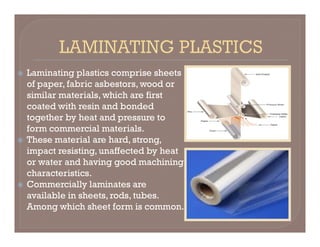
 Laminating plastics comprise sheets
of paper, fabric asbestors, wood or
similar materials, which are first
coated with resin and bonded
together by heat and pressure to
form commercial materials.
 These material are hard, strong,
impact resisting, unaffected by heat
or water and having good machining
characteristics.
 Commercially laminates are
available in sheets, rods, tubes.
Among which sheet form is common.
Plastic moulding methods

Plastic moulding methods

  • 1.
    PLASTIC MOULDING METHODS ME 405- UNIT 111 ME 405 - UNIT 111
  • 2.
     Moulding ofplastics comprises forming an article to the desired shape by application of heat and pressure to the moulding compound in a suitable mould and compound in a suitable mould and hardening the material in the mould.  There are two types of material generally used : 1.Thermosetting Plastic 2.Thermo Plastic
  • 3.
    COMPRESSION MOULDING TRANSFER MOULDING TRANSFERMOULDING INJECTION MOULDING EXTRUSION MOULDING
  • 4.
    THERMOSETTING material aregenerally processed by Compression Moulding and Transfer Moulding. THERMOPLASTIC material are generally processed by Injection moulding and Extrusion Moulding.
  • 5.
     In COMPRESSION mouldingprocess the monomers are partially polymerised in a polymerised in a separate operation and the polymerisation reaction completes in a mould.
  • 6.
     Partially polymerizedmaterial is prepared as pallets for COMPRESSION moulding.  It is placed in heated mould.  After the compound is softened and becomes plastic, the upper part of the die moves downwards, compressing the materials to the plastic, the upper part of the die moves downwards, compressing the materials to the required shape and density.  Continuous heat and pressure produce the chemical reaction, leading to cross linking between the molecule chains, that hardens the thermosetting material.  The mould remains closed until the curing is complete.
  • 7.
     COMPRESSION mouldingis suitable for large, bulk parts of both Thermosetting and Thermoplastic materials.  COMPRESSION moulding is also suitable for  COMPRESSION moulding is also suitable for making small parts of Thermosetting materials.  Moulding large size parts by COMPRESSION moulding might be a problem.
  • 8.
     The mouldingTemperature of thermosetting materials ranges from 150°C to 180°C.  The moulding Pressure ranges from 135 -  The moulding Pressure ranges from 135 - 535 kgf/cm².  The Time required to harden the mould piece ranges from 1 to 15 minutes depending upon the maximum thickness of the moulded article and the cooling facilities of the die.
  • 9.
     TRANSFER mouldingcan be generally employed for moulding thick sections.  In TRANSFER moulding process, charge of moulding powder is forced from a cylinder through a relatively restricted opening into the main mould. restricted opening into the main mould.  Due to flow through restricted passage, the moulding powder becomes heated much more rapidly and uniformly.  A high pressure in the order of 700 kg/cm² is applied.  Ejector pins are provided at suitable sections in order to facilitate the removal of product from the mould.
  • 10.
     In TRANSFERmoulding, the THERMOSETTING moulding powder is prepared by mixing filler with resin which is only partly condensed and makes it capable of being softened on re-heating.  The resin and the filler is mixed together and heated until the desired characteristics of the moulding poeder is attained.The most commonly used fillers are wood, flour, nylon and glass.
  • 12.
    In TRANSFER moulding,the following points are to be kept in mind:  Material should flow easily in the mould to take the required shape.  All parts of the charge must be heated so as to  All parts of the charge must be heated so as to harden  When the sections are thick, it become necessary to pre-heat the charge of material before placing it in mould.  Usually ejector pins are provided at suitable sections in order to facilitate the removal of product from the mould.
  • 14.
     In INJECTIONmoulding process the granular moulding material is loaded into a hopper from where it is metered out by a heating cylinder by a feeding device.  The exact amount of material is delivered to the material which is required to melt completely. The injection ram pushes the material into the heating  The injection ram pushes the material into the heating cylinder and in doing so pushes a small amount of heated material out of the other end of the cylinder through the nozzle and screw bushing and into the cavities of the closed mould.  The material is cooled to a rigid state in the mould.  The mould is then opened and the piece is ejected out.
  • 16.
     The temperatureto which the material is raised in Injection moulding in the heating cylinder is usually between 180 - 280°C.  The higher the temperature the lower the viscocity and more lower the viscocity and more readily it can be pushed into the die.  INJECTION moulding process makes use of heating softening characteristics of Thermosetting plastics.  These material soften when heated and hardens when cools.
  • 18.
     EXTRUSION mouldingprocess is a continuous operation in which powdered polymer or monomer is fed by a screw along a cylindrical chamber.  As the powder moves towards the die, it is heated and melts.  The molten plastic is forced through a die opening of  The molten plastic is forced through a die opening of desired shape.  The material in granular form together with necessary additives is placed into a feed hopper which feeds the cylinder of the extruding machine.  A rotating screw is used for carrying and mixing of material through cylinder and forcing it through a die of required shape.
  • 20.
    The BLOW mouldingprocess is applied to only thermoplastics which are used for producing hollow objects such as bottle by applying air pressure. by applying air pressure. The air under pressure is blown into the tube, which causes the tube to expand to the walls of cavity.
  • 22.
     Sheets ofPVC can be produced by CALENDERING process.  The polymer is first mixed with the plasticizers and other additives such as colouring agents.The mix is then heated for a short time to produce a heated for a short time to produce a rough sheet which is fed through a series of roll.  The thickness is gradually reduced, and at the same time a smooth textured surface is produced.  The finished thickness is determined by setting the thickness between the paired of rolls.
  • 24.
     Laminating plasticscomprise sheets of paper, fabric asbestors, wood or similar materials, which are first coated with resin and bonded together by heat and pressure to form commercial materials. form commercial materials.  These material are hard, strong, impact resisting, unaffected by heat or water and having good machining characteristics.  Commercially laminates are available in sheets, rods, tubes. Among which sheet form is common.