CHAPTER - 1. High Polymers and Elastomers
 The compound formed by large number of small molecules (called monomers) linked together are known as POLYMERS
[poly = many].
 Thus the single repeating unit is called as monomer, and the resultant high molecular weight compound is called as polymer.
Classification of polymers
Tacticity
a) Isotactic polymers
b) Atactic polymers
c) Syndiotactic polymers
In isotactic, the head to tail configuration in macromolecule
with respect to functional group is iso, i.e. all the functional groups lie
on the same side of the chain.
In atactic, the head to tail configuration is random i.e. the functional
groups are arranged randomly.
In syndiotactic polymers, the functional groups occupy the alternating
position.
Condensation/Step polymerization.
 [May 2004, Dec.2004, May 2006, Dec.2006, May 2007, Dec. 2007]
The monomers having certain functional group such as -
OH, -COOH,
-N etc. show the tendency to undergo polymerizations by
the elimination of one molecule of a simple by-product such
as , Salt or alcohol etc. Unlike addition/chain
polymerizations, polymer loses simple molecules at every
combination.
Thus,
i. Condensation Polymerization is undergone by the monomers
which possess functional groups.
ii. Generally monomers are like acids, amines, alcohols,
phenols, carbonyl compounds etc.
iii. This type of polymerization occurs stepwise, hence the rate
of polymerization is comparatively low.
eg. Ureaformaldehyde
 In the formation of ureaformaldehyde, hydrogen from group of urea condenses with oxygen to form ureaformaldehyde
with free valency and eliminates water molecule as shown in reaction.
 These terminated groups further condense with formaldehyde to form long chains, thus the urea formaldehyde can be
represented can be represented as,
Plastics
 The name plastic refers to its meaning that these are the polymers which mould themselves into articles by heat and pressure.
Comparison of Plastics
 [Dec.2003, May 2005, Dec.2005, May 2006, May 2008]
Sr.
No.
Thermoplastics or thermosoftening
Plactics
Thermosetting Plastic or
Thermohaidening Plastics
1. These are formed by addition polymerization These are formed by condensation polymerization
only
2. They are long chain linear polymer with negligible
cross links
These have three-dimensional network structure with
number of cross links
3. Structural formula: Structural formula:
4. Monomer used in these is generally bifunctional In this, monomer used is of higher functionality
5. They have low molecule weight They have high molecular weight
6. They are usually soft, weak and less brittle. They are usually hard, strong and more brittle
7. They are usually soluble in some organic solvents. Due to strong bonds and cross links, they are insoluble
in almost all organic solvents
8. They get softened on reheating readily because second
ary force between the individual chain can break by
heat or pressure.
They do no soften on heating because the cross links
and bonds retain their strength on heating and hence.
9. They can be softened, reshaped and thus reused.
(reclaimed from waste) (by reheating to a suitable
temperature)
They retain their shape and structure even on heating.
Hence, they cannot be reshaped and reused. (cannot
be reclaimed)
10. Example : Polyethylene, polystyrene, PVC, PVA Example : Phenolformadehyde, ureaformaldehyde,
Nylon 6:6.
Fabrication of Plastics or Moulding of Plastics
 [Dec.2003, Dec.2007, May 2008]
 The fabrication is the process in which the prepared resins in the form of granules or powder are converted into desired shape
by using various machines or moulds.
 The basic principle involved in this is partially melting (softening) resinous mass by the application of heat.
Compression Moulding
 [Dec.2003, May 2005]
 It is one of the most common method for moulding
thermosetting materials which can withstand high temperature
and pressure.
 This process consist of compressing the molten resinous material
into the desired shape by the use of moulds, heat and pressure.
 A predetermined quantity of resin powder of pallets is usually
preheated to about 120 C before the cavity of the heated mould
is filled with it.
 After charging the mould, the two parts of moulds are carefully
brought together under low pressure. (Refer Fig.)
 It is then compressed by hydraulic pressure.
 Pressures from 2,000 to 10,000 p.s.i are used.
 This pressure and heat allow the resin to melt and flow, thereby filling the cavity between the two parts of the mould.
 The material in the mould is kept for the specified time under a correct temperature and pressure for a proper curve. The
curing is done either by heating (in case of thermosetting) or cooling (in case of thermoplastics).
 After curing, the moulded articles are taken out by opening the mould apart.
 A varity of products ranging from ash trays and elastric switch boxes to radio and television cabinets are manufactured this
way.
Injection Moulding
 It is one of the most widely used processes for converting thermoplastic raw
materials into finish product.
 It is fundamentally simple and capable of producing a very wide range of
industrial and domestic articles.
 In this process a predetermined quantity of the granular or powdered resin is
fed into a heated cylinder from where it is injected at a controlled rate
through a nozzle into the tightly locked mould by means of a screw
arrangement or by position plunger as shown in the fig.
 Pressure upto 1758 kg/cm is used for injections. The mould is kept cold to allow the hot plastic to cure and become rigid.
 When the material has been cured sufficiently, half of the mould is opened to allow the ejections of the finished article without
any deformation.
 The entire cyclic operation may be made automatic.
 This method is most widely used for moulding of thermoplastic because of high speed production, low mould cost, very low
loss of material and low finishing cost.
 However, there are limitations of design of articles to be moulded because of large number of cavities cannot be filled
simultaneously.
Transfer Moulding
 It is the method which uses the principle of injection moulding and is used for thermosetting materials.
 When relatively intricate designs are required in the fabricated
products, especially when metal insets are to be fabricated, transfer
moulding is used.
 Though transfer moulding is the combination of injection and
compression moulding, it differs from both these methods.
 In this moulding, powdered resins are placed in the heated chamber,
maintained at a minimum temperature at which the powered resins
just begins to become plastic.
 This plastic material is then injected through an orifice into the
mould by plunger, working at a high pressure.
 Due to a very high friction developed at the orifice, the temperature
of the material at the time of ejection from the orifice rises to such an
extent that the moulding powder becomes almost liquid, and
consequently it flows quickly into the mould which is heated upto
curing temperature required for setting.
 The moulded article is then ejected mechanically.
Advantages
1. Intricate shapes not attainable by compression moulding can readily be produced.
2. Article produced is free from flow mark.
3. Even thick pieces cure almost completely and uniformly.
4. Finishing cost of fabricated article is almost entirely eliminated.
5. Blistering is almost eliminated, since air and excluded gases are expelled in the plasticizing chamber itself.
6. Mould cost is less, since it involves very low abrasive action.
7. Fine wires and glasses fibers can be inserted into the mould.
Extrusion Moulding
 [Dec.2005]
 It is mainly used for manufacturing moulding articles of
thermoplastic resins.
 For example tubes, rods, strips, insulated electric cable etc.
 In this method dry moulding powder or granular material is
first fed through hopper into the rear of the heated chamber
which has a resolving screw.
 When the screw is rotated the molten material is pushed
forward through the small orifice of the die to form
continuous uniform shaped articles.
 When the article leaves the orifice, it is allowed to passed
through water for solidification of plastic material.
 The control of the temperature of heating chamber and
speed of the extruder screw are the two most important
factors of successful extruder operation.
There are two types of moulding.
1. Vertical extruder moulding.
2. Horizontal extruder moulding as shown in the following fig.
Name Synthesis Properties Uses
[1]Poly
Styrene
(1) Polystyrene is a transparent, light (Sp.
Gravity 1.05 to 1.07 g/ ) and
stable material.
(2) It has excellent moisture resistance.
(3) it can be nitrated by fuming nitric and
sulphonated by conc. , at about
100 C to yield water soluble emulsion.
(4) It is a highly electric insulating material.
(5) It is highly resistance to acids and has a
In moulding of article like
(1) Toys, combs, buttons
(2) Bucket, radio and television
parts
(3) Refrigerator parts, battery
cases
(4) High frequency insulators
(5)Lenses
(6) Indoor-lighting panels etc.
good chemical resistance.
(6) it has a relatively low softening range
(90 to 100 C) and is brittle.
(7) It has an unique property of transmitting
light through curved section.
[2]PMMA (1) It is transparent and colourless plastic.
(2) Easy to mould in desired shapes.
(3) Refractive index is 1.59
(4) At lower temperature (R.T.) it is brittle
and rigid
(5) When heated slowly, acquires rubber
like properties at about 65 C where as so
items at about 130 C.
Use for making
(1) Artificial eyes
(2) Screens for T.V.
(3) Air crafts, light fixtures
(4) Also used in optical
instruments, bone splints,
adhesives, paints etc.
(5) In skylights, decorative
articles etc.
[3] Phenol
Formaldehyde
(1) They are scratch resistant, water
(2) resistant, water resistant and insoluble
solids.
(3) They possess excellent electrical
insulating character.
(1) For making electronic
(2) insulator parts like switches,
plugs, switch boards, heater handles etc.
(3) For making moulded articles
like telephone parts, cabinet
for radio and television etc.
(4) As a binder for grinding wheels.
(5) It is used in paints and
vanishes.
[4] Urea
Formaldehyde
(1) They possess good electrical insulating character.
(2) Resistant to water.
(3) Resistant to heat/flame.
(1) Used as a binder of glass fibers, rock wool etc.
which are used for
filtration and insulation purpose.
(2)Used in bonding plywood.
(3) Used as an electrical insulation.
(4) For decorative articles like
plates, drinking glasses, dishes etc
Urea formaldehyde
 [Dec.2003, Dec.2004, May.2006,
May.2007, May.2008]
Synthesis
 These are also called as amino resins
or amino plants.
 In general amino organic compounds
and formaldehyde combine by
condensation polymerization to give
these resins.
 In this particular types of resins,
organic amine being urea, reacts with
formaldehyde and polymerises to
give resins.
Reaction
Properties and Drawbacks of natural Rubber
 [Dec.2003]
 The natural rubber has following properties, (drawbacks) :
1. Its plasticity is greater than elasticity. It cannot sustain stress. Thus when stretched to a great extent, it undergoes deformation
permanently.
2. It has large water absorption tendency, which makes it weak.
3. It has very low tensile strength (20 kg/cm ).
4. Due to large percentage of unsaturation in its structure, it is easily attacked by various reagents such as , conc. ,
organic solvents, air, oxygen, ozone etc. and as a result gets gradually disintegrated.
5. It possesses high percentage of tackiness (Property of developing stickiness on surface) which makes it difficult to store the
rubber stocks.
6. Durability and abrasion resistance of natural rubber is very low.
 Thus the natural rubber does not have the desirable properties.
 Hence to make its maximum use, it is essential to improve its properties by means of certain catalyst.
 Any catalyst used to improve the drawbacks of natural rubber is known as a vulcanizing agent, and the process by which the
undesirable properties of natural rubber are improved upon is known as vulcanization.
Vulcanisation
 [Dec.2004, May.2006, Dec.2006, May.2007, Dec.2007, May.2008]
 To improve the properties of raw rubber, it is compounded with some chemicals like sulphur. , benzyl chloride etc.
 Most important of all the process of compounding (vulcanizing) is the addition of sulphur.
 The process consist of heating the crude rubber with sulphur to a high temperature.
 The sulphur combines chemically at the double bond in the rubber molecule. Vulcanization brings about stiffening of the
rubber by a sort of cross-linking and consequently preventing inter molecular movement or sliding of rubber springs.
 The extent of stiffness or loss of elasticity of vulcanized rubber depends upon the amount of sulpher added.
 For example, a tyre rubber may contain 3 to 5% sulphur, but a battery case rubber may contain as much as 30% sulphur.
 The changes in properties that take place due to vulcanization is shown as below :
Undesirable properties Improvement
Tacky Non-tacky
Weak Vulcanization Strong
Plastic Elastic
Soluble Insoluble
Advantages of using vulcanization
1) It has good tensile strength and extensibility when tensile force is applied.
2) It possesses low water absorption tendency.
3) It has much higher resistance to wear and tear.
4) It is a better electrical insulator.
Co-polymerisation
 [May.2005, Dec.2007]
 Copolymerization is nothing but specific type of addition polymerization.
 In this the monomers of more than one type are involved.
 Copolymerization has unique importance in the industry.
 This is because products formed by copolymerization shown the specific properties of the monomers.
 Sometimes such special properties are further enhanced or sometimes unique properties in the product as a result of the
reaction between two different types of monomers.
 Thus copolymerization gives rise to variety of the products.
 Thus several useful and commercially important polymers are formed by copolymerization.
e.g. Styrene butadiene rubber (SBR – GR – S)
Acrylonitrile rubber NBR or GR – A
 Example : Ethylene copolymerized with propylene and also propylene copolymerised with butadiene gives rise to plastic
resistance to oxygen, and heat.
 Properties of the copolymers depends on the relative amount of the two monomers constituting a polymers and also on the
type of monomer.
Polymer Crystallinity
 [Dec.2007]
It is a property a polymer exhibits in varying extent, which is based on the pattern of arrangement of molecules of polymer.
A polymer is said to be „crystalline‟ if all molecules are arranged in orderly compact manner with symmetrical orientation,
with higher force of attraction between two chains.
Crystalline polymers generally,
1) Posses high density.
2) Strong, hard but brittle
3) Have sharp M.P.
This property can be calculated by density measurement of sample and of other known highly crystalline to highly
amorphous polymer. Then,
% crystallinity =
density of sample d – ensity of highly crystalline dc polymer
dc – da
Visco-elasticity of polymers
 [Dec.2007]
Physical state of a polymer is governed by chain length and molecular weight.
Based on molecular weight, polymers are either elastic solids or viscous
liquids.
These physical states are temperatures servitive.
If cooled slowly, polymer becomes hard and brittle, and vice-versa.
 The time taken for cooling/heating also plays equally important role.
 Thus with variation in temperature and time duration between the range of temperature, a polymeric material exhibits different
range of viscocities. This behaniour of a polymer is known as “viscoelasticity”
Melting and Glass Transition
 [Dec.2007, May 2008]
 The behavior of polymer with respect to its flow properties
is temperature sersitive.
 When a polymer is cooled slowly, it becomes more and
more viscous, finally becomes hard solid and brittle. At this
stage polymer behaves like glass, and breaks if stressed.
 Glass Transition temperature is defined as, “the lowest temperature beyond which the polymer becomes hard, glass-like and
brittle and the high temperature above which it becomes flexible, soft and elastic like rubber.”
 It is denoted as and respectively.
 Thus a polymer changes states as follows:
 In viscoelastic state, polymer molecule has total flexibility, which diminishes beyond , and brittleness is developed.
 Above , polymer is in molten state, where it does not exhibits and shape.
 Thus between and , polymer can sustain stress, because all along the chains, the stress gets distributed almost equally.
 As compared to is an important property for polymer because the value(or range of it)of helps to anticipate flow
properties/softening temperatures of polymers. By the different samples can be compared and selection of polymer for
desired moulding can be done more efficiently.
 depends upon molecular structure presence of side chain, polar group and also on chain length iucluding frequency of
repeating groups along chain. The geometry of molecule also influences .
 Example : increases if aromatic ring is present or high M.W, stronger intermolecular forces of attraction, coiling of
molecule etc.
Supra molecular chemistry and molecular electronics
 [May.2008]
 Supra molecular chemistry is a relatively new field of chemistry which focuses quite literally on going “beyond” molecular
chemistry.
 It can be describe as the study of systems which contain more than one molecule, and it aims to understand the structure,
function and properties of these assemblies.
 Examples of super molecular systems include biological membranes , polynuclear metal complexes, liquid crystals, and
molecule-based crystals.
 A cell (very complex) supermolecular system biopolymers such as nucleic acids, and proteins.
 A supermolecular assembly is a multi component system of atoms, ions and/or molecular, which are held together by non-
covalent interactions such as hydrogen bonds, van der waals forces, pi-pi interactions, and/or electrostatic effects.
 The latter mode of bonding is particularly important for assemblies involving metal ions.
 These various bonding interactions are far weaker than covalent bonding (which are the kind of bonds which hold molecules
together) therefore supermolecular assemblies are usually far less stable than molecular compounds (for example, they can be
more susceptible to breaking apart at high temperatures or if they are mixed with acid).
Formation od Supermolecular Assemblies
 [May.2008]
 The most common method is to use self-assembly techniques, in which the different components are mixed under given set of
conditions (solvent, temperature, pH etc.) and then they are allowed to form assembly.
 Such self-assembly process form a single product which is result of the countless possible combinations of the starting
materials.
 Such supermolecule (product) is formed because it is the most thermodynamically stable arrangement of the constituent
entities.
 If in case the combinations take some wrong path which may be thermodynamically unfavoured, the molecule breaks
immediately.
 This type of „reversibillity‟ id one of the unique features of supermolecular synthesis and this is the major difference between
the molecular synthesis and the conventional molecular synthesis involving covalent bonds.
 In molecular synthesis, a reaction which goes down the „wrong pathway‟ often ends up at a dead end and the material which is
formed must in the end be separated from the desired product.
 One of the major goal of supermolecular chemists is the synthesis of supermolecular assemblies which have new functions
that cannot appear from a single molecular or ion.
 These functions are based on novel magnetic properties, light responsiveness, catalytic activity, fluorescence, redox properties,
etc., of super molecular systems.
 These useful properties may lead to the application of these assemblies as and thse is the list of random examples high-tech
sensors for pollutants in air or water, compact information storage device for next-generation computers, as high-performance
catalysts in industrial processes, or as contrast agents for CAT scans.
 Supermolecular chemistry is intimately related to nanotechnology, and many promising nanotech devices are based on the
principles of supermolecular chemistry.
Subdivision of supermolecular chemistry
 Supermolecular
 Host-guest chemistry
 Helicates
 Catenenes
 Rotaxanes
 Knotanes
 Supra molecular Assemblies
 Micelles
 Membranes
 Vesicles
 Liquid crystals
ADDITIONAL
 Viscoelasticity
Physical state of a polymer is governed by chain length and molecular weight. Based on molecular weight, polymers
are either elastic solids or viscous liquids/flowy liquids.
These physical states are temperatures servitive. If cooled slowly, polymer becomes hard and brittle, and vice-versa.
The time taken for cooling/heating also plays equally important role.
Thus with variation in temperature and time duration between the range of temperature, a polymeric material exhibits
different range of viscocities. This behavior of polymer is known as “viscoelsticity”
 Short note
Conducting Polymers.
Ans. :
Polymers, generally with high crystallinity, are more commonly, developed conductivity more easily.
e.g. Cis-polyacetylene or poly para phenylene
These are following types of conducting polymers :
1. Intrinscially conducting polymers (ICP)
2. Doped conducting polymers (DCP)
3. Extrinsicially conducting polymers (ECP)
4. Co-ordination conducting polymers (CCP) (Inorganic polymers)
Characteristics of each type are discussed in brief.
ICP
These possess conjugated electrons backbone. When such polymer faces electric field, these electrons get excited,
and hence move through polymer material. The orbitals of conjugated electrons get overlapped on the backbone and hence
valence bands and conduction bands are developed which get distributed over entire surface of polymer. Appropriate
proportion of conjugated electrons makes polymer to conduct electricity very efficiently.
e.g. Polyacetylences
Polyquinoline
Poly-p-phenylene
Poly-m-phenylene sulphides etc.
Aromatic : Polyaniline, Polyanthrylene
Aromatic hetrocyclic : Polypyrrole, polythiophene, polybutadienylene.
DCP
These are prepared by exposure of the polymer to a charged transfer agent either in gas phase or in liquid phase (i.e.
solution). As compared to plain ICP, these have low I.P. but high E.A/ Hence these can be easily oxidized or reduced.
ICP can be made more conductive by creating + ve ot – ve charge on its backbone by oxidation or reduction.
ECP
These are the conducting polymers which possess conductivity due to externally added ingredient in them.
There are two types of ECPs,
1. Conductive element filled polymer
In this type, resin or polymer is filled up with conducting element.
e.g. carbon black, metallic fibers, metal oxides etc.
The polymer holds the metallic element, thus acting as a binder. Their conductivity is reasonable high.
Properties
1) Cost is low.
2) They are light in weight.
3) Strong.
4) Can be easily moulded.
2. Blended conducting polymer
These are nothing but blend of normal polymer with conducting polymer. The blending is either only physical change or in
certain cases chemical change. They possess good mechanical properties.
Co-ordination Conducting Polymers : (Inorganic Polymers)
These are inorganic in nature, in which a complex involved in transfer of charge is combined with polymer, and a metal
atom is combined with polydentete ligands. They have very low degree of polymerization ( 18). They are corrosion resistant.
Applications of Conducting Polymers
1) In rechargeable light height batteries.
2) Optically display devices.
3) In wiring in aircrafts and aerospace components.
4) In tele-communication systems.
5) In electromagnetic screening material.
6) Solar cells, photovoltaic devices, transistors, diodes, molecular wires and switches etc.
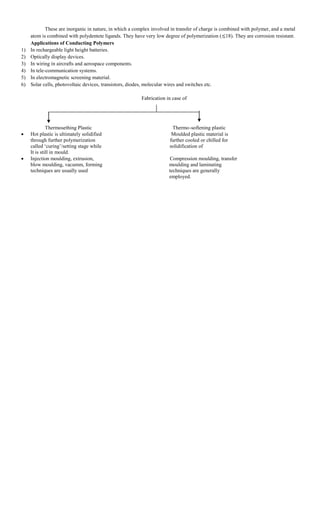
Fabrication in case of
Thermosething Plastic Thermo-softening plastic
 Hot plastic is ultimately solidified Moulded plastic material is
through further polymerization further cooled or chilled for
called „curing‟/setting stage while solidification of
It is still in mould.
 Injection moulding, extrusion, Compression moulding, transfer
blow moulding, vacumm, forming moulding and laminating
techniques are usually used techniques are generally
employed.

1 high polymers and elastomers

  • 1.
    CHAPTER - 1.High Polymers and Elastomers  The compound formed by large number of small molecules (called monomers) linked together are known as POLYMERS [poly = many].  Thus the single repeating unit is called as monomer, and the resultant high molecular weight compound is called as polymer. Classification of polymers Tacticity a) Isotactic polymers b) Atactic polymers c) Syndiotactic polymers In isotactic, the head to tail configuration in macromolecule with respect to functional group is iso, i.e. all the functional groups lie on the same side of the chain. In atactic, the head to tail configuration is random i.e. the functional groups are arranged randomly. In syndiotactic polymers, the functional groups occupy the alternating position. Condensation/Step polymerization.  [May 2004, Dec.2004, May 2006, Dec.2006, May 2007, Dec. 2007] The monomers having certain functional group such as - OH, -COOH, -N etc. show the tendency to undergo polymerizations by the elimination of one molecule of a simple by-product such as , Salt or alcohol etc. Unlike addition/chain polymerizations, polymer loses simple molecules at every combination. Thus, i. Condensation Polymerization is undergone by the monomers which possess functional groups. ii. Generally monomers are like acids, amines, alcohols, phenols, carbonyl compounds etc. iii. This type of polymerization occurs stepwise, hence the rate of polymerization is comparatively low. eg. Ureaformaldehyde  In the formation of ureaformaldehyde, hydrogen from group of urea condenses with oxygen to form ureaformaldehyde with free valency and eliminates water molecule as shown in reaction.  These terminated groups further condense with formaldehyde to form long chains, thus the urea formaldehyde can be represented can be represented as,
  • 2.
    Plastics  The nameplastic refers to its meaning that these are the polymers which mould themselves into articles by heat and pressure. Comparison of Plastics  [Dec.2003, May 2005, Dec.2005, May 2006, May 2008] Sr. No. Thermoplastics or thermosoftening Plactics Thermosetting Plastic or Thermohaidening Plastics 1. These are formed by addition polymerization These are formed by condensation polymerization only 2. They are long chain linear polymer with negligible cross links These have three-dimensional network structure with number of cross links 3. Structural formula: Structural formula: 4. Monomer used in these is generally bifunctional In this, monomer used is of higher functionality 5. They have low molecule weight They have high molecular weight 6. They are usually soft, weak and less brittle. They are usually hard, strong and more brittle 7. They are usually soluble in some organic solvents. Due to strong bonds and cross links, they are insoluble in almost all organic solvents 8. They get softened on reheating readily because second ary force between the individual chain can break by heat or pressure. They do no soften on heating because the cross links and bonds retain their strength on heating and hence. 9. They can be softened, reshaped and thus reused. (reclaimed from waste) (by reheating to a suitable temperature) They retain their shape and structure even on heating. Hence, they cannot be reshaped and reused. (cannot be reclaimed) 10. Example : Polyethylene, polystyrene, PVC, PVA Example : Phenolformadehyde, ureaformaldehyde, Nylon 6:6. Fabrication of Plastics or Moulding of Plastics  [Dec.2003, Dec.2007, May 2008]  The fabrication is the process in which the prepared resins in the form of granules or powder are converted into desired shape by using various machines or moulds.  The basic principle involved in this is partially melting (softening) resinous mass by the application of heat. Compression Moulding  [Dec.2003, May 2005]  It is one of the most common method for moulding thermosetting materials which can withstand high temperature and pressure.  This process consist of compressing the molten resinous material into the desired shape by the use of moulds, heat and pressure.  A predetermined quantity of resin powder of pallets is usually preheated to about 120 C before the cavity of the heated mould is filled with it.  After charging the mould, the two parts of moulds are carefully brought together under low pressure. (Refer Fig.)  It is then compressed by hydraulic pressure.  Pressures from 2,000 to 10,000 p.s.i are used.  This pressure and heat allow the resin to melt and flow, thereby filling the cavity between the two parts of the mould.  The material in the mould is kept for the specified time under a correct temperature and pressure for a proper curve. The curing is done either by heating (in case of thermosetting) or cooling (in case of thermoplastics).  After curing, the moulded articles are taken out by opening the mould apart.  A varity of products ranging from ash trays and elastric switch boxes to radio and television cabinets are manufactured this way. Injection Moulding  It is one of the most widely used processes for converting thermoplastic raw materials into finish product.  It is fundamentally simple and capable of producing a very wide range of industrial and domestic articles.  In this process a predetermined quantity of the granular or powdered resin is fed into a heated cylinder from where it is injected at a controlled rate through a nozzle into the tightly locked mould by means of a screw arrangement or by position plunger as shown in the fig.
  • 3.
     Pressure upto1758 kg/cm is used for injections. The mould is kept cold to allow the hot plastic to cure and become rigid.  When the material has been cured sufficiently, half of the mould is opened to allow the ejections of the finished article without any deformation.  The entire cyclic operation may be made automatic.  This method is most widely used for moulding of thermoplastic because of high speed production, low mould cost, very low loss of material and low finishing cost.  However, there are limitations of design of articles to be moulded because of large number of cavities cannot be filled simultaneously. Transfer Moulding  It is the method which uses the principle of injection moulding and is used for thermosetting materials.  When relatively intricate designs are required in the fabricated products, especially when metal insets are to be fabricated, transfer moulding is used.  Though transfer moulding is the combination of injection and compression moulding, it differs from both these methods.  In this moulding, powdered resins are placed in the heated chamber, maintained at a minimum temperature at which the powered resins just begins to become plastic.  This plastic material is then injected through an orifice into the mould by plunger, working at a high pressure.  Due to a very high friction developed at the orifice, the temperature of the material at the time of ejection from the orifice rises to such an extent that the moulding powder becomes almost liquid, and consequently it flows quickly into the mould which is heated upto curing temperature required for setting.  The moulded article is then ejected mechanically. Advantages 1. Intricate shapes not attainable by compression moulding can readily be produced. 2. Article produced is free from flow mark. 3. Even thick pieces cure almost completely and uniformly. 4. Finishing cost of fabricated article is almost entirely eliminated. 5. Blistering is almost eliminated, since air and excluded gases are expelled in the plasticizing chamber itself. 6. Mould cost is less, since it involves very low abrasive action. 7. Fine wires and glasses fibers can be inserted into the mould. Extrusion Moulding  [Dec.2005]  It is mainly used for manufacturing moulding articles of thermoplastic resins.  For example tubes, rods, strips, insulated electric cable etc.  In this method dry moulding powder or granular material is first fed through hopper into the rear of the heated chamber which has a resolving screw.  When the screw is rotated the molten material is pushed forward through the small orifice of the die to form continuous uniform shaped articles.  When the article leaves the orifice, it is allowed to passed through water for solidification of plastic material.  The control of the temperature of heating chamber and speed of the extruder screw are the two most important factors of successful extruder operation. There are two types of moulding. 1. Vertical extruder moulding. 2. Horizontal extruder moulding as shown in the following fig. Name Synthesis Properties Uses [1]Poly Styrene (1) Polystyrene is a transparent, light (Sp. Gravity 1.05 to 1.07 g/ ) and stable material. (2) It has excellent moisture resistance. (3) it can be nitrated by fuming nitric and sulphonated by conc. , at about 100 C to yield water soluble emulsion. (4) It is a highly electric insulating material. (5) It is highly resistance to acids and has a In moulding of article like (1) Toys, combs, buttons (2) Bucket, radio and television parts (3) Refrigerator parts, battery cases (4) High frequency insulators (5)Lenses (6) Indoor-lighting panels etc.
  • 4.
    good chemical resistance. (6)it has a relatively low softening range (90 to 100 C) and is brittle. (7) It has an unique property of transmitting light through curved section. [2]PMMA (1) It is transparent and colourless plastic. (2) Easy to mould in desired shapes. (3) Refractive index is 1.59 (4) At lower temperature (R.T.) it is brittle and rigid (5) When heated slowly, acquires rubber like properties at about 65 C where as so items at about 130 C. Use for making (1) Artificial eyes (2) Screens for T.V. (3) Air crafts, light fixtures (4) Also used in optical instruments, bone splints, adhesives, paints etc. (5) In skylights, decorative articles etc. [3] Phenol Formaldehyde (1) They are scratch resistant, water (2) resistant, water resistant and insoluble solids. (3) They possess excellent electrical insulating character. (1) For making electronic (2) insulator parts like switches, plugs, switch boards, heater handles etc. (3) For making moulded articles like telephone parts, cabinet for radio and television etc. (4) As a binder for grinding wheels. (5) It is used in paints and vanishes. [4] Urea Formaldehyde (1) They possess good electrical insulating character. (2) Resistant to water. (3) Resistant to heat/flame. (1) Used as a binder of glass fibers, rock wool etc. which are used for filtration and insulation purpose. (2)Used in bonding plywood. (3) Used as an electrical insulation. (4) For decorative articles like plates, drinking glasses, dishes etc Urea formaldehyde  [Dec.2003, Dec.2004, May.2006, May.2007, May.2008] Synthesis  These are also called as amino resins or amino plants.  In general amino organic compounds and formaldehyde combine by condensation polymerization to give these resins.  In this particular types of resins, organic amine being urea, reacts with formaldehyde and polymerises to give resins. Reaction Properties and Drawbacks of natural Rubber  [Dec.2003]  The natural rubber has following properties, (drawbacks) : 1. Its plasticity is greater than elasticity. It cannot sustain stress. Thus when stretched to a great extent, it undergoes deformation permanently. 2. It has large water absorption tendency, which makes it weak. 3. It has very low tensile strength (20 kg/cm ). 4. Due to large percentage of unsaturation in its structure, it is easily attacked by various reagents such as , conc. , organic solvents, air, oxygen, ozone etc. and as a result gets gradually disintegrated. 5. It possesses high percentage of tackiness (Property of developing stickiness on surface) which makes it difficult to store the rubber stocks. 6. Durability and abrasion resistance of natural rubber is very low.  Thus the natural rubber does not have the desirable properties.  Hence to make its maximum use, it is essential to improve its properties by means of certain catalyst.  Any catalyst used to improve the drawbacks of natural rubber is known as a vulcanizing agent, and the process by which the undesirable properties of natural rubber are improved upon is known as vulcanization. Vulcanisation
  • 5.
     [Dec.2004, May.2006,Dec.2006, May.2007, Dec.2007, May.2008]  To improve the properties of raw rubber, it is compounded with some chemicals like sulphur. , benzyl chloride etc.  Most important of all the process of compounding (vulcanizing) is the addition of sulphur.  The process consist of heating the crude rubber with sulphur to a high temperature.  The sulphur combines chemically at the double bond in the rubber molecule. Vulcanization brings about stiffening of the rubber by a sort of cross-linking and consequently preventing inter molecular movement or sliding of rubber springs.  The extent of stiffness or loss of elasticity of vulcanized rubber depends upon the amount of sulpher added.  For example, a tyre rubber may contain 3 to 5% sulphur, but a battery case rubber may contain as much as 30% sulphur.  The changes in properties that take place due to vulcanization is shown as below : Undesirable properties Improvement Tacky Non-tacky Weak Vulcanization Strong Plastic Elastic Soluble Insoluble Advantages of using vulcanization 1) It has good tensile strength and extensibility when tensile force is applied. 2) It possesses low water absorption tendency. 3) It has much higher resistance to wear and tear. 4) It is a better electrical insulator. Co-polymerisation  [May.2005, Dec.2007]  Copolymerization is nothing but specific type of addition polymerization.  In this the monomers of more than one type are involved.  Copolymerization has unique importance in the industry.  This is because products formed by copolymerization shown the specific properties of the monomers.  Sometimes such special properties are further enhanced or sometimes unique properties in the product as a result of the reaction between two different types of monomers.  Thus copolymerization gives rise to variety of the products.  Thus several useful and commercially important polymers are formed by copolymerization. e.g. Styrene butadiene rubber (SBR – GR – S) Acrylonitrile rubber NBR or GR – A  Example : Ethylene copolymerized with propylene and also propylene copolymerised with butadiene gives rise to plastic resistance to oxygen, and heat.  Properties of the copolymers depends on the relative amount of the two monomers constituting a polymers and also on the type of monomer. Polymer Crystallinity  [Dec.2007] It is a property a polymer exhibits in varying extent, which is based on the pattern of arrangement of molecules of polymer. A polymer is said to be „crystalline‟ if all molecules are arranged in orderly compact manner with symmetrical orientation, with higher force of attraction between two chains. Crystalline polymers generally, 1) Posses high density. 2) Strong, hard but brittle 3) Have sharp M.P. This property can be calculated by density measurement of sample and of other known highly crystalline to highly amorphous polymer. Then, % crystallinity = density of sample d – ensity of highly crystalline dc polymer dc – da Visco-elasticity of polymers  [Dec.2007] Physical state of a polymer is governed by chain length and molecular weight. Based on molecular weight, polymers are either elastic solids or viscous liquids. These physical states are temperatures servitive. If cooled slowly, polymer becomes hard and brittle, and vice-versa.
  • 6.
     The timetaken for cooling/heating also plays equally important role.  Thus with variation in temperature and time duration between the range of temperature, a polymeric material exhibits different range of viscocities. This behaniour of a polymer is known as “viscoelasticity” Melting and Glass Transition  [Dec.2007, May 2008]  The behavior of polymer with respect to its flow properties is temperature sersitive.  When a polymer is cooled slowly, it becomes more and more viscous, finally becomes hard solid and brittle. At this stage polymer behaves like glass, and breaks if stressed.  Glass Transition temperature is defined as, “the lowest temperature beyond which the polymer becomes hard, glass-like and brittle and the high temperature above which it becomes flexible, soft and elastic like rubber.”  It is denoted as and respectively.  Thus a polymer changes states as follows:  In viscoelastic state, polymer molecule has total flexibility, which diminishes beyond , and brittleness is developed.  Above , polymer is in molten state, where it does not exhibits and shape.  Thus between and , polymer can sustain stress, because all along the chains, the stress gets distributed almost equally.  As compared to is an important property for polymer because the value(or range of it)of helps to anticipate flow properties/softening temperatures of polymers. By the different samples can be compared and selection of polymer for desired moulding can be done more efficiently.  depends upon molecular structure presence of side chain, polar group and also on chain length iucluding frequency of repeating groups along chain. The geometry of molecule also influences .  Example : increases if aromatic ring is present or high M.W, stronger intermolecular forces of attraction, coiling of molecule etc. Supra molecular chemistry and molecular electronics  [May.2008]  Supra molecular chemistry is a relatively new field of chemistry which focuses quite literally on going “beyond” molecular chemistry.  It can be describe as the study of systems which contain more than one molecule, and it aims to understand the structure, function and properties of these assemblies.  Examples of super molecular systems include biological membranes , polynuclear metal complexes, liquid crystals, and molecule-based crystals.  A cell (very complex) supermolecular system biopolymers such as nucleic acids, and proteins.  A supermolecular assembly is a multi component system of atoms, ions and/or molecular, which are held together by non- covalent interactions such as hydrogen bonds, van der waals forces, pi-pi interactions, and/or electrostatic effects.  The latter mode of bonding is particularly important for assemblies involving metal ions.  These various bonding interactions are far weaker than covalent bonding (which are the kind of bonds which hold molecules together) therefore supermolecular assemblies are usually far less stable than molecular compounds (for example, they can be more susceptible to breaking apart at high temperatures or if they are mixed with acid). Formation od Supermolecular Assemblies  [May.2008]  The most common method is to use self-assembly techniques, in which the different components are mixed under given set of conditions (solvent, temperature, pH etc.) and then they are allowed to form assembly.  Such self-assembly process form a single product which is result of the countless possible combinations of the starting materials.  Such supermolecule (product) is formed because it is the most thermodynamically stable arrangement of the constituent entities.  If in case the combinations take some wrong path which may be thermodynamically unfavoured, the molecule breaks immediately.  This type of „reversibillity‟ id one of the unique features of supermolecular synthesis and this is the major difference between the molecular synthesis and the conventional molecular synthesis involving covalent bonds.  In molecular synthesis, a reaction which goes down the „wrong pathway‟ often ends up at a dead end and the material which is formed must in the end be separated from the desired product.  One of the major goal of supermolecular chemists is the synthesis of supermolecular assemblies which have new functions that cannot appear from a single molecular or ion.  These functions are based on novel magnetic properties, light responsiveness, catalytic activity, fluorescence, redox properties, etc., of super molecular systems.  These useful properties may lead to the application of these assemblies as and thse is the list of random examples high-tech sensors for pollutants in air or water, compact information storage device for next-generation computers, as high-performance catalysts in industrial processes, or as contrast agents for CAT scans.  Supermolecular chemistry is intimately related to nanotechnology, and many promising nanotech devices are based on the principles of supermolecular chemistry.
  • 7.
    Subdivision of supermolecularchemistry  Supermolecular  Host-guest chemistry  Helicates  Catenenes  Rotaxanes  Knotanes  Supra molecular Assemblies  Micelles  Membranes  Vesicles  Liquid crystals ADDITIONAL  Viscoelasticity Physical state of a polymer is governed by chain length and molecular weight. Based on molecular weight, polymers are either elastic solids or viscous liquids/flowy liquids. These physical states are temperatures servitive. If cooled slowly, polymer becomes hard and brittle, and vice-versa. The time taken for cooling/heating also plays equally important role. Thus with variation in temperature and time duration between the range of temperature, a polymeric material exhibits different range of viscocities. This behavior of polymer is known as “viscoelsticity”  Short note Conducting Polymers. Ans. : Polymers, generally with high crystallinity, are more commonly, developed conductivity more easily. e.g. Cis-polyacetylene or poly para phenylene These are following types of conducting polymers : 1. Intrinscially conducting polymers (ICP) 2. Doped conducting polymers (DCP) 3. Extrinsicially conducting polymers (ECP) 4. Co-ordination conducting polymers (CCP) (Inorganic polymers) Characteristics of each type are discussed in brief. ICP These possess conjugated electrons backbone. When such polymer faces electric field, these electrons get excited, and hence move through polymer material. The orbitals of conjugated electrons get overlapped on the backbone and hence valence bands and conduction bands are developed which get distributed over entire surface of polymer. Appropriate proportion of conjugated electrons makes polymer to conduct electricity very efficiently. e.g. Polyacetylences Polyquinoline Poly-p-phenylene Poly-m-phenylene sulphides etc. Aromatic : Polyaniline, Polyanthrylene Aromatic hetrocyclic : Polypyrrole, polythiophene, polybutadienylene. DCP These are prepared by exposure of the polymer to a charged transfer agent either in gas phase or in liquid phase (i.e. solution). As compared to plain ICP, these have low I.P. but high E.A/ Hence these can be easily oxidized or reduced. ICP can be made more conductive by creating + ve ot – ve charge on its backbone by oxidation or reduction. ECP These are the conducting polymers which possess conductivity due to externally added ingredient in them. There are two types of ECPs, 1. Conductive element filled polymer In this type, resin or polymer is filled up with conducting element. e.g. carbon black, metallic fibers, metal oxides etc. The polymer holds the metallic element, thus acting as a binder. Their conductivity is reasonable high. Properties 1) Cost is low. 2) They are light in weight. 3) Strong. 4) Can be easily moulded. 2. Blended conducting polymer These are nothing but blend of normal polymer with conducting polymer. The blending is either only physical change or in certain cases chemical change. They possess good mechanical properties. Co-ordination Conducting Polymers : (Inorganic Polymers)
  • 8.
    These are inorganicin nature, in which a complex involved in transfer of charge is combined with polymer, and a metal atom is combined with polydentete ligands. They have very low degree of polymerization ( 18). They are corrosion resistant. Applications of Conducting Polymers 1) In rechargeable light height batteries. 2) Optically display devices. 3) In wiring in aircrafts and aerospace components. 4) In tele-communication systems. 5) In electromagnetic screening material. 6) Solar cells, photovoltaic devices, transistors, diodes, molecular wires and switches etc. Fabrication in case of Thermosething Plastic Thermo-softening plastic  Hot plastic is ultimately solidified Moulded plastic material is through further polymerization further cooled or chilled for called „curing‟/setting stage while solidification of It is still in mould.  Injection moulding, extrusion, Compression moulding, transfer blow moulding, vacumm, forming moulding and laminating techniques are usually used techniques are generally employed.