Contents:
 Introduced
 DNA vectors
 Cloning vectors
 Types of Plasmid
 Positive side
 Recombination DNA
 Modern use of Plasmid
 Problems
 Solution
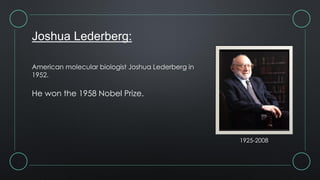
Joshua Lederberg:
American molecular biologist Joshua Lederberg in
1952.
He won the 1958 Nobel Prize.
1925-2008
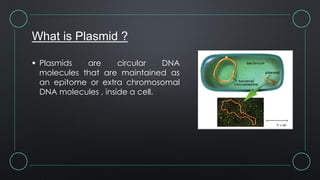
What is Plasmid ?
 Plasmids are circular DNA
molecules that are maintained as
an epitome or extra chromosomal
DNA molecules , inside a cell.
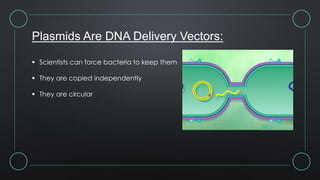
Plasmids Are DNA Delivery Vectors:
 Scientists can force bacteria to keep them
 They are copied independently
 They are circular
Types of Cloning Vectors:
 Plasmid
 Bacteriophage
 Cosmic
 Bacterial Artificial Chromosome
 Yeast Artificial Chromosome
 Human Artificial Chromosome
Types of Plasmids:
 General Types
 Conjugative and Non-Conjugative
 Incompatibility
 Specific Types
 Fertility F-plasmids
 Resistance plasmids
 Virulence plasmids,
 Degradative plasmids and
 Col plasmids.
The Positive Side:
 Although plasmids can carry genes that
make antibiotics ineffective, we can use
them for research in a positive way.
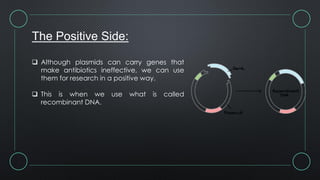
 This is when we use what is called
recombinant DNA.
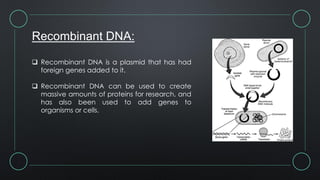
Recombinant DNA:
 Recombinant DNA is a plasmid that has had
foreign genes added to it.
 Recombinant DNA can be used to create
massive amounts of proteins for research, and
has also been used to add genes to
organisms or cells.
Modern Use Of Plasmids:
 Cardio myocytes – heart muscle cells that allow your
heart to beat.
 Researchers at Johns Hopkins Medical Institutions have
created these cells with plasmids.
 Cardio myocytes can be used in transplants and for
testing heart drugs, which is much needed in today’s
popsci.com world.
Problems:
 Proteins are often being studied by researchers.
 However, before genetic engineering, they were
produced in insufficient quantities and researchers had
to dig through tons of biomass to get a usable quantity.
 Even with proteins in such small amounts, the purity of
the proteins was still very poor.
Solution With Plasmid:
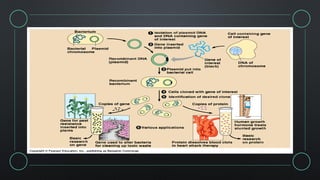
 To get mass quantities of a protein, a scientist can do the
following
 Get the gene for a protein from an animal that produces
it naturally.
 Use restriction enzymes to cut the plasmid and splice the
gene into place.
 Insert the plasmid into an E.coli bacteria and let it
multiply.
Plasmid

Plasmid

  • 2.
    Contents:  Introduced  DNAvectors  Cloning vectors  Types of Plasmid  Positive side  Recombination DNA  Modern use of Plasmid  Problems  Solution
  • 3.
    Joshua Lederberg: American molecularbiologist Joshua Lederberg in 1952. He won the 1958 Nobel Prize. 1925-2008
  • 4.
    What is Plasmid?  Plasmids are circular DNA molecules that are maintained as an epitome or extra chromosomal DNA molecules , inside a cell.
  • 5.
    Plasmids Are DNADelivery Vectors:  Scientists can force bacteria to keep them  They are copied independently  They are circular
  • 6.
    Types of CloningVectors:  Plasmid  Bacteriophage  Cosmic  Bacterial Artificial Chromosome  Yeast Artificial Chromosome  Human Artificial Chromosome
  • 7.
    Types of Plasmids: General Types  Conjugative and Non-Conjugative  Incompatibility  Specific Types  Fertility F-plasmids  Resistance plasmids  Virulence plasmids,  Degradative plasmids and  Col plasmids.
  • 8.
    The Positive Side: Although plasmids can carry genes that make antibiotics ineffective, we can use them for research in a positive way.  This is when we use what is called recombinant DNA.
  • 9.
    Recombinant DNA:  RecombinantDNA is a plasmid that has had foreign genes added to it.  Recombinant DNA can be used to create massive amounts of proteins for research, and has also been used to add genes to organisms or cells.
  • 11.
    Modern Use OfPlasmids:  Cardio myocytes – heart muscle cells that allow your heart to beat.  Researchers at Johns Hopkins Medical Institutions have created these cells with plasmids.  Cardio myocytes can be used in transplants and for testing heart drugs, which is much needed in today’s popsci.com world.
  • 12.
    Problems:  Proteins areoften being studied by researchers.  However, before genetic engineering, they were produced in insufficient quantities and researchers had to dig through tons of biomass to get a usable quantity.  Even with proteins in such small amounts, the purity of the proteins was still very poor.
  • 13.
    Solution With Plasmid: To get mass quantities of a protein, a scientist can do the following  Get the gene for a protein from an animal that produces it naturally.  Use restriction enzymes to cut the plasmid and splice the gene into place.  Insert the plasmid into an E.coli bacteria and let it multiply.