BACTERIAL CELL MEMBRANE
Cytoplasmic
membrane
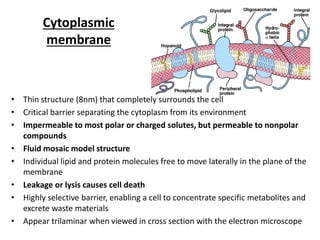
• Thin structure (8nm) that completely surrounds the cell
• Critical barrier separating the cytoplasm from its environment
• Impermeable to most polar or charged solutes, but permeable to nonpolar
compounds
• Fluid mosaic model structure
• Individual lipid and protein molecules free to move laterally in the plane of the
membrane
• Leakage or lysis causes cell death
• Highly selective barrier, enabling a cell to concentrate specific metabolites and
excrete waste materials
• Appear trilaminar when viewed in cross section with the electron microscope
Bacterial cell membrane
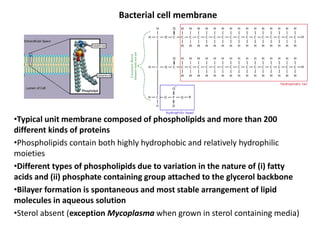
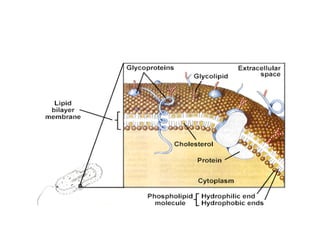
•Typical unit membrane composed of phospholipids and more than 200
different kinds of proteins
•Phospholipids contain both highly hydrophobic and relatively hydrophilic
moieties
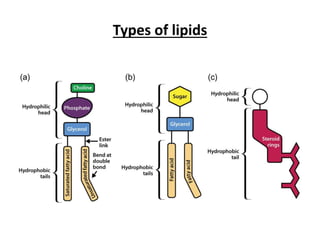
•Different types of phospholipids due to variation in the nature of (i) fatty
acids and (ii) phosphate containing group attached to the glycerol backbone
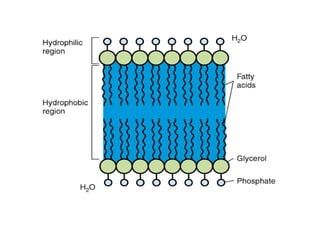
•Bilayer formation is spontaneous and most stable arrangement of lipid
molecules in aqueous solution
•Sterol absent (exception Mycoplasma when grown in sterol containing media)
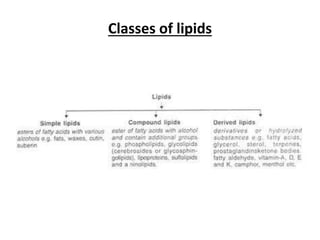
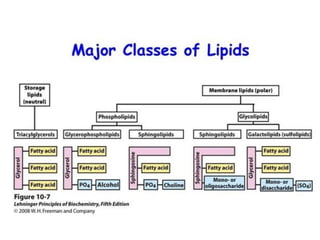
Types of lipids
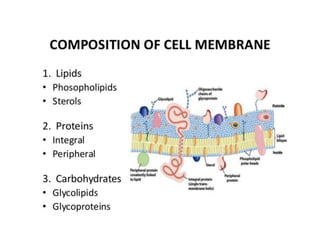
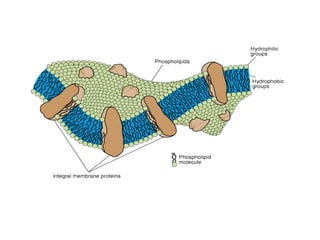
Fluid Mosaic Model
• Proposed by Singer and Nicholson in 1972
• Phospholipids and sterols form a lipid bilayer in which the non-polar
regions of the lipid molecules face each other at the core of the bilayer
and their polar head groups face outward
• In this bilayer sheet, proteins are embedded at irregular intervals, held by
hydrophobic interactions between the membrane lipid and hydrophobic
domains of the proteins.
• The individual lipid and protein units in a membrane form a fluid mosaic
• Some proteins protrude from one side of the membrane only, others have
domains exposed on both sides.
• The membrane mosaic is fluid because most of the interactions among
its components is non-covalent, leaving individual lipid and protein
molecules free to move laterally in the plane of the membrane
The relative proportion of proteins and lipids
vary
• The relative proportion of proteins and lipids vary with the type of
membranes. Proportion of lipids and proteins in the membrane is based
on the function of that membrane
• Membrane with more proportion of lipids than proteins: myelin sheath
in neuron. Here lipids function as insulator and helps in transmission of
electrical impulses.
• Membrane with more proteins than lipids: membranes in bacterial cell,
mitochondria, chloroplasts. In bacterial cell membrane the proteins
function as enzymes producing energy, synthesizing lipids, export of
proteins, cell division etc.
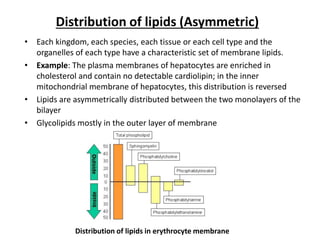
Distribution of lipids (Asymmetric)
• Each kingdom, each species, each tissue or each cell type and the
organelles of each type have a characteristic set of membrane lipids.
• Example: The plasma membranes of hepatocytes are enriched in
cholesterol and contain no detectable cardiolipin; in the inner
mitochondrial membrane of hepatocytes, this distribution is reversed
• Lipids are asymmetrically distributed between the two monolayers of the
bilayer
• Glycolipids mostly in the outer layer of membrane
Distribution of lipids in erythrocyte membrane
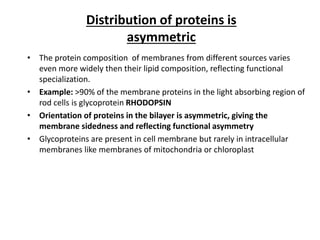
Distribution of proteins is
asymmetric
• The protein composition of membranes from different sources varies
even more widely then their lipid composition, reflecting functional
specialization.
• Example: >90% of the membrane proteins in the light absorbing region of
rod cells is glycoprotein RHODOPSIN
• Orientation of proteins in the bilayer is asymmetric, giving the
membrane sidedness and reflecting functional asymmetry
• Glycoproteins are present in cell membrane but rarely in intracellular
membranes like membranes of mitochondria or chloroplast
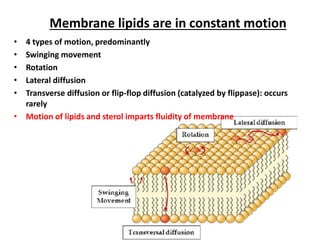
Membrane lipids are in constant motion
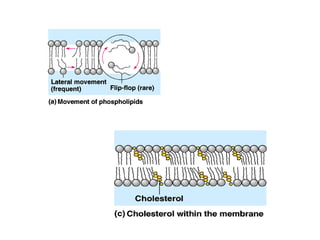
• 4 types of motion, predominantly
• Swinging movement
• Rotation
• Lateral diffusion
• Transverse diffusion or flip-flop diffusion (catalyzed by flippase): occurs
rarely
• Motion of lipids and sterol imparts fluidity of membrane
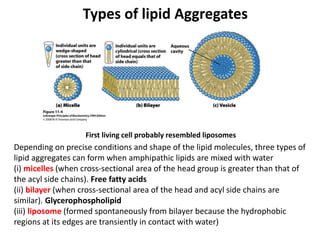
Types of lipid Aggregates
Depending on precise conditions and shape of the lipid molecules, three types of
lipid aggregates can form when amphipathic lipids are mixed with water
(i) micelles (when cross-sectional area of the head group is greater than that of
the acyl side chains). Free fatty acids
(ii) bilayer (when cross-sectional area of the head and acyl side chains are
similar). Glycerophospholipid
(iii) liposome (formed spontaneously from bilayer because the hydrophobic
regions at its edges are transiently in contact with water)
First living cell probably resembled liposomes
Membrane proteins
• Proteins account for approximately 70% of the mass of the bacterial cell
membrane (in eukaryotes approx. 50%)
• Three types of membrane protein
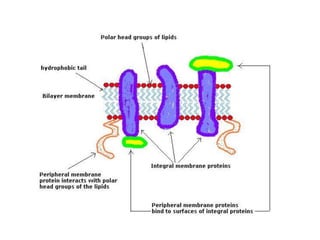
1) Integral membrane proteins
2) Peripheral membrane proteins
3) lipid anchored membrane proteins
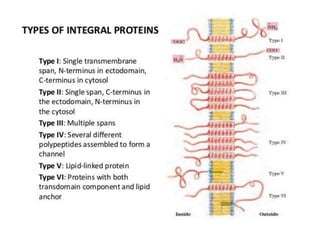
Integral /intrinsic protein
• Like membrane lipids are amphipatihic
• Their hydrophobic regions are buried in the lipid while the hydrophilic
portions project from the membrane surface
• Associated with the fatty acid layer in lipid core forming hydrophobic bonds
where the predominant amino acids are hydrophobic in nature
• Some are transmembrane traversing the membrane throughout
• Extended surfaces at both ends contain hydrophilic amino acids resulting ionic
interaction with polar heads and other proteins
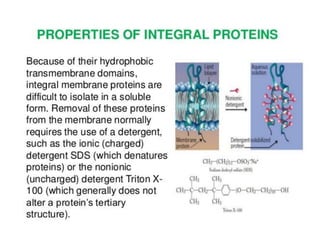
• Strongly bound to the membrane and can not be easily extracted from
membranes
• Can be released by treating membrane with agents that interfere with
hydrophobic interactions like detergents (SDS), organic solvents or
denaturants
• Insoluble in aqueous solution when even freed of lipids
• 70-80% of total membrane proteins
• Can diffuse laterally in the membrane to new locations but can not flip-flop
• Function: transport of ions and solutes, receptor of ligands and signal
transduction
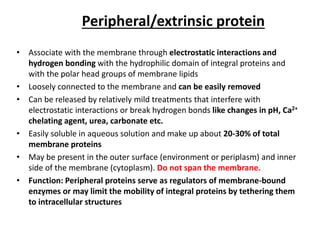
Peripheral/extrinsic protein
• Associate with the membrane through electrostatic interactions and
hydrogen bonding with the hydrophilic domain of integral proteins and
with the polar head groups of membrane lipids
• Loosely connected to the membrane and can be easily removed
• Can be released by relatively mild treatments that interfere with
electrostatic interactions or break hydrogen bonds like changes in pH, Ca2+
chelating agent, urea, carbonate etc.
• Easily soluble in aqueous solution and make up about 20-30% of total
membrane proteins
• May be present in the outer surface (environment or periplasm) and inner
side of the membrane (cytoplasm). Do not span the membrane.
• Function: Peripheral proteins serve as regulators of membrane-bound
enzymes or may limit the mobility of integral proteins by tethering them
to intracellular structures
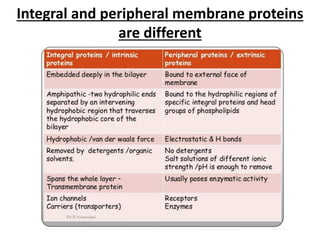
Integral and peripheral membrane proteins
are different
Lipid anchored membrane
proteins
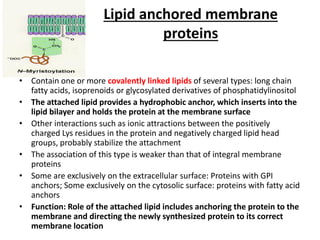
• Contain one or more covalently linked lipids of several types: long chain
fatty acids, isoprenoids or glycosylated derivatives of phosphatidylinositol
• The attached lipid provides a hydrophobic anchor, which inserts into the
lipid bilayer and holds the protein at the membrane surface
• Other interactions such as ionic attractions between the positively
charged Lys residues in the protein and negatively charged lipid head
groups, probably stabilize the attachment
• The association of this type is weaker than that of integral membrane
proteins
• Some are exclusively on the extracellular surface: Proteins with GPI
anchors; Some exclusively on the cytosolic surface: proteins with fatty acid
anchors
• Function: Role of the attached lipid includes anchoring the protein to the
membrane and directing the newly synthesized protein to its correct
membrane location
Membrane
strengthening agent
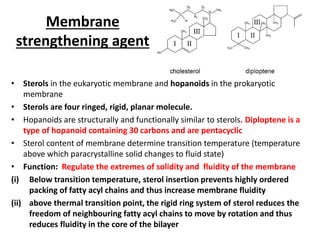
• Sterols in the eukaryotic membrane and hopanoids in the prokaryotic
membrane
• Sterols are four ringed, rigid, planar molecule.
• Hopanoids are structurally and functionally similar to sterols. Diploptene is a
type of hopanoid containing 30 carbons and are pentacyclic
• Sterol content of membrane determine transition temperature (temperature
above which paracrystalline solid changes to fluid state)
• Function: Regulate the extremes of solidity and fluidity of the membrane
(i) Below transition temperature, sterol insertion prevents highly ordered
packing of fatty acyl chains and thus increase membrane fluidity
(ii) above thermal transition point, the rigid ring system of sterol reduces the
freedom of neighbouring fatty acyl chains to move by rotation and thus
reduces fluidity in the core of the bilayer
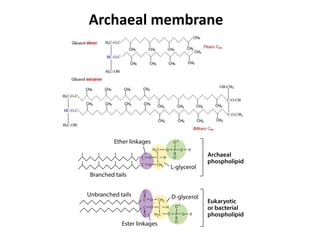
Archaeal membrane
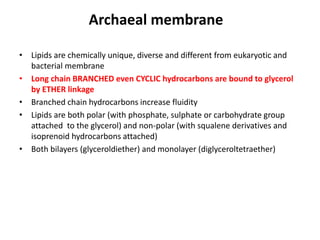
• Lipids are chemically unique, diverse and different from eukaryotic and
bacterial membrane
• Long chain BRANCHED even CYCLIC hydrocarbons are bound to glycerol
by ETHER linkage
• Branched chain hydrocarbons increase fluidity
• Lipids are both polar (with phosphate, sulphate or carbohydrate group
attached to the glycerol) and non-polar (with squalene derivatives and
isoprenoid hydrocarbons attached)
• Both bilayers (glyceroldiether) and monolayer (diglyceroltetraether)
Archaeal membrane
END
Classes of lipids
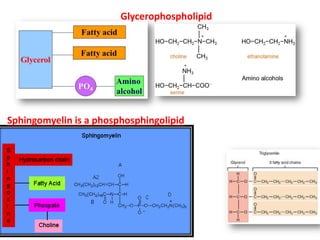
Glycerophospholipid
Sphingomyelin is a phosphosphingolipid
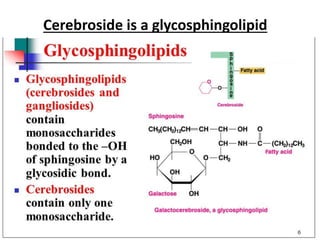
Cerebroside is a glycosphingolipid
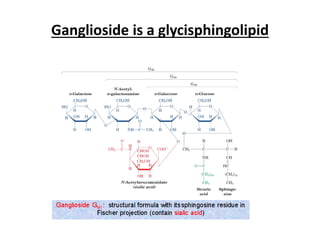
Ganglioside is a glycisphingolipid
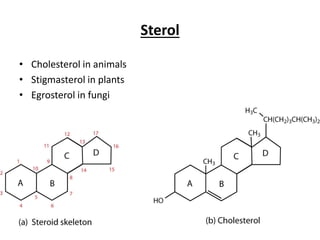
Sterol
• Cholesterol in animals
• Stigmasterol in plants
• Egrosterol in fungi

Bacterial cell membrane a brief description

  • 1.
  • 2.
    Cytoplasmic membrane • Thin structure(8nm) that completely surrounds the cell • Critical barrier separating the cytoplasm from its environment • Impermeable to most polar or charged solutes, but permeable to nonpolar compounds • Fluid mosaic model structure • Individual lipid and protein molecules free to move laterally in the plane of the membrane • Leakage or lysis causes cell death • Highly selective barrier, enabling a cell to concentrate specific metabolites and excrete waste materials • Appear trilaminar when viewed in cross section with the electron microscope
  • 3.
    Bacterial cell membrane •Typicalunit membrane composed of phospholipids and more than 200 different kinds of proteins •Phospholipids contain both highly hydrophobic and relatively hydrophilic moieties •Different types of phospholipids due to variation in the nature of (i) fatty acids and (ii) phosphate containing group attached to the glycerol backbone •Bilayer formation is spontaneous and most stable arrangement of lipid molecules in aqueous solution •Sterol absent (exception Mycoplasma when grown in sterol containing media)
  • 5.
  • 6.
    Fluid Mosaic Model •Proposed by Singer and Nicholson in 1972 • Phospholipids and sterols form a lipid bilayer in which the non-polar regions of the lipid molecules face each other at the core of the bilayer and their polar head groups face outward • In this bilayer sheet, proteins are embedded at irregular intervals, held by hydrophobic interactions between the membrane lipid and hydrophobic domains of the proteins. • The individual lipid and protein units in a membrane form a fluid mosaic • Some proteins protrude from one side of the membrane only, others have domains exposed on both sides. • The membrane mosaic is fluid because most of the interactions among its components is non-covalent, leaving individual lipid and protein molecules free to move laterally in the plane of the membrane
  • 10.
    The relative proportionof proteins and lipids vary • The relative proportion of proteins and lipids vary with the type of membranes. Proportion of lipids and proteins in the membrane is based on the function of that membrane • Membrane with more proportion of lipids than proteins: myelin sheath in neuron. Here lipids function as insulator and helps in transmission of electrical impulses. • Membrane with more proteins than lipids: membranes in bacterial cell, mitochondria, chloroplasts. In bacterial cell membrane the proteins function as enzymes producing energy, synthesizing lipids, export of proteins, cell division etc.
  • 11.
    Distribution of lipids(Asymmetric) • Each kingdom, each species, each tissue or each cell type and the organelles of each type have a characteristic set of membrane lipids. • Example: The plasma membranes of hepatocytes are enriched in cholesterol and contain no detectable cardiolipin; in the inner mitochondrial membrane of hepatocytes, this distribution is reversed • Lipids are asymmetrically distributed between the two monolayers of the bilayer • Glycolipids mostly in the outer layer of membrane Distribution of lipids in erythrocyte membrane
  • 12.
    Distribution of proteinsis asymmetric • The protein composition of membranes from different sources varies even more widely then their lipid composition, reflecting functional specialization. • Example: >90% of the membrane proteins in the light absorbing region of rod cells is glycoprotein RHODOPSIN • Orientation of proteins in the bilayer is asymmetric, giving the membrane sidedness and reflecting functional asymmetry • Glycoproteins are present in cell membrane but rarely in intracellular membranes like membranes of mitochondria or chloroplast
  • 13.
    Membrane lipids arein constant motion • 4 types of motion, predominantly • Swinging movement • Rotation • Lateral diffusion • Transverse diffusion or flip-flop diffusion (catalyzed by flippase): occurs rarely • Motion of lipids and sterol imparts fluidity of membrane
  • 14.
    Types of lipidAggregates Depending on precise conditions and shape of the lipid molecules, three types of lipid aggregates can form when amphipathic lipids are mixed with water (i) micelles (when cross-sectional area of the head group is greater than that of the acyl side chains). Free fatty acids (ii) bilayer (when cross-sectional area of the head and acyl side chains are similar). Glycerophospholipid (iii) liposome (formed spontaneously from bilayer because the hydrophobic regions at its edges are transiently in contact with water) First living cell probably resembled liposomes
  • 15.
    Membrane proteins • Proteinsaccount for approximately 70% of the mass of the bacterial cell membrane (in eukaryotes approx. 50%) • Three types of membrane protein 1) Integral membrane proteins 2) Peripheral membrane proteins 3) lipid anchored membrane proteins
  • 17.
    Integral /intrinsic protein •Like membrane lipids are amphipatihic • Their hydrophobic regions are buried in the lipid while the hydrophilic portions project from the membrane surface • Associated with the fatty acid layer in lipid core forming hydrophobic bonds where the predominant amino acids are hydrophobic in nature • Some are transmembrane traversing the membrane throughout • Extended surfaces at both ends contain hydrophilic amino acids resulting ionic interaction with polar heads and other proteins • Strongly bound to the membrane and can not be easily extracted from membranes • Can be released by treating membrane with agents that interfere with hydrophobic interactions like detergents (SDS), organic solvents or denaturants • Insoluble in aqueous solution when even freed of lipids • 70-80% of total membrane proteins • Can diffuse laterally in the membrane to new locations but can not flip-flop • Function: transport of ions and solutes, receptor of ligands and signal transduction
  • 21.
    Peripheral/extrinsic protein • Associatewith the membrane through electrostatic interactions and hydrogen bonding with the hydrophilic domain of integral proteins and with the polar head groups of membrane lipids • Loosely connected to the membrane and can be easily removed • Can be released by relatively mild treatments that interfere with electrostatic interactions or break hydrogen bonds like changes in pH, Ca2+ chelating agent, urea, carbonate etc. • Easily soluble in aqueous solution and make up about 20-30% of total membrane proteins • May be present in the outer surface (environment or periplasm) and inner side of the membrane (cytoplasm). Do not span the membrane. • Function: Peripheral proteins serve as regulators of membrane-bound enzymes or may limit the mobility of integral proteins by tethering them to intracellular structures
  • 22.
    Integral and peripheralmembrane proteins are different
  • 23.
    Lipid anchored membrane proteins •Contain one or more covalently linked lipids of several types: long chain fatty acids, isoprenoids or glycosylated derivatives of phosphatidylinositol • The attached lipid provides a hydrophobic anchor, which inserts into the lipid bilayer and holds the protein at the membrane surface • Other interactions such as ionic attractions between the positively charged Lys residues in the protein and negatively charged lipid head groups, probably stabilize the attachment • The association of this type is weaker than that of integral membrane proteins • Some are exclusively on the extracellular surface: Proteins with GPI anchors; Some exclusively on the cytosolic surface: proteins with fatty acid anchors • Function: Role of the attached lipid includes anchoring the protein to the membrane and directing the newly synthesized protein to its correct membrane location
  • 24.
    Membrane strengthening agent • Sterolsin the eukaryotic membrane and hopanoids in the prokaryotic membrane • Sterols are four ringed, rigid, planar molecule. • Hopanoids are structurally and functionally similar to sterols. Diploptene is a type of hopanoid containing 30 carbons and are pentacyclic • Sterol content of membrane determine transition temperature (temperature above which paracrystalline solid changes to fluid state) • Function: Regulate the extremes of solidity and fluidity of the membrane (i) Below transition temperature, sterol insertion prevents highly ordered packing of fatty acyl chains and thus increase membrane fluidity (ii) above thermal transition point, the rigid ring system of sterol reduces the freedom of neighbouring fatty acyl chains to move by rotation and thus reduces fluidity in the core of the bilayer
  • 26.
    Archaeal membrane • Lipidsare chemically unique, diverse and different from eukaryotic and bacterial membrane • Long chain BRANCHED even CYCLIC hydrocarbons are bound to glycerol by ETHER linkage • Branched chain hydrocarbons increase fluidity • Lipids are both polar (with phosphate, sulphate or carbohydrate group attached to the glycerol) and non-polar (with squalene derivatives and isoprenoid hydrocarbons attached) • Both bilayers (glyceroldiether) and monolayer (diglyceroltetraether)
  • 27.
  • 28.
  • 29.
  • 31.
  • 32.
    Cerebroside is aglycosphingolipid
  • 33.
    Ganglioside is aglycisphingolipid
  • 34.
    Sterol • Cholesterol inanimals • Stigmasterol in plants • Egrosterol in fungi