Activity 1:
Describe your best teacher/s from
kinder to college (Dropping name/s is
not important)
Recall his / her classroom
management style.
Activity 1:
Describe your worst teacher/s from
kinder to college (Dropping name/s is
not important)
Recall his / her classroom
management style.
Classroom management plays a crucial
role in education. Thornbury (2023)
describes it as a set of techniques, skills,
and strategies aimed at helping learners
work efficiently and stay focused. The
primary objective is to establish an
organized environment that minimizes
chaos.
In a similar context, Gräber (2023) defines
classroom management as a preventive
approach that seeks to reduce disruptions
through conditioning measures, ultimately
fostering effective teaching.
Furthermore, Utilova et al. (2024) emphasize
that classroom management involves
creating a conducive learning environment
that anticipates challenges and promotes
positive behavior, rather than simply
enforcing discipline.
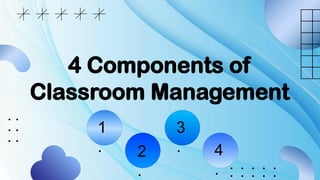
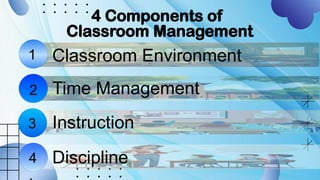
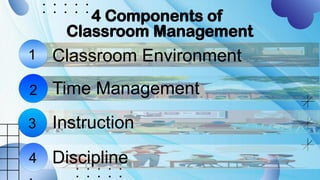
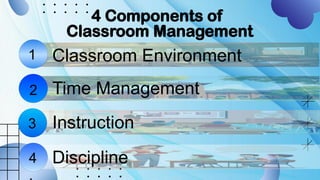
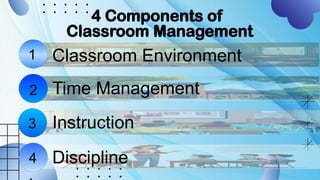
4 Components of
Classroom Management
1
. 2
.
3
. 4
.
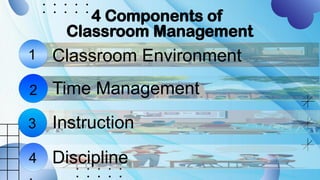
4 Components of
Classroom Management
1
.
2
.
3
.
4
.
Time Management
Instruction
Discipline
Classroom Environment
1
.
Classroom Environment
A. promotes non-threatening classroom
atmosphere
B. observes systematic seating arrangement
that makes the students feel comfortable,
organized, and suitably positioned
The teacher should:
1
.
Classroom Environment
The teacher should:
C. Sees to it that the classroom is well-
lighted and ventilated
D. Maintains the cleanliness, neatness or
orderliness of the classroom
E. Maintains the security and safety of the
classroom
1
.
Classroom Environment
The teacher should:
F. Sees to it that the chairs and tables are
properly arranged before and after class
G. Shows respect and good rapport with
her/his students
H. Begins and ends the class with a clean
chalkboard.
4 Components of
Classroom Management
1
.
2
.
3
.
4
.
Time Management
Instruction
Discipline
Classroom Environment
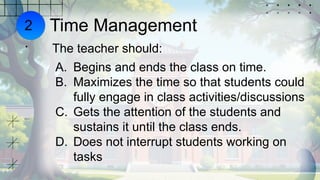
Time Management
The teacher should:
A. Begins and ends the class on time.
B. Maximizes the time so that students could
fully engage in class activities/discussions
C. Gets the attention of the students and
sustains it until the class ends.
D. Does not interrupt students working on
tasks
2
.
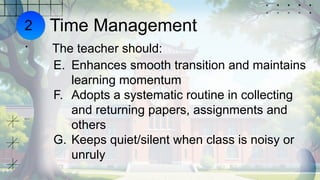
Time Management
The teacher should:
E. Enhances smooth transition and maintains
learning momentum
F. Adopts a systematic routine in collecting
and returning papers, assignments and
others
G. Keeps quiet/silent when class is noisy or
unruly
2
.
4 Components of
Classroom Management
1
.
2
.
3
.
4
.
Time Management
Instruction
Discipline
Classroom Environment
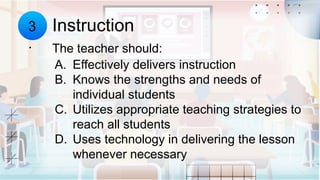
Instruction
A. Effectively delivers instruction
B. Knows the strengths and needs of
individual students
C. Utilizes appropriate teaching strategies to
reach all students
D. Uses technology in delivering the lesson
whenever necessary
3
. The teacher should:
Instruction
3
. The teacher should:
E. Moves around and interacts with students
F. Makes sure that her/his voice is audible so
that students can hear her/him
G. Is consistent and provides frequent
feedback
4 Components of
Classroom Management
1
.
2
.
3
.
4
.
Time Management
Instruction
Discipline
Classroom Environment
Discipline
The teacher should:
4
.
A. Ensures that all students know what
she/he expects of them in class
B. Ensures that her/his students understand
classroom rules and procedures well
C. Is consistent with her/his system of
rewards and punishment when enforcing
rules and procedures
Discipline
The teacher should:
4
.
D. Shows respect by listening to her/his
students; she/he then earns the respect of
her/his students.
E. Plans engaging lessons to reduce the
occurrence of behavioral problems
F. Reprimands student privately, on a one-
on-one manner rather than in front of the
whole class
Discipline
The teacher should:
4
.
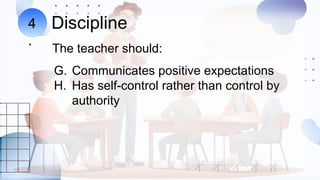
G. Communicates positive expectations
H. Has self-control rather than control by
authority
4 Components of
Classroom Management
1
.
2
.
3
.
4
.
Time Management
Instruction
Discipline
Classroom Environment
Activity 2:
Dealing With Discipline
Problems in the
Classroom
Set an Example
 Discipline starts with you. Begin each class
period with a positive attitude and high
expectations.
Be Proactive With Discipline Problems
 Watch your students as they come into
class and look for signs of discord.
 Post a discipline plan that you follow
consistently to govern student conduct.
Be Firm But Fair
 Consistency and fairness are essential for
effective classroom management. If you
ignore disruptions one day and come down
hard on them the next, your students won't
take you seriously.
Be Firm But Fair
 If you appear unfair in how you enforce the
rules, the students will resent you.
 Address disruptions with in-kind responses.
In other words, don't elevate disruptions
above their current significance.
Be Firm But Fair
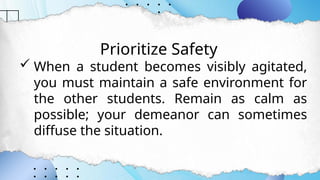
 When a student becomes visibly agitated,
you must maintain a safe environment for
the other students. Remain as calm as
possible; your demeanor can sometimes
diffuse the situation.
Prioritize Safety
 When a student becomes visibly agitated,
you must maintain a safe environment for
the other students. Remain as calm as
possible; your demeanor can sometimes
diffuse the situation.
Prioritize Safety
 When a student becomes visibly agitated,
you must maintain a safe environment for
the other students. Remain as calm as
possible; your demeanor can sometimes
diffuse the situation.
Activity 3:
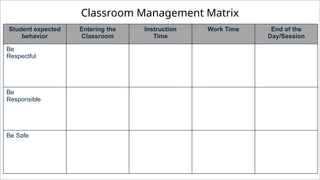
Classroom Management Matrix
Student expected
behavior
Entering the
Classroom
Instruction
Time
Work Time End of the
Day/Session
Be
Respectful
Be
Responsible
Be Safe
Individual Task:
Individual Task:
classroom management Proven Effective Methods for Classroom Management (2025)

classroom management Proven Effective Methods for Classroom Management (2025)

  • 2.
    Activity 1: Describe yourbest teacher/s from kinder to college (Dropping name/s is not important) Recall his / her classroom management style.
  • 3.
    Activity 1: Describe yourworst teacher/s from kinder to college (Dropping name/s is not important) Recall his / her classroom management style.
  • 5.
    Classroom management playsa crucial role in education. Thornbury (2023) describes it as a set of techniques, skills, and strategies aimed at helping learners work efficiently and stay focused. The primary objective is to establish an organized environment that minimizes chaos.
  • 6.
    In a similarcontext, Gräber (2023) defines classroom management as a preventive approach that seeks to reduce disruptions through conditioning measures, ultimately fostering effective teaching.
  • 7.
    Furthermore, Utilova etal. (2024) emphasize that classroom management involves creating a conducive learning environment that anticipates challenges and promotes positive behavior, rather than simply enforcing discipline.
  • 8.
    4 Components of ClassroomManagement 1 . 2 . 3 . 4 .
  • 9.
    4 Components of ClassroomManagement 1 . 2 . 3 . 4 . Time Management Instruction Discipline Classroom Environment
  • 10.
    1 . Classroom Environment A. promotesnon-threatening classroom atmosphere B. observes systematic seating arrangement that makes the students feel comfortable, organized, and suitably positioned The teacher should:
  • 11.
    1 . Classroom Environment The teachershould: C. Sees to it that the classroom is well- lighted and ventilated D. Maintains the cleanliness, neatness or orderliness of the classroom E. Maintains the security and safety of the classroom
  • 12.
    1 . Classroom Environment The teachershould: F. Sees to it that the chairs and tables are properly arranged before and after class G. Shows respect and good rapport with her/his students H. Begins and ends the class with a clean chalkboard.
  • 13.
    4 Components of ClassroomManagement 1 . 2 . 3 . 4 . Time Management Instruction Discipline Classroom Environment
  • 14.
    Time Management The teachershould: A. Begins and ends the class on time. B. Maximizes the time so that students could fully engage in class activities/discussions C. Gets the attention of the students and sustains it until the class ends. D. Does not interrupt students working on tasks 2 .
  • 15.
    Time Management The teachershould: E. Enhances smooth transition and maintains learning momentum F. Adopts a systematic routine in collecting and returning papers, assignments and others G. Keeps quiet/silent when class is noisy or unruly 2 .
  • 16.
    4 Components of ClassroomManagement 1 . 2 . 3 . 4 . Time Management Instruction Discipline Classroom Environment
  • 17.
    Instruction A. Effectively deliversinstruction B. Knows the strengths and needs of individual students C. Utilizes appropriate teaching strategies to reach all students D. Uses technology in delivering the lesson whenever necessary 3 . The teacher should:
  • 18.
    Instruction 3 . The teachershould: E. Moves around and interacts with students F. Makes sure that her/his voice is audible so that students can hear her/him G. Is consistent and provides frequent feedback
  • 19.
    4 Components of ClassroomManagement 1 . 2 . 3 . 4 . Time Management Instruction Discipline Classroom Environment
  • 20.
    Discipline The teacher should: 4 . A.Ensures that all students know what she/he expects of them in class B. Ensures that her/his students understand classroom rules and procedures well C. Is consistent with her/his system of rewards and punishment when enforcing rules and procedures
  • 21.
    Discipline The teacher should: 4 . D.Shows respect by listening to her/his students; she/he then earns the respect of her/his students. E. Plans engaging lessons to reduce the occurrence of behavioral problems F. Reprimands student privately, on a one- on-one manner rather than in front of the whole class
  • 22.
    Discipline The teacher should: 4 . G.Communicates positive expectations H. Has self-control rather than control by authority
  • 23.
    4 Components of ClassroomManagement 1 . 2 . 3 . 4 . Time Management Instruction Discipline Classroom Environment
  • 24.
  • 34.
  • 35.
    Set an Example Discipline starts with you. Begin each class period with a positive attitude and high expectations.
  • 36.
    Be Proactive WithDiscipline Problems  Watch your students as they come into class and look for signs of discord.  Post a discipline plan that you follow consistently to govern student conduct.
  • 37.
    Be Firm ButFair  Consistency and fairness are essential for effective classroom management. If you ignore disruptions one day and come down hard on them the next, your students won't take you seriously.
  • 38.
    Be Firm ButFair  If you appear unfair in how you enforce the rules, the students will resent you.  Address disruptions with in-kind responses. In other words, don't elevate disruptions above their current significance.
  • 39.
    Be Firm ButFair  When a student becomes visibly agitated, you must maintain a safe environment for the other students. Remain as calm as possible; your demeanor can sometimes diffuse the situation.
  • 40.
    Prioritize Safety  Whena student becomes visibly agitated, you must maintain a safe environment for the other students. Remain as calm as possible; your demeanor can sometimes diffuse the situation.
  • 41.
    Prioritize Safety  Whena student becomes visibly agitated, you must maintain a safe environment for the other students. Remain as calm as possible; your demeanor can sometimes diffuse the situation.
  • 43.
  • 44.
    Classroom Management Matrix Studentexpected behavior Entering the Classroom Instruction Time Work Time End of the Day/Session Be Respectful Be Responsible Be Safe
  • 45.
  • 46.

Editor's Notes

  • #2 Neris Haydee May Criz Pj Edwin Jef
  • #5 https://www.cambridge.org/core/books/abs/herbert-puchtas-101-tips-for-teaching-teenagers/classroom-management/26C17557792A9E4057DD4825A4916585
  • #6 https://link.springer.com/article/10.1007/s12054-023-00635-y
  • #7 https://ojs.ksu.edu.kz/index.php/3i/article/view/652 It focuses on fostering academic and personal growth, allowing students to thrive in their educational journey.
  • #12 good sense of understanding and trust
  • #19 @Comlab301274#
  • #21 1. What was the cause of the Cambrian explosion? socoro fundivilla
  • #23 @Comlab301274#
  • #35 https://www.thoughtco.com/handling-classroom-discipline-problems-7799 Discipline problems challenge most new teachers and even some veteran educators. Good classroom management combined with an effective discipline plan helps keep bad behavior to a minimum so the entire class can focus on learning. Classroom rules must be easy to understand and manageable. Make sure that you don't have such a large number of rules that your students can't consistently follow them.
  • #36 It'll help create a positive learning environment. Come to class prepared with lessons for the day. Reduce downtime for students to help maintain order.
  • #37 For example, if you notice a heated discussion before class starts, deal with it then. Give the students a few moments to work things out before you start your lesson. Separate them if necessary and try to gain agreement that during your class period at least, they will drop the issue. . Depending on the severity of an offense, this should provide a warning or two before formal punishment. Your plan should be easy to follow and cause minimal disruption to your class. For example, first offense: verbal warning; second offense: detention with the teacher; third offense: referral.
  • #38 For example, if you notice a heated discussion before class starts, deal with it then. Give the students a few moments to work things out before you start your lesson. Separate them if necessary and try to gain agreement that during your class period at least, they will drop the issue. .
  • #39 For example, if two students keep talking in class, don't disrupt your lesson to yell at them. Instead, simply say the students' names and issue a verbal warning. You can also try asking one of them a question to bring their focus back to the lesson.
  • #40 If a student becomes verbally confrontational, remain calm and remove them from the situation as quickly as possible.
  • #41 You should have a plan for dealing with violence that you discussed with students early in the year. You should use the call button for assistance or have a designated student get help from another teacher. Send the other students from the room if it appears they could get hurt. If a fight breaks out in the classroom, follow your school's rules concerning teacher involvement as many administrators want teachers to stay out of fights until help arrives. .
  • #42 Keep an anecdotal record of major issues that arise in your class. This might be necessary if you are asked for a history of classroom disruptions or other documentation. .
  • #43 Keep an anecdotal record of major issues that arise in your class. This might be necessary if you are asked for a history of classroom disruptions or other documentation. .
  • #46 New south wales australia