What is Plant Biotechnology?
• The application of scientific method to manipulate living cells or
organisms for practical uses
• It is a biological phenomenon for copying and manufacturing various
kinds of useful substances
• It is a controlled use of biological agents such as micro-organisms or
cellular components for beneficial use
Historical Overview of Plant Biotechnology
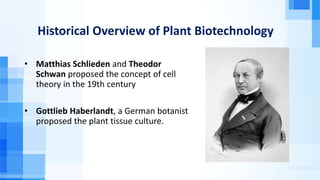
• Matthias Schlieden and Theodor
Schwan proposed the concept of cell
theory in the 19th century
• Gottlieb Haberlandt, a German botanist
proposed the plant tissue culture.
Historical Overview cont’d
• In 1981, scientists at Ohio university proposed the first transgenic
animals by transferring genes from other animals into mice
• In 1980 genetic engineering was first used
Methods of Plant Biotechnology
• Gene Transfer
• Plasmids as Vectors
• Restriction Enzymes and DNA Ligase
• Cloning
• Polymerase Chain Reaction
• Tissue Culture
Gene Transfer:
• It’s the insertion of unrelated genetic information in the form of DNA
into cells
• Gene can be transferred between species through genetic engineering
• Genes can be transfer in two methods;
→ Vector mediated gene transfer
→ Direct gene transfer
• The result of gene transfer is called trans-genic organism
Gene Transfer Cont’d
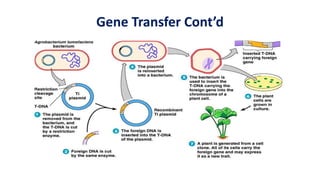
• Vector-mediated gene transfer is carried out by a factor called
• Agrobacterium-mediate transformation
• Agrobacterium tumefaciens is a soil-borne gram-negative bacterium
• There are mainly two species of agrobacterium:
̶ A tumefaciens that induces Crown gall disease
̶ A rhizogene that induces hairy root disease
• Tumefaciens is a phytopathogen and is treated as the nature’s most effective
plant genetic engineer
Gene Transfer Cont’d
Plasmid as Vectors
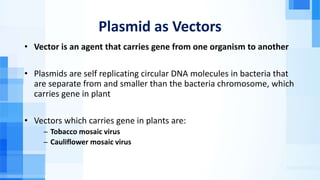
• Vector is an agent that carries gene from one organism to another
• Plasmids are self replicating circular DNA molecules in bacteria that
are separate from and smaller than the bacteria chromosome, which
carries gene in plant
• Vectors which carries gene in plants are:
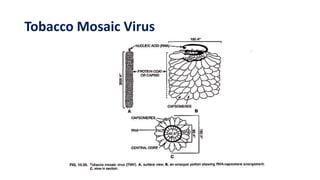
̶ Tobacco mosaic virus
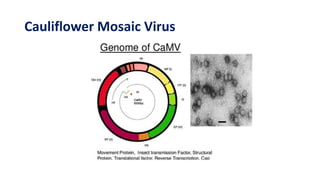
̶ Cauliflower mosaic virus
Tobacco Mosaic Virus
Cauliflower Mosaic Virus
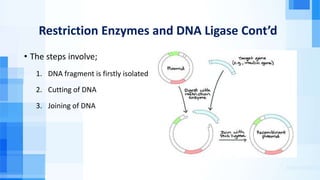
Restriction Enzymes and DNA Ligase
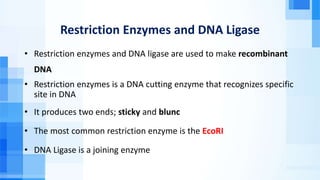
• Restriction enzymes and DNA ligase are used to make recombinant
DNA
• Restriction enzymes is a DNA cutting enzyme that recognizes specific
site in DNA
• It produces two ends; sticky and blunc
• The most common restriction enzyme is the EcoRI
• DNA Ligase is a joining enzyme
Restriction Enzymes and DNA Ligase Cont’d
• The steps involve;
1. DNA fragment is firstly isolated
2. Cutting of DNA
3. Joining of DNA
Cloning:
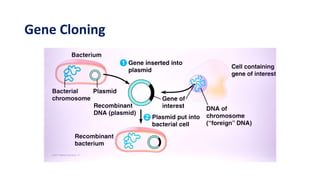
• Cloning is the process of genetically producing exact copy of a gene,
cell or organism
• Cloning produces multiple copies of recombinant DNA
• A clone is an exact copy of a gene, cell or organism
• Recombinant DNA involves modifying pre-existing genes to form new
genes
• The most common plasmids used in cloning are: pbr322 and puc18
Cloning Cont’d
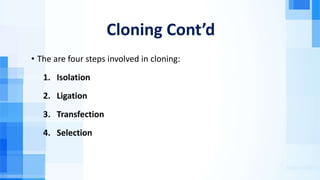
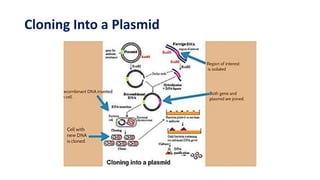
• The are four steps involved in cloning:
1. Isolation
2. Ligation
3. Transfection
4. Selection
Cloning Into a Plasmid
Gene Cloning
Polymerase Chain Reaction
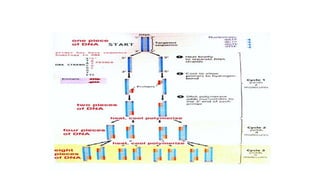
• The polymerase chain reaction clones DNA without using cells.
• PCR takes place in a small tube that contains the sample DNA called
primers.
• It includes all the four nucleotides of DNA coding (a, t, g and c)
• PCR is an indispensable tool
• Strength of PCR
• Weaknesses of PCR
Methods of Inserting Clone Genes Into
Plant Cells
• There are basically four ways of inserting clone genes into plant cells.
̶ Gene-gun
̶ Electroporation
̶ Micro-injection
̶ Liposomes
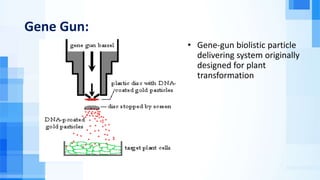
Gene Gun:
• Gene-gun biolistic particle
delivering system originally
designed for plant
transformation
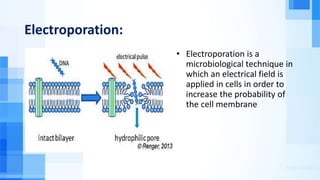
Electroporation:
• Electroporation is a
microbiological technique in
which an electrical field is
applied in cells in order to
increase the probability of
the cell membrane
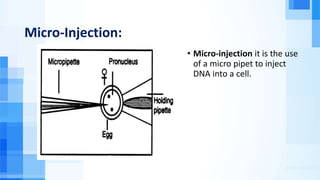
Micro-Injection:
• Micro-injection it is the use
of a micro pipet to inject
DNA into a cell.
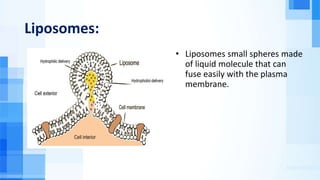
Liposomes:
• Liposomes small spheres made
of liquid molecule that can
fuse easily with the plasma
membrane.
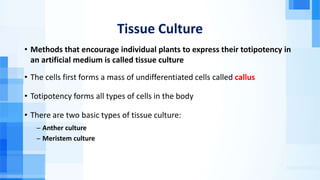
Tissue Culture
• Methods that encourage individual plants to express their totipotency in
an artificial medium is called tissue culture
• The cells first forms a mass of undifferentiated cells called callus
• Totipotency forms all types of cells in the body
• There are two basic types of tissue culture:
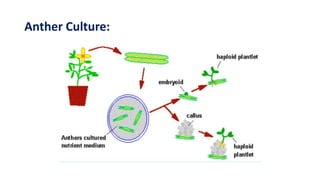
̶ Anther culture
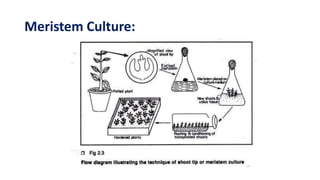
̶ Meristem culture
Anther Culture:
Meristem Culture:
Genetic Engineering
• Genetic engineering transfers genes from varieties of organisms into
plants.
• Genetic engineering has made pest resistant plants
• This engineering has also made plants more productive
• As well they are resistant to pests
Genetic Engineering Cont’d
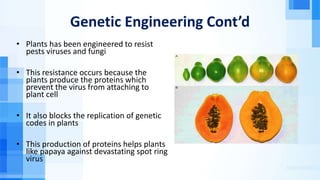
• Plants has been engineered to resist
pests viruses and fungi
• This resistance occurs because the
plants produce the proteins which
prevent the virus from attaching to
plant cell
• It also blocks the replication of genetic
codes in plants
• This production of proteins helps plants
like papaya against devastating spot ring
virus
Genetic Engineering Cont’d
• Genetic Engineering is the artificial manipulation, modification and
recombination of DNA or other nuclei acid molecules.
• Genetic engineering has made plants more resistant to harsh soil
conditions and pest.
• Plants have been engineered to overproduce than usual
Genetic Engineering Cont’d
• Plants are also engineered to be resistant to droughts and other soil
conditions
• Transgenic plants increases the crop production
• Transgenic plants contributes to human health and nutrition
Transgenic Plants
• Benefits of transgenic plants to humans
̶ Medical benefits
̶ Industrial benefits
̶ Agricultural benefits
̶ Transgenic plants improves poor access of food
Genetically Engineered Crops Require Extensive Field and
Market Testing Before They Are Released
• Field testing is creating, using and iterating your offering before
offering it to customers
• Test marketing is an experiment conducted in a field laboratory (the
test market) comprising of actual stores and real life buying
situations ,without the buyers knowing they are participating in an
evaluation exercise
• The sensitivity of a new plant may have increased in fungal disease.
• Time frame is 6yrs before it is available on the markets
Genetically Engineered Plants Must Be Safe For
Environment and Consumers
• It helps in the reduction of malnutrition
• It provides vitamins such as vitamin a, iron, zinc, protein, essential
amino acids and essential fatty acids
• It reduces the level of anti nutritional factors such as cyanogens etc
Advantages of Genetically Modified
Crops
• Nutritional content can be improved
• Genetically modified foods can have a longer shelf life
• We receive medical benefits from GM crops
• It creates foods that are more appealing to eat
• GM foods are easier to transport
Disadvantages of Genetically Modified Crops
• GM crops may cause antibiotic resistance
• Genes go into different plant species
• Independent research is not allowed
Brief History On The First Genetically
Modified Crop
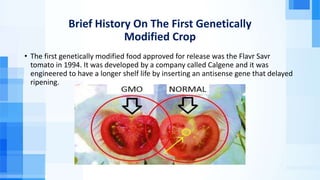
• The first genetically modified food approved for release was the Flavr Savr
tomato in 1994. It was developed by a company called Calgene and it was
engineered to have a longer shelf life by inserting an antisense gene that delayed
ripening.
Golden Rice
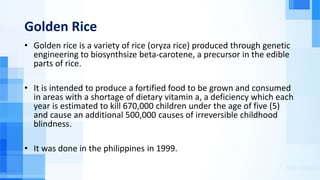
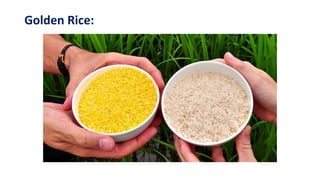
• Golden rice is a variety of rice (oryza rice) produced through genetic
engineering to biosynthsize beta-carotene, a precursor in the edible
parts of rice.
• It is intended to produce a fortified food to be grown and consumed
in areas with a shortage of dietary vitamin a, a deficiency which each
year is estimated to kill 670,000 children under the age of five (5)
and cause an additional 500,000 causes of irreversible childhood
blindness.
• It was done in the philippines in 1999.
Golden Rice:
Genomics and Proteomics
• Genomics is the science which determine the nucleotide sequence
of a whole genome
• The nucleotide sequence specifies the amino acid sequence of a
protein, in which genomics is related to proteomics, which is the
science that deals with organisms’ proteins and functions
plantbiotechnologydrew-190124090457.pdf

plantbiotechnologydrew-190124090457.pdf

  • 1.
    What is PlantBiotechnology? • The application of scientific method to manipulate living cells or organisms for practical uses • It is a biological phenomenon for copying and manufacturing various kinds of useful substances • It is a controlled use of biological agents such as micro-organisms or cellular components for beneficial use
  • 2.
    Historical Overview ofPlant Biotechnology • Matthias Schlieden and Theodor Schwan proposed the concept of cell theory in the 19th century • Gottlieb Haberlandt, a German botanist proposed the plant tissue culture.
  • 3.
    Historical Overview cont’d •In 1981, scientists at Ohio university proposed the first transgenic animals by transferring genes from other animals into mice • In 1980 genetic engineering was first used
  • 4.
    Methods of PlantBiotechnology • Gene Transfer • Plasmids as Vectors • Restriction Enzymes and DNA Ligase • Cloning • Polymerase Chain Reaction • Tissue Culture
  • 5.
    Gene Transfer: • It’sthe insertion of unrelated genetic information in the form of DNA into cells • Gene can be transferred between species through genetic engineering • Genes can be transfer in two methods; → Vector mediated gene transfer → Direct gene transfer • The result of gene transfer is called trans-genic organism
  • 6.
    Gene Transfer Cont’d •Vector-mediated gene transfer is carried out by a factor called • Agrobacterium-mediate transformation • Agrobacterium tumefaciens is a soil-borne gram-negative bacterium • There are mainly two species of agrobacterium: ̶ A tumefaciens that induces Crown gall disease ̶ A rhizogene that induces hairy root disease • Tumefaciens is a phytopathogen and is treated as the nature’s most effective plant genetic engineer
  • 7.
  • 8.
    Plasmid as Vectors •Vector is an agent that carries gene from one organism to another • Plasmids are self replicating circular DNA molecules in bacteria that are separate from and smaller than the bacteria chromosome, which carries gene in plant • Vectors which carries gene in plants are: ̶ Tobacco mosaic virus ̶ Cauliflower mosaic virus
  • 9.
  • 10.
  • 11.
    Restriction Enzymes andDNA Ligase • Restriction enzymes and DNA ligase are used to make recombinant DNA • Restriction enzymes is a DNA cutting enzyme that recognizes specific site in DNA • It produces two ends; sticky and blunc • The most common restriction enzyme is the EcoRI • DNA Ligase is a joining enzyme
  • 12.
    Restriction Enzymes andDNA Ligase Cont’d • The steps involve; 1. DNA fragment is firstly isolated 2. Cutting of DNA 3. Joining of DNA
  • 13.
    Cloning: • Cloning isthe process of genetically producing exact copy of a gene, cell or organism • Cloning produces multiple copies of recombinant DNA • A clone is an exact copy of a gene, cell or organism • Recombinant DNA involves modifying pre-existing genes to form new genes • The most common plasmids used in cloning are: pbr322 and puc18
  • 14.
    Cloning Cont’d • Theare four steps involved in cloning: 1. Isolation 2. Ligation 3. Transfection 4. Selection
  • 15.
  • 16.
  • 17.
    Polymerase Chain Reaction •The polymerase chain reaction clones DNA without using cells. • PCR takes place in a small tube that contains the sample DNA called primers. • It includes all the four nucleotides of DNA coding (a, t, g and c) • PCR is an indispensable tool • Strength of PCR • Weaknesses of PCR
  • 19.
    Methods of InsertingClone Genes Into Plant Cells • There are basically four ways of inserting clone genes into plant cells. ̶ Gene-gun ̶ Electroporation ̶ Micro-injection ̶ Liposomes
  • 20.
    Gene Gun: • Gene-gunbiolistic particle delivering system originally designed for plant transformation
  • 21.
    Electroporation: • Electroporation isa microbiological technique in which an electrical field is applied in cells in order to increase the probability of the cell membrane
  • 22.
    Micro-Injection: • Micro-injection itis the use of a micro pipet to inject DNA into a cell.
  • 23.
    Liposomes: • Liposomes smallspheres made of liquid molecule that can fuse easily with the plasma membrane.
  • 24.
    Tissue Culture • Methodsthat encourage individual plants to express their totipotency in an artificial medium is called tissue culture • The cells first forms a mass of undifferentiated cells called callus • Totipotency forms all types of cells in the body • There are two basic types of tissue culture: ̶ Anther culture ̶ Meristem culture
  • 25.
  • 26.
  • 27.
    Genetic Engineering • Geneticengineering transfers genes from varieties of organisms into plants. • Genetic engineering has made pest resistant plants • This engineering has also made plants more productive • As well they are resistant to pests
  • 28.
    Genetic Engineering Cont’d •Plants has been engineered to resist pests viruses and fungi • This resistance occurs because the plants produce the proteins which prevent the virus from attaching to plant cell • It also blocks the replication of genetic codes in plants • This production of proteins helps plants like papaya against devastating spot ring virus
  • 29.
    Genetic Engineering Cont’d •Genetic Engineering is the artificial manipulation, modification and recombination of DNA or other nuclei acid molecules. • Genetic engineering has made plants more resistant to harsh soil conditions and pest. • Plants have been engineered to overproduce than usual
  • 30.
    Genetic Engineering Cont’d •Plants are also engineered to be resistant to droughts and other soil conditions • Transgenic plants increases the crop production • Transgenic plants contributes to human health and nutrition
  • 31.
    Transgenic Plants • Benefitsof transgenic plants to humans ̶ Medical benefits ̶ Industrial benefits ̶ Agricultural benefits ̶ Transgenic plants improves poor access of food
  • 32.
    Genetically Engineered CropsRequire Extensive Field and Market Testing Before They Are Released • Field testing is creating, using and iterating your offering before offering it to customers • Test marketing is an experiment conducted in a field laboratory (the test market) comprising of actual stores and real life buying situations ,without the buyers knowing they are participating in an evaluation exercise • The sensitivity of a new plant may have increased in fungal disease. • Time frame is 6yrs before it is available on the markets
  • 33.
    Genetically Engineered PlantsMust Be Safe For Environment and Consumers • It helps in the reduction of malnutrition • It provides vitamins such as vitamin a, iron, zinc, protein, essential amino acids and essential fatty acids • It reduces the level of anti nutritional factors such as cyanogens etc
  • 34.
    Advantages of GeneticallyModified Crops • Nutritional content can be improved • Genetically modified foods can have a longer shelf life • We receive medical benefits from GM crops • It creates foods that are more appealing to eat • GM foods are easier to transport
  • 35.
    Disadvantages of GeneticallyModified Crops • GM crops may cause antibiotic resistance • Genes go into different plant species • Independent research is not allowed
  • 36.
    Brief History OnThe First Genetically Modified Crop • The first genetically modified food approved for release was the Flavr Savr tomato in 1994. It was developed by a company called Calgene and it was engineered to have a longer shelf life by inserting an antisense gene that delayed ripening.
  • 37.
    Golden Rice • Goldenrice is a variety of rice (oryza rice) produced through genetic engineering to biosynthsize beta-carotene, a precursor in the edible parts of rice. • It is intended to produce a fortified food to be grown and consumed in areas with a shortage of dietary vitamin a, a deficiency which each year is estimated to kill 670,000 children under the age of five (5) and cause an additional 500,000 causes of irreversible childhood blindness. • It was done in the philippines in 1999.
  • 38.
  • 39.
    Genomics and Proteomics •Genomics is the science which determine the nucleotide sequence of a whole genome • The nucleotide sequence specifies the amino acid sequence of a protein, in which genomics is related to proteomics, which is the science that deals with organisms’ proteins and functions