S
St
te
em C
m Ce
el
ll
ls
s
Clinical Applications
Nerve Cell Cannot Regenerate
Nerve Cell Cannot Regenerate ?
?

In 1913 the great Spanish neuroscientist
Santiago Ramón y Cajal
Santiago Ramón y Cajal pronounced
pronounced
“that in adult centres the nerve paths are
something fixed, ended, immutable.
Everything may die, nothing may be
regenerated”. For many years
neuroscientists believed not just that brain
damage was irreparable, but also that no
process to replace lost neurons existed in
our brain.
our brain.
antiago Ramón
antiago Ramón y
y Cajal
Cajal (1852-
(1852-
1934)
1934)
Both beliefs turned out to be false as several
types of cells can regenerate
Cell – A complex Organ

Cell Theory: all living
things are composed of
one or more cells
one or more cells

Cells fall into two basic
types prokaryotic and
eukaryotic.
eukaryotic.

Prokaryotic cells are
smaller and lack much of
the internal
the internal
compartmentalizin
compartmentalizin
and complexity of
and complexity of
eukaryotic cells.
eukaryotic cells.
History of Adult Stem Cell
Research
Research

Since the 1970’s,
Since the 1970’s, bone marrow
bone marrow
transplants have been used for
treatment of
treatment of Immunodeficient
Immunodeficient
and
and leukemia.
leukemia.
History of Human Embryonic
Stem Cell Research
Stem Cell Research
In 1998, James Thomson (University of
Wisconsin-Madison) isolated cells from the inner
cell mass of the blastocyst, and developed the
first human embryonic stem cell line in culture.
Isolate inner cell mass
Culture cells
Inner cell mass
(forms fetus)
Day 5-6
Blastocyst
Stem Cell History
Stem Cell History

1998 - Researchers first extract stem cells from human
embryos

1999 - First Successful human transplant of insulin-making
cells from cadavers

2001 - President Bush restricts federal funding for embryonic
stem-cell research

2002 - Juvenile Diabetes Research Foundation International
creates $20 million fund-raising effort to support stem-cell
research

2003?? - California ok stem cell research

2004 - Harvard researchers grow stem cells from embryos
using private funding

2004 - Ballot measure for $3 Billion bond for stem cells

In 1998, James Thomson (University of
Wisconsin-Madison) isolated cells from the
inner cell mass of the early embryo, and
developed the first human embryonic stem cell
lines,
lines,
History of Human Embryonic Stem Cell
Research
Research
 In 1998, John Gearhart (Johns Hopkins
University) derived human
embryonic germ cells from cells in
fetal gonadal tissue (primordial germ
cells).
 Pluripotent stem cell “lines” were
developed from both sources
Stem Cell/Cloning Topics

What are stem cells?

History of stem
History of stem
cell/cloning research

Possible uses of the
technology
technology

Current
Current
status/knowledge
status/knowledge

Questions and known
Questions and known
problems
problems

Legal considerations

Politics
Politics

Moral considerations
What Are Stem Cells?
Stem cells are the raw
Stem cells are the raw
material from which all
of the body’s mature,
differentiated cells are
made. Stem cells give
rise to brain cells, nerve
cells, heart cells,
cells, heart cells,
pancreatic cells, etc.
Stem Cell – Definition

A cell that has the
A cell that has the
ability to
ability to
continuously divide
continuously divide
and differentiate
and differentiate
(develop) into
(develop) into
various other
various other
kind(s) of
kind(s) of
cells/tissues
cells/tissues
Stem Cell – are Dynamic
 Are undifferentiated
Are undifferentiated
“master”
“master” cell that do
cell that do
not yet have a specific
function
function
 Can change to one or
Can change to one or
several different cell
types (differentiate)
under proper
under proper
conditions
conditions
 Can undergo unlimited
Can undergo unlimited
cell division, self-
renewal)
renewal)
Stem cell
Stem cell
S
e
l
f
-
r
e
n
e
w
a
l
Specialized cell
(e.g., white blood cell)
D
i
f
f
e
r
e
n
t
i
a
t
e
One Cell - Several lineages
Embryogenesis and
Embryogenesis and
Differentiation
Differentiation

Specific regions of the embryo give rise to the
specific organ systems

Ectoderm
Ectoderm generates the outer layer of the
generates the outer layer of the
embryo and produces the surface layer
(epidermis) of the skin and forms the nerves

Endoderm
Endoderm becomes the innermost layer of
becomes the innermost layer of
the embryo and produces the digestive tube
and its associated organs (including the
lungs)
lungs)

Mesoderm
Mesoderm becomes sandwiched between
becomes sandwiched between
the ectoderm and endoderm and generates
the blood, heart, kidney, gonads, bones, and
connective tissues.
connective tissues.
Stages of Development
Early Human Development
An Overview of Early Development
modeled with Play-Dough
Fertilized egg
Totipotent
stem cells
Totipotent: Can become any cell in
body or placenta
Fate Decision
Pluripotent
stem cells
(3-5 days old)
Blastocyst
Pluripotent: Can become any cell in
body
Implantation
Fate Decision
Gastrulation (day 14) leads to
Primary Germ Cells
Endoderm (inner)digestive tract, resp. track
Mesoderm (middle)bones, blood cells, heart
Ectoderm (outer)skin, CNS
Multipotent: Can become any cell
within a specific germ layer or cell
lineage
Embryonic stem cells come from inner cell mass of blastocyst.
Implantation
Fate Decision
Gastrulation (day 14) leads to
Primary Germ Cells
Endoderm (inner)digestive tract, resp. track
Mesoderm (middle)bones, blood cells, heart
Ectoderm (outer)skin, CNS
Multipotent: Can become any cell
within a specific germ layer or cell
lineage
Multipotent
Somatic Cell
Endoderm Ectoderm Mesoderm
Liver
Intestine
Pancreas
Skin
Hair
Nerves
Blood
Muscle
Bone
Cartilage
Somatic
stem cell
Germ stem
cell
Primitive
germ cell
Gametes
Pluripotent
Embryonal stem cell
Totipotent
stem cells
Pluripotent
stem cells
Adult Multipotent
stem cell
Courtesy of Dr F. Prosper
Cardoso.
Bone Marrow Stem Cells
How to Derive an Embryonic Stem Cell Line?
Inner cell mass
Day 5-6
Blastocyst
Isolate inner cell mass
(destroys embryo)
ETHICS?
Culture cells
A stem cell line is
composed of a
population of cells
that can replicate
themselves for
long periods of
time in vitro
(out of the body) An embryonic
stem cell
clone
The Science of Stem Cells

Stem cells have the ability to continually
reproduce themselves while maintaining the
capacity to give rise to other more specialized
cells.
cells.

Stem cells are found at all stages of development,
from embryonic stem (ES) cells that can
differentiate into all specialized cells found in the
human body, to adult stem cells capable of
regenerating their tissue of origin.

Stem cells occur from the earliest stages of
development and provide the starting material
for every organ and tissues
for every organ and tissues.
.
Embryonic stem (ES) cells

ES cells are found
ES cells are found
at the blastocyst
at the blastocyst
stage, four to five
stage, four to five
days after the
days after the
union of the sperm
union of the sperm
and egg, before
and egg, before
the embryo
the embryo
implants in the
implants in the
uterus.
uterus.
ES Cells are "pluripotent" - i.e. capable
of forming embryonic tissues
Source of Stem cells

Stem cells may be derived from
autologus, allogeneic or xenogenic
sources. Histocompatability is prerequisite
for transplantation of allogeneic stem
cells. Fatal tissue is the best current
tissue source for human neural stem cells,
however ethical issues are a major
concern.
concern.
Placenta a Source of Stem Cells

Placental stem cells,
like umbilical cord
like umbilical cord
blood and bone
blood and bone
marrow stem cells,
marrow stem cells,
can be used to cure
can be used to cure
chronic blood-related
disorders such as
disorders such as
sickle cell disease,
Thalasemia, and
Thalasemia, and
leukaemia.
leukaemia.

Report of preliminary
results of
results of
transplantation using
partially HLA-
partially HLA-
mismatched
mismatched
placental blood from
unrelated donors.
unrelated donors.

Joanne Kurtzberg,
Joanne Kurtzberg,
M.D.et al
M.D.et al
Placental Blood as a Source of
Hematopoietic Stem Cells for
Transplantation into Unrelated Recipients
Umbilical Cord Blood Stem Cell
Transplant
Transplant

Umbilical cord blood
stem cell transplants are
less prone to rejection
than either bone marrow
or peripheral blood stem
cells. This is probably
because the cells have
not yet developed the
features that can be
recognized and attacked
by the recipient's
by the recipient's
immune system
immune system
Kinds of Stem Cells
Kinds of Stem Cells
Stem cell type
Stem cell type Description
Description Examples
Examples
Totipotent
Totipotent Each cell can develop into a
Each cell can develop into a
new individual
new individual
Cells from early (1-3
days) embryos
days) embryos
Pluripotent
Pluripotent Cells can form any (over 200)
Cells can form any (over 200)
cell types
cell types
Some cells of
Some cells of
blastocyst (5 to 14
blastocyst (5 to 14
days)
days)
Multipotent
Multipotent Cells differentiated, but can
Cells differentiated, but can
form a number of other
tissues
tissues
Fetal tissue, cord
Fetal tissue, cord
blood, and adult stem
cells
cells
What’s So Special About
Stem Cells?
Stem Cells?
They have the potential to
They have the potential to replace cell tissue
replace cell tissue
that has been damaged or destroyed by
severe illnesses.
severe illnesses.
They can replicate themselves over and over
for a very long time.
Understanding how stem cells develop into
healthy and diseased cells will assist the
search for cures.
search for cures.
Two Kinds of Stem Cells
Embryonic
Embryonic (also called “pluripotent”)
(also called “pluripotent”)
stem cells are capable of developing into
all the cell types of the body.
Adult stem cells are less versatile and
more difficult to identify, isolate, and
purify.
purify.
Stages of Embryogenesis
Day 1
Fertilized egg
Day 2
2-cell embryo Day 3-4
Multi-cell embryo
Day 5-6
Blastocyst
Day 11-14
Tissue Differentiation
Derivation and Use of
Embryonic Stem Cell Lines
Isolate inner cell mass
(destroys embryo)
Heart muscle
Kidney
Liver
“Special sauce”
(largely unknown)
Day 5-6
Blastocyst
Inner cells
(forms fetus)
Outer cells
(forms placenta)
Heart
repaired
Culture cells
Embryonic Stem Cells:
Researchers extract stem cells from a 5-7 days old
Researchers extract stem cells from a 5-7 days old blastocyst
blastocyst.
.
Stem cells can divide in culture to form more of their own kind,
thereby creating a stem cell line.
The research aims to induce these cells to generate healthy
tissue needed by patients.
How Many Human Embryonic Stem
Cell Lines are There?

The actual number of human
embryonic stem cell lines is a matter
of some debate.
of some debate.

To date,
To date, more than 100
more than 100 human
human
embryonic stem cell lines have been
derived worldwide.
derived worldwide.

However, most of those lines are not
adequately characterized yet.

Only 22 cell lines are eligible for
federal funding in the USA.
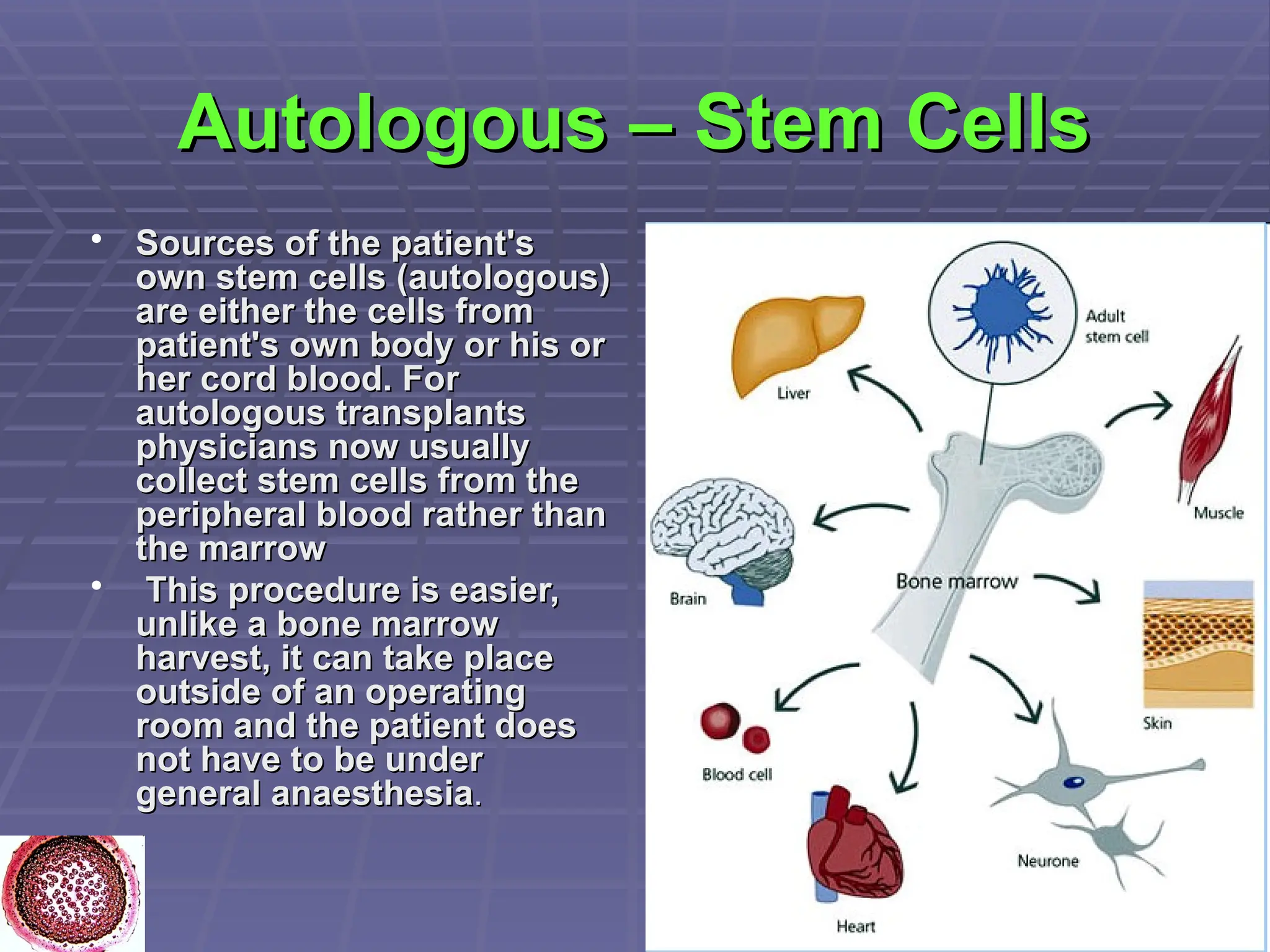
Autologous – Stem Cells

Sources of the patient's
own stem cells (autologous)
are either the cells from
patient's own body or his or
her cord blood. For
her cord blood. For
autologous transplants
physicians now usually
collect stem cells from the
peripheral blood rather than
the marrow
the marrow

This procedure is easier,
unlike a bone marrow
harvest, it can take place
outside of an operating
room and the patient does
not have to be under
general anaesthesia
general anaesthesia.
.
Allogeneic – Stem Cells

Sources of stem cells
from another donor
from another donor
(allogeneic) are primarily
relatives (familial-
allogeneic) or completely
unrelated donors
unrelated donors
(unrelated-allogeneic).
The stem cells in this
situation are extracted
from either the donor's
body or cord blood
body or cord blood
Xenogenic - Stem Cells

In this stem cells from
different species are
transplanted, e.g. striatal
porcine fetal ventral
mesencephalic (FVM)
mesencephalic (FVM)
xenotransplants for
xenotransplants for
Parkinson's disease.
This has no major ethical
concerns and a large
amount of tissue is
amount of tissue is
available, however life
long immunosupression
and risk of rejection are
the major limitations
How Does Cell Therapy Work
How Does Cell Therapy Work?
?

Stem cells can be
Stem cells can be
used to generate
used to generate
healthy and
healthy and
functioning
functioning
specialized cells,
specialized cells,
which can then
which can then
replace diseased or
replace diseased or
dysfunctional cells.

It is similar to the
process of organ
process of organ
transplantation only the
treatment consists of
transplanting cells
transplanting cells
instead of organs
instead of organs.
.
How Does Cell Therapy Work?

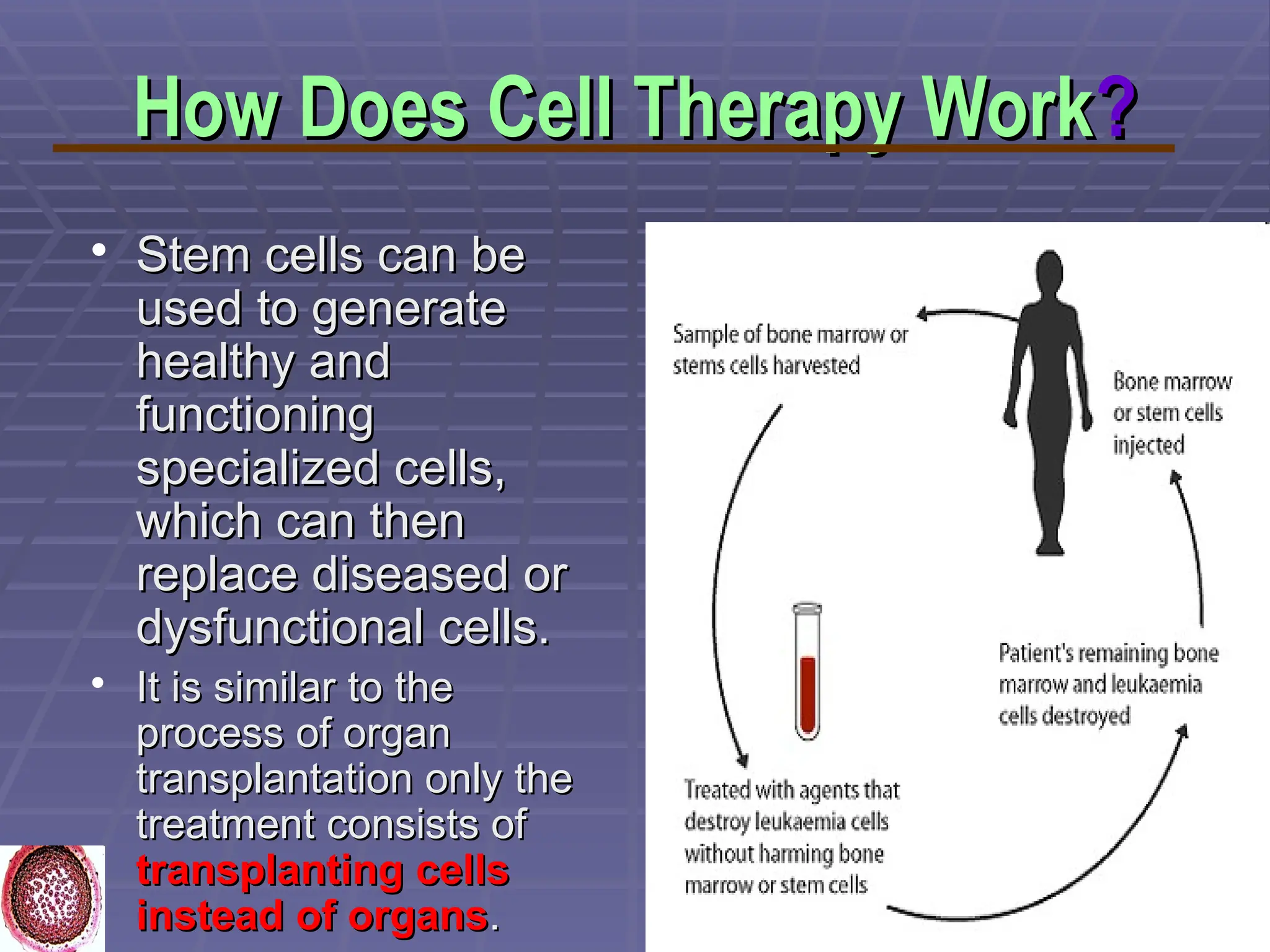
Bone marrow transplants
Bone marrow transplants are an example of
are an example of
cell therapy in which the stem cells in a
donor's marrow are used to replace the blood
cells of the victims of leukemia.

Cell therapy is also being used in experiments
to
to graft new skin
graft new skin cells
cells to treat serious burn
to treat serious burn
victims, and to
victims, and to grow new corneas
grow new corneas for the
for the
sight-impaired.
sight-impaired.

In all of these uses, the goal is for the
healthy cells to become integrated into the
body and begin to function like the
patient's own cells.
What Diseases Can be
Cured by Stem Cell Therapies

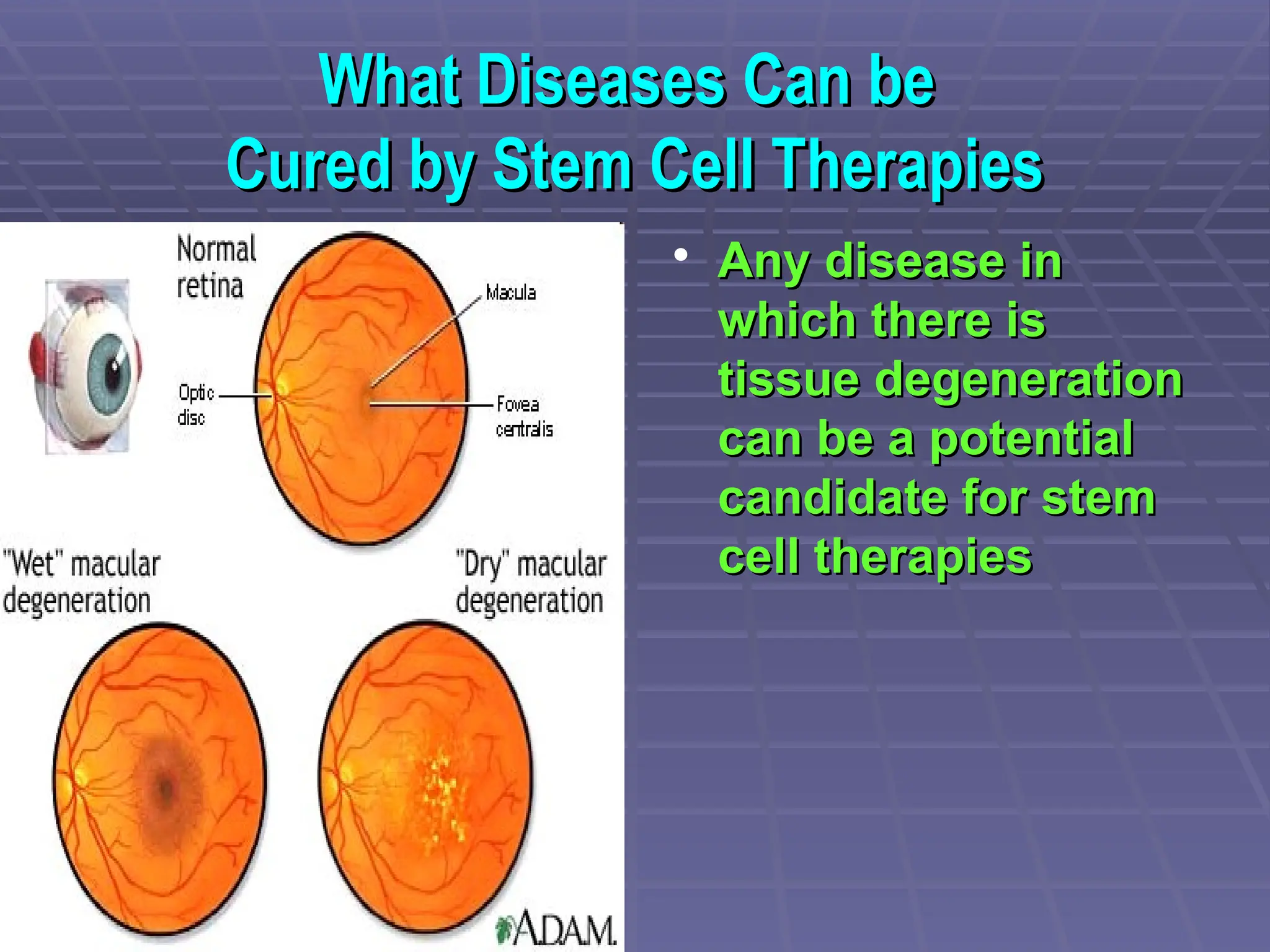
Any disease in
Any disease in
which there is
which there is
tissue degeneration
tissue degeneration
can be a potential
can be a potential
candidate for stem
candidate for stem
cell therapies
cell therapies
Major Progress in Several
Important Health problems

Alzheimer’s disease

Parkinson’s disease

Spinal cord injury

Heart disease

Severe burns

Diabetes
Alzheimer’s disease and can
stem cells help?
stem cells help?

Stem cells could,
Stem cells could,
however, be genetically
modified so as to deliver
substances to the
substances to the
Alzheimer brain, to stop
cells from dying and
stimulate the function of
existing cells. A recent
clinical trial (Phase I) has
shown this approach to
be of some benefit to
patients with Alzheimer’s
disease, by slowing
disease, by slowing
down the progression of
the disease.
the disease.
Drug Testing
Drug Testing
Stem cells could allow scientists
Stem cells could allow scientists
to test new drugs using human
cell line which could speed up
new drug development.
Only drugs that were safe and
Only drugs that were safe and
had beneficial effects in cell line
testing would graduate to whole
animal or human testing.
It would allow quicker and safer
It would allow quicker and safer
development of new drugs.
Major types of Stem Cells

The two broad types of
mammalian stem cells
are:
are: embryonic stem
embryonic stem
cells
cells that are isolated
that are isolated
from the inner cell mass
of blastocysts, and
of blastocysts, and adult
adult
stem cells
stem cells that are
that are
found in adult tissues. In
a developing embryo,
stem cells can
stem cells can
differentiate into all of the
specialized embryonic
tissues. I
tissues. I
Stem cells act as Progenitor
cells
cells

In adult organisms,
In adult organisms,
stem cells and
stem cells and
progenitor cells
progenitor cells act
act
as a repair system for
the body,
the body,
replenishing
replenishing
specialized cells, but
also maintain the
also maintain the
normal turnover of
normal turnover of
regenerative organs,
such as blood, skin
such as blood, skin
or intestinal tissues.
History of Animal Cloning
Since then, animals including mice (1998),
cows (1998), pigs (2000), cats (2001), and
rabbits (2002) were successfully cloned.
RABBIT
MOUSE
CAT
Cattle
PIG
Dolly
Dolly (
(sheep)
sheep) 1 live birth out of 29 cloned
1 live birth out of 29 cloned
embryos
embryos
3%
3%
Cloned
Cloned mice
mice 31 live births out of 2468
31 live births out of 2468
cloned embryos
cloned embryos
1%
1%
Cloned
Cloned pigs
pigs 5 live births out of 335 cloned
5 live births out of 335 cloned
embryos
embryos
1%
1%
Cloned
Cloned goats
goats 3 live births out of 85 cloned
3 live births out of 85 cloned
embryos
embryos
3%
3%
Cloned
Cloned cattle
cattle 30 live births out of 496 cloned
30 live births out of 496 cloned
embryos
embryos
6%
6%
Cloned
Cloned cat
cat 1 live birth out of 87 cloned
1 live birth out of 87 cloned
embryos
embryos
1%
1%
Cloned
Cloned
rabbits
rabbits
6 live births out of 371 of
cloned embryos
cloned embryos
1%
1%
How Successful Was Animal
Cloning? Very low (~1-3%)
First Success of Human Embryo
Cloning
Cloning
On February 12, 2004, South Korean
scientists, Dr. Woo Suk Hwang and Dr.
Shin Young Moon of Seoul National
University, reported the successful
creation of 30 cloned human embryos
developed to the blastocyst stage and
then destroyed by stem cell extraction,
yielding one embryonic stem cell line.
Source of Stem Cells for Medical
therapies
therapies

Tens of thousands of
frozen embryos are
routinely destroyed
when couples finish
their treatment.

These surplus embryos
can be used to produce
stem cells.

Regenerative medical
research aims to
develop these cells into
new, healthy tissue to
heal severe illnesses.
Stem Cell Research Worldwide
Adult multipotent stem cells
Adult Stem Cells
Autologus – Stem Cells

While most blood stem
cells reside in the bone
marrow, a small number
are present in the
are present in the
bloodstream. These
bloodstream. These
multipotent peripheral
blood stem cells, or
PBSCs, can be used just
like bone marrow stem
cells to treat leukaemia,
other cancers and
other cancers and
various blood disorders
multipoten
t
Speculation
Treatments becomes specific
Applications of Stem Cells

Cell Replacement Therapies

Cells could be stimulated to develop into
specialized cells that represent renewable
sources of cells and tissue for transplantation.

Cell replacement therapy could treat injuries
and various genetic and degenerative
conditions including muscular dystrophies,
retinal degeneration, Alzheimer disease,
Parkinson's disease, arthritis, diabetes, spinal
cord injuries, and blood disorders such as
hemophilia.
hemophilia.
Understanding Cell
Understanding Cell
Specialization
Specialization


Studying human pluripotent stem cells can lead to
the identification of factors responsible for
differentiation of stem cells into specialized cell
types.
types.
 these factors may ultimately be used to drive tissue
these factors may ultimately be used to drive tissue
regeneration and repair if administered therapeutically.

This work will provide basic knowledge on cell
determination and differentiation, human
development, genomic imprinting and somatic cell
aging.
aging.
Development and Testing of
Drugs
Drugs


Researchers could
Researchers could
study the
study the
beneficial and
beneficial and
toxic effects of
toxic effects of
new medications
new medications
on human
on human
pluripotent stem
pluripotent stem
cells that have
cells that have
been developed to
been developed to
mimic the disease
mimic the disease
processes.
processes.
Can Sex Make difference in Stem
cell Therapy ?
cell Therapy ?

Are there sex-specific
differences in the biology
of stem cells? (short-long
term
term

•
• How do sex-specific
How do sex-specific
differences play out in
terms of self-renewal and
differentiation? (mid-long
term)
term)
• Is there existing
Is there existing
evidence that the sex of
stem cells affects
stem cells affects
success of the
success of the
transplant?
transplant?


XX
XX
 vs.
vs.

X
XY
Y
Stem cells – Blindness

In clinical trials at
Moorfields Eye
Moorfields Eye
Hospital in London,
Hospital in London,
surgeons restored
surgeons restored
eye sight for six
eye sight for six
patients who lost
patients who lost
their sight after
their sight after
chemical accidents
chemical accidents
and genetic
and genetic
diseases. The
diseases. The
patients went under
patients went under
successful stem-cell
transplant.
transplant.
Limbal stem Cell therapy

The treatment is known
as limbal stem cell
as limbal stem cell
therapy, and the patients
who received the
who received the
treatment suffered from
chemical burn or genetic
disease know as aniridia

By replacing the limbal
stem cells, the cornea
begins to clear up as the
cells are replaced with
the healthy transparent
layer again.
layer again.
Current possible uses

Research in stem cells has opened up
new horizons in the area of treatment of
disorders such as stroke, epilepsy, neuro-
degeneration and trauma. Current
research is aimed at finding the
appropriate source of stem cells for a
given indication, ways of expanding and
perpetuating these cells in culture, best
route of administration of these cells and
methods to overcome rejection
Possible Uses of Stem Cell
Technology
Technology

Replaceable
Replaceable
tissues/organs
tissues/organs

Repair of defective
Repair of defective
cell types
cell types

Delivery of genetic
Delivery of genetic
therapies
therapies

Delivery
Delivery
chemotherapeutic
chemotherapeutic
agents
agents
Future –Making cells and
replacing the diseased cells ?
Obstacles of Stem Cell Research
How to find the right type of stem cells?
How to find the right type of stem cells?
How to put the stem cells into the right
How to put the stem cells into the right
place?
place?
Will the stem cells perform the desired
Will the stem cells perform the desired
function in the body?
Differentiation protocols for many cell
Differentiation protocols for many cell
types have not been developed.
Embryonic Stem Cells are Unstable
and Mutate in Culture

Like ordinary cells,
stem cells
stem cells
accumulate
accumulate
significant numbers
significant numbers
of
of mutations
mutations over
over
time, including
time, including
several that could
several that could
cause them to
cause them to
become tumors.
become tumors.
Ethical debate
Ethical debate

Harvesting ES cells
Harvesting ES cells
destroys the blast
destroys the blast
cyst
cyst

“
“This is murder”
This is murder”

ES cell research
ES cell research
requires human cells

Could create a
Could create a
commercial market
commercial market
for human cells
for human cells

“
“This devalues life”
This devalues life”
Reproduced
by
permission
of
Dave
Catrow
and
Copley
News
Service
Destroying life to cure some one
–
– Ethical ?
Ethical ?

If stem cells have such potential to relieve
suffering, why are so many people so
upset about their use? The reason is that
the most powerful type of stem cell �
embryonic stem (ES) cells can only be
�
embryonic stem (ES) cells can only be
�
obtained from human embryos. Many
people think that it's wrong to create and
destroy human embryos to treat disease
Religious Debate over Harvesting
Embryonic Stem Cells
 The pro-life group generally
The pro-life group generally
believes that:
believes that:
 Personhood happens at, or
Personhood happens at, or
shortly after, conception.
 Thus, they consider the
Thus, they consider the
removal of stem cells from an
embryo -- a procedure which
kills the stem cells -- to be a
form of murder of a human
being.
being.
 They argue that no potential
They argue that no potential
health benefits to even
hundreds of millions of people
can justify the murder of other
humans.
humans.
Day 5-6
Blastocyst
Religious Debate over Harvesting
Embryonic Stem Cells
 The pro-choice group generally
The pro-choice group generally
believes that:
believes that:

Personhood is attained much later in
pregnancy, perhaps when the fetal
brain develops consciousness during
the third trimester
the third trimester.
.

Thus, extracting stem cells from
Thus, extracting stem cells from an
an
five or ten-day old pre-embryo is
not murder.
not murder.

Killing a pre-embryo, which is only
a potential human being, is justified
if it has the potential to cure
diseases and extend the lives of
people.
people.
Day 5-6
Blastocyst
Why we should support
Can help several disabled
 Human embryonic
Human embryonic
stem cell (HESC)
stem cell (HESC)
research offers
research offers
great promise of
great promise of
cures for
cures for
otherwise
otherwise
incurable
incurable
conditions: spinal
conditions: spinal
cord injuries, ALS,
cord injuries, ALS,
Alzheimer’s,
Alzheimer’s,
Shall be Clone Humans ?

Arguments for and
Arguments for and
against human cloning
research. Should we ban
human cloning? Why
human cloning? Why
investors are moving
away from human
away from human
cloning and why human
cloning now looks a last-
century way to fight
disease. Why some
disease. Why some
people want to clone
themselves or even to
clone the dead.
clone the dead.
Research on Stem Cells is progressing
in spite of several restrictions
Created for awareness to
Medical and Paramedical
Medical Students in
Medical Students in
Developing World
Developing World
Dr.T.V.Rao MD
Dr.T.V.Rao MD
Email
Email
doctortvrao@gmail.com

Stem cells-2.ppt for undergraduate students

  • 1.
    S St te em C m Ce el ll ls s ClinicalApplications Clinical Applications
  • 2.
    Nerve Cell CannotRegenerate Nerve Cell Cannot Regenerate ? ?  In 1913 the great Spanish neuroscientist In 1913 the great Spanish neuroscientist Santiago Ramón y Cajal Santiago Ramón y Cajal pronounced pronounced “that in adult centres the nerve paths are “that in adult centres the nerve paths are something fixed, ended, immutable. something fixed, ended, immutable. Everything may die, nothing may be Everything may die, nothing may be regenerated”. For many years regenerated”. For many years neuroscientists believed not just that brain neuroscientists believed not just that brain damage was irreparable, but also that no damage was irreparable, but also that no process to replace lost neurons existed in process to replace lost neurons existed in our brain. our brain.
  • 3.
    antiago Ramón antiago Ramóny y Cajal Cajal (1852- (1852- 1934) 1934)
  • 4.
    Both beliefs turnedout to be false as several Both beliefs turned out to be false as several types of cells can regenerate types of cells can regenerate
  • 5.
    Cell – Acomplex Organ Cell – A complex Organ  Cell Theory: all living Cell Theory: all living things are composed of things are composed of one or more cells one or more cells  Cells fall into two basic Cells fall into two basic types prokaryotic and types prokaryotic and eukaryotic. eukaryotic.  Prokaryotic cells are Prokaryotic cells are smaller and lack much of smaller and lack much of the internal the internal compartmentalizin compartmentalizin and complexity of and complexity of eukaryotic cells. eukaryotic cells.
  • 6.
    History of AdultStem Cell History of Adult Stem Cell Research Research  Since the 1970’s, Since the 1970’s, bone marrow bone marrow transplants have been used for transplants have been used for treatment of treatment of Immunodeficient Immunodeficient and and leukemia. leukemia.
  • 7.
    History of HumanEmbryonic History of Human Embryonic Stem Cell Research Stem Cell Research In 1998, James Thomson (University of Wisconsin-Madison) isolated cells from the inner cell mass of the blastocyst, and developed the first human embryonic stem cell line in culture. Isolate inner cell mass Culture cells Inner cell mass (forms fetus) Day 5-6 Blastocyst
  • 8.
    Stem Cell History StemCell History  1998 - Researchers first extract stem cells from human embryos  1999 - First Successful human transplant of insulin-making cells from cadavers  2001 - President Bush restricts federal funding for embryonic stem-cell research  2002 - Juvenile Diabetes Research Foundation International creates $20 million fund-raising effort to support stem-cell research  2003?? - California ok stem cell research  2004 - Harvard researchers grow stem cells from embryos using private funding  2004 - Ballot measure for $3 Billion bond for stem cells
  • 9.
     In 1998, JamesThomson (University of In 1998, James Thomson (University of Wisconsin-Madison) isolated cells from the Wisconsin-Madison) isolated cells from the inner cell mass of the early embryo, and inner cell mass of the early embryo, and developed the first human embryonic stem cell developed the first human embryonic stem cell lines, lines, History of Human Embryonic Stem Cell History of Human Embryonic Stem Cell Research Research  In 1998, John Gearhart (Johns Hopkins University) derived human embryonic germ cells from cells in fetal gonadal tissue (primordial germ cells).  Pluripotent stem cell “lines” were developed from both sources
  • 10.
    Stem Cell/Cloning Topics StemCell/Cloning Topics  What are stem cells? What are stem cells?  History of stem History of stem cell/cloning research cell/cloning research  Possible uses of the Possible uses of the technology technology  Current Current status/knowledge status/knowledge  Questions and known Questions and known problems problems  Legal considerations Legal considerations  Politics Politics  Moral considerations Moral considerations
  • 11.
    What Are StemCells? What Are Stem Cells? Stem cells are the raw Stem cells are the raw material from which all material from which all of the body’s mature, of the body’s mature, differentiated cells are differentiated cells are made. Stem cells give made. Stem cells give rise to brain cells, nerve rise to brain cells, nerve cells, heart cells, cells, heart cells, pancreatic cells, etc. pancreatic cells, etc.
  • 12.
    Stem Cell –Definition Stem Cell – Definition  A cell that has the A cell that has the ability to ability to continuously divide continuously divide and differentiate and differentiate (develop) into (develop) into various other various other kind(s) of kind(s) of cells/tissues cells/tissues
  • 13.
    Stem Cell –are Dynamic Stem Cell – are Dynamic  Are undifferentiated Are undifferentiated “master” “master” cell that do cell that do not yet have a specific not yet have a specific function function  Can change to one or Can change to one or several different cell several different cell types (differentiate) types (differentiate) under proper under proper conditions conditions  Can undergo unlimited Can undergo unlimited cell division, self- cell division, self- renewal) renewal) Stem cell Stem cell S e l f - r e n e w a l Specialized cell (e.g., white blood cell) D i f f e r e n t i a t e
  • 14.
    One Cell -Several lineages One Cell - Several lineages
  • 15.
    Embryogenesis and Embryogenesis and Differentiation Differentiation  Specificregions of the embryo give rise to the Specific regions of the embryo give rise to the specific organ systems specific organ systems  Ectoderm Ectoderm generates the outer layer of the generates the outer layer of the embryo and produces the surface layer embryo and produces the surface layer (epidermis) of the skin and forms the nerves (epidermis) of the skin and forms the nerves  Endoderm Endoderm becomes the innermost layer of becomes the innermost layer of the embryo and produces the digestive tube the embryo and produces the digestive tube and its associated organs (including the and its associated organs (including the lungs) lungs)  Mesoderm Mesoderm becomes sandwiched between becomes sandwiched between the ectoderm and endoderm and generates the ectoderm and endoderm and generates the blood, heart, kidney, gonads, bones, and the blood, heart, kidney, gonads, bones, and connective tissues. connective tissues.
  • 16.
  • 17.
  • 18.
    An Overview ofEarly Development An Overview of Early Development modeled with Play-Dough modeled with Play-Dough Fertilized egg Totipotent stem cells Totipotent: Can become any cell in body or placenta Fate Decision Pluripotent stem cells (3-5 days old) Blastocyst Pluripotent: Can become any cell in body Implantation Fate Decision Gastrulation (day 14) leads to Primary Germ Cells Endoderm (inner)digestive tract, resp. track Mesoderm (middle)bones, blood cells, heart Ectoderm (outer)skin, CNS Multipotent: Can become any cell within a specific germ layer or cell lineage Embryonic stem cells come from inner cell mass of blastocyst. Implantation Fate Decision Gastrulation (day 14) leads to Primary Germ Cells Endoderm (inner)digestive tract, resp. track Mesoderm (middle)bones, blood cells, heart Ectoderm (outer)skin, CNS Multipotent: Can become any cell within a specific germ layer or cell lineage Multipotent
  • 20.
    Somatic Cell Endoderm EctodermMesoderm Liver Intestine Pancreas Skin Hair Nerves Blood Muscle Bone Cartilage Somatic stem cell Germ stem cell Primitive germ cell Gametes Pluripotent Embryonal stem cell Totipotent stem cells Pluripotent stem cells Adult Multipotent stem cell Courtesy of Dr F. Prosper Cardoso.
  • 21.
    Bone Marrow StemCells Bone Marrow Stem Cells
  • 22.
    How to Derivean Embryonic Stem Cell Line? How to Derive an Embryonic Stem Cell Line? Inner cell mass Day 5-6 Blastocyst Isolate inner cell mass (destroys embryo) ETHICS? Culture cells A stem cell line is composed of a population of cells that can replicate themselves for long periods of time in vitro (out of the body) An embryonic stem cell clone
  • 23.
    The Science ofStem Cells The Science of Stem Cells  Stem cells have the ability to continually Stem cells have the ability to continually reproduce themselves while maintaining the reproduce themselves while maintaining the capacity to give rise to other more specialized capacity to give rise to other more specialized cells. cells.  Stem cells are found at all stages of development, Stem cells are found at all stages of development, from embryonic stem (ES) cells that can from embryonic stem (ES) cells that can differentiate into all specialized cells found in the differentiate into all specialized cells found in the human body, to adult stem cells capable of human body, to adult stem cells capable of regenerating their tissue of origin. regenerating their tissue of origin.  Stem cells occur from the earliest stages of Stem cells occur from the earliest stages of development and provide the starting material development and provide the starting material for every organ and tissues for every organ and tissues. .
  • 24.
    Embryonic stem (ES)cells Embryonic stem (ES) cells  ES cells are found ES cells are found at the blastocyst at the blastocyst stage, four to five stage, four to five days after the days after the union of the sperm union of the sperm and egg, before and egg, before the embryo the embryo implants in the implants in the uterus. uterus.
  • 25.
    ES Cells are"pluripotent" - i.e. capable ES Cells are "pluripotent" - i.e. capable of forming embryonic tissues of forming embryonic tissues
  • 27.
    Source of Stemcells Source of Stem cells  Stem cells may be derived from Stem cells may be derived from autologus, allogeneic or xenogenic autologus, allogeneic or xenogenic sources. Histocompatability is prerequisite sources. Histocompatability is prerequisite for transplantation of allogeneic stem for transplantation of allogeneic stem cells. Fatal tissue is the best current cells. Fatal tissue is the best current tissue source for human neural stem cells, tissue source for human neural stem cells, however ethical issues are a major however ethical issues are a major concern. concern.
  • 28.
    Placenta a Sourceof Stem Cells Placenta a Source of Stem Cells  Placental stem cells, Placental stem cells, like umbilical cord like umbilical cord blood and bone blood and bone marrow stem cells, marrow stem cells, can be used to cure can be used to cure chronic blood-related chronic blood-related disorders such as disorders such as sickle cell disease, sickle cell disease, Thalasemia, and Thalasemia, and leukaemia. leukaemia.
  • 29.
     Report of preliminary Reportof preliminary results of results of transplantation using transplantation using partially HLA- partially HLA- mismatched mismatched placental blood from placental blood from unrelated donors. unrelated donors.  Joanne Kurtzberg, Joanne Kurtzberg, M.D.et al M.D.et al Placental Blood as a Source of Placental Blood as a Source of Hematopoietic Stem Cells for Hematopoietic Stem Cells for Transplantation into Unrelated Recipients Transplantation into Unrelated Recipients
  • 30.
    Umbilical Cord BloodStem Cell Umbilical Cord Blood Stem Cell Transplant Transplant  Umbilical cord blood Umbilical cord blood stem cell transplants are stem cell transplants are less prone to rejection less prone to rejection than either bone marrow than either bone marrow or peripheral blood stem or peripheral blood stem cells. This is probably cells. This is probably because the cells have because the cells have not yet developed the not yet developed the features that can be features that can be recognized and attacked recognized and attacked by the recipient's by the recipient's immune system immune system
  • 31.
    Kinds of StemCells Kinds of Stem Cells Stem cell type Stem cell type Description Description Examples Examples Totipotent Totipotent Each cell can develop into a Each cell can develop into a new individual new individual Cells from early (1-3 Cells from early (1-3 days) embryos days) embryos Pluripotent Pluripotent Cells can form any (over 200) Cells can form any (over 200) cell types cell types Some cells of Some cells of blastocyst (5 to 14 blastocyst (5 to 14 days) days) Multipotent Multipotent Cells differentiated, but can Cells differentiated, but can form a number of other form a number of other tissues tissues Fetal tissue, cord Fetal tissue, cord blood, and adult stem blood, and adult stem cells cells
  • 32.
    What’s So SpecialAbout What’s So Special About Stem Cells? Stem Cells? They have the potential to They have the potential to replace cell tissue replace cell tissue that has been damaged or destroyed by that has been damaged or destroyed by severe illnesses. severe illnesses. They can replicate themselves over and over They can replicate themselves over and over for a very long time. for a very long time. Understanding how stem cells develop into Understanding how stem cells develop into healthy and diseased cells will assist the healthy and diseased cells will assist the search for cures. search for cures.
  • 33.
    Two Kinds ofStem Cells Two Kinds of Stem Cells Embryonic Embryonic (also called “pluripotent”) (also called “pluripotent”) stem cells are capable of developing into stem cells are capable of developing into all the cell types of the body. all the cell types of the body. Adult stem cells are less versatile and Adult stem cells are less versatile and more difficult to identify, isolate, and more difficult to identify, isolate, and purify. purify.
  • 34.
    Stages of Embryogenesis Stagesof Embryogenesis Day 1 Fertilized egg Day 2 2-cell embryo Day 3-4 Multi-cell embryo Day 5-6 Blastocyst Day 11-14 Tissue Differentiation
  • 35.
    Derivation and Useof Derivation and Use of Embryonic Stem Cell Lines Embryonic Stem Cell Lines Isolate inner cell mass (destroys embryo) Heart muscle Kidney Liver “Special sauce” (largely unknown) Day 5-6 Blastocyst Inner cells (forms fetus) Outer cells (forms placenta) Heart repaired Culture cells
  • 36.
    Embryonic Stem Cells: EmbryonicStem Cells: Researchers extract stem cells from a 5-7 days old Researchers extract stem cells from a 5-7 days old blastocyst blastocyst. . Stem cells can divide in culture to form more of their own kind, Stem cells can divide in culture to form more of their own kind, thereby creating a stem cell line. thereby creating a stem cell line. The research aims to induce these cells to generate healthy tissue needed by patients.
  • 37.
    How Many HumanEmbryonic Stem How Many Human Embryonic Stem Cell Lines are There? Cell Lines are There?  The actual number of human The actual number of human embryonic stem cell lines is a matter embryonic stem cell lines is a matter of some debate. of some debate.  To date, To date, more than 100 more than 100 human human embryonic stem cell lines have been embryonic stem cell lines have been derived worldwide. derived worldwide.  However, most of those lines are not However, most of those lines are not adequately characterized yet. adequately characterized yet.  Only 22 cell lines are eligible for Only 22 cell lines are eligible for federal funding in the USA. federal funding in the USA.
  • 38.
    Autologous – StemCells Autologous – Stem Cells  Sources of the patient's Sources of the patient's own stem cells (autologous) own stem cells (autologous) are either the cells from are either the cells from patient's own body or his or patient's own body or his or her cord blood. For her cord blood. For autologous transplants autologous transplants physicians now usually physicians now usually collect stem cells from the collect stem cells from the peripheral blood rather than peripheral blood rather than the marrow the marrow  This procedure is easier, This procedure is easier, unlike a bone marrow unlike a bone marrow harvest, it can take place harvest, it can take place outside of an operating outside of an operating room and the patient does room and the patient does not have to be under not have to be under general anaesthesia general anaesthesia. .
  • 39.
    Allogeneic – StemCells Allogeneic – Stem Cells  Sources of stem cells Sources of stem cells from another donor from another donor (allogeneic) are primarily (allogeneic) are primarily relatives (familial- relatives (familial- allogeneic) or completely allogeneic) or completely unrelated donors unrelated donors (unrelated-allogeneic). (unrelated-allogeneic). The stem cells in this The stem cells in this situation are extracted situation are extracted from either the donor's from either the donor's body or cord blood body or cord blood
  • 40.
    Xenogenic - StemCells Xenogenic - Stem Cells  In this stem cells from In this stem cells from different species are different species are transplanted, e.g. striatal transplanted, e.g. striatal porcine fetal ventral porcine fetal ventral mesencephalic (FVM) mesencephalic (FVM) xenotransplants for xenotransplants for Parkinson's disease. Parkinson's disease. This has no major ethical This has no major ethical concerns and a large concerns and a large amount of tissue is amount of tissue is available, however life available, however life long immunosupression long immunosupression and risk of rejection are and risk of rejection are the major limitations the major limitations
  • 41.
    How Does CellTherapy Work How Does Cell Therapy Work? ?  Stem cells can be Stem cells can be used to generate used to generate healthy and healthy and functioning functioning specialized cells, specialized cells, which can then which can then replace diseased or replace diseased or dysfunctional cells. dysfunctional cells.  It is similar to the It is similar to the process of organ process of organ transplantation only the transplantation only the treatment consists of treatment consists of transplanting cells transplanting cells instead of organs instead of organs. .
  • 42.
    How Does CellTherapy Work? How Does Cell Therapy Work?  Bone marrow transplants Bone marrow transplants are an example of are an example of cell therapy in which the stem cells in a cell therapy in which the stem cells in a donor's marrow are used to replace the blood donor's marrow are used to replace the blood cells of the victims of leukemia. cells of the victims of leukemia.  Cell therapy is also being used in experiments Cell therapy is also being used in experiments to to graft new skin graft new skin cells cells to treat serious burn to treat serious burn victims, and to victims, and to grow new corneas grow new corneas for the for the sight-impaired. sight-impaired.  In all of these uses, the goal is for the In all of these uses, the goal is for the healthy cells to become integrated into the healthy cells to become integrated into the body and begin to function like the body and begin to function like the patient's own cells. patient's own cells.
  • 43.
    What Diseases Canbe What Diseases Can be Cured by Stem Cell Therapies Cured by Stem Cell Therapies  Any disease in Any disease in which there is which there is tissue degeneration tissue degeneration can be a potential can be a potential candidate for stem candidate for stem cell therapies cell therapies
  • 44.
    Major Progress inSeveral Major Progress in Several Important Health problems Important Health problems  Alzheimer’s disease  Parkinson’s disease  Spinal cord injury  Heart disease  Severe burns  Diabetes
  • 45.
    Alzheimer’s disease andcan Alzheimer’s disease and can stem cells help? stem cells help?  Stem cells could, Stem cells could, however, be genetically however, be genetically modified so as to deliver modified so as to deliver substances to the substances to the Alzheimer brain, to stop Alzheimer brain, to stop cells from dying and cells from dying and stimulate the function of stimulate the function of existing cells. A recent existing cells. A recent clinical trial (Phase I) has clinical trial (Phase I) has shown this approach to shown this approach to be of some benefit to be of some benefit to patients with Alzheimer’s patients with Alzheimer’s disease, by slowing disease, by slowing down the progression of down the progression of the disease. the disease.
  • 46.
    Drug Testing Drug Testing Stemcells could allow scientists Stem cells could allow scientists to test new drugs using human to test new drugs using human cell line which could speed up cell line which could speed up new drug development. new drug development. Only drugs that were safe and Only drugs that were safe and had beneficial effects in cell line had beneficial effects in cell line testing would graduate to whole testing would graduate to whole animal or human testing. animal or human testing. It would allow quicker and safer It would allow quicker and safer development of new drugs. development of new drugs.
  • 47.
    Major types ofStem Cells Major types of Stem Cells  The two broad types of The two broad types of mammalian stem cells mammalian stem cells are: are: embryonic stem embryonic stem cells cells that are isolated that are isolated from the inner cell mass from the inner cell mass of blastocysts, and of blastocysts, and adult adult stem cells stem cells that are that are found in adult tissues. In found in adult tissues. In a developing embryo, a developing embryo, stem cells can stem cells can differentiate into all of the differentiate into all of the specialized embryonic specialized embryonic tissues. I tissues. I
  • 48.
    Stem cells actas Progenitor Stem cells act as Progenitor cells cells  In adult organisms, In adult organisms, stem cells and stem cells and progenitor cells progenitor cells act act as a repair system for as a repair system for the body, the body, replenishing replenishing specialized cells, but specialized cells, but also maintain the also maintain the normal turnover of normal turnover of regenerative organs, regenerative organs, such as blood, skin such as blood, skin or intestinal tissues. or intestinal tissues.
  • 49.
    History of AnimalCloning History of Animal Cloning Since then, animals including mice (1998), cows (1998), pigs (2000), cats (2001), and rabbits (2002) were successfully cloned. RABBIT MOUSE CAT Cattle PIG
  • 50.
    Dolly Dolly ( (sheep) sheep) 1live birth out of 29 cloned 1 live birth out of 29 cloned embryos embryos 3% 3% Cloned Cloned mice mice 31 live births out of 2468 31 live births out of 2468 cloned embryos cloned embryos 1% 1% Cloned Cloned pigs pigs 5 live births out of 335 cloned 5 live births out of 335 cloned embryos embryos 1% 1% Cloned Cloned goats goats 3 live births out of 85 cloned 3 live births out of 85 cloned embryos embryos 3% 3% Cloned Cloned cattle cattle 30 live births out of 496 cloned 30 live births out of 496 cloned embryos embryos 6% 6% Cloned Cloned cat cat 1 live birth out of 87 cloned 1 live birth out of 87 cloned embryos embryos 1% 1% Cloned Cloned rabbits rabbits 6 live births out of 371 of 6 live births out of 371 of cloned embryos cloned embryos 1% 1% How Successful Was Animal How Successful Was Animal Cloning? Very low (~1-3%) Cloning? Very low (~1-3%)
  • 51.
    First Success ofHuman Embryo First Success of Human Embryo Cloning Cloning On February 12, 2004, South Korean scientists, Dr. Woo Suk Hwang and Dr. Shin Young Moon of Seoul National University, reported the successful creation of 30 cloned human embryos developed to the blastocyst stage and then destroyed by stem cell extraction, yielding one embryonic stem cell line.
  • 52.
    Source of StemCells for Medical Source of Stem Cells for Medical therapies therapies  Tens of thousands of frozen embryos are routinely destroyed when couples finish their treatment.  These surplus embryos can be used to produce stem cells.  Regenerative medical research aims to develop these cells into new, healthy tissue to heal severe illnesses.
  • 53.
    Stem Cell ResearchWorldwide Stem Cell Research Worldwide
  • 54.
  • 55.
  • 56.
    Autologus – StemCells Autologus – Stem Cells  While most blood stem While most blood stem cells reside in the bone cells reside in the bone marrow, a small number marrow, a small number are present in the are present in the bloodstream. These bloodstream. These multipotent peripheral multipotent peripheral blood stem cells, or blood stem cells, or PBSCs, can be used just PBSCs, can be used just like bone marrow stem like bone marrow stem cells to treat leukaemia, cells to treat leukaemia, other cancers and other cancers and various blood disorders various blood disorders
  • 57.
  • 58.
  • 59.
    Applications of StemCells Applications of Stem Cells  Cell Replacement Therapies Cell Replacement Therapies  Cells could be stimulated to develop into Cells could be stimulated to develop into specialized cells that represent renewable specialized cells that represent renewable sources of cells and tissue for transplantation. sources of cells and tissue for transplantation.  Cell replacement therapy could treat injuries Cell replacement therapy could treat injuries and various genetic and degenerative and various genetic and degenerative conditions including muscular dystrophies, conditions including muscular dystrophies, retinal degeneration, Alzheimer disease, retinal degeneration, Alzheimer disease, Parkinson's disease, arthritis, diabetes, spinal Parkinson's disease, arthritis, diabetes, spinal cord injuries, and blood disorders such as cord injuries, and blood disorders such as hemophilia. hemophilia.
  • 60.
    Understanding Cell Understanding Cell Specialization Specialization   Studyinghuman pluripotent stem cells can lead to Studying human pluripotent stem cells can lead to the identification of factors responsible for the identification of factors responsible for differentiation of stem cells into specialized cell differentiation of stem cells into specialized cell types. types.  these factors may ultimately be used to drive tissue these factors may ultimately be used to drive tissue regeneration and repair if administered therapeutically. regeneration and repair if administered therapeutically.  This work will provide basic knowledge on cell This work will provide basic knowledge on cell determination and differentiation, human determination and differentiation, human development, genomic imprinting and somatic cell development, genomic imprinting and somatic cell aging. aging.
  • 61.
    Development and Testingof Development and Testing of Drugs Drugs   Researchers could Researchers could study the study the beneficial and beneficial and toxic effects of toxic effects of new medications new medications on human on human pluripotent stem pluripotent stem cells that have cells that have been developed to been developed to mimic the disease mimic the disease processes. processes.
  • 62.
    Can Sex Makedifference in Stem Can Sex Make difference in Stem cell Therapy ? cell Therapy ?  Are there sex-specific Are there sex-specific differences in the biology differences in the biology of stem cells? (short-long of stem cells? (short-long term term  • • How do sex-specific How do sex-specific differences play out in differences play out in terms of self-renewal and terms of self-renewal and differentiation? (mid-long differentiation? (mid-long term) term) • Is there existing Is there existing evidence that the sex of evidence that the sex of stem cells affects stem cells affects success of the success of the transplant? transplant?   XX XX  vs. vs.  X XY Y
  • 63.
    Stem cells –Blindness Stem cells – Blindness  In clinical trials at In clinical trials at Moorfields Eye Moorfields Eye Hospital in London, Hospital in London, surgeons restored surgeons restored eye sight for six eye sight for six patients who lost patients who lost their sight after their sight after chemical accidents chemical accidents and genetic and genetic diseases. The diseases. The patients went under patients went under successful stem-cell successful stem-cell transplant. transplant.
  • 65.
    Limbal stem Celltherapy Limbal stem Cell therapy  The treatment is known The treatment is known as limbal stem cell as limbal stem cell therapy, and the patients therapy, and the patients who received the who received the treatment suffered from treatment suffered from chemical burn or genetic chemical burn or genetic disease know as aniridia disease know as aniridia  By replacing the limbal By replacing the limbal stem cells, the cornea stem cells, the cornea begins to clear up as the begins to clear up as the cells are replaced with cells are replaced with the healthy transparent the healthy transparent layer again. layer again.
  • 66.
    Current possible uses Currentpossible uses  Research in stem cells has opened up Research in stem cells has opened up new horizons in the area of treatment of new horizons in the area of treatment of disorders such as stroke, epilepsy, neuro- disorders such as stroke, epilepsy, neuro- degeneration and trauma. Current degeneration and trauma. Current research is aimed at finding the research is aimed at finding the appropriate source of stem cells for a appropriate source of stem cells for a given indication, ways of expanding and given indication, ways of expanding and perpetuating these cells in culture, best perpetuating these cells in culture, best route of administration of these cells and route of administration of these cells and methods to overcome rejection methods to overcome rejection
  • 67.
    Possible Uses ofStem Cell Possible Uses of Stem Cell Technology Technology  Replaceable Replaceable tissues/organs tissues/organs  Repair of defective Repair of defective cell types cell types  Delivery of genetic Delivery of genetic therapies therapies  Delivery Delivery chemotherapeutic chemotherapeutic agents agents
  • 68.
    Future –Making cellsand Future –Making cells and replacing the diseased cells ? replacing the diseased cells ?
  • 69.
    Obstacles of StemCell Research Obstacles of Stem Cell Research How to find the right type of stem cells? How to find the right type of stem cells? How to put the stem cells into the right How to put the stem cells into the right place? place? Will the stem cells perform the desired Will the stem cells perform the desired function in the body? function in the body? Differentiation protocols for many cell Differentiation protocols for many cell types have not been developed. types have not been developed.
  • 70.
    Embryonic Stem Cellsare Unstable Embryonic Stem Cells are Unstable and Mutate in Culture and Mutate in Culture  Like ordinary cells, Like ordinary cells, stem cells stem cells accumulate accumulate significant numbers significant numbers of of mutations mutations over over time, including time, including several that could several that could cause them to cause them to become tumors. become tumors.
  • 71.
    Ethical debate Ethical debate  HarvestingES cells Harvesting ES cells destroys the blast destroys the blast cyst cyst  “ “This is murder” This is murder”  ES cell research ES cell research requires human cells requires human cells  Could create a Could create a commercial market commercial market for human cells for human cells  “ “This devalues life” This devalues life” Reproduced by permission of Dave Catrow and Copley News Service
  • 72.
    Destroying life tocure some one Destroying life to cure some one – – Ethical ? Ethical ?  If stem cells have such potential to relieve If stem cells have such potential to relieve suffering, why are so many people so suffering, why are so many people so upset about their use? The reason is that upset about their use? The reason is that the most powerful type of stem cell � the most powerful type of stem cell � embryonic stem (ES) cells can only be � embryonic stem (ES) cells can only be � obtained from human embryos. Many obtained from human embryos. Many people think that it's wrong to create and people think that it's wrong to create and destroy human embryos to treat disease destroy human embryos to treat disease
  • 73.
    Religious Debate overHarvesting Religious Debate over Harvesting Embryonic Stem Cells Embryonic Stem Cells  The pro-life group generally The pro-life group generally believes that: believes that:  Personhood happens at, or Personhood happens at, or shortly after, conception. shortly after, conception.  Thus, they consider the Thus, they consider the removal of stem cells from an removal of stem cells from an embryo -- a procedure which embryo -- a procedure which kills the stem cells -- to be a kills the stem cells -- to be a form of murder of a human form of murder of a human being. being.  They argue that no potential They argue that no potential health benefits to even health benefits to even hundreds of millions of people hundreds of millions of people can justify the murder of other can justify the murder of other humans. humans. Day 5-6 Blastocyst
  • 74.
    Religious Debate overHarvesting Religious Debate over Harvesting Embryonic Stem Cells Embryonic Stem Cells  The pro-choice group generally The pro-choice group generally believes that: believes that:  Personhood is attained much later in Personhood is attained much later in pregnancy, perhaps when the fetal pregnancy, perhaps when the fetal brain develops consciousness during brain develops consciousness during the third trimester the third trimester. .  Thus, extracting stem cells from Thus, extracting stem cells from an an five or ten-day old pre-embryo is five or ten-day old pre-embryo is not murder. not murder.  Killing a pre-embryo, which is only Killing a pre-embryo, which is only a potential human being, is justified a potential human being, is justified if it has the potential to cure if it has the potential to cure diseases and extend the lives of diseases and extend the lives of people. people. Day 5-6 Blastocyst
  • 75.
    Why we shouldsupport Why we should support Can help several disabled Can help several disabled  Human embryonic Human embryonic stem cell (HESC) stem cell (HESC) research offers research offers great promise of great promise of cures for cures for otherwise otherwise incurable incurable conditions: spinal conditions: spinal cord injuries, ALS, cord injuries, ALS, Alzheimer’s, Alzheimer’s,
  • 77.
    Shall be CloneHumans ? Shall be Clone Humans ?  Arguments for and Arguments for and against human cloning against human cloning research. Should we ban research. Should we ban human cloning? Why human cloning? Why investors are moving investors are moving away from human away from human cloning and why human cloning and why human cloning now looks a last- cloning now looks a last- century way to fight century way to fight disease. Why some disease. Why some people want to clone people want to clone themselves or even to themselves or even to clone the dead. clone the dead.
  • 78.
    Research on StemCells is progressing Research on Stem Cells is progressing in spite of several restrictions in spite of several restrictions
  • 79.
    Created for awarenessto Created for awareness to Medical and Paramedical Medical and Paramedical Medical Students in Medical Students in Developing World Developing World Dr.T.V.Rao MD Dr.T.V.Rao MD Email Email doctortvrao@gmail.com doctortvrao@gmail.com

Editor's Notes

  • #6 Adult stem cell research on humans began in the 1960's, first achieving success in the treatment of a patient with severe combined immunodeficiency disorder in 1968. Since the early 1970's, adult stem cells have been successfully used for treatment of immunodeficiencies and leukemias.
  • #9 Human embryonic stem cells were first isolated in 1998. The cells from these embryos were established as immortal pluripotent cell lines that are still in existence today.
  • #10 The topics to be covered in this presentation are listed above. First topic: What are stem cells?
  • #12 Stem cells are different from other cells of the body in that they have the ability to differentiate into other cell/tissue types. This ability allows them to replace cells that have died. With this ability, they have been used to replace defective cells/tissues in patients who have certain diseases or defects.
  • #21 Stem cells from bone marrow form a number of cell types of the immune and circulatory system. These stem cells have been used to cure diseases since the 1960's.
  • #22 The inner cell mass (the part that would form the fetus) of the embryo is isolated and disrupted to form embryonic cell lines. This process destroys the embryo. Under special culture conditions, the cells of the embryonic lines can be coaxed to form certain kinds of differentiated cell types. In theory, these differentiated cells could be used to repair or replace defective cells or tissues.
  • #31 Stem cells can be classified into three broad categories, based on their ability to differentiate. Totipotent stem cells are found only in early embryos. Each cell can form a complete organism (e.g., identical twins). Pluripotent stem cells exist in the undifferentiated inner cell mass of the blastocyst and can form any of the over 200 different cell types found in the body. Multipotent stem cells are derived from fetal tissue, cord blood and adult stem cells. Although their ability to differentiate is more limited than pluripotent stem cells, they already have a track record of success in cell-based therapies. Here is a current list of the sources of stem cells: Embryonic stem cells - are harvested from the inner cell mass of the blastocyst seven to ten days after fertilization. Fetal stem cells - are taken from the germline tissues that will make up the gonads of aborted fetuses. Umbilical cord stem cells - Umbilical cord blood contains stem cells similar to those found in bone marrow. Placenta derived stem cells - up to ten times as many stem cells can be harvested from a placenta as from cord blood. Adult stem cells - Many adult tissues contain stem cells that can be isolated.
  • #34 The early stages of embryogenesis are the point at which embryonic stem cell lines are derived. The fertilized egg (day 1) undergoes cell division to form a 2-cell embryo, followed by 4-cell, etc. until a ball of cells is formed by the fourth day. The ball becomes hollow, forming the blastocyst. This is the stage at which pluripotent embryonic stem cell lines are generated. Following the blastocyst stage, the tissues of the embryo start to form and the cells become multipotent.
  • #35 The inner cell mass (the part that would form the fetus) of the embryo is isolated and disrupted to form embryonic cell lines. This process destroys the embryo. Under special culture conditions, the cells of the embryonic lines can be coaxed to form certain kinds of differentiated cell types. In theory, these differentiated cells could be used to repair or replace defective cells or tissues.
  • #71  ES cell research is a very controversial topic. The main issue is the moral status of a human embryo. Is it ethical to destroy an embryo in order to save a patient’s life? This isn’t the only issue raised by ES cells. Even if you believe that it is ethically acceptable to destroy human embryos, other issues arise. This section of the presentation uses cartoons to introduce some of the basic ethical issues surrounding ES cell research.   ES cell research involves the destruction of embryos. The destruction of the embryo happens when the ES cells are harvested from the ICM.  Some people believe that an embryo contains a human life. For them, killing an embryo is equivalent to murder.  Notice that the artist represents the embryo in this cartoon as a miniature baby. People who hold this position often point out that AS cells, whose derivation does not entail the destruction of embryos, may be able to provide the same life-saving benefits of ES cells. They argue that ES cell research is not only wrong--it is unnecessary. 