

RECENT DEVELOPMENTS IN PLANT
TRANSFORMATION STRATEGIES
What is transformation
• Transformation is the genetic alteration of a
cell resulting from the direct uptake and
incorporation of exogenous genetic material
from its surrounding and taken up through
the plama membrane.
• Transgenic plants are produced by
transformation and stable integration of
foreign gene into the plant genome.
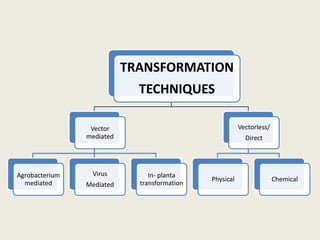
TRANSFORMATION
TECHNIQUES
Vector
mediated
Agrobacterium
mediated
Virus
Mediated
In- planta
transformation
Vectorless/
Direct
Physical Chemical
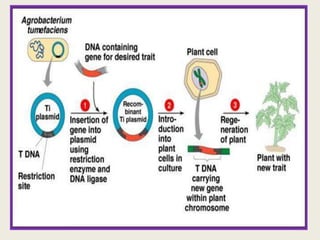
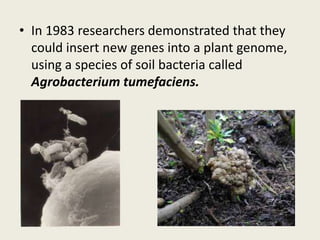
• In 1983 researchers demonstrated that they
could insert new genes into a plant genome,
using a species of soil bacteria called
Agrobacterium tumefaciens.
AGROBACTERIUM MEDIATED GENE
TRANSFER
• It is one of the most ancient and still accepted
tool for transformation in plants.
• It can be achieved through two ways:
a. Coculture with tissue explant
b. Agroinfection
• 1974: Marc Van Montagu and Jeff Schell at Ghent
University show that Agrobacterium uses a
plasmid, known as the Ti plasmid, to transfer its
genetic material into a plant cell.
• 1979: Dick Flavell is the first researcher anywhere
in the world to successfully clone plant DNA.
• 1983: Three groups, including Mike Bevan and
Dick Flavell published research papers
demonstrating that they can stably introduce and
express bacterial genes into a plant genome.
• 1987: Creation of the GUS reporter system by
Richard Jefferson and Mike Bevan. The paper
describing their work is now the most highly-cited
plant transformation paper to date.
Thirty years of plant transformation A case study exploring the impact of plant transformation technology on plant science research and
the global agricultural biotechnology industry
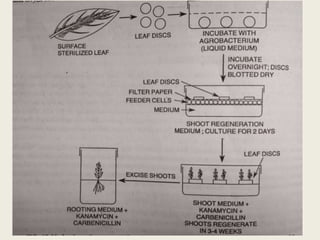
Co-culture with tissue explants
• Gene construct inserted within the region of
T-region of either co-integrate or a binary
vector.
• Recombinant DNA is placed in Agrobacterium.
• Co-cultured for about 2 days with plant tissue.
• Transformed plants are selected onto
regeneration media.
• The shoots are separated and rooted and
finally transferred into soil.
• Agrobacterium does infect monocot plant
species and form crowngalls, eg. Asparagus or
induces swelling in Chlorophytum, Allium
cepa, Narcissus.
• Efficient transformation of monocot cells can
be obtained by providing acetosyringone
during the co- culture of plant cell with
Agrobacterium.
• Some maize variety secrete DIMBOA which
inhibit the induction of vir operon by
acetosyringone.
AGROINFECTION
• Introduction of a viral genome into plant cells
by placing it within the T-DNA of a Ti plasmid,
and using agrobacterium containing this
plasmid for coculture with plant cells is called
agroinfection.
• Maize streak virus, wheat dwarf virus.
AGROINFECTION
• MSV (Maize Streak Virus) genome has been
successfully introduced into plant cell by inserting
it within the TDNA in the form of tandem dimer.
• Agrobacterium containing this recombinant pTi
was used to infect maize, which develop streak
on their leaves within 2 weeks of inoculation.
• This proved that Agrobacterium is capable to
transfer DNA in maize.
• Cloned MSV is fully functional in infection.
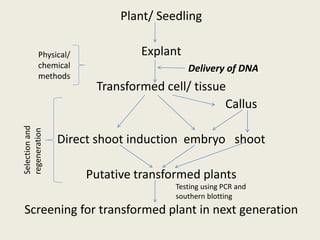
Plant/ Seedling
Explant
Transformed cell/ tissue
Callus
Direct shoot induction embryo shoot
Putative transformed plants
Screening for transformed plant in next generation
Physical/
chemical
methods
Delivery of DNA
Selectionand
regeneration
Testing using PCR and
southern blotting
Chemical methods:
• PEG mediated
• DEAE- dextran
• Calcium phosphate
• Artificial lipids
PEG mediated
1. Protoplast isolation in the form of suspension
2. Taken in a test tube followed by addition of plasmid DNA
3. To this 40% PEG dissolved in mannitol and calcium nitrate solution is
slowly added because of high viscosity
4. This mixture is incubated for 5 min.
5. Testing
6. Regeneration
Efficient transformation of Arabidopsis thaliana using direct gene transfer to
protoplasts.
Transgenic Arabidopsis plants resistant to hygromycin B have been regenerated
from mesophyll protoplasts treated with polyethylene glycol and plasmid
DNA carrying the hygromycin phosphotransferase (HPT) gene under the
control of the 35 S promoter of cauliflower mosaic virus.
Transformation experiments performed with a selectable and a non-selectable
gene on separate plasmids resulted in a co-transformation rate of
functionally active copies in about 25% of the transformants analysed.
Hence this approach can be used to introduce non-selectable genes into
the Arabidopsis genome.
Efficient transformation of Arabidopsis thaliana using direct gene transfer to protoplasts.1989 May;217(1):6-12.
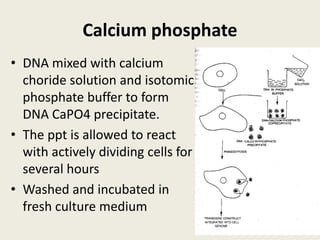
Calcium phosphate
• DNA mixed with calcium
choride solution and isotomic
phosphate buffer to form
DNA CaPO4 precipitate.
• The ppt is allowed to react
with actively dividing cells for
several hours
• Washed and incubated in
fresh culture medium
• Tomato protoplast DNA transformation: physical
linkage and recombination of exogenous DNA
sequences.
• Tomato protoplasts have been transformed with
plasmid DNA's, containing a chimeric kanamycin
resistance gene and putative tomato origins of
replication. A calcium phosphate-
DNA mediated transformation procedure was
employed in combination with either
polyethylene glycol or polyvinyl alcohol.
Artificial lipids
• Liposomes are artificial lipids vesicles surrounded
by synthetic membrane of phospholipid.
• The positively charged lipids and liposomes are
thought to improve transgene delivery mainly
through binding to and condensing negatively
charged DNA, forming a complex called lipoplex
in which the DNA is protected against
extracellular degradation.
• Moreover, the positively charged lipoplex binds
to the negatively charged cell surface molecules
facilitating endocytosis.
• Release of plasmid inside the cell.
DIRECT TRANSFER
Physical method
• Electroporation
• Particle gun delivery
• Microinjection
• Macroinjection
• Pollen transformation
• Ultra sound mediated
• Laser induced
• Silicon carbide fibre mediated
• Origami based technique
• Nanotechnology aided delivery(nanoclay, nansheets,
nanocapsule)
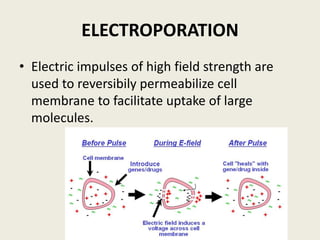
ELECTROPORATION
• Electric impulses of high field strength are
used to reversibily permeabilize cell
membrane to facilitate uptake of large
molecules.
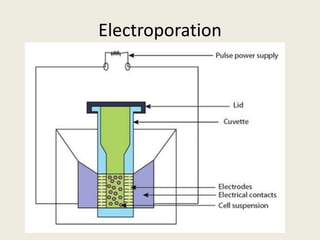
Electroporation
Genetic transformation of plants by
protoplast electroporation
• This article describes an optimized protocol for
the electroporation of tobacco mesophyll protoplasts
together with notes and data on the effects of various
parameters and suggestions for work with protoplasts
of other species. In this protocol, electroporation is
achieved by means of electrical pulses from a high-
voltage, capacitive-discharge unit. Procedures are
described for measurement of protoplast viability with
Evan's blue, the detection of transient expression of
CAT and GUS gene plasmid constructs, and for the
recovery of stable transformants based on selection for
kanamycin resistance.
1994 Oct;2(2):135-45.
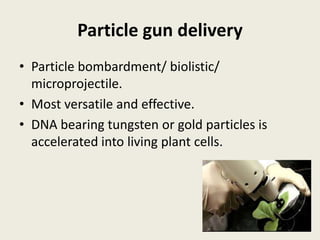
Particle gun delivery
• Particle bombardment/ biolistic/
microprojectile.
• Most versatile and effective.
• DNA bearing tungsten or gold particles is
accelerated into living plant cells.
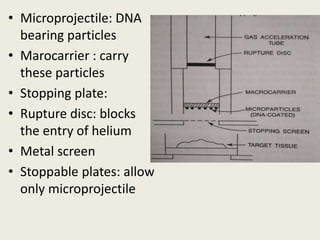
• Microprojectile: DNA
bearing particles
• Marocarrier : carry
these particles
• Stopping plate:
• Rupture disc: blocks
the entry of helium
• Metal screen
• Stoppable plates: allow
only microprojectile
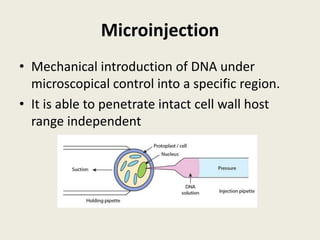
Microinjection
• Mechanical introduction of DNA under
microscopical control into a specific region.
• It is able to penetrate intact cell wall host
range independent
Macroinjection
• Injection of DNA solution (5-10 µl) by
micropipette into developing floral side shoots
of plant.
• These tillers have archaesporial cell that give
rise to pollen in developing sac by meiotic cell
division.
Ultra sound mediated
• To stimulate uptake of foreign DNA by plant
protoplast and leaf segment of tobacco.
• Immersion of explant in sonication buffer
containing plasmid DNA
• Sonication with ultrasonic pulse generator at
0.5w/cm² for 30 min.
• Regeneration and differentiation.
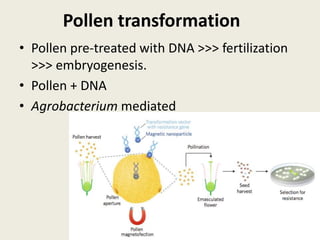
Pollen transformation
• Pollen pre-treated with DNA >>> fertilization
>>> embryogenesis.
• Pollen + DNA
• Agrobacterium mediated
Pollen magnetofection for genetic
modification with magnetic
nanoparticles as gene carriers
• The ability to generate transgenic plants has revolutionised plant
science research. However, many species and genotypes remain
challenging and time-consuming to transform. Zhao et al. provide a
novel and potentially ground-breaking method of transgene
delivery. In the presence of a magnetic field, iron oxide
nanoparticles coated with plasmid DNA entered pollen grains
through apertures in the pollen wall. Artificial pollination with
‘magnetofected’ pollen yielded transgenic seed, with the transgene
stably integrating into the host genome. Using this method, the
authors generated transgenic cotton plants expressing the
insecticidal Bt toxin, as-well-as transgenic pumpkin (Cucurbita
moschata) and pepper (Cucurbita pepo L.) plants, marking a
breakthrough for these recalcitrant species.
Pollen magnetofection for genetic modification with magnetic nanoparticles as gene carriers December 1,
2017/in Blog, Research, Research Blog, What We're Reading This Week /by Mike Page
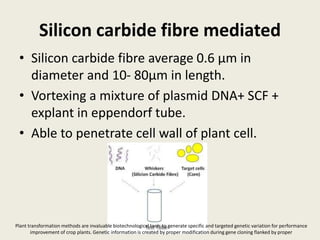
Silicon carbide fibre mediated
• Silicon carbide fibre average 0.6 µm in
diameter and 10- 80µm in length.
• Vortexing a mixture of plasmid DNA+ SCF +
explant in eppendorf tube.
• Able to penetrate cell wall of plant cell.
Plant transformation methods are invaluable biotechnological tools to generate specific and targeted genetic variation for performance
improvement of crop plants. Genetic information is created by proper modification during gene cloning flanked by proper
• The conventional plant transformation methods are
biological transfer method through Agrobacterium and
physical or chemical gene transfer methods like gene
gun etc. are used to produce plants of desired traits.
• These methods have been successfully used to
transform agronomically important genes to many crop
plants whose tissue culture system has already been
established.
• But, the disadvantages of tissue culture based
transformation methods are time consuming and leads
soma clonal variation that affect both qualitative and
quantitative characters of plants. The direct
transformation method without any tissue culture
steps is termed as ‘‘in-planta’’ transformation.
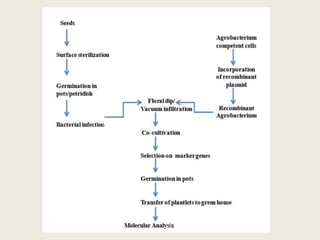
• The direct transformation method without any
tissue culture steps is termed as ‘‘in-planta’’
transformation.
• The production a large number of uniform
plants in short time, less labor efforts and
minimal reagents requirements are some of
main advantages of in-planta transformation
system.
Vaccum Infilteration Method
• In early experiments this method was used
and is based on the infection of flowering
plants through Agrobacterium cell
suspension, followed by regeneration of
plants, harvesting and selection of transgenic
plants on screening media containing marker
genes such as antibiotic and herbicides
resistant genes. Stable transgenic plants with
lower transformation frequency were
produced through this method.
Floral Dip Method
• In other experiment the floral parts of flower
buds are dipped in Agrobacterium culture to
produce transgenic plants. This method is
commonly known as floral dip method. This
method is quick, reliable and free from
microbial attacks. The disadvantages of floral
dip methods are their low transformation
efficiency and random integration of foreign
gene into host genome.
In-Planta Transformation in Cereal
Crops
a) The young, mid and late uninucleated microspores of spikes
were immersed in Agrobacterium suspension via infiltration
method and the resulted plantlets were selected with
paromomycin spray to whole plants. The transgenic plants
remain green while the non-transgenic plants die with
screening marker. The resulted transgenic plants showed very
low level of transgene expression.
b) The syringes containing the Agraobacterium suspension was
injected to apical meristem and florets followed by co-
cultivation on filter paper. The resulted transgenic plants were
screened with kanamycin and GUS assay. The results revealed
that 27% of transgenic plants show positive GUS activity and
26% of transgenic plants give positive PCR amplification.
c) The needle was dipped in the Agrobacterium suspension
and pinched on the top of young embryo. The young embryo
was then grown on filter paper and kept in dark for few days.
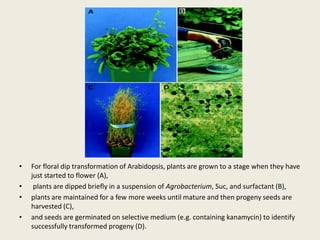
• For floral dip transformation of Arabidopsis, plants are grown to a stage when they have
just started to flower (A),
• plants are dipped briefly in a suspension of Agrobacterium, Suc, and surfactant (B),
• plants are maintained for a few more weeks until mature and then progeny seeds are
harvested (C),
• and seeds are germinated on selective medium (e.g. containing kanamycin) to identify
successfully transformed progeny (D).
References
• Thirty years of plant transformation A case study exploring
the impact of plant transformation technology on plant
science research and the global agricultural biotechnology
industry
• In-planta transformation: recent advances Received for
publication, October 12, 2014 Accepted, August 11, 2015
• SOHAIL AHMAD JAN1*, ZABTA KHAN SHINWARI1, SABIR
HUSSAIN SHAH2, ARMGHAN SHAHZAD3, MUHAMMAD
AMIR ZIA3, NAZIR AHMAD3 1Department of Biotechnology,
Quaid-i- Azam University, Islamabad, Pakistan;
2Department of Agricultural Sciences, Allama Iqbal Open
University, Islamabad, Pakistan; 3National Institute for
Genomics and Advanced Biotechnology (NIGAB), NARC,
Islamabad, Pakistan;
Thank you

Recent developments in plant transformation strategies

  • 1.
    RECENT DEVELOPMENTS INPLANT TRANSFORMATION STRATEGIES
  • 2.
    What is transformation •Transformation is the genetic alteration of a cell resulting from the direct uptake and incorporation of exogenous genetic material from its surrounding and taken up through the plama membrane. • Transgenic plants are produced by transformation and stable integration of foreign gene into the plant genome.
  • 4.
  • 5.
    • In 1983researchers demonstrated that they could insert new genes into a plant genome, using a species of soil bacteria called Agrobacterium tumefaciens.
  • 6.
    AGROBACTERIUM MEDIATED GENE TRANSFER •It is one of the most ancient and still accepted tool for transformation in plants. • It can be achieved through two ways: a. Coculture with tissue explant b. Agroinfection
  • 7.
    • 1974: MarcVan Montagu and Jeff Schell at Ghent University show that Agrobacterium uses a plasmid, known as the Ti plasmid, to transfer its genetic material into a plant cell. • 1979: Dick Flavell is the first researcher anywhere in the world to successfully clone plant DNA. • 1983: Three groups, including Mike Bevan and Dick Flavell published research papers demonstrating that they can stably introduce and express bacterial genes into a plant genome. • 1987: Creation of the GUS reporter system by Richard Jefferson and Mike Bevan. The paper describing their work is now the most highly-cited plant transformation paper to date. Thirty years of plant transformation A case study exploring the impact of plant transformation technology on plant science research and the global agricultural biotechnology industry
  • 8.
    Co-culture with tissueexplants • Gene construct inserted within the region of T-region of either co-integrate or a binary vector. • Recombinant DNA is placed in Agrobacterium. • Co-cultured for about 2 days with plant tissue. • Transformed plants are selected onto regeneration media. • The shoots are separated and rooted and finally transferred into soil.
  • 9.
    • Agrobacterium doesinfect monocot plant species and form crowngalls, eg. Asparagus or induces swelling in Chlorophytum, Allium cepa, Narcissus. • Efficient transformation of monocot cells can be obtained by providing acetosyringone during the co- culture of plant cell with Agrobacterium. • Some maize variety secrete DIMBOA which inhibit the induction of vir operon by acetosyringone.
  • 11.
    AGROINFECTION • Introduction ofa viral genome into plant cells by placing it within the T-DNA of a Ti plasmid, and using agrobacterium containing this plasmid for coculture with plant cells is called agroinfection. • Maize streak virus, wheat dwarf virus.
  • 12.
    AGROINFECTION • MSV (MaizeStreak Virus) genome has been successfully introduced into plant cell by inserting it within the TDNA in the form of tandem dimer. • Agrobacterium containing this recombinant pTi was used to infect maize, which develop streak on their leaves within 2 weeks of inoculation. • This proved that Agrobacterium is capable to transfer DNA in maize. • Cloned MSV is fully functional in infection.
  • 13.
    Plant/ Seedling Explant Transformed cell/tissue Callus Direct shoot induction embryo shoot Putative transformed plants Screening for transformed plant in next generation Physical/ chemical methods Delivery of DNA Selectionand regeneration Testing using PCR and southern blotting
  • 14.
    Chemical methods: • PEGmediated • DEAE- dextran • Calcium phosphate • Artificial lipids
  • 15.
    PEG mediated 1. Protoplastisolation in the form of suspension 2. Taken in a test tube followed by addition of plasmid DNA 3. To this 40% PEG dissolved in mannitol and calcium nitrate solution is slowly added because of high viscosity 4. This mixture is incubated for 5 min. 5. Testing 6. Regeneration Efficient transformation of Arabidopsis thaliana using direct gene transfer to protoplasts. Transgenic Arabidopsis plants resistant to hygromycin B have been regenerated from mesophyll protoplasts treated with polyethylene glycol and plasmid DNA carrying the hygromycin phosphotransferase (HPT) gene under the control of the 35 S promoter of cauliflower mosaic virus. Transformation experiments performed with a selectable and a non-selectable gene on separate plasmids resulted in a co-transformation rate of functionally active copies in about 25% of the transformants analysed. Hence this approach can be used to introduce non-selectable genes into the Arabidopsis genome. Efficient transformation of Arabidopsis thaliana using direct gene transfer to protoplasts.1989 May;217(1):6-12.
  • 16.
    Calcium phosphate • DNAmixed with calcium choride solution and isotomic phosphate buffer to form DNA CaPO4 precipitate. • The ppt is allowed to react with actively dividing cells for several hours • Washed and incubated in fresh culture medium
  • 17.
    • Tomato protoplastDNA transformation: physical linkage and recombination of exogenous DNA sequences. • Tomato protoplasts have been transformed with plasmid DNA's, containing a chimeric kanamycin resistance gene and putative tomato origins of replication. A calcium phosphate- DNA mediated transformation procedure was employed in combination with either polyethylene glycol or polyvinyl alcohol.
  • 18.
    Artificial lipids • Liposomesare artificial lipids vesicles surrounded by synthetic membrane of phospholipid. • The positively charged lipids and liposomes are thought to improve transgene delivery mainly through binding to and condensing negatively charged DNA, forming a complex called lipoplex in which the DNA is protected against extracellular degradation. • Moreover, the positively charged lipoplex binds to the negatively charged cell surface molecules facilitating endocytosis. • Release of plasmid inside the cell.
  • 19.
  • 20.
    Physical method • Electroporation •Particle gun delivery • Microinjection • Macroinjection • Pollen transformation • Ultra sound mediated • Laser induced • Silicon carbide fibre mediated • Origami based technique • Nanotechnology aided delivery(nanoclay, nansheets, nanocapsule)
  • 21.
    ELECTROPORATION • Electric impulsesof high field strength are used to reversibily permeabilize cell membrane to facilitate uptake of large molecules.
  • 22.
  • 23.
    Genetic transformation ofplants by protoplast electroporation • This article describes an optimized protocol for the electroporation of tobacco mesophyll protoplasts together with notes and data on the effects of various parameters and suggestions for work with protoplasts of other species. In this protocol, electroporation is achieved by means of electrical pulses from a high- voltage, capacitive-discharge unit. Procedures are described for measurement of protoplast viability with Evan's blue, the detection of transient expression of CAT and GUS gene plasmid constructs, and for the recovery of stable transformants based on selection for kanamycin resistance. 1994 Oct;2(2):135-45.
  • 24.
    Particle gun delivery •Particle bombardment/ biolistic/ microprojectile. • Most versatile and effective. • DNA bearing tungsten or gold particles is accelerated into living plant cells.
  • 25.
    • Microprojectile: DNA bearingparticles • Marocarrier : carry these particles • Stopping plate: • Rupture disc: blocks the entry of helium • Metal screen • Stoppable plates: allow only microprojectile
  • 26.
    Microinjection • Mechanical introductionof DNA under microscopical control into a specific region. • It is able to penetrate intact cell wall host range independent
  • 27.
    Macroinjection • Injection ofDNA solution (5-10 µl) by micropipette into developing floral side shoots of plant. • These tillers have archaesporial cell that give rise to pollen in developing sac by meiotic cell division.
  • 28.
    Ultra sound mediated •To stimulate uptake of foreign DNA by plant protoplast and leaf segment of tobacco. • Immersion of explant in sonication buffer containing plasmid DNA • Sonication with ultrasonic pulse generator at 0.5w/cm² for 30 min. • Regeneration and differentiation.
  • 29.
    Pollen transformation • Pollenpre-treated with DNA >>> fertilization >>> embryogenesis. • Pollen + DNA • Agrobacterium mediated
  • 30.
    Pollen magnetofection forgenetic modification with magnetic nanoparticles as gene carriers • The ability to generate transgenic plants has revolutionised plant science research. However, many species and genotypes remain challenging and time-consuming to transform. Zhao et al. provide a novel and potentially ground-breaking method of transgene delivery. In the presence of a magnetic field, iron oxide nanoparticles coated with plasmid DNA entered pollen grains through apertures in the pollen wall. Artificial pollination with ‘magnetofected’ pollen yielded transgenic seed, with the transgene stably integrating into the host genome. Using this method, the authors generated transgenic cotton plants expressing the insecticidal Bt toxin, as-well-as transgenic pumpkin (Cucurbita moschata) and pepper (Cucurbita pepo L.) plants, marking a breakthrough for these recalcitrant species. Pollen magnetofection for genetic modification with magnetic nanoparticles as gene carriers December 1, 2017/in Blog, Research, Research Blog, What We're Reading This Week /by Mike Page
  • 31.
    Silicon carbide fibremediated • Silicon carbide fibre average 0.6 µm in diameter and 10- 80µm in length. • Vortexing a mixture of plasmid DNA+ SCF + explant in eppendorf tube. • Able to penetrate cell wall of plant cell. Plant transformation methods are invaluable biotechnological tools to generate specific and targeted genetic variation for performance improvement of crop plants. Genetic information is created by proper modification during gene cloning flanked by proper
  • 32.
    • The conventionalplant transformation methods are biological transfer method through Agrobacterium and physical or chemical gene transfer methods like gene gun etc. are used to produce plants of desired traits. • These methods have been successfully used to transform agronomically important genes to many crop plants whose tissue culture system has already been established. • But, the disadvantages of tissue culture based transformation methods are time consuming and leads soma clonal variation that affect both qualitative and quantitative characters of plants. The direct transformation method without any tissue culture steps is termed as ‘‘in-planta’’ transformation.
  • 33.
    • The directtransformation method without any tissue culture steps is termed as ‘‘in-planta’’ transformation. • The production a large number of uniform plants in short time, less labor efforts and minimal reagents requirements are some of main advantages of in-planta transformation system.
  • 35.
    Vaccum Infilteration Method •In early experiments this method was used and is based on the infection of flowering plants through Agrobacterium cell suspension, followed by regeneration of plants, harvesting and selection of transgenic plants on screening media containing marker genes such as antibiotic and herbicides resistant genes. Stable transgenic plants with lower transformation frequency were produced through this method.
  • 36.
    Floral Dip Method •In other experiment the floral parts of flower buds are dipped in Agrobacterium culture to produce transgenic plants. This method is commonly known as floral dip method. This method is quick, reliable and free from microbial attacks. The disadvantages of floral dip methods are their low transformation efficiency and random integration of foreign gene into host genome.
  • 37.
    In-Planta Transformation inCereal Crops a) The young, mid and late uninucleated microspores of spikes were immersed in Agrobacterium suspension via infiltration method and the resulted plantlets were selected with paromomycin spray to whole plants. The transgenic plants remain green while the non-transgenic plants die with screening marker. The resulted transgenic plants showed very low level of transgene expression. b) The syringes containing the Agraobacterium suspension was injected to apical meristem and florets followed by co- cultivation on filter paper. The resulted transgenic plants were screened with kanamycin and GUS assay. The results revealed that 27% of transgenic plants show positive GUS activity and 26% of transgenic plants give positive PCR amplification. c) The needle was dipped in the Agrobacterium suspension and pinched on the top of young embryo. The young embryo was then grown on filter paper and kept in dark for few days.
  • 39.
    • For floraldip transformation of Arabidopsis, plants are grown to a stage when they have just started to flower (A), • plants are dipped briefly in a suspension of Agrobacterium, Suc, and surfactant (B), • plants are maintained for a few more weeks until mature and then progeny seeds are harvested (C), • and seeds are germinated on selective medium (e.g. containing kanamycin) to identify successfully transformed progeny (D).
  • 40.
    References • Thirty yearsof plant transformation A case study exploring the impact of plant transformation technology on plant science research and the global agricultural biotechnology industry • In-planta transformation: recent advances Received for publication, October 12, 2014 Accepted, August 11, 2015 • SOHAIL AHMAD JAN1*, ZABTA KHAN SHINWARI1, SABIR HUSSAIN SHAH2, ARMGHAN SHAHZAD3, MUHAMMAD AMIR ZIA3, NAZIR AHMAD3 1Department of Biotechnology, Quaid-i- Azam University, Islamabad, Pakistan; 2Department of Agricultural Sciences, Allama Iqbal Open University, Islamabad, Pakistan; 3National Institute for Genomics and Advanced Biotechnology (NIGAB), NARC, Islamabad, Pakistan;
  • 41.

Editor's Notes

  • #9 Carbenicillin- kill Agrobacterium