Questioned
Documents
FRS
401
Definition
s
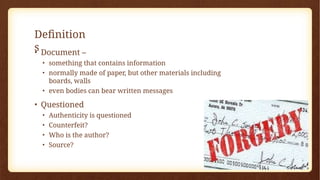
• Document –
• something that contains information
• normally made of paper, but other materials including
boards, walls
• even bodies can bear written messages
• Questioned
• Authenticity is questioned
• Counterfeit?
• Who is the author?
• Source?
Two levels of
information
• Superficial
• where what is conveyed by the document is expressed in writing,
typewriting, or
printing, or a combination
• Deeper
• other, less obvious, evidence can be found
• The main area of interest
• identity of the writer
• the source of the typewriting or printing
• the presence of traces of erased entries
Evidence that can be obtained from a
document
• A connection between a crime and an individual
• the exclusion of that individual from the investigation,
can be
established.
• Author
• Authenticity
• Age
Analysi
s
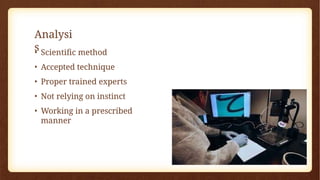
• Scientific method
• Accepted technique
• Proper trained experts
• Not relying on instinct
• Working in a prescribed
manner
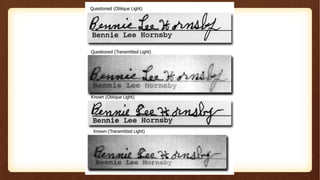
1. Documents with questioned
signatures.
• any one of the ordinary commercial or legal papers such as a
check, note, receipt, draft, order, contract, assignment, will,
deed, or similar paper
• the signature of which is under suspicion.
• In this class are found
• the traced forgery
• the forgery produced by the simulating or copying process.
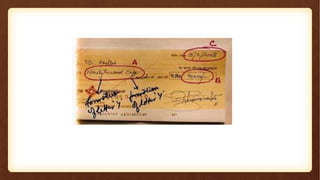
2. Documents containing alleged
fraudulent alterations
• all those in which it is alleged some alteration has been made by
• erasure, addition, interlineation or substitution by reason of which the effect or value of the
document is
materially changed.
• In connection with this class of documents questions may arise regarding
• the order or sequence of writing as shown by crossed lines
• age of writing
• continuity of writing
• erasures and changes,
• identity of ink
• identity of pen
• pen condition
• under certain conditions, the question may arise whether writing preceded or followed the folding
of the paper.
• This important class of questioned documents also includes all varieties of "raised"
checks, drafts and notes as well as fraudulent interlineations in contracts, deeds, wills
and other legal papers.
3. Holograph documents questioned or
disputed.
• Watermarks
• Seals
• Tickets of many kinds are frequently forged or
counterfeited
• rare stamps
• valuable manuscripts
• Certificates
• letters of introduction and recommendation,
• Diplomas
• marriage certificates, marriage contracts,
• court papers
• autographs and letters of famous people
4. Documents attacked on the question of their
age or date.
• in which the age of an instrument or the age of some
part of it is investigated
• a paper in which the comparative age of different parts may
have some bearing on the question of its genuineness.
• purport to be ancient documents of great importance
• it is usually claimed, were found in some strange place
or under peculiar conditions
5. Documents attacked on the question of
materials used in their production
• Documents have frequently been shown to be false because
they were dated many years before the paper was made on
which they were written
• type printed forms
• lithographed forms
• Typewriting
• Seals
• Envelopes
• stamps, or any tangible thing that may have a date value
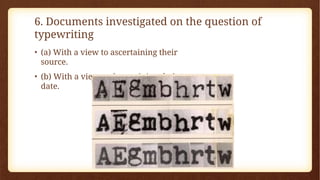
6. Documents investigated on the question of
typewriting
• (a) With a view to ascertaining their
source.
• (b) With a view to determining their
date.
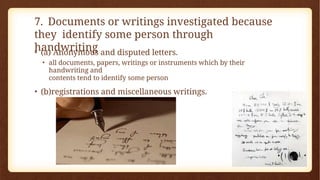
7. Documents or writings investigated because
they identify some person through
handwriting
• (a) Anonymous and disputed letters.
• all documents, papers, writings or instruments which by their
handwriting and
contents tend to identify some person
• (b)registrations and miscellaneous writings.
Preliminary
examination
• systematic approach
• standard method of operation assures
• that a complete analysis is conducted methodically
• meets the requirements for expert testimony, according to
Daubert.
First
step
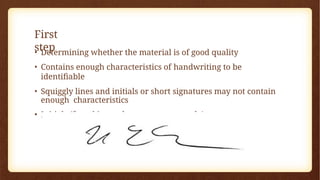
• Determining whether the material is of good quality
• Contains enough characteristics of handwriting to be
identifiable
• Squiggly lines and initials or short signatures may not contain
enough characteristics
• Initials (found in teachers most commonly)
Second Step – only if sufficient characteristics can
be found
• Exemplar collection (Standard writing)
• determine if they are suitable for comparison with the
questioned
material.
• must be representative of the writer
• written under similar conditions as the questioned material
within a
reasonable time frame.
Exemplar
Parameters
• should come from an environment similar to that of the
questioned material
• should reflect the physical and mental condition of the
writer at the time of the questioned writing
• should have been written before the questioned material
and some shortly after
• should contain suitable material for comparison, such as
similar letter combinations and spacing
• all of the exemplars are genuine
Factors to be kept in
mind
• Mechanical factors such as
• writing instrument
• type of paper
• writing surface
• amount of light used.
• Physical factors incorporate
• health of the writer, both physical and mental
• any handicaps or accidents affecting the writing hand
• whether the writer was under the influence of drugs or alcohol.
• amount of formal education of the writer in order to identify the
skill level.
Initial
examination
• search for obvious signs of forgery in the questioned material.
• simple forgery is generally the easiest type of forgery to
identify
• determine if there is any evidence of self-disguise (if there are
no signs of forgery)
Basic tools needed for
forensic documents’
examination
UV
Ultraviolet
fluorescence
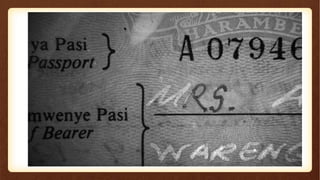
• can be used as a means for testing whether two or more
pieces are similar or different
• materials, such as glues, adhesive tapes, and sealing waxes, can
also be distinguished by their fluorescences
• application of solvents or chemicals to paper can
cause the fluorescence to change
• some differences between inks
• Invisible inks
• writing that has been erased
• 10-400nm in wavelength of the electromagnetic
spectrum
• Three types
• Short wavelength – 180-280
• Sterilization, chromatography, etc
• Medium wavelength -280-320
• Cosmetic and therapeutic purpose
• Long wavelength – 320-400
• Beneficial for forensic examination
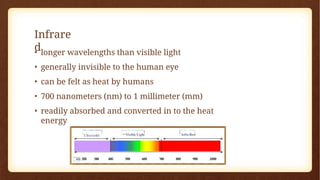
Infrare
d
• longer wavelengths than visible light
• generally invisible to the human eye
• can be felt as heat by humans
• 700 nanometers (nm) to 1 millimeter (mm)
• readily absorbed and converted in to the heat
energy
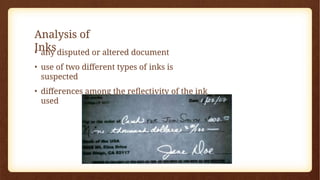
Analysis of
Inks
• any disputed or altered document
• use of two different types of inks is
suspected
• differences among the reflectivity of the ink
used
Analysis of Obliterated
Writings
• using correction fluid and then over-writing
• by damaging the previous text and then over-writing
• One ink will be opaque and other will be transparent at
certain wavelength
Examination of
Erasures
• Small particles of the ink or pencil often linger in the
outline when writing is erased mechanically
• Cancellation Marks
• The cancelation mark residues may not be visible duets the stamp's dark
background. An infrared photograph may reveal the remains of previous
marks of cancellation.
• Water Damaged
• the residual ink in the paper fluoresced in the infrared and this can be
recorded further to decipher the written matter.
ESD
A
Electrostatic detection
apparatus
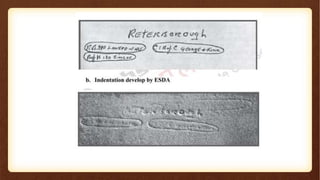
• to decipher indentations or impressions in paper.
• a non-destructive technique
• capable of detecting indentations or impressions or sub-
surface writings created on pages which are several layers
beneath the top- most sheet.
Indented
writing
• writing that is formed to a sheet of paper underneath the one
on which the original writing was done.
• he pressure exerted by the pen or pencil is sufficient to
indent the papers beneath
• partially visible depressions
• he indented writing would appear as a carbon copy of the
top sheet
Working of
ESDA
• Plastic sheet and questioned document with some toner
• Put in vacuum
• Charge is applied
• Difference in charge on the plastic sheet corresponding
to the indentations of the questioned document
• Toner goes and rests there creating a carbon image of the
indentations marks.
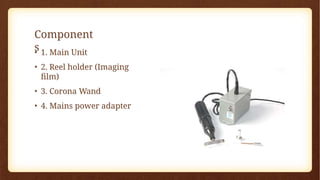
Component
s
• 1. Main Unit
• 2. Reel holder (Imaging
film)
• 3. Corona Wand
• 4. Mains power adapter
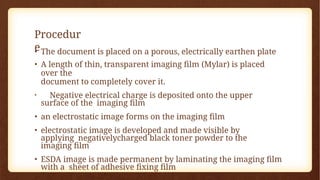
Procedur
e
• The document is placed on a porous, electrically earthen plate
• A length of thin, transparent imaging film (Mylar) is placed
over the
document to completely cover it.
• Negative electrical charge is deposited onto the upper
surface of the imaging film
• an electrostatic image forms on the imaging film
• electrostatic image is developed and made visible by
applying negativelycharged black toner powder to the
imaging film
• ESDA image is made permanent by laminating the imaging film
with a sheet of adhesive fixing film
USE
S
• Cheque Forgery-: In this category of forgery, possibility of cheque book
in the
hands of awful people can be there. The person can forge the
signature on
cheque and withdraw the money. In such a case we can examine
second
cheque for any indentations present.
• Traced Forgery-: Traced forgery can be done by tracing signature or
handwriting impressed on second page. The forger will follow the
pattern of
indentation of signature or handwriting to forge the signature or
handwriting
of someone. In this case deciphering of traced forgery can be
done using ESDA.
• Ransom note existence can be determined from the source of
indentations by deciphering it on another piece of paper (culprit’s
notepad) in case written.
• An anonymous letter may bear impressions of writings that relate to
Handwriti
ng
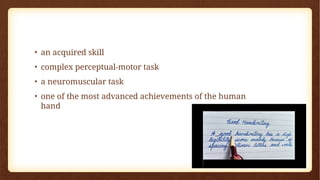
• an acquired skill
• complex perceptual-motor task
• a neuromuscular task
• one of the most advanced achievements of the human
hand
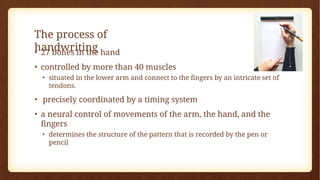
The process of
handwriting
• 27 bones in the hand
• controlled by more than 40 muscles
• situated in the lower arm and connect to the fingers by an intricate set of
tendons.
• precisely coordinated by a timing system
• a neural control of movements of the arm, the hand, and the
fingers
• determines the structure of the pattern that is recorded by the pen or
pencil
Development of
writing
• culture dependent
• cultures differ with locales
• undergo constant change
• class, system, or national
characteristics
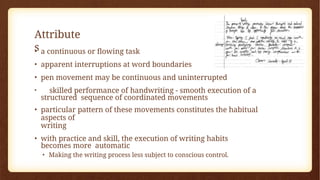
Attribute
s
• a continuous or flowing task
• apparent interruptions at word boundaries
• pen movement may be continuous and uninterrupted
• skilled performance of handwriting - smooth execution of a
structured sequence of coordinated movements
• particular pattern of these movements constitutes the habitual
aspects of
writing
• with practice and skill, the execution of writing habits
becomes more automatic
• Making the writing process less subject to conscious control.
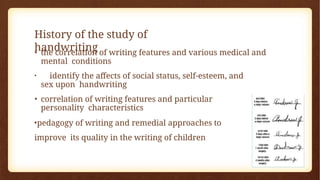
History of the study of
handwriting
• the correlation of writing features and various medical and
mental conditions
• identify the affects of social status, self-esteem, and
sex upon handwriting
• correlation of writing features and particular
personality characteristics
•pedagogy of writing and remedial approaches to
improve its quality in the writing of children
Principles of
Handwriting
• No two people write exactly alike
• all writing contains natural variation so that no two writing
samples by
the same writer will be exactly the same
• Writing is a complex act and a highly developed skill. Many
influences affect the development of each person’s writing
ability, resulting in the unique style of each individual writer
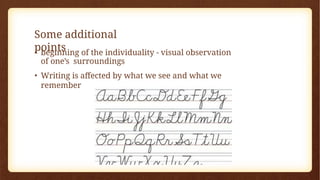
Some additional
points
• beginning of the individuality - visual observation
of one’s surroundings
• Writing is affected by what we see and what we
remember
Factors that help in mastering
handwriting
• powers of observation
• the ability to remember the forms
• attempt to reproduce the forms observed.
• ability to overcome the mechanical and physical
impediments to writing
• placing the paper at the proper angle
• holding the paper in place with one hand to steady it while writing
with the other,
• learning to control the pen or pencil and direct the movements
• Choosing a pen that you are comfortable with
Natural variations in
Handwriting
• graphic maturity - Once a writer has reached the permanent
condition of automatic writing
• Continues until some physical or mental disturbance interferes
• Robert Saudek[ states that a person is capable of writing fluently,
easily, and automatically only under the following conditions:
1.The writer is familiar with the letters so that mention of a letter
conjures a graphic image of that letter in his or her mind.
2.The writer has control of the writing instrument and the mechanical
factors of the paper, pen, and writing surface do not interfere with the
writing.
3. The writer is free of any physical impediment that would hinder
writing.
4.The writer knows how to spell the words and does not have to
concentrate on the spelling.
5. The writer is writing in his or her native language.
Basic factors that influence
writing
• MECHANICAL FACTORS
• change of body position
• Lighting
• type of pen and paper
• writing surface
• TIME SPAN
• changes over the course of one’s life.
• from childhood to adolescence
• change again when one reaches adulthood
• until one reaches graphic maturity
• decline as the aging process reduces one’s skill
level
• HEALTH
• BLINDNESS
• MENTAL HEALTH
• DRUGS AND MEDICATION
• ALCOHOL AND DRUG
ABUSE
• ACCIDENTALS
• GUIDED HAND
• TREMOR IN HANDWRITING
Determining the age
and relative age of
documents
• is not as old as it purports to be
• whether a document is actually as old as its date would indicate
• to show the probable date of an undated document
• whether several documents, or several writings bearing
different dates, are not actually of the same age
Pape
r
• when the paper was first manufactured
• the manufacturer of the paper must be known
• the manufacturer must have records that disclose when
certain combinations of materials were first introduced
• watermark found in better grades of writing, typing, and
computer
printing papers
• Few watermarks include a dating code that allows the
manufacturer to determine the year in which the paper was
made
• Records are generally available
• changes in design of the watermark or by defects developed
over time in the watermark dandy roll – help in dating
documents or proving the dates fraudulent
• Making watermarks – a simple process- ht
tps://www.youtube.com
/watch?v=QQwTblKyU8g
Writing
Inks
• During the 20th century a number of new chemicals were
developed and used in the production of writing inks.
• new classes of inks have been developed for use in a variety of
pens now on the market, including ballpoint, roller ball,
porous tip and gel
• Their presence on a document of a particular date may be
inconsistent with the earliest availability of the writing ink or
pen
• In the early 1970s rare-earth elements, and later special
chemicals, were added to some inks in order to tag them for
identification and dating purposes
• The rare-earth component was dropped early on due to problems in
detecting their presence and other analytical problems.
• Extensive ink reference libraries have been developed by
government laboratories in the U.S. and overseas as well as by a
small number of private practitioners
• The application of TLC allows for the differentiation of the
various dye components that make up the ink’s color.
• The results can be compared with the ink reference library and
probable matches made, which may allow the document
examiner to establish the earliest date of commercial availability.
• These reference specimens are most helpful in proving that a
document could not have been written on a certain date because the
ink was not then available.
Photocopiers and
Printers
• earliest copier models used a liquid toner
• later years dry toner became the standard
• advances in inkjet technology
• Dot matrix technology has, to some extent, fallen by the way
• It may be possible to determine that a document could not have
been produced on the date suggested based on the availability
of the copying or printing process at that time.
Pape
r
• Egyptians used papyrus as a writing surface.
• To make papyrus, they mashed reeds together into a flat sheet
of pulp
and dried them.
• They mixed soot with water as ink and sharpened a reed into
a pen to write on the papyrus.
• https://www.youtube.com/watch?v=sO72jfUCYSg
• Vellum was created as a writing surface from the skin of calves.
It came into use in the second century BC
• paper from the inner bark of bamboo and hemp
• The Arabs learned to make paper when they conquered the
Chinese in 751
• Eleven hundred years later Europeans began making
paper, using cotton and linen as the base
• William Rittenhouse of Roxborough, PA founded the first
paper plant in America in 1690.
• Today most paper is made from wood pulp and may
contain some cotton.
• Higher quality paper uses cotton rag
• a scientific process that employs highly sophisticated
equipment in the manufacture of thousands of varieties of
paper
• chipping pulpwood into small pieces that are then mixed
with chemicals and fed into pressure vessels called digesters
to soften the lignin, which binds the fibers together. In this
cooking process, the cellulose fibers are separated.
• They proceed through several stages of washing, screening,
cleaning, and, if necessary, bleaching to the desired
brightness.
• Next, the fibers are combined with pigments, dyes, and sizing.
This mixture is more than 99% water and less than 1% fiber
and other solids. It flows onto a moving screen called a
Fourdrinier, on which the fibers mat, forming a continuous
sheet of paper with much of the water drawn through the
screen into collection tanks to be recycled.
• The web of pulp passes through heavy rollers, which press
moisture from the sheet.
• This sheet proceeds over steam-heated cylinders to
complete the drying stage through the evaporation of the
water.
• Frequently, a starch application or pigmented coating is applied
by a size press or coater. The paper then passes through a
series of calendar stacks (iron rollers stacked together) that
smooth the paper. The paper is rewound into smaller rolls or
converted into sheets ready for shipment.
Water
mark
• During the pressing process the paper passes over a dandy
roll, which imprints the watermark on the paper.
• The watermark is actually a thinner area of the paper.
• The dandy roll contains the design of the watermark in a
metal form, which pushes the paper fibers aside, leaving an
imprint in the paper.
• Most sheets of paper contain a single watermark, but some
paper, such
as safety paper, may contain multiple designs.
• The dandy roll also makes the imprint for woven or laid
papers, particularly rag bonds. Laid paper has a grid pattern
impressed in the paper
PAPER FOR PRINTING OR
WRITING
• Newsprint - is the least expensive paper manufactured. It is
composed mostly of ground wood, causing it to discolor easily.
Its principal asset is opacity, a result of the impurities of the
wood.
• Offset - an uncoated paper that usually contains fillers and
additives. It is bleached and sized to resist water. Cost is slightly
more than double the cost of newsprint. It is used for the
publication of books as well as catalog sheets, loose-leaf inserts,
and tablet paper.
• Bond paper - so named because it was originally used to
print stocks and bonds. It is popular in the modern business
office. Law firms frequently use high-quality bond paper.
• Lightweight, uncoated papers include onionskin, which
comes in smooth or cockle finishes, and snap-out forms,
which are frequently made with manifold papers made
from wood fibers. Another classification in lightweight
paper is “bible” paper
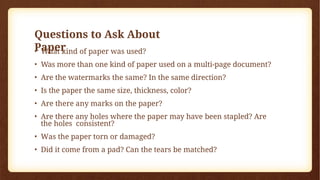
Questions to Ask About
Paper
• What kind of paper was used?
• Was more than one kind of paper used on a multi-page document?
• Are the watermarks the same? In the same direction?
• Is the paper the same size, thickness, color?
• Are there any marks on the paper?
• Are there any holes where the paper may have been stapled? Are
the holes consistent?
• Was the paper torn or damaged?
• Did it come from a pad? Can the tears be matched?
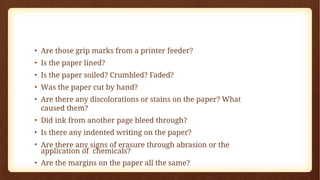
• Are those grip marks from a printer feeder?
• Is the paper lined?
• Is the paper soiled? Crumbled? Faded?
• Was the paper cut by hand?
• Are there any discolorations or stains on the paper? What
caused them?
• Did ink from another page bleed through?
• Is there any indented writing on the paper?
• Are there any signs of erasure through abrasion or the
application of chemicals?
• Are the margins on the paper all the same?

FRS 401.pptx lecture notes for undergradutes

  • 1.
  • 2.
    Definition s • Document – •something that contains information • normally made of paper, but other materials including boards, walls • even bodies can bear written messages • Questioned • Authenticity is questioned • Counterfeit? • Who is the author? • Source?
  • 3.
    Two levels of information •Superficial • where what is conveyed by the document is expressed in writing, typewriting, or printing, or a combination • Deeper • other, less obvious, evidence can be found • The main area of interest • identity of the writer • the source of the typewriting or printing • the presence of traces of erased entries
  • 4.
    Evidence that canbe obtained from a document • A connection between a crime and an individual • the exclusion of that individual from the investigation, can be established. • Author • Authenticity • Age
  • 5.
    Analysi s • Scientific method •Accepted technique • Proper trained experts • Not relying on instinct • Working in a prescribed manner
  • 6.
    1. Documents withquestioned signatures. • any one of the ordinary commercial or legal papers such as a check, note, receipt, draft, order, contract, assignment, will, deed, or similar paper • the signature of which is under suspicion. • In this class are found • the traced forgery • the forgery produced by the simulating or copying process.
  • 7.
    2. Documents containingalleged fraudulent alterations • all those in which it is alleged some alteration has been made by • erasure, addition, interlineation or substitution by reason of which the effect or value of the document is materially changed. • In connection with this class of documents questions may arise regarding • the order or sequence of writing as shown by crossed lines • age of writing • continuity of writing • erasures and changes, • identity of ink • identity of pen • pen condition • under certain conditions, the question may arise whether writing preceded or followed the folding of the paper. • This important class of questioned documents also includes all varieties of "raised" checks, drafts and notes as well as fraudulent interlineations in contracts, deeds, wills and other legal papers.
  • 9.
    3. Holograph documentsquestioned or disputed. • Watermarks • Seals • Tickets of many kinds are frequently forged or counterfeited • rare stamps • valuable manuscripts • Certificates • letters of introduction and recommendation, • Diplomas • marriage certificates, marriage contracts, • court papers • autographs and letters of famous people
  • 10.
    4. Documents attackedon the question of their age or date. • in which the age of an instrument or the age of some part of it is investigated • a paper in which the comparative age of different parts may have some bearing on the question of its genuineness. • purport to be ancient documents of great importance • it is usually claimed, were found in some strange place or under peculiar conditions
  • 11.
    5. Documents attackedon the question of materials used in their production • Documents have frequently been shown to be false because they were dated many years before the paper was made on which they were written • type printed forms • lithographed forms • Typewriting • Seals • Envelopes • stamps, or any tangible thing that may have a date value
  • 12.
    6. Documents investigatedon the question of typewriting • (a) With a view to ascertaining their source. • (b) With a view to determining their date.
  • 13.
    7. Documents orwritings investigated because they identify some person through handwriting • (a) Anonymous and disputed letters. • all documents, papers, writings or instruments which by their handwriting and contents tend to identify some person • (b)registrations and miscellaneous writings.
  • 14.
  • 15.
    • systematic approach •standard method of operation assures • that a complete analysis is conducted methodically • meets the requirements for expert testimony, according to Daubert.
  • 16.
    First step • Determining whetherthe material is of good quality • Contains enough characteristics of handwriting to be identifiable • Squiggly lines and initials or short signatures may not contain enough characteristics • Initials (found in teachers most commonly)
  • 17.
    Second Step –only if sufficient characteristics can be found • Exemplar collection (Standard writing) • determine if they are suitable for comparison with the questioned material. • must be representative of the writer • written under similar conditions as the questioned material within a reasonable time frame.
  • 18.
    Exemplar Parameters • should comefrom an environment similar to that of the questioned material • should reflect the physical and mental condition of the writer at the time of the questioned writing • should have been written before the questioned material and some shortly after • should contain suitable material for comparison, such as similar letter combinations and spacing • all of the exemplars are genuine
  • 19.
    Factors to bekept in mind • Mechanical factors such as • writing instrument • type of paper • writing surface • amount of light used. • Physical factors incorporate • health of the writer, both physical and mental • any handicaps or accidents affecting the writing hand • whether the writer was under the influence of drugs or alcohol. • amount of formal education of the writer in order to identify the skill level.
  • 20.
    Initial examination • search forobvious signs of forgery in the questioned material. • simple forgery is generally the easiest type of forgery to identify • determine if there is any evidence of self-disguise (if there are no signs of forgery)
  • 21.
    Basic tools neededfor forensic documents’ examination UV
  • 22.
    Ultraviolet fluorescence • can beused as a means for testing whether two or more pieces are similar or different • materials, such as glues, adhesive tapes, and sealing waxes, can also be distinguished by their fluorescences • application of solvents or chemicals to paper can cause the fluorescence to change • some differences between inks • Invisible inks • writing that has been erased
  • 23.
    • 10-400nm inwavelength of the electromagnetic spectrum • Three types • Short wavelength – 180-280 • Sterilization, chromatography, etc • Medium wavelength -280-320 • Cosmetic and therapeutic purpose • Long wavelength – 320-400 • Beneficial for forensic examination
  • 25.
    Infrare d • longer wavelengthsthan visible light • generally invisible to the human eye • can be felt as heat by humans • 700 nanometers (nm) to 1 millimeter (mm) • readily absorbed and converted in to the heat energy
  • 26.
    Analysis of Inks • anydisputed or altered document • use of two different types of inks is suspected • differences among the reflectivity of the ink used
  • 27.
    Analysis of Obliterated Writings •using correction fluid and then over-writing • by damaging the previous text and then over-writing • One ink will be opaque and other will be transparent at certain wavelength
  • 29.
    Examination of Erasures • Smallparticles of the ink or pencil often linger in the outline when writing is erased mechanically • Cancellation Marks • The cancelation mark residues may not be visible duets the stamp's dark background. An infrared photograph may reveal the remains of previous marks of cancellation. • Water Damaged • the residual ink in the paper fluoresced in the infrared and this can be recorded further to decipher the written matter.
  • 30.
  • 31.
    Electrostatic detection apparatus • todecipher indentations or impressions in paper. • a non-destructive technique • capable of detecting indentations or impressions or sub- surface writings created on pages which are several layers beneath the top- most sheet.
  • 32.
    Indented writing • writing thatis formed to a sheet of paper underneath the one on which the original writing was done. • he pressure exerted by the pen or pencil is sufficient to indent the papers beneath • partially visible depressions • he indented writing would appear as a carbon copy of the top sheet
  • 33.
    Working of ESDA • Plasticsheet and questioned document with some toner • Put in vacuum • Charge is applied • Difference in charge on the plastic sheet corresponding to the indentations of the questioned document • Toner goes and rests there creating a carbon image of the indentations marks.
  • 34.
    Component s • 1. MainUnit • 2. Reel holder (Imaging film) • 3. Corona Wand • 4. Mains power adapter
  • 35.
    Procedur e • The documentis placed on a porous, electrically earthen plate • A length of thin, transparent imaging film (Mylar) is placed over the document to completely cover it. • Negative electrical charge is deposited onto the upper surface of the imaging film • an electrostatic image forms on the imaging film • electrostatic image is developed and made visible by applying negativelycharged black toner powder to the imaging film • ESDA image is made permanent by laminating the imaging film with a sheet of adhesive fixing film
  • 36.
    USE S • Cheque Forgery-:In this category of forgery, possibility of cheque book in the hands of awful people can be there. The person can forge the signature on cheque and withdraw the money. In such a case we can examine second cheque for any indentations present. • Traced Forgery-: Traced forgery can be done by tracing signature or handwriting impressed on second page. The forger will follow the pattern of indentation of signature or handwriting to forge the signature or handwriting of someone. In this case deciphering of traced forgery can be done using ESDA. • Ransom note existence can be determined from the source of indentations by deciphering it on another piece of paper (culprit’s notepad) in case written. • An anonymous letter may bear impressions of writings that relate to
  • 38.
  • 39.
    • an acquiredskill • complex perceptual-motor task • a neuromuscular task • one of the most advanced achievements of the human hand
  • 40.
    The process of handwriting •27 bones in the hand • controlled by more than 40 muscles • situated in the lower arm and connect to the fingers by an intricate set of tendons. • precisely coordinated by a timing system • a neural control of movements of the arm, the hand, and the fingers • determines the structure of the pattern that is recorded by the pen or pencil
  • 41.
    Development of writing • culturedependent • cultures differ with locales • undergo constant change • class, system, or national characteristics
  • 42.
    Attribute s • a continuousor flowing task • apparent interruptions at word boundaries • pen movement may be continuous and uninterrupted • skilled performance of handwriting - smooth execution of a structured sequence of coordinated movements • particular pattern of these movements constitutes the habitual aspects of writing • with practice and skill, the execution of writing habits becomes more automatic • Making the writing process less subject to conscious control.
  • 43.
    History of thestudy of handwriting • the correlation of writing features and various medical and mental conditions • identify the affects of social status, self-esteem, and sex upon handwriting • correlation of writing features and particular personality characteristics •pedagogy of writing and remedial approaches to improve its quality in the writing of children
  • 44.
    Principles of Handwriting • Notwo people write exactly alike • all writing contains natural variation so that no two writing samples by the same writer will be exactly the same • Writing is a complex act and a highly developed skill. Many influences affect the development of each person’s writing ability, resulting in the unique style of each individual writer
  • 45.
    Some additional points • beginningof the individuality - visual observation of one’s surroundings • Writing is affected by what we see and what we remember
  • 46.
    Factors that helpin mastering handwriting • powers of observation • the ability to remember the forms • attempt to reproduce the forms observed. • ability to overcome the mechanical and physical impediments to writing • placing the paper at the proper angle • holding the paper in place with one hand to steady it while writing with the other, • learning to control the pen or pencil and direct the movements • Choosing a pen that you are comfortable with
  • 47.
  • 48.
    • graphic maturity- Once a writer has reached the permanent condition of automatic writing • Continues until some physical or mental disturbance interferes
  • 49.
    • Robert Saudek[states that a person is capable of writing fluently, easily, and automatically only under the following conditions: 1.The writer is familiar with the letters so that mention of a letter conjures a graphic image of that letter in his or her mind. 2.The writer has control of the writing instrument and the mechanical factors of the paper, pen, and writing surface do not interfere with the writing. 3. The writer is free of any physical impediment that would hinder writing. 4.The writer knows how to spell the words and does not have to concentrate on the spelling. 5. The writer is writing in his or her native language.
  • 50.
    Basic factors thatinfluence writing • MECHANICAL FACTORS • change of body position • Lighting • type of pen and paper • writing surface • TIME SPAN • changes over the course of one’s life. • from childhood to adolescence • change again when one reaches adulthood • until one reaches graphic maturity • decline as the aging process reduces one’s skill level • HEALTH • BLINDNESS
  • 51.
    • MENTAL HEALTH •DRUGS AND MEDICATION • ALCOHOL AND DRUG ABUSE • ACCIDENTALS • GUIDED HAND • TREMOR IN HANDWRITING
  • 53.
    Determining the age andrelative age of documents
  • 54.
    • is notas old as it purports to be • whether a document is actually as old as its date would indicate • to show the probable date of an undated document • whether several documents, or several writings bearing different dates, are not actually of the same age
  • 55.
    Pape r • when thepaper was first manufactured • the manufacturer of the paper must be known • the manufacturer must have records that disclose when certain combinations of materials were first introduced • watermark found in better grades of writing, typing, and computer printing papers • Few watermarks include a dating code that allows the manufacturer to determine the year in which the paper was made
  • 56.
    • Records aregenerally available • changes in design of the watermark or by defects developed over time in the watermark dandy roll – help in dating documents or proving the dates fraudulent • Making watermarks – a simple process- ht tps://www.youtube.com /watch?v=QQwTblKyU8g
  • 57.
    Writing Inks • During the20th century a number of new chemicals were developed and used in the production of writing inks. • new classes of inks have been developed for use in a variety of pens now on the market, including ballpoint, roller ball, porous tip and gel • Their presence on a document of a particular date may be inconsistent with the earliest availability of the writing ink or pen • In the early 1970s rare-earth elements, and later special chemicals, were added to some inks in order to tag them for identification and dating purposes
  • 58.
    • The rare-earthcomponent was dropped early on due to problems in detecting their presence and other analytical problems. • Extensive ink reference libraries have been developed by government laboratories in the U.S. and overseas as well as by a small number of private practitioners • The application of TLC allows for the differentiation of the various dye components that make up the ink’s color. • The results can be compared with the ink reference library and probable matches made, which may allow the document examiner to establish the earliest date of commercial availability. • These reference specimens are most helpful in proving that a document could not have been written on a certain date because the ink was not then available.
  • 59.
    Photocopiers and Printers • earliestcopier models used a liquid toner • later years dry toner became the standard • advances in inkjet technology • Dot matrix technology has, to some extent, fallen by the way • It may be possible to determine that a document could not have been produced on the date suggested based on the availability of the copying or printing process at that time.
  • 60.
  • 61.
    • Egyptians usedpapyrus as a writing surface. • To make papyrus, they mashed reeds together into a flat sheet of pulp and dried them. • They mixed soot with water as ink and sharpened a reed into a pen to write on the papyrus. • https://www.youtube.com/watch?v=sO72jfUCYSg
  • 62.
    • Vellum wascreated as a writing surface from the skin of calves. It came into use in the second century BC • paper from the inner bark of bamboo and hemp • The Arabs learned to make paper when they conquered the Chinese in 751 • Eleven hundred years later Europeans began making paper, using cotton and linen as the base • William Rittenhouse of Roxborough, PA founded the first paper plant in America in 1690.
  • 63.
    • Today mostpaper is made from wood pulp and may contain some cotton. • Higher quality paper uses cotton rag • a scientific process that employs highly sophisticated equipment in the manufacture of thousands of varieties of paper
  • 64.
    • chipping pulpwoodinto small pieces that are then mixed with chemicals and fed into pressure vessels called digesters to soften the lignin, which binds the fibers together. In this cooking process, the cellulose fibers are separated. • They proceed through several stages of washing, screening, cleaning, and, if necessary, bleaching to the desired brightness. • Next, the fibers are combined with pigments, dyes, and sizing. This mixture is more than 99% water and less than 1% fiber and other solids. It flows onto a moving screen called a Fourdrinier, on which the fibers mat, forming a continuous sheet of paper with much of the water drawn through the screen into collection tanks to be recycled.
  • 65.
    • The webof pulp passes through heavy rollers, which press moisture from the sheet. • This sheet proceeds over steam-heated cylinders to complete the drying stage through the evaporation of the water. • Frequently, a starch application or pigmented coating is applied by a size press or coater. The paper then passes through a series of calendar stacks (iron rollers stacked together) that smooth the paper. The paper is rewound into smaller rolls or converted into sheets ready for shipment.
  • 66.
    Water mark • During thepressing process the paper passes over a dandy roll, which imprints the watermark on the paper. • The watermark is actually a thinner area of the paper. • The dandy roll contains the design of the watermark in a metal form, which pushes the paper fibers aside, leaving an imprint in the paper. • Most sheets of paper contain a single watermark, but some paper, such as safety paper, may contain multiple designs. • The dandy roll also makes the imprint for woven or laid papers, particularly rag bonds. Laid paper has a grid pattern impressed in the paper
  • 67.
    PAPER FOR PRINTINGOR WRITING • Newsprint - is the least expensive paper manufactured. It is composed mostly of ground wood, causing it to discolor easily. Its principal asset is opacity, a result of the impurities of the wood. • Offset - an uncoated paper that usually contains fillers and additives. It is bleached and sized to resist water. Cost is slightly more than double the cost of newsprint. It is used for the publication of books as well as catalog sheets, loose-leaf inserts, and tablet paper. • Bond paper - so named because it was originally used to print stocks and bonds. It is popular in the modern business office. Law firms frequently use high-quality bond paper.
  • 68.
    • Lightweight, uncoatedpapers include onionskin, which comes in smooth or cockle finishes, and snap-out forms, which are frequently made with manifold papers made from wood fibers. Another classification in lightweight paper is “bible” paper
  • 69.
    Questions to AskAbout Paper • What kind of paper was used? • Was more than one kind of paper used on a multi-page document? • Are the watermarks the same? In the same direction? • Is the paper the same size, thickness, color? • Are there any marks on the paper? • Are there any holes where the paper may have been stapled? Are the holes consistent? • Was the paper torn or damaged? • Did it come from a pad? Can the tears be matched?
  • 70.
    • Are thosegrip marks from a printer feeder? • Is the paper lined? • Is the paper soiled? Crumbled? Faded? • Was the paper cut by hand? • Are there any discolorations or stains on the paper? What caused them? • Did ink from another page bleed through? • Is there any indented writing on the paper? • Are there any signs of erasure through abrasion or the application of chemicals? • Are the margins on the paper all the same?