NUCLEI ACID BASED
VIRUS INDEXING METHODS
INTRODUCTION
VIRUS INDEXING : A technology for the production of
quality planting material
What does ‘virus-indexed’ mean ?
A virus – indexed variety is one that has been tested
and deemed free of viruses it was tested for up to the point
of testing .
VIRAL GENOME BASED METHODS
 RT- PCR
 MULTIPLEX PCR & IMMUNO-CAPTURE PCR
 REAL TIME PCR
 NUCLEIC ACID BASED SPOT HYBRIDIZATION ( NASH)
 DNA MICROARRAY TECHNOLOGY
METHOD OF VIRUS INDEXING
1. PHYSICAL ASSAY : Electron microscopy
2. BIOLOGICAL INDEXING : Sap transmission test
3. MOLECULAR INDEXING : Nucleic acid based and
protein based ( Serological assay )
REVERSE TRANSCRIPTASE PCR
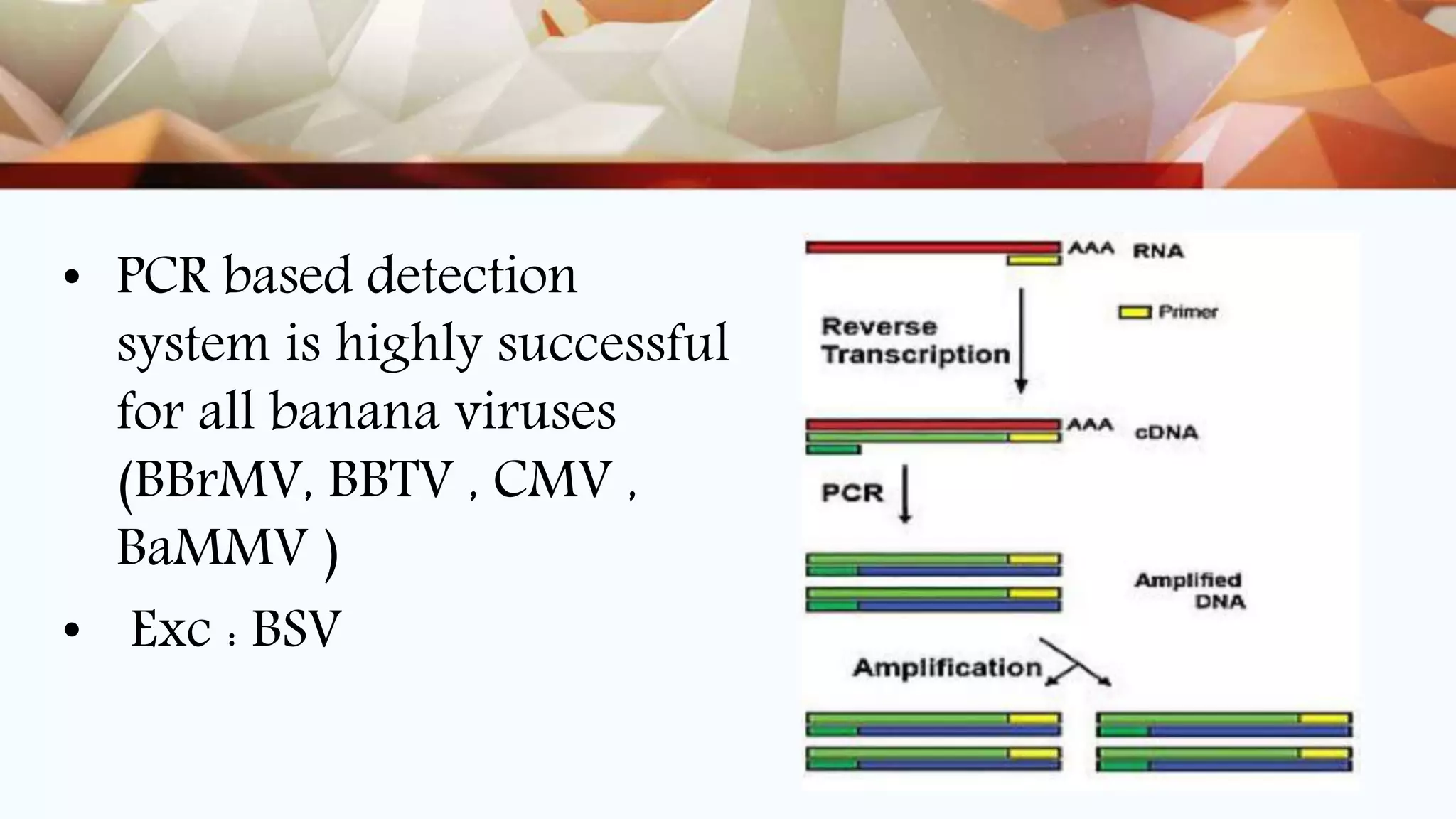
• RT-PCR : A variant of PCR is a technique commonly used
in molecular biology to detect RNA transcript levels.
• It qualitatively detect gene expression through the
creation of complementary DNA .
• Hence it is frequently used in the expression analysis of
single or multiple genes and the exp. Patterns for
identifying infections and diseases.
• PCR based detection
system is highly successful
for all banana viruses
(BBrMV, BBTV , CMV ,
BaMMV )
• Exc : BSV
MULTIPLEX PCR & IMMUNO CAPTURE PCR
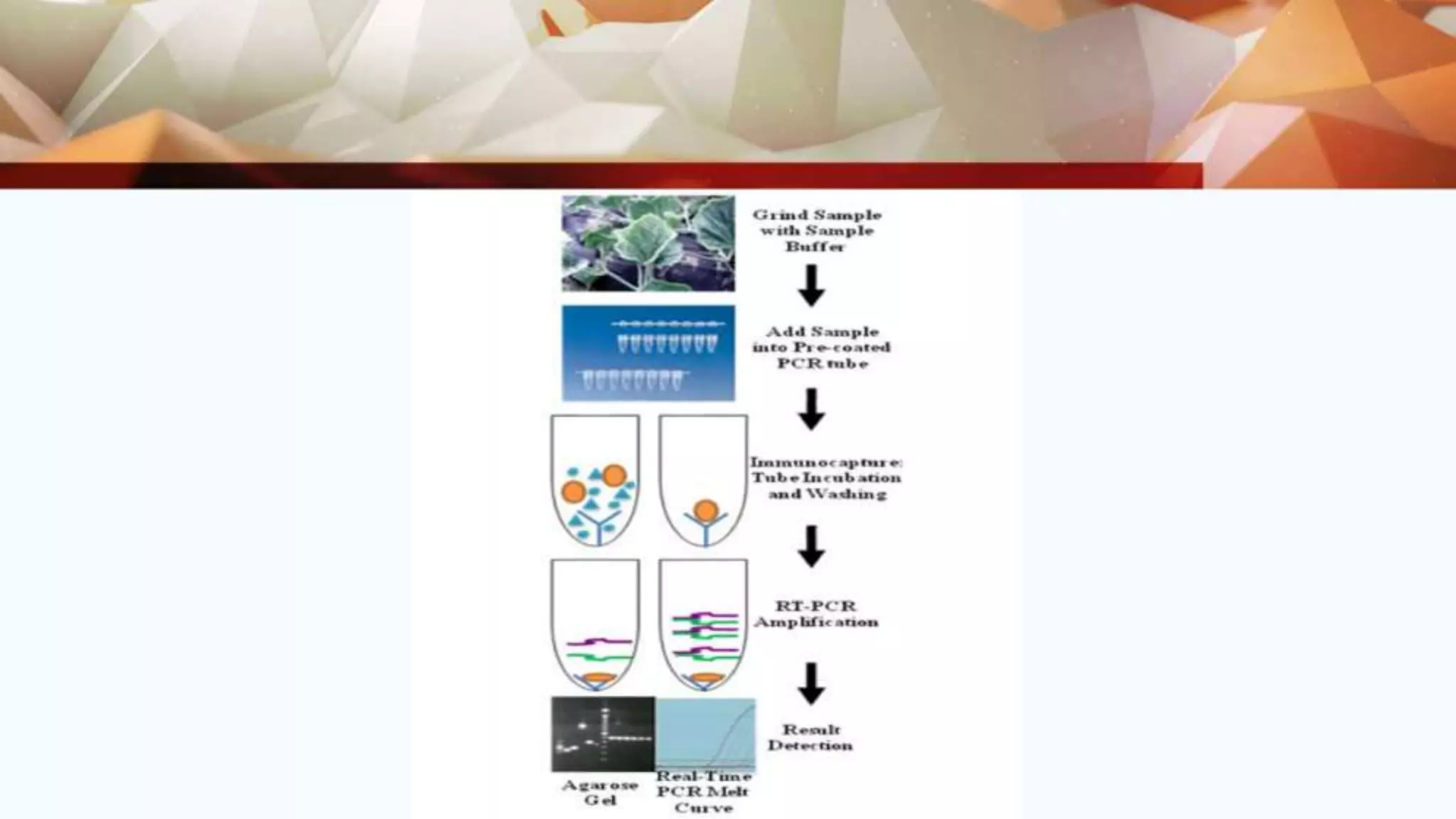
 Simultaneous detection of viruses
 In IC-PCR , virus particles trapped onto a specific
antibody Disruption nucleic acids released
amplified .
 Especially used in case of low virus titre value .
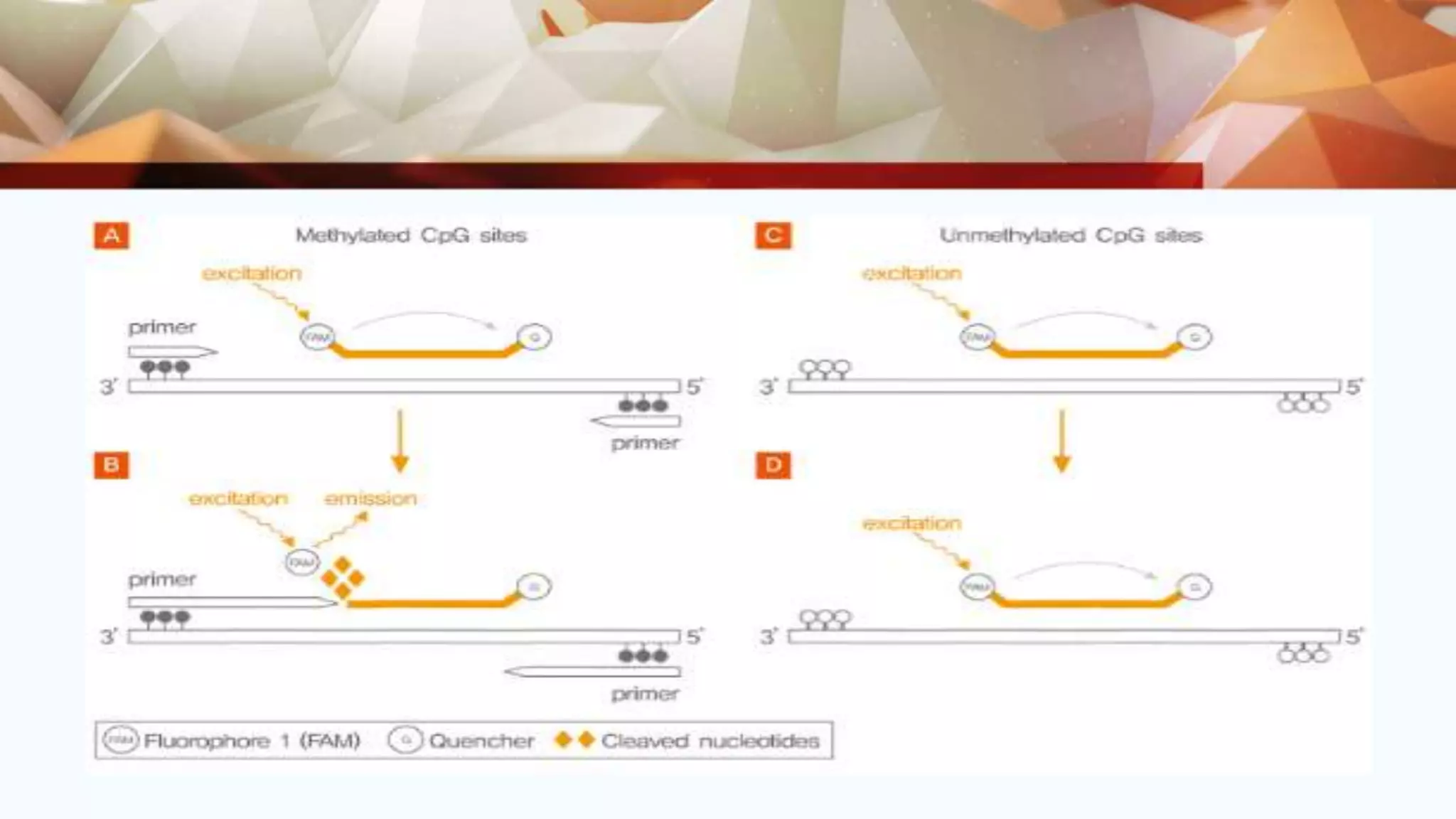
REAL TIME PCR & END POINT PCR
 Quantification of plant viruses
 More reliable , sensitive and specific than PCR .
 Reduce cross contamination.
 Real time PCR : Validate analyses and gene expression
changes on global scale.
 End point PCR : Measures gene expression changes in
small number of samples.
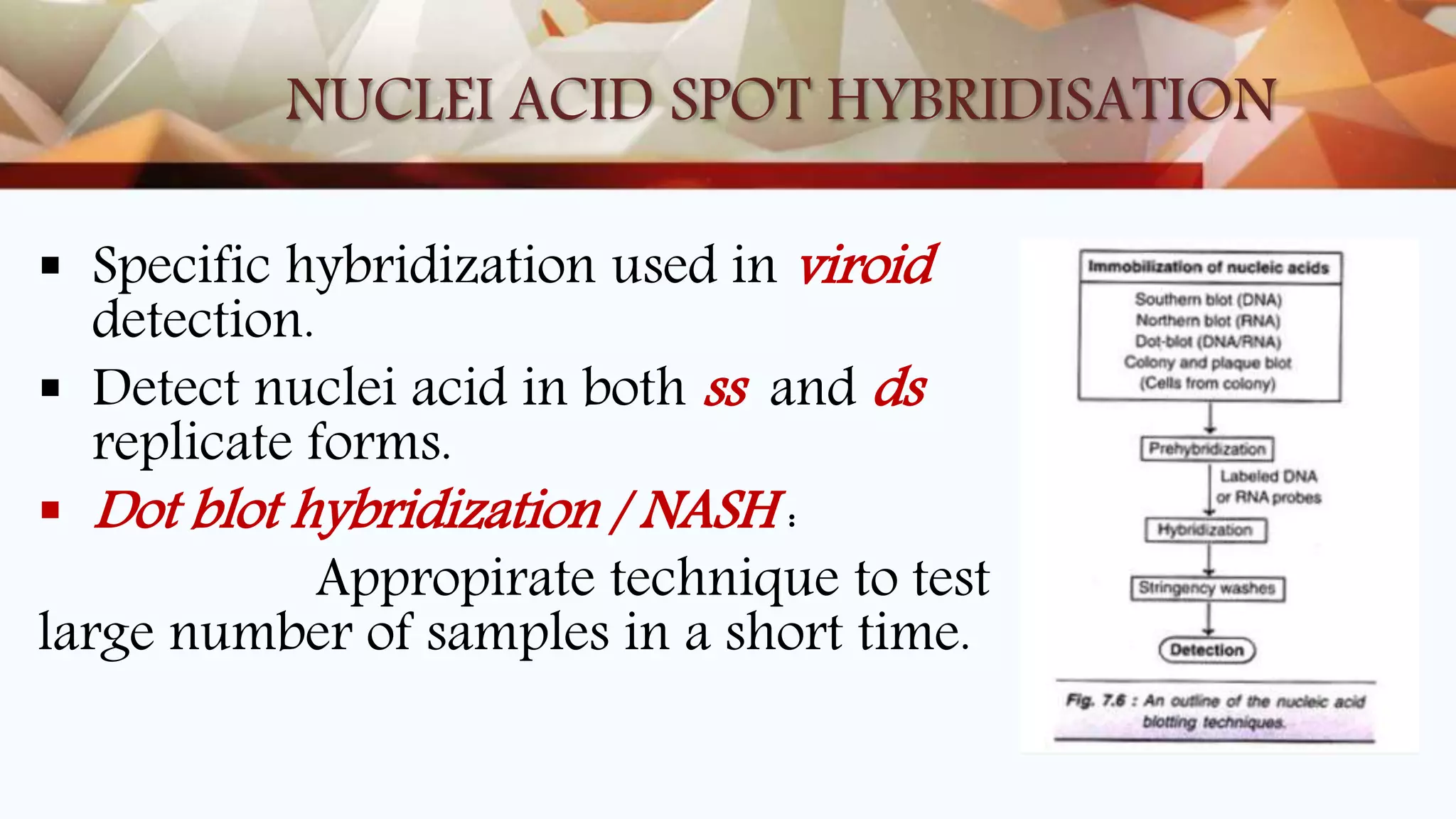
NUCLEI ACID SPOT HYBRIDISATION
 Specific hybridization used in viroid
detection.
 Detect nuclei acid in both ss and ds
replicate forms.
 Dot blot hybridization / NASH :
Appropirate technique to test
large number of samples in a short time.
• Viral genomes are detected from crude or purified
samples after hybridizing with labelled specific probes.
• Sent to testing centres.
• NRCB has developed NASH technique for BBTV
• Also applied for the detection of BBrMV, CMV and BSV.
DNA MICROARRAY TECHNOLOGY
• Detect a myriad of viruses, viroids and phytoplasmas
infecting the plant .
• The unique pattern of hybridization for each of the
pathogen will be the distinguishing feature of this
technique.
• New pathogens could be identified through the use of
microarray sequences derived from highly conserved
regions in a given pathogen group.
METHODS OF VIRUS ELIMINATION
 Thermo-therapy and meristem culture
 Cryo-therapy
 Chemo-therapy
 Anti viral antibiotics
 Micrografting
SUMMARY
Not all plants produced through a combination of
therapies or by any other methods of virus eradication
programmes are virus-free.
Hence the plants should be indexed several times at
regular intervals during the first 18 months to
completely get rid of viruses.
THANK YOU

Virus Indexing methods

  • 1.
    NUCLEI ACID BASED VIRUSINDEXING METHODS
  • 2.
    INTRODUCTION VIRUS INDEXING :A technology for the production of quality planting material What does ‘virus-indexed’ mean ? A virus – indexed variety is one that has been tested and deemed free of viruses it was tested for up to the point of testing .
  • 3.
    VIRAL GENOME BASEDMETHODS  RT- PCR  MULTIPLEX PCR & IMMUNO-CAPTURE PCR  REAL TIME PCR  NUCLEIC ACID BASED SPOT HYBRIDIZATION ( NASH)  DNA MICROARRAY TECHNOLOGY
  • 4.
    METHOD OF VIRUSINDEXING 1. PHYSICAL ASSAY : Electron microscopy 2. BIOLOGICAL INDEXING : Sap transmission test 3. MOLECULAR INDEXING : Nucleic acid based and protein based ( Serological assay )
  • 5.
    REVERSE TRANSCRIPTASE PCR •RT-PCR : A variant of PCR is a technique commonly used in molecular biology to detect RNA transcript levels. • It qualitatively detect gene expression through the creation of complementary DNA . • Hence it is frequently used in the expression analysis of single or multiple genes and the exp. Patterns for identifying infections and diseases.
  • 6.
    • PCR baseddetection system is highly successful for all banana viruses (BBrMV, BBTV , CMV , BaMMV ) • Exc : BSV
  • 7.
    MULTIPLEX PCR &IMMUNO CAPTURE PCR  Simultaneous detection of viruses  In IC-PCR , virus particles trapped onto a specific antibody Disruption nucleic acids released amplified .  Especially used in case of low virus titre value .
  • 9.
    REAL TIME PCR& END POINT PCR  Quantification of plant viruses  More reliable , sensitive and specific than PCR .  Reduce cross contamination.  Real time PCR : Validate analyses and gene expression changes on global scale.  End point PCR : Measures gene expression changes in small number of samples.
  • 11.
    NUCLEI ACID SPOTHYBRIDISATION  Specific hybridization used in viroid detection.  Detect nuclei acid in both ss and ds replicate forms.  Dot blot hybridization / NASH : Appropirate technique to test large number of samples in a short time.
  • 12.
    • Viral genomesare detected from crude or purified samples after hybridizing with labelled specific probes. • Sent to testing centres. • NRCB has developed NASH technique for BBTV • Also applied for the detection of BBrMV, CMV and BSV.
  • 13.
    DNA MICROARRAY TECHNOLOGY •Detect a myriad of viruses, viroids and phytoplasmas infecting the plant . • The unique pattern of hybridization for each of the pathogen will be the distinguishing feature of this technique. • New pathogens could be identified through the use of microarray sequences derived from highly conserved regions in a given pathogen group.
  • 14.
    METHODS OF VIRUSELIMINATION  Thermo-therapy and meristem culture  Cryo-therapy  Chemo-therapy  Anti viral antibiotics  Micrografting
  • 15.
    SUMMARY Not all plantsproduced through a combination of therapies or by any other methods of virus eradication programmes are virus-free. Hence the plants should be indexed several times at regular intervals during the first 18 months to completely get rid of viruses.
  • 16.