
SIMPLE TISSUES
“ A simple tissue is made up of similar
type of cells which have common origin
and function”
Three types of simple tissues are
1. Parenchyma
2. Collenchyma
3. sclerenchyma
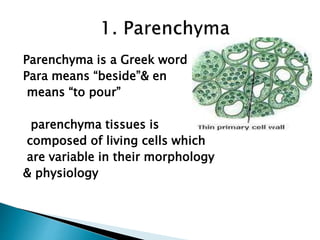
Parenchyma is a Greek word
Para means “beside”& en
means “to pour”
parenchyma tissues is
composed of living cells which
are variable in their morphology
& physiology
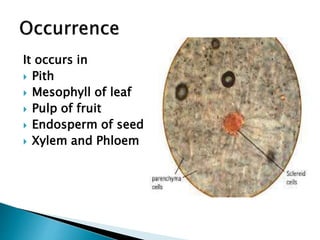
It occurs in
 Pith
 Mesophyll of leaf
 Pulp of fruit
 Endosperm of seed
 Xylem and Phloem
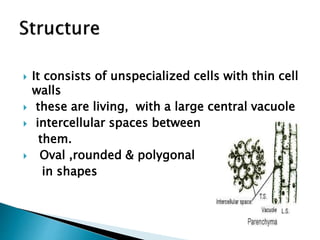
 It consists of unspecialized cells with thin cell
walls
 these are living, with a large central vacuole
 intercellular spaces between
them.
 Oval ,rounded & polygonal
in shapes
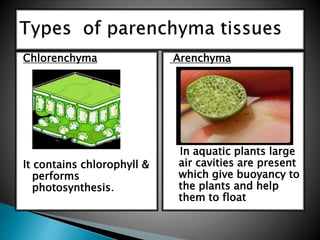
Arenchyma
In aquatic plants large
air cavities are present
which give buoyancy to
the plants and help
them to float
Chlorenchyma
It contains chlorophyll &
performs
photosynthesis.
1. It provides support to plants and also stores
food in the form of starch grains fats & oils
2. Air spaces in parenchyma also facilitate
exchange of gases
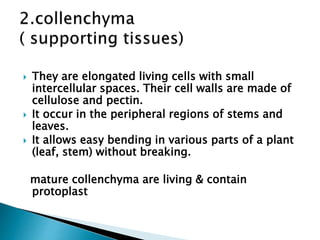
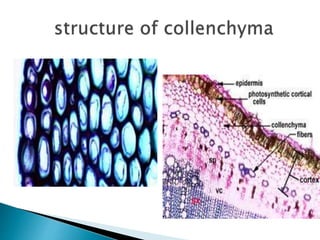
 They are elongated living cells with small
intercellular spaces. Their cell walls are made of
cellulose and pectin.
 It occur in the peripheral regions of stems and
leaves.
 It allows easy bending in various parts of a plant
(leaf, stem) without breaking.
mature collenchyma are living & contain
protoplast
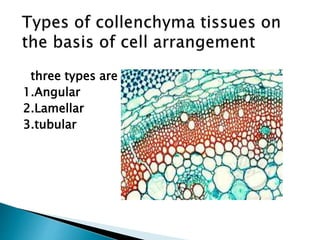
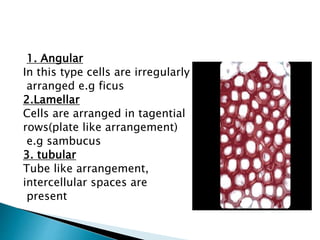
three types are
1.Angular
2.Lamellar
3.tubular
1. Angular
In this type cells are irregularly
arranged e.g ficus
2.Lamellar
Cells are arranged in tagential
rows(plate like arrangement)
e.g sambucus
3. tubular
Tube like arrangement,
intercellular spaces are
present
 It provides mechanical support and flexibility
in plants.
 Helps in photosynthesis
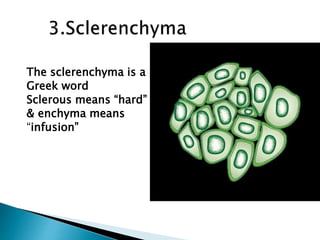
The sclerenchyma is a
Greek word
Sclerous means “hard”
& enchyma means
“infusion”
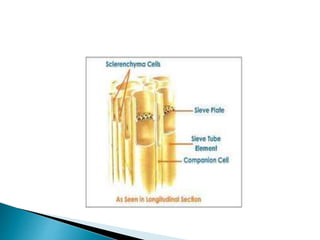
 Sclerenchyma are long, dead cells with a
deposit of lignin in their cell wall.
 They have no intercellular spaces.
 This tissue is present in stems, around
vascular bundles, in the veins of leaves and in
the hard covering of seeds and nuts.
 Thick walled cells
 Don’t possess living protoplast at maturity
 It provides strength to the plant parts.
 it maintain the turgidity of plants
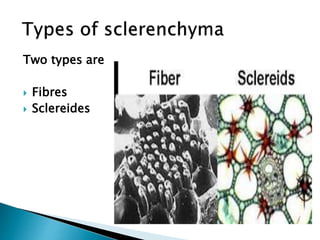
Two types are
 Fibres
 Sclereides
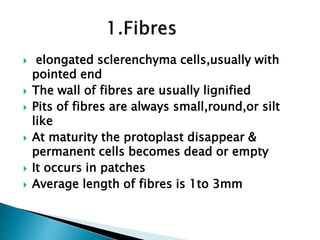
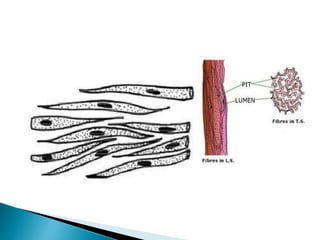
 elongated sclerenchyma cells,usually with
pointed end
 The wall of fibres are usually lignified
 Pits of fibres are always small,round,or silt
like
 At maturity the protoplast disappear &
permanent cells becomes dead or empty
 It occurs in patches
 Average length of fibres is 1to 3mm
Two types of fibres are
 Xylem fibres
 Extraxylary fibres
the fibres develop from the same
maristematic tissues as the other xylem cells
or
The fibres which originated from xylem
These are related to phloem that form
continous cylinder in monocotyledon stem arise
in the ground tissue under the epidermis at
variable distance
TYPES:
1.Phloem fibres (originating primary & secondary
phloem)
2.Cortical fibres ( originating in the cortex)
3.Perivascular fibres( originated in the peripheral
region of vascular cylinder
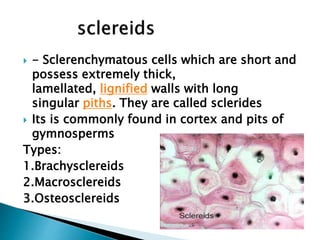
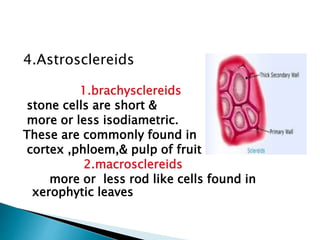
 - Sclerenchymatous cells which are short and
possess extremely thick,
lamellated, lignified walls with long
singular piths. They are called sclerides
 Its is commonly found in cortex and pits of
gymnosperms
Types:
1.Brachysclereids
2.Macrosclereids
3.Osteosclereids
4.Astrosclereids
1.brachysclereids
stone cells are short &
more or less isodiametric.
These are commonly found in
cortex ,phloem,& pulp of fruit
2.macrosclereids
more or less rod like cells found in
xerophytic leaves
3.osteosclereids
theses are bone shaped & found in the
hypodermal layer of seeds & fruits
4.Asterosclereids
these are star shaped found in
intercellular spaces of the leaves & stem of
hydrophytes