PLANT
TISSUES
JKS JACOB
INTRODUCTION
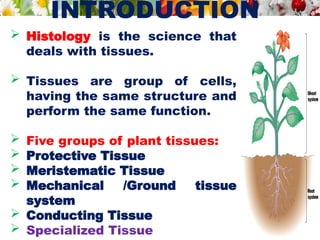
 Histology is the science that
deals with tissues.
 Tissues are group of cells,
having the same structure and
perform the same function.
 Five groups of plant tissues:
 Protective Tissue
 Meristematic Tissue
 Mechanical /Ground tissue
system
 Conducting Tissue
 Specialized Tissue
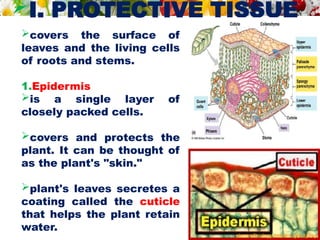
I. PROTECTIVE TISSUE
covers the surface of
leaves and the living cells
of roots and stems.
1.Epidermis
is a single layer of
closely packed cells.
covers and protects the
plant. It can be thought of
as the plant's "skin."
plant's leaves secretes a
coating called the cuticle
that helps the plant retain
water.
plantcellbiology.masters.grkraj.org
I. PROTECTIVE TISSUE
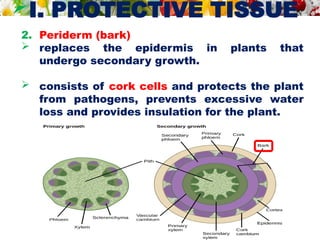
2. Periderm (bark)
 replaces the epidermis in plants that
undergo secondary growth.
 consists of cork cells and protects the plant
from pathogens, prevents excessive water
loss and provides insulation for the plant.
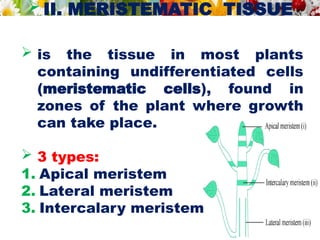
 II. MERISTEMATIC TISSUE
 is the tissue in most plants
containing undifferentiated cells
(meristematic cells), found in
zones of the plant where growth
can take place.
 3 types:
1. Apical meristem
2. Lateral meristem
3. Intercalary meristem
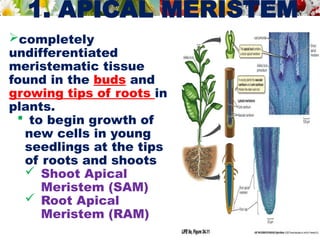
1. APICAL MERISTEM
completely
undifferentiated
meristematic tissue
found in the buds and
growing tips of roots in
plants.
 to begin growth of
new cells in young
seedlings at the tips
of roots and shoots
 Shoot Apical
Meristem (SAM)
 Root Apical
Meristem (RAM)
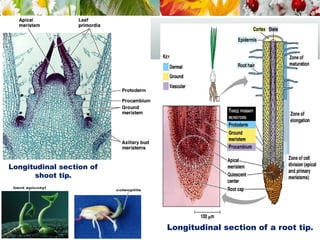
Longitudinal section of
shoot tip.
Longitudinal section of a root tip.
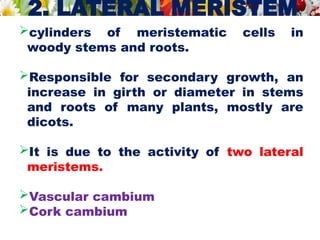
2. LATERAL MERISTEM
cylinders of meristematic cells in
woody stems and roots.
Responsible for secondary growth, an
increase in girth or diameter in stems
and roots of many plants, mostly are
dicots.
It is due to the activity of two lateral
meristems.
Vascular cambium
Cork cambium
2. LATERAL MERISTEM
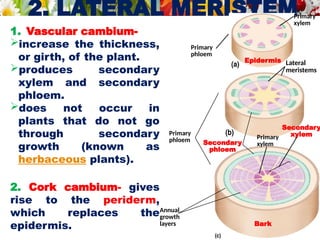
1. Vascular cambium-
increase the thickness,
or girth, of the plant.
produces secondary
xylem and secondary
phloem.
does not occur in
plants that do not go
through secondary
growth (known as
herbaceous plants).
2. Cork cambium- gives
rise to the periderm,
which replaces the
epidermis.
Primary
phloem Primary
xylem
Secondary
phloem
Secondary
xylem
Annual
growth
layers
Lateral
meristems
Primary
xylem
Primary
phloem
Bark
Epidermis
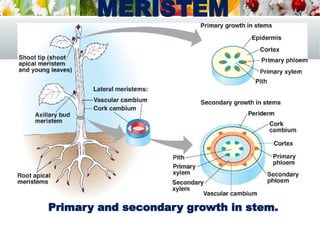
Primary and secondary growth in stem.
MERISTEM
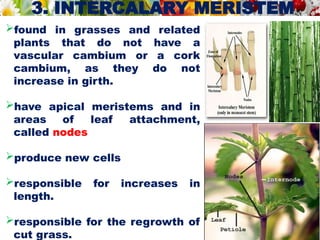
3. INTERCALARY MERISTEM
found in grasses and related
plants that do not have a
vascular cambium or a cork
cambium, as they do not
increase in girth.
have apical meristems and in
areas of leaf attachment,
called nodes
produce new cells
responsible for increases in
length.
responsible for the regrowth of
cut grass.
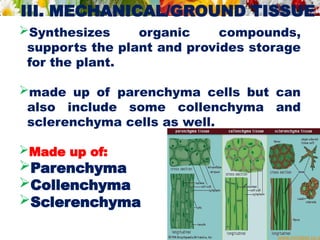
III. MECHANICAL/GROUND TISSUE
Synthesizes organic compounds,
supports the plant and provides storage
for the plant.
made up of parenchyma cells but can
also include some collenchyma and
sclerenchyma cells as well.
Made up of:
Parenchyma
Collenchyma
Sclerenchyma
www.mindset.co.z
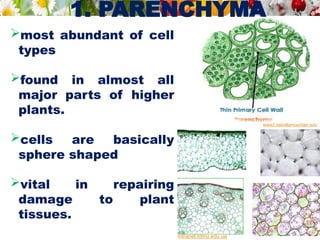
1. PARENCHYMA
most abundant of cell
types
found in almost all
major parts of higher
plants.
cells are basically
sphere shaped
vital in repairing
damage to plant
tissues.
www2.estrellamountain.edu
intranet.tdmu.edu.ua
1. PARENCHYMA
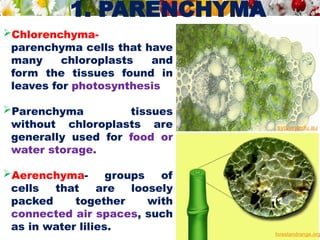
Chlorenchyma-
parenchyma cells that have
many chloroplasts and
form the tissues found in
leaves for photosynthesis
Parenchyma tissues
without chloroplasts are
generally used for food or
water storage.
Aerenchyma- groups of
cells that are loosely
packed together with
connected air spaces, such
as in water lilies.
sydney.edu.au
forestandrange.org
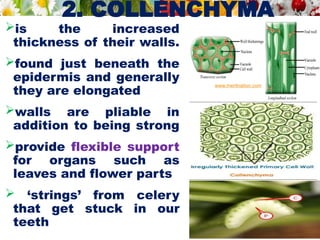
2. COLLENCHYMA
is the increased
thickness of their walls.
found just beneath the
epidermis and generally
they are elongated
walls are pliable in
addition to being strong
provide flexible support
for organs such as
leaves and flower parts
 ‘strings’ from celery
that get stuck in our
teeth
www.meritnation.com
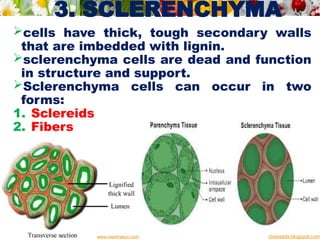
3. SCLERENCHYMA
cells have thick, tough secondary walls
that are imbedded with lignin.
sclerenchyma cells are dead and function
in structure and support.
Sclerenchyma cells can occur in two
forms:
1. Sclereids
2. Fibers
cbseadda.blogspot.com
www.meritnation.com
3. SCLERENCHYMA
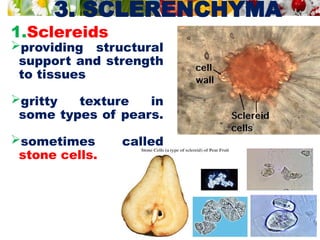
1.Sclereids
providing structural
support and strength
to tissues
gritty texture in
some types of pears.
sometimes called
stone cells.
3. SCLERENCHYMA
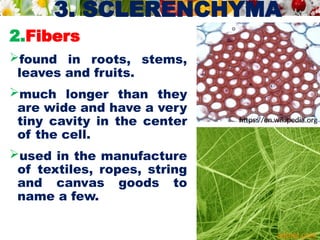
2.Fibers
found in roots, stems,
leaves and fruits.
much longer than they
are wide and have a very
tiny cavity in the center
of the cell.
used in the manufacture
of textiles, ropes, string
and canvas goods to
name a few.
https://en.wikipedia.org
admet.com
IV. CONDUCTING TISSUE
xylem and phloem
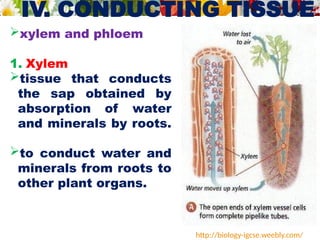
1. Xylem
tissue that conducts
the sap obtained by
absorption of water
and minerals by roots.
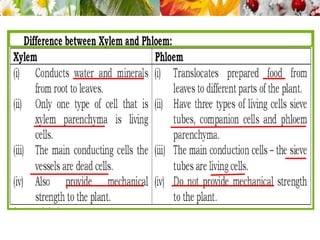
to conduct water and
minerals from roots to
other plant organs.
http://biology-igcse.weebly.com/
IV. CONDUCTING TISSUE
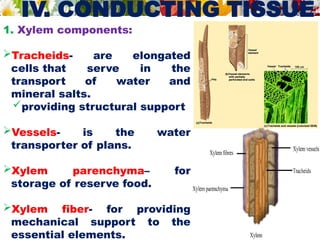
1. Xylem components:
Tracheids- are elongated
cells that serve in the
transport of water and
mineral salts.
providing structural support
Vessels- is the water
transporter of plans.
Xylem parenchyma– for
storage of reserve food.
Xylem fiber- for providing
mechanical support to the
essential elements.
IV. CONDUCTING TISSUE
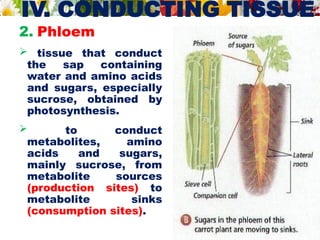
2. Phloem
 tissue that conduct
the sap containing
water and amino acids
and sugars, especially
sucrose, obtained by
photosynthesis.
 to conduct
metabolites, amino
acids and sugars,
mainly sucrose, from
metabolite sources
(production sites) to
metabolite sinks
(consumption sites).
IV. CONDUCTING TISSUE
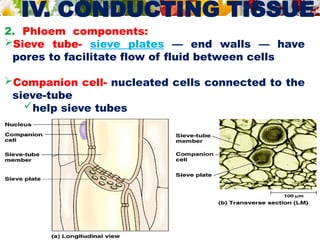
2. Phloem components:
Sieve tube- sieve plates — end walls — have
pores to facilitate flow of fluid between cells
Companion cell- nucleated cells connected to the
sieve-tube
help sieve tubes
IV. CONDUCTING TISSUE
2. Phloem
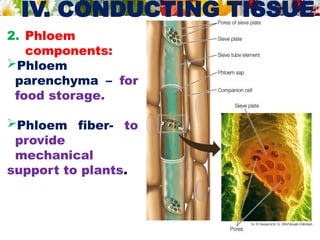
components:
Phloem
parenchyma – for
food storage.
Phloem fiber- to
provide
mechanical
support to plants.
V. SPECIALIZED TISSUE
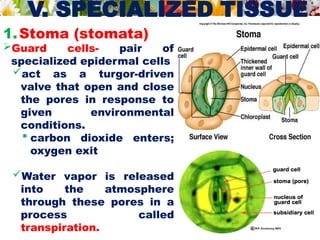
1.Stoma (stomata)
Guard cells- pair of
specialized epidermal cells
act as a turgor-driven
valve that open and close
the pores in response to
given environmental
conditions.
 carbon dioxide enters;
oxygen exit
Water vapor is released
into the atmosphere
through these pores in a
process called
transpiration.
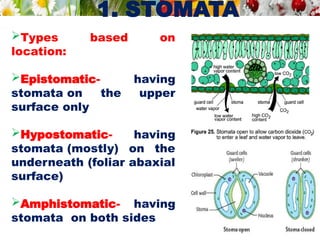
1. STOMATA
Types based on
location:
Epistomatic- having
stomata on the upper
surface only
Hypostomatic- having
stomata (mostly) on the
underneath (foliar abaxial
surface)
Amphistomatic- having
stomata on both sides
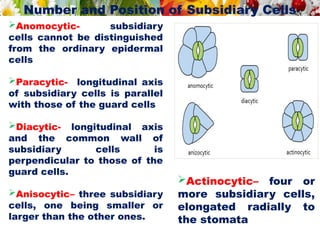
Anomocytic- subsidiary
cells cannot be distinguished
from the ordinary epidermal
cells
Paracytic- longitudinal axis
of subsidiary cells is parallel
with those of the guard cells
Diacytic- longitudinal axis
and the common wall of
subsidiary cells is
perpendicular to those of the
guard cells.
Anisocytic– three subsidiary
cells, one being smaller or
larger than the other ones.
Number and Position of Subsidiary Cells
Actinocytic– four or
more subsidiary cells,
elongated radially to
the stomata
V. SPECIALIZED TISSUE
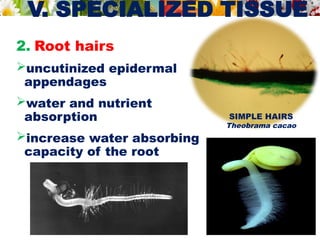
2. Root hairs
uncutinized epidermal
appendages
water and nutrient
absorption
increase water absorbing
capacity of the root
SIMPLE HAIRS
Theobrama cacao
V. SPECIALIZED TISSUE
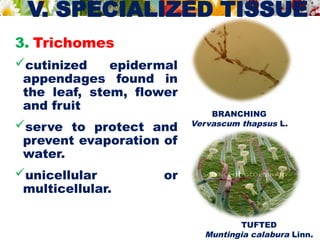
3. Trichomes
cutinized epidermal
appendages found in
the leaf, stem, flower
and fruit
serve to protect and
prevent evaporation of
water.
unicellular or
multicellular.
TUFTED
Muntingia calabura Linn.
BRANCHING
Vervascum thapsus L.
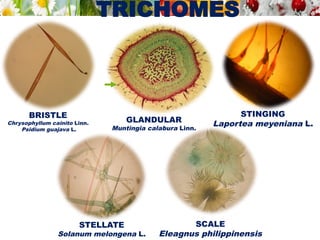
TRICHOMES
BRISTLE
Chrysophyllum cainito Linn.
Psidium guajava L.
GLANDULAR
Muntingia calabura Linn.
STINGING
Laportea meyeniana L.
STELLATE
Solanum melongena L.
SCALE
Eleagnus philippinensis
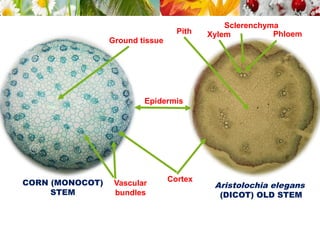
CORN (MONOCOT)
STEM
Aristolochia elegans
(DICOT) OLD STEM
Epidermis
Vascular
bundles
Ground tissue
Pith
Cortex
Xylem Phloem
Sclerenchyma
FIRST TERM
QUIZ MARCH 2

Math, Science and Technology - PLANT TISSUE T.pptx

  • 1.
  • 2.
    INTRODUCTION  Histology isthe science that deals with tissues.  Tissues are group of cells, having the same structure and perform the same function.  Five groups of plant tissues:  Protective Tissue  Meristematic Tissue  Mechanical /Ground tissue system  Conducting Tissue  Specialized Tissue
  • 3.
    I. PROTECTIVE TISSUE coversthe surface of leaves and the living cells of roots and stems. 1.Epidermis is a single layer of closely packed cells. covers and protects the plant. It can be thought of as the plant's "skin." plant's leaves secretes a coating called the cuticle that helps the plant retain water. plantcellbiology.masters.grkraj.org
  • 4.
    I. PROTECTIVE TISSUE 2.Periderm (bark)  replaces the epidermis in plants that undergo secondary growth.  consists of cork cells and protects the plant from pathogens, prevents excessive water loss and provides insulation for the plant.
  • 5.
     II. MERISTEMATICTISSUE  is the tissue in most plants containing undifferentiated cells (meristematic cells), found in zones of the plant where growth can take place.  3 types: 1. Apical meristem 2. Lateral meristem 3. Intercalary meristem
  • 6.
    1. APICAL MERISTEM completely undifferentiated meristematictissue found in the buds and growing tips of roots in plants.  to begin growth of new cells in young seedlings at the tips of roots and shoots  Shoot Apical Meristem (SAM)  Root Apical Meristem (RAM)
  • 7.
    Longitudinal section of shoottip. Longitudinal section of a root tip.
  • 8.
    2. LATERAL MERISTEM cylindersof meristematic cells in woody stems and roots. Responsible for secondary growth, an increase in girth or diameter in stems and roots of many plants, mostly are dicots. It is due to the activity of two lateral meristems. Vascular cambium Cork cambium
  • 9.
    2. LATERAL MERISTEM 1.Vascular cambium- increase the thickness, or girth, of the plant. produces secondary xylem and secondary phloem. does not occur in plants that do not go through secondary growth (known as herbaceous plants). 2. Cork cambium- gives rise to the periderm, which replaces the epidermis. Primary phloem Primary xylem Secondary phloem Secondary xylem Annual growth layers Lateral meristems Primary xylem Primary phloem Bark Epidermis
  • 10.
    Primary and secondarygrowth in stem. MERISTEM
  • 11.
    3. INTERCALARY MERISTEM foundin grasses and related plants that do not have a vascular cambium or a cork cambium, as they do not increase in girth. have apical meristems and in areas of leaf attachment, called nodes produce new cells responsible for increases in length. responsible for the regrowth of cut grass.
  • 12.
    III. MECHANICAL/GROUND TISSUE Synthesizesorganic compounds, supports the plant and provides storage for the plant. made up of parenchyma cells but can also include some collenchyma and sclerenchyma cells as well. Made up of: Parenchyma Collenchyma Sclerenchyma www.mindset.co.z
  • 13.
    1. PARENCHYMA most abundantof cell types found in almost all major parts of higher plants. cells are basically sphere shaped vital in repairing damage to plant tissues. www2.estrellamountain.edu intranet.tdmu.edu.ua
  • 14.
    1. PARENCHYMA Chlorenchyma- parenchyma cellsthat have many chloroplasts and form the tissues found in leaves for photosynthesis Parenchyma tissues without chloroplasts are generally used for food or water storage. Aerenchyma- groups of cells that are loosely packed together with connected air spaces, such as in water lilies. sydney.edu.au forestandrange.org
  • 15.
    2. COLLENCHYMA is theincreased thickness of their walls. found just beneath the epidermis and generally they are elongated walls are pliable in addition to being strong provide flexible support for organs such as leaves and flower parts  ‘strings’ from celery that get stuck in our teeth www.meritnation.com
  • 16.
    3. SCLERENCHYMA cells havethick, tough secondary walls that are imbedded with lignin. sclerenchyma cells are dead and function in structure and support. Sclerenchyma cells can occur in two forms: 1. Sclereids 2. Fibers cbseadda.blogspot.com www.meritnation.com
  • 17.
    3. SCLERENCHYMA 1.Sclereids providing structural supportand strength to tissues gritty texture in some types of pears. sometimes called stone cells.
  • 18.
    3. SCLERENCHYMA 2.Fibers found inroots, stems, leaves and fruits. much longer than they are wide and have a very tiny cavity in the center of the cell. used in the manufacture of textiles, ropes, string and canvas goods to name a few. https://en.wikipedia.org admet.com
  • 19.
    IV. CONDUCTING TISSUE xylemand phloem 1. Xylem tissue that conducts the sap obtained by absorption of water and minerals by roots. to conduct water and minerals from roots to other plant organs. http://biology-igcse.weebly.com/
  • 20.
    IV. CONDUCTING TISSUE 1.Xylem components: Tracheids- are elongated cells that serve in the transport of water and mineral salts. providing structural support Vessels- is the water transporter of plans. Xylem parenchyma– for storage of reserve food. Xylem fiber- for providing mechanical support to the essential elements.
  • 21.
    IV. CONDUCTING TISSUE 2.Phloem  tissue that conduct the sap containing water and amino acids and sugars, especially sucrose, obtained by photosynthesis.  to conduct metabolites, amino acids and sugars, mainly sucrose, from metabolite sources (production sites) to metabolite sinks (consumption sites).
  • 22.
    IV. CONDUCTING TISSUE 2.Phloem components: Sieve tube- sieve plates — end walls — have pores to facilitate flow of fluid between cells Companion cell- nucleated cells connected to the sieve-tube help sieve tubes
  • 23.
    IV. CONDUCTING TISSUE 2.Phloem components: Phloem parenchyma – for food storage. Phloem fiber- to provide mechanical support to plants.
  • 25.
    V. SPECIALIZED TISSUE 1.Stoma(stomata) Guard cells- pair of specialized epidermal cells act as a turgor-driven valve that open and close the pores in response to given environmental conditions.  carbon dioxide enters; oxygen exit Water vapor is released into the atmosphere through these pores in a process called transpiration.
  • 26.
    1. STOMATA Types basedon location: Epistomatic- having stomata on the upper surface only Hypostomatic- having stomata (mostly) on the underneath (foliar abaxial surface) Amphistomatic- having stomata on both sides
  • 27.
    Anomocytic- subsidiary cells cannotbe distinguished from the ordinary epidermal cells Paracytic- longitudinal axis of subsidiary cells is parallel with those of the guard cells Diacytic- longitudinal axis and the common wall of subsidiary cells is perpendicular to those of the guard cells. Anisocytic– three subsidiary cells, one being smaller or larger than the other ones. Number and Position of Subsidiary Cells Actinocytic– four or more subsidiary cells, elongated radially to the stomata
  • 28.
    V. SPECIALIZED TISSUE 2.Root hairs uncutinized epidermal appendages water and nutrient absorption increase water absorbing capacity of the root SIMPLE HAIRS Theobrama cacao
  • 29.
    V. SPECIALIZED TISSUE 3.Trichomes cutinized epidermal appendages found in the leaf, stem, flower and fruit serve to protect and prevent evaporation of water. unicellular or multicellular. TUFTED Muntingia calabura Linn. BRANCHING Vervascum thapsus L.
  • 30.
    TRICHOMES BRISTLE Chrysophyllum cainito Linn. Psidiumguajava L. GLANDULAR Muntingia calabura Linn. STINGING Laportea meyeniana L. STELLATE Solanum melongena L. SCALE Eleagnus philippinensis
  • 31.
    CORN (MONOCOT) STEM Aristolochia elegans (DICOT)OLD STEM Epidermis Vascular bundles Ground tissue Pith Cortex Xylem Phloem Sclerenchyma
  • 32.

Editor's Notes

  • #3 1.It can be thought of as the …………. Depending on the part of the plant that it covers, the dermal tissue system can be specialized to a certain extent. For instance, the epidermis of a
  • #4 The periderm
  • #5 are the cells that are constantly dividing These regions produce new cells. These new cells are generally small, six-sided boxlike structures with a number of tiny vacuoles and a large nucleus, by comparison. Sometimes there are no vacuoles at all.
  • #6 are the cells that are constantly dividing These regions produce new cells. These new cells are generally small, six-sided boxlike structures with a number of tiny vacuoles and a large nucleus, by comparison. Sometimes there are no vacuoles at all. As new cells form in the meristems, the roots and shoots will increase in length.
  • #7 Shoot Apical Meristem (SAM) Root Apical Meristem (RAM)
  • #9 Cork cambium-makes bark
  • #10 Phellogen is defined as the meristematic cell layer responsible for the development of the periderm. Cells that grow inwards from the phellogen are termed phelloderm, and cells that develop outwards are termed phellem or cork (note similarity with vascular cambium).
  • #11 2. , These plants do …….. they have the third type of meristematic tissue. 3.This meristem will also actively Intercalary meristems are capable of cell division, and they allow for rapid growth and regrowth of many monocots.  Intercalary meristems at the nodes of bamboo allow for rapid stem elongation, while those at the base of most grass leaf blades allow damaged leaves to rapidly regrow.
  • #12 2. It is mostly
  • #13 2. when they are first made. However, these cells have thin walls, which flatten at the points of contact when many cells are packed together. 3. Parenchyma cells can divide if they are mature, and this is
  • #14 2. when they are first made. However, these cells have thin walls, which flatten at the points of contact when many cells are packed together. 3. Parenchyma cells can divide if they are mature, and this is
  • #15 1.Their main distinguishing difference from parenchyma cells ------------In x.s. the walls looks uneven. 2.Collenchyma cells are 3. As a plant grows these cells and the tissues they form 4. Good examples of collenchyma plant cells are the Pliable-flexible,easily bent
  • #16 2. At maturity, most 1. The grittiness is due to groups of sclereid cells.
  • #17 2. At maturity, most The grittiness is due to groups of sclereid cells. Pear fruit sclereid
  • #18 2. Usually fiber cells are 3. Currently, fibers from ………….. over 40 different plant families are
  • #19 1.In vascular plants, conducting tissues are …………….. They conduct different saps and have different structures. \ XYLEM 2.The main function of xylem is 3. Xylem sap flow is powered by solar transpiration and some physical properties of water such as capillarity. Plant sap, or just sap, is fluid transported in xylem tubes or phloem cells of a plant.
  • #20 1.In vascular plants, conducting tissues are …………….. They conduct different saps and have different structures. \ XYLEM 2.The main function of xylem is 3. Xylem sap flow is powered by solar transpiration and some physical properties of water such as capillarity.
  • #21 1.In vascular plants, conducting tissues are …………….. They conduct different saps and have different structures. \ 2. The main function of phloem is Leaves Root stem fruits
  • #25 Enters carbon dioxide for photosynthesis and respiration Oxygen produced by photosynthesis in the spongy layer cells (parenchyma cells with pectin)
  • #26 Enters carbon dioxide for photosynthesis and respiration Oxygen produced by photosynthesis in the spongy layer cells (parenchyma cells with pectin)
  • #29 Vervascum thapsus L. velvet dock Muntingia calabura (aratilis)– branching
  • #30 Chrysophyllum cainito Linn./ Psidium guajava L. Laportea- lipang kalabaw Melongena- eggplant Eleagnus- lingaro
  • #31  MONOCOT DICOT Vascular bundle Scattered Distinct ring Ground tissue Undifferentiated Pith and cortex