All living things will eventually leave
our planet, either by dying of old
age, disease or accidents. If living
organisms did not reproduce, life
would cease to continue in our planet
until each member of life forms
become extinct.
Nature ensures that life continues in
every type of living organism through
the process of reproduction.
Reproduction
Process by which organisms replace
themselves, the “old circle of life”.
Reproduction in Lower life forms
Plants, just like other living organisms, are also
part of the “circle of life”. They cannot live forever and
therefore each species of plants must replace
themselves with younger members. Plants do this in two
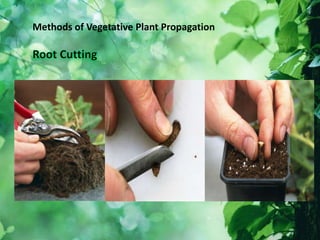
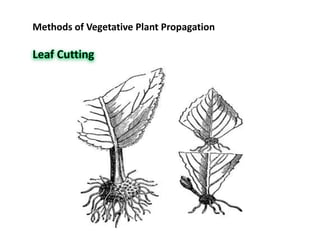
ways, asexually and sexually.
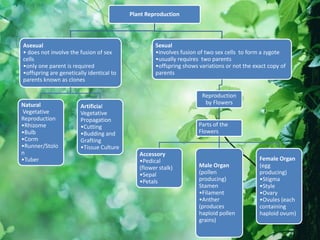
Plant Reproduction
Asexual
• does not involve the fusion of sex
cells
•only one parent is required
•offspring are genetically identical to
parents known as clones
Natural
Vegetative
Reproduction
•Rhizome
•Bulb
•Corm
•Runner/Stolo
n
•Tuber
Artificial
Vegetative
Propagation
•Cutting
•Budding and
Grafting
•Tissue Culture
Sexual
•involves fusion of two sex cells to form a zygote
•usually requires two parents
•offspring shows variations or not the exact copy of
parents
Reproduction
by Flowers
Parts of the
Flowers
Accessory
•Pedical
(flower stalk)
•Sepal
•Petals
Male Organ
(pollen
producing)
Stamen
•Filament
•Anther
(produces
haploid pollen
grains)
Female Organ
(egg
producing)
•Stigma
•Style
•Ovary
•Ovules (each
containing
haploid ovum)
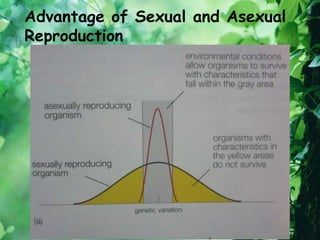
Advantage of Sexual and Asexual
Reproduction
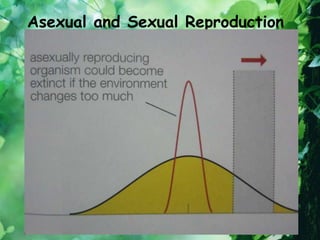
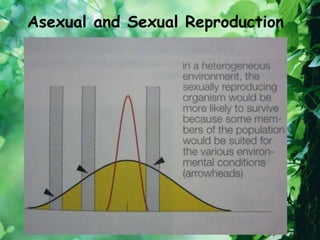
Asexual and Sexual Reproduction
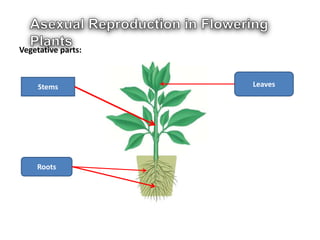
Vegetative parts:
Stems
Roots
Leaves
•The new plant that results is
genetically identical to its parent plant.
•
•Can occur naturally or artificially with
the aids of humans
◘ Reproduction in plants from its vegetative
parts or specialized reproductive structures
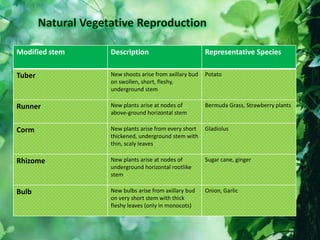
Modified stem Description Representative Species
Tuber New shoots arise from axillary bud
on swollen, short, fleshy,
underground stem
Potato
Runner New plants arise at nodes of
above-ground horizontal stem
Bermuda Grass, Strawberry plants
Corm New plants arise from every short
thickened, underground stem with
thin, scaly leaves
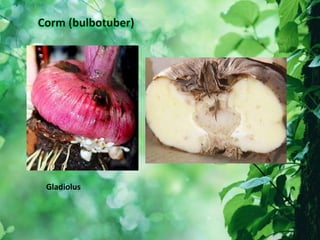
Gladiolus
Rhizome New plants arise at nodes of
underground horizontal rootlike
stem
Sugar cane, ginger
Bulb New bulbs arise from axillary bud
on very short stem with thick
fleshy leaves (only in monocots)
Onion, Garlic
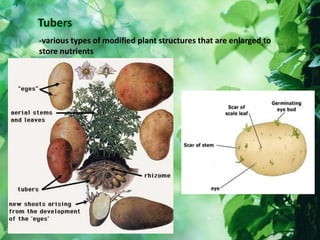
-various types of modified plant structures that are enlarged to
store nutrients
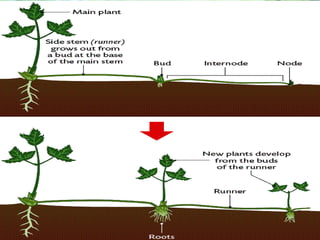
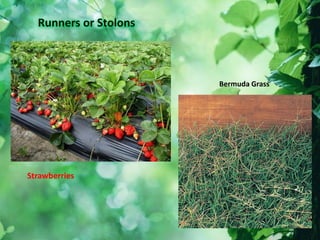
stems which grow at the soil surface or just below ground that form
adventitious roots at the nodes, and new plants from the buds.
Strawberries
Bermuda Grass
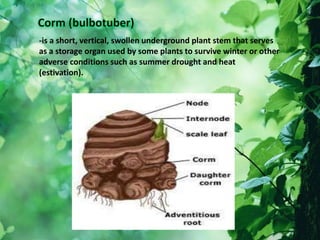
-is a short, vertical, swollen underground plant stem that serves
as a storage organ used by some plants to survive winter or other
adverse conditions such as summer drought and heat
(estivation).
Gladiolus
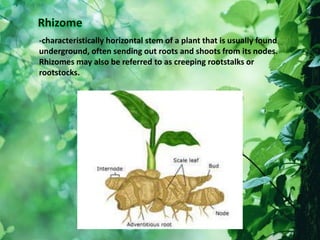
-characteristically horizontal stem of a plant that is usually found
underground, often sending out roots and shoots from its nodes.
Rhizomes may also be referred to as creeping rootstalks or
rootstocks.
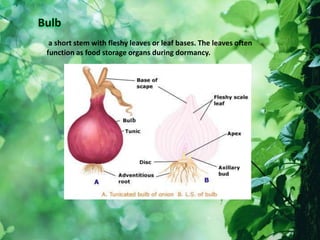
a short stem with fleshy leaves or leaf bases. The leaves often
function as food storage organs during dormancy.
-Asexual methods practiced with a little help from
humans.
- Often faster than growing plants from seeds.
- Farmers propagate plants by using a piece of plant
material.
- Each plant generated that is identical and genetically
the same as the parent tree is said to be a clone
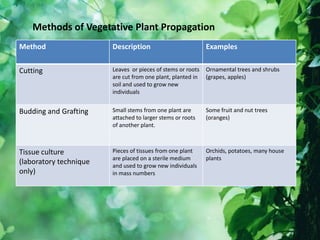
Method Description Examples
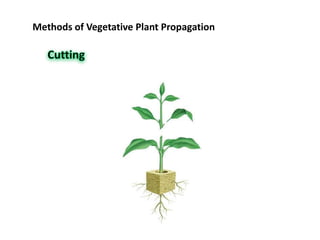
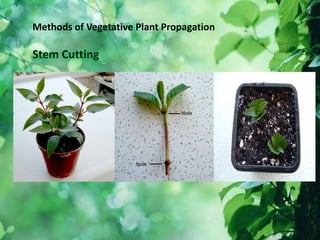
Cutting Leaves or pieces of stems or roots
are cut from one plant, planted in
soil and used to grow new
individuals
Ornamental trees and shrubs
(grapes, apples)
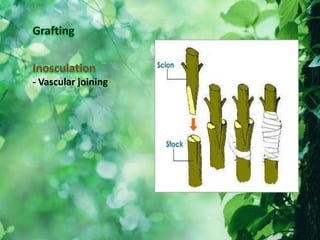
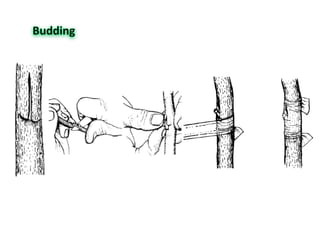
Budding and Grafting Small stems from one plant are
attached to larger stems or roots
of another plant.
Some fruit and nut trees
(oranges)
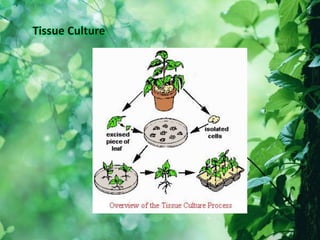
Tissue culture
(laboratory technique
only)
Pieces of tissues from one plant
are placed on a sterile medium
and used to grow new individuals
in mass numbers
Orchids, potatoes, many house
plants
Methods of Vegetative Plant Propagation
- Vascular joining
•All flowering plants reproduce
sexually
•Sexual Reproduction happens in the
sexual organs of flowering plants.
•Most plants are Hermaphrodites
•Involves the fusion of sex cells from
parent plants.
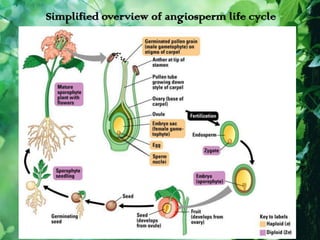
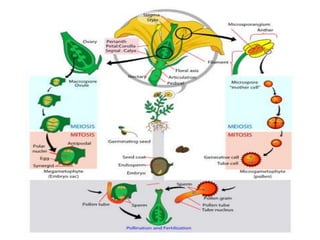
Simplified overview of angiosperm life cycle
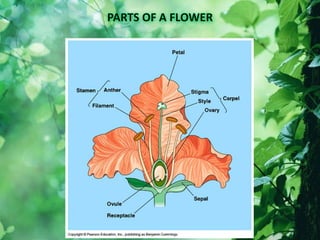
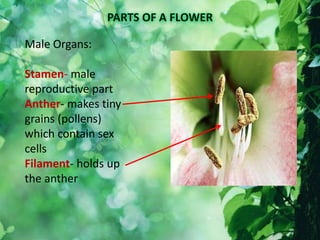
Male Organs:
Stamen- male
reproductive part
Anther- makes tiny
grains (pollens)
which contain sex
cells
Filament- holds up
the anther
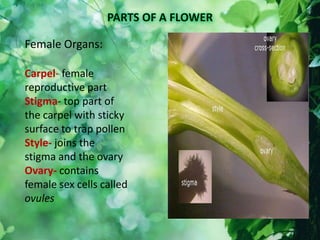
Female Organs:
Carpel- female
reproductive part
Stigma- top part of
the carpel with sticky
surface to trap pollen
Style- joins the
stigma and the ovary
Ovary- contains
female sex cells called
ovules
-Transfer of pollen grains from the
stamen to the stigma
-Pollen grains produced in the anther
of one plant land of the stigma of the
flower of another plant.
-The stigma is often quite sticky, so
the pollen grains stick to it easily.
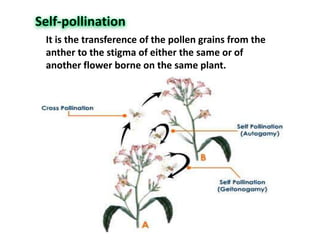
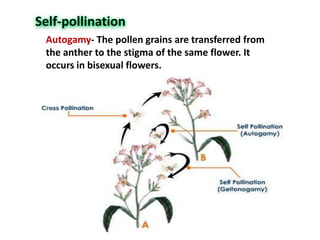
It is the transference of the pollen grains from the
anther to the stigma of either the same or of
another flower borne on the same plant.
Autogamy- The pollen grains are transferred from
the anther to the stigma of the same flower. It
occurs in bisexual flowers.
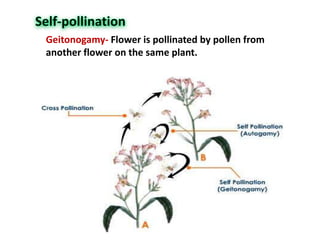
Geitonogamy- Flower is pollinated by pollen from
another flower on the same plant.
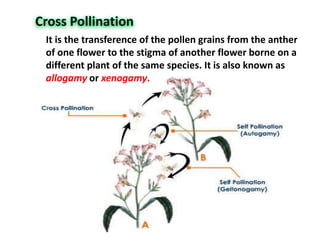
It is the transference of the pollen grains from the anther
of one flower to the stigma of another flower borne on a
different plant of the same species. It is also known as
allogamy or xenogamy.
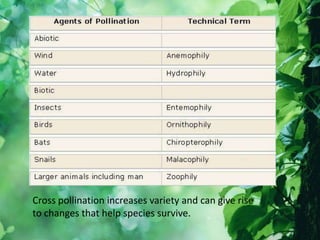
Cross pollination increases variety and can give rise
to changes that help species survive.
In order to prevent overcrowding
and competition for basic needs,
such as space, light, and water, seeds
together with its fruit are sometimes
carried away from the parent plant
in a process called dispersal.
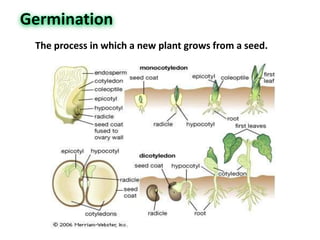
The process in which a new plant grows from a seed.
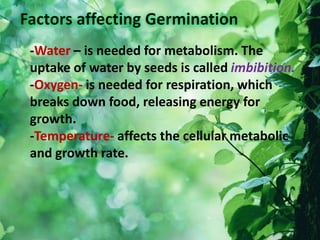
-Water – is needed for metabolism. The
uptake of water by seeds is called imbibition.
-Oxygen- is needed for respiration, which
breaks down food, releasing energy for
growth.
-Temperature- affects the cellular metabolic
and growth rate.
Plant reproduction final

Plant reproduction final

  • 1.
    All living thingswill eventually leave our planet, either by dying of old age, disease or accidents. If living organisms did not reproduce, life would cease to continue in our planet until each member of life forms become extinct. Nature ensures that life continues in every type of living organism through the process of reproduction.
  • 2.
    Reproduction Process by whichorganisms replace themselves, the “old circle of life”. Reproduction in Lower life forms Plants, just like other living organisms, are also part of the “circle of life”. They cannot live forever and therefore each species of plants must replace themselves with younger members. Plants do this in two ways, asexually and sexually.
  • 3.
    Plant Reproduction Asexual • doesnot involve the fusion of sex cells •only one parent is required •offspring are genetically identical to parents known as clones Natural Vegetative Reproduction •Rhizome •Bulb •Corm •Runner/Stolo n •Tuber Artificial Vegetative Propagation •Cutting •Budding and Grafting •Tissue Culture Sexual •involves fusion of two sex cells to form a zygote •usually requires two parents •offspring shows variations or not the exact copy of parents Reproduction by Flowers Parts of the Flowers Accessory •Pedical (flower stalk) •Sepal •Petals Male Organ (pollen producing) Stamen •Filament •Anther (produces haploid pollen grains) Female Organ (egg producing) •Stigma •Style •Ovary •Ovules (each containing haploid ovum)
  • 4.
    Advantage of Sexualand Asexual Reproduction
  • 5.
    Asexual and SexualReproduction
  • 6.
    Asexual and SexualReproduction
  • 7.
  • 8.
    •The new plantthat results is genetically identical to its parent plant. • •Can occur naturally or artificially with the aids of humans
  • 9.
    ◘ Reproduction inplants from its vegetative parts or specialized reproductive structures Modified stem Description Representative Species Tuber New shoots arise from axillary bud on swollen, short, fleshy, underground stem Potato Runner New plants arise at nodes of above-ground horizontal stem Bermuda Grass, Strawberry plants Corm New plants arise from every short thickened, underground stem with thin, scaly leaves Gladiolus Rhizome New plants arise at nodes of underground horizontal rootlike stem Sugar cane, ginger Bulb New bulbs arise from axillary bud on very short stem with thick fleshy leaves (only in monocots) Onion, Garlic
  • 10.
    -various types ofmodified plant structures that are enlarged to store nutrients
  • 11.
    stems which growat the soil surface or just below ground that form adventitious roots at the nodes, and new plants from the buds.
  • 12.
  • 13.
    -is a short,vertical, swollen underground plant stem that serves as a storage organ used by some plants to survive winter or other adverse conditions such as summer drought and heat (estivation).
  • 14.
  • 15.
    -characteristically horizontal stemof a plant that is usually found underground, often sending out roots and shoots from its nodes. Rhizomes may also be referred to as creeping rootstalks or rootstocks.
  • 16.
    a short stemwith fleshy leaves or leaf bases. The leaves often function as food storage organs during dormancy.
  • 17.
    -Asexual methods practicedwith a little help from humans. - Often faster than growing plants from seeds. - Farmers propagate plants by using a piece of plant material. - Each plant generated that is identical and genetically the same as the parent tree is said to be a clone
  • 18.
    Method Description Examples CuttingLeaves or pieces of stems or roots are cut from one plant, planted in soil and used to grow new individuals Ornamental trees and shrubs (grapes, apples) Budding and Grafting Small stems from one plant are attached to larger stems or roots of another plant. Some fruit and nut trees (oranges) Tissue culture (laboratory technique only) Pieces of tissues from one plant are placed on a sterile medium and used to grow new individuals in mass numbers Orchids, potatoes, many house plants Methods of Vegetative Plant Propagation
  • 19.
    Methods of VegetativePlant Propagation
  • 20.
    Methods of VegetativePlant Propagation
  • 21.
    Methods of VegetativePlant Propagation
  • 22.
    Methods of VegetativePlant Propagation
  • 23.
  • 26.
    •All flowering plantsreproduce sexually •Sexual Reproduction happens in the sexual organs of flowering plants. •Most plants are Hermaphrodites •Involves the fusion of sex cells from parent plants.
  • 27.
    Simplified overview ofangiosperm life cycle
  • 29.
    Male Organs: Stamen- male reproductivepart Anther- makes tiny grains (pollens) which contain sex cells Filament- holds up the anther
  • 30.
    Female Organs: Carpel- female reproductivepart Stigma- top part of the carpel with sticky surface to trap pollen Style- joins the stigma and the ovary Ovary- contains female sex cells called ovules
  • 31.
    -Transfer of pollengrains from the stamen to the stigma -Pollen grains produced in the anther of one plant land of the stigma of the flower of another plant. -The stigma is often quite sticky, so the pollen grains stick to it easily.
  • 32.
    It is thetransference of the pollen grains from the anther to the stigma of either the same or of another flower borne on the same plant.
  • 33.
    Autogamy- The pollengrains are transferred from the anther to the stigma of the same flower. It occurs in bisexual flowers.
  • 34.
    Geitonogamy- Flower ispollinated by pollen from another flower on the same plant.
  • 35.
    It is thetransference of the pollen grains from the anther of one flower to the stigma of another flower borne on a different plant of the same species. It is also known as allogamy or xenogamy.
  • 36.
    Cross pollination increasesvariety and can give rise to changes that help species survive.
  • 38.
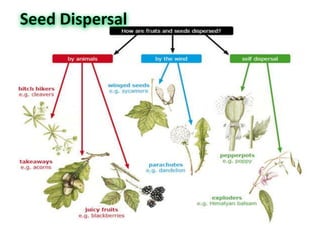
    In order toprevent overcrowding and competition for basic needs, such as space, light, and water, seeds together with its fruit are sometimes carried away from the parent plant in a process called dispersal.
  • 40.
    The process inwhich a new plant grows from a seed.
  • 41.
    -Water – isneeded for metabolism. The uptake of water by seeds is called imbibition. -Oxygen- is needed for respiration, which breaks down food, releasing energy for growth. -Temperature- affects the cellular metabolic and growth rate.