Ray Butch D Mahinay, MASE
Tablon National High School
DepEd-Cagayan de Oro City
Instructions

1. There are 35 items in this reviewer. Answer each item for 30
   seconds only.
2. Turn to the next slide ONLY when you hear a call bell.
3. No turning back of slides.
4. Answer with the corresponding letter only.

                                                          -RBM
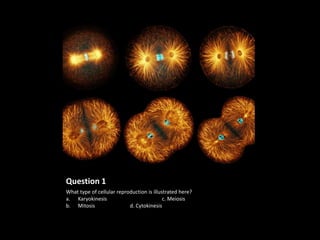
Question 1
What type of cellular reproduction is illustrated here?
a. Karyokinesis                            c. Meiosis
b. Mitosis                 d. Cytokinesis
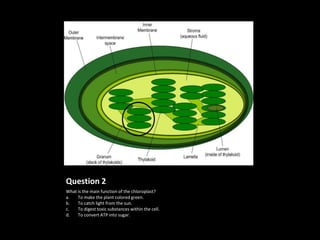
Question 2
What is the main function of the chloroplast?
a.   To make the plant colored green.
b.   To catch light from the sun.
c.   To digest toxic substances within the cell.

d.   To convert ATP into sugar.
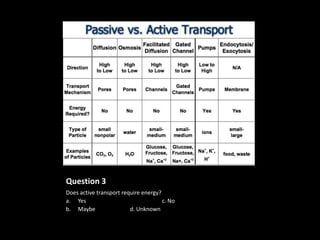
Question 3
Does active transport require energy?

a. Yes                                c. No
b. Maybe                 d. Unknown
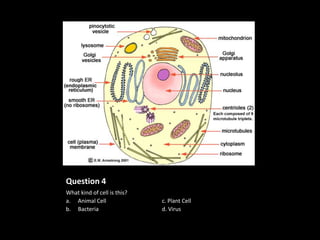
Question 4
What kind of cell is this?
a. Animal Cell               c. Plant Cell
b. Bacteria                  d. Virus
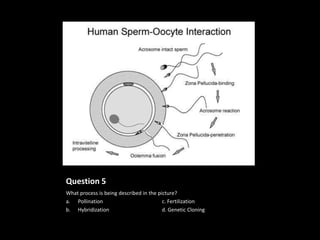
Question 5
What process is being described in the picture?
a. Pollination                           c. Fertilization
b. Hybridization                         d. Genetic Cloning
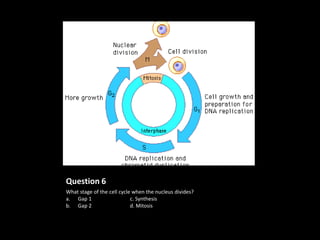
Question 6
What stage of the cell cycle when the nucleus divides?
a. Gap 1                    c. Synthesis
b. Gap 2                    d. Mitosis
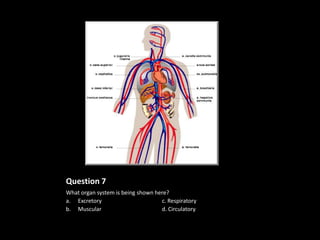
Question 7
What organ system is being shown here?
a. Excretory                       c. Respiratory
b. Muscular                        d. Circulatory
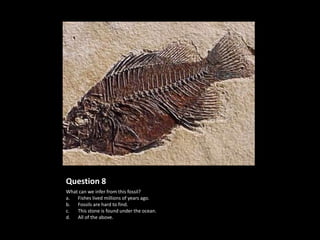
Question 8
What can we infer from this fossil?
a.  Fishes lived millions of years ago.
b. Fossils are hard to find.
c.  This stone is found under the ocean.
d. All of the above.
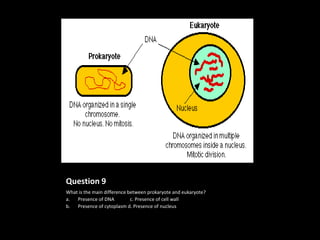
Question 9
What is the main difference between prokaryote and eukaryote?
a.  Presence of DNA          c. Presence of cell wall
b. Presence of cytoplasm d. Presence of nucleus
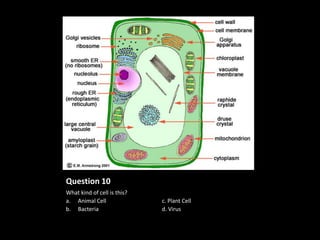
Question 10
What kind of cell is this?
a. Animal Cell               c. Plant Cell
b. Bacteria                  d. Virus
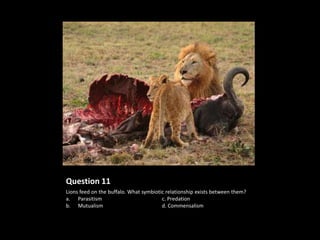
Question 11
Lions feed on the buffalo. What symbiotic relationship exists between them?
a. Parasitism                           c. Predation
b. Mutualism                            d. Commensalism
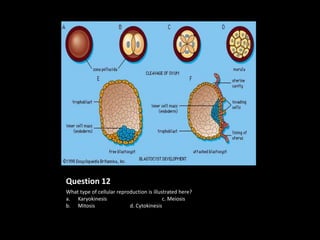
Question 12
What type of cellular reproduction is illustrated here?
a. Karyokinesis                            c. Meiosis
b. Mitosis                 d. Cytokinesis
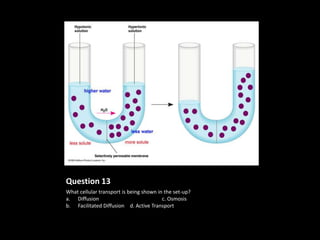
Question 13
What cellular transport is being shown in the set-up?
a. Diffusion                             c. Osmosis
b. Facilitated Diffusion d. Active Transport
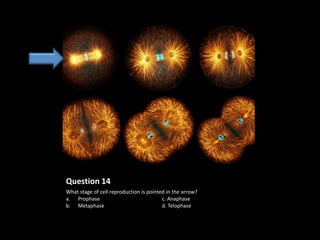
Question 14
What stage of cell reproduction is pointed in the arrow?
a. Prophase                              c. Anaphase
b. Metaphase                             d. Telophase
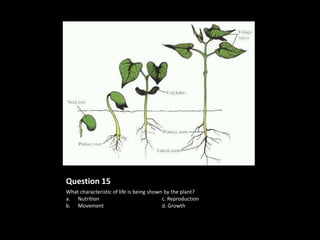
Question 15
What characteristic of life is being shown by the plant?
a. Nutrition                              c. Reproduction
b. Movement                               d. Growth
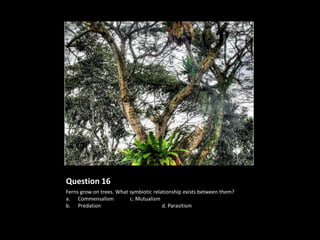
Question 16
Ferns grow on trees. What symbiotic relationship exists between them?
a. Commensalism           c. Mutualism
b. Predation                            d. Parasitism
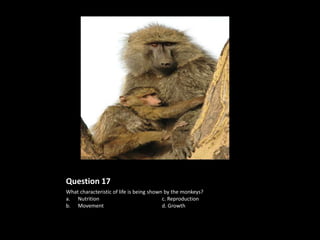
Question 17
What characteristic of life is being shown by the monkeys?
a. Nutrition                              c. Reproduction
b. Movement                               d. Growth
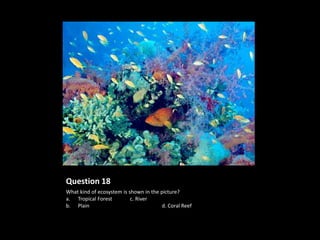
Question 18
What kind of ecosystem is shown in the picture?
a. Tropical Forest         c. River
b. Plain                                d. Coral Reef
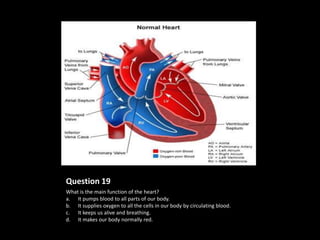
Question 19
What is the main function of the heart?
a. It pumps blood to all parts of our body.
b. It supplies oxygen to all the cells in our body by circulating blood.
c. It keeps us alive and breathing.
d. It makes our body normally red.
Question 20
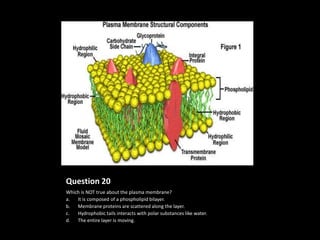
Which is NOT true about the plasma membrane?
a.  It is composed of a phospholipid bilayer.
b. Membrane proteins are scattered along the layer.
c.  Hydrophobic tails interacts with polar substances like water.
d. The entire layer is moving.
Question 21
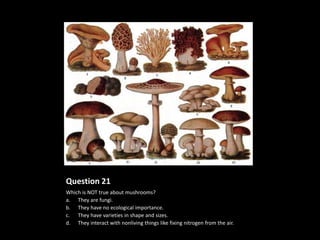
Which is NOT true about mushrooms?
a. They are fungi.
b. They have no ecological importance.
c. They have varieties in shape and sizes.
d. They interact with nonliving things like fixing nitrogen from the air.
Question 22
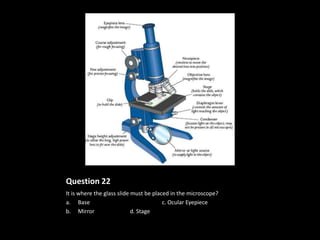
It is where the glass slide must be placed in the microscope?
a. Base                                 c. Ocular Eyepiece
b. Mirror                   d. Stage
Question 23
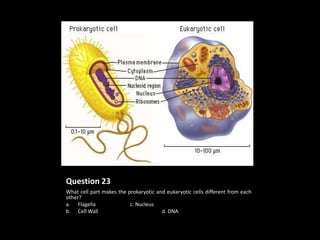
What cell part makes the prokaryotic and eukaryotic cells different from each
other?
a. Flagella               c. Nucleus
b. Cell Wall                           d. DNA
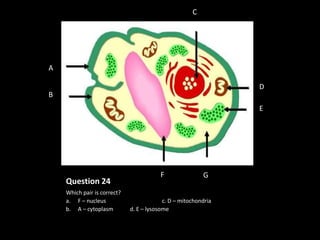
C


A

                                                                D
B
                                                                E


                                         F               G
    Question 24
    Which pair is correct?
    a. F – nucleus                        c. D – mitochondria
    b. A – cytoplasm         d. E – lysosome
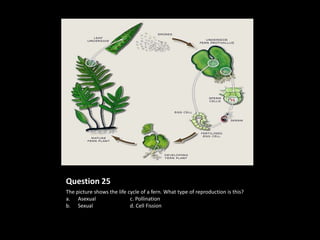
Question 25
The picture shows the life cycle of a fern. What type of reproduction is this?
a. Asexual                  c. Pollination
b. Sexual                   d. Cell Fission
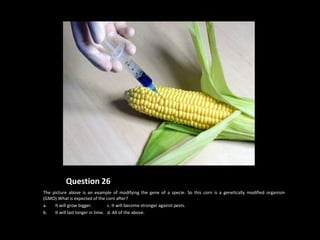
Question 26
The picture above is an example of modifying the gene of a specie. So this corn is a genetically modified organism
(GMO).What is expected of the corn after?
a.   It will grow bigger.         c. It will become stronger against pests.
b.   It will last longer in time. d. All of the above.
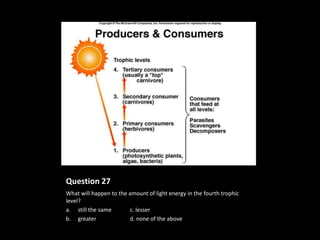
Question 27
What will happen to the amount of light energy in the fourth trophic
level?
a. still the same       c. lesser
b. greater              d. none of the above
Question 28
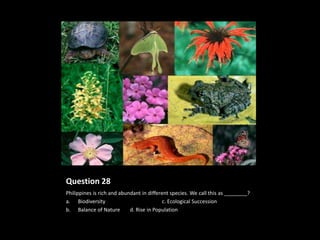
Philippines is rich and abundant in different species. We call this as ________?
a. Biodiversity                            c. Ecological Succession
b. Balance of Nature        d. Rise in Population
Question 29
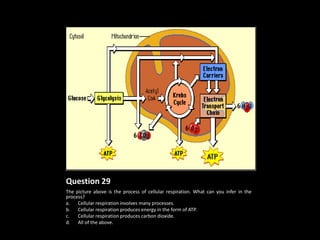
The picture above is the process of cellular respiration. What can you infer in the
process?
a.   Cellular respiration involves many processes.
b. Cellular respiration produces energy in the form of ATP.
c.   Cellular respiration produces carbon dioxide.
d. All of the above.
Question 30
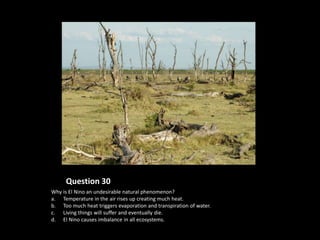
Why is El Nino an undesirable natural phenomenon?
a. Temperature in the air rises up creating much heat.
b. Too much heat triggers evaporation and transpiration of water.
c. Living things will suffer and eventually die.
d. El Nino causes imbalance in all ecosystems.
Question 31
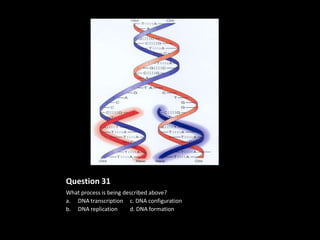
What process is being described above?
a. DNA transcription c. DNA configuration
b. DNA replication      d. DNA formation
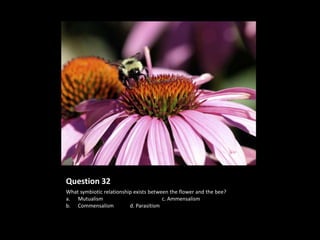
Question 32
What symbiotic relationship exists between the flower and the bee?
a. Mutualism                            c. Ammensalism
b. Commensalism           d. Parasitism
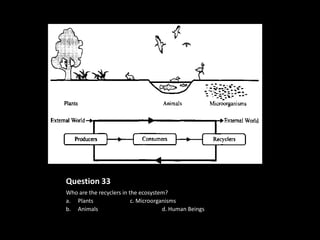
Question 33
Who are the recyclers in the ecosystem?
a. Plants                 c. Microorganisms
b. Animals                            d. Human Beings
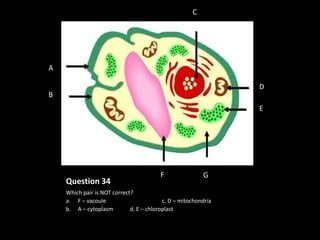
C


A

                                                                D
B
                                                                E


                                         F               G
    Question 34
    Which pair is NOT correct?
    a. F – vacoule                        c. D – mitochondria
    b. A – cytoplasm         d. E – chloroplast
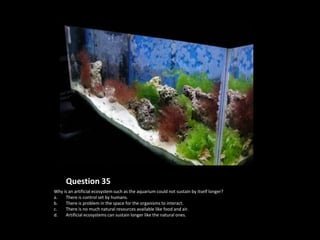
Question 35
Why is an artificial ecosystem such as the aquarium could not sustain by itself longer?
a.   There is control set by humans.
b.   There is problem in the space for the organisms to interact.
c.   There is no much natural resources available like food and air.
d.   Artificial ecosystems can sustain longer like the natural ones.
End of Review
SOURCES


All pictures/graphics are taken from Google Images.
DEVELOPER

Ray Butch D Mahinay, MASE
ICT Laboratory
Tablon National High School
(088) 323-1061


School of Education
G/F Social Science Building
Xavier University-Ateneo de Cagayan
(088) 858-3116 local 3034

NAT Review for Biology

  • 1.
    Ray Butch DMahinay, MASE Tablon National High School DepEd-Cagayan de Oro City
  • 2.
    Instructions 1. There are35 items in this reviewer. Answer each item for 30 seconds only. 2. Turn to the next slide ONLY when you hear a call bell. 3. No turning back of slides. 4. Answer with the corresponding letter only. -RBM
  • 3.
    Question 1 What typeof cellular reproduction is illustrated here? a. Karyokinesis c. Meiosis b. Mitosis d. Cytokinesis
  • 4.
    Question 2 What isthe main function of the chloroplast? a. To make the plant colored green. b. To catch light from the sun. c. To digest toxic substances within the cell. d. To convert ATP into sugar.
  • 5.
    Question 3 Does activetransport require energy? a. Yes c. No b. Maybe d. Unknown
  • 6.
    Question 4 What kindof cell is this? a. Animal Cell c. Plant Cell b. Bacteria d. Virus
  • 7.
    Question 5 What processis being described in the picture? a. Pollination c. Fertilization b. Hybridization d. Genetic Cloning
  • 8.
    Question 6 What stageof the cell cycle when the nucleus divides? a. Gap 1 c. Synthesis b. Gap 2 d. Mitosis
  • 9.
    Question 7 What organsystem is being shown here? a. Excretory c. Respiratory b. Muscular d. Circulatory
  • 10.
    Question 8 What canwe infer from this fossil? a. Fishes lived millions of years ago. b. Fossils are hard to find. c. This stone is found under the ocean. d. All of the above.
  • 11.
    Question 9 What isthe main difference between prokaryote and eukaryote? a. Presence of DNA c. Presence of cell wall b. Presence of cytoplasm d. Presence of nucleus
  • 12.
    Question 10 What kindof cell is this? a. Animal Cell c. Plant Cell b. Bacteria d. Virus
  • 13.
    Question 11 Lions feedon the buffalo. What symbiotic relationship exists between them? a. Parasitism c. Predation b. Mutualism d. Commensalism
  • 14.
    Question 12 What typeof cellular reproduction is illustrated here? a. Karyokinesis c. Meiosis b. Mitosis d. Cytokinesis
  • 15.
    Question 13 What cellulartransport is being shown in the set-up? a. Diffusion c. Osmosis b. Facilitated Diffusion d. Active Transport
  • 16.
    Question 14 What stageof cell reproduction is pointed in the arrow? a. Prophase c. Anaphase b. Metaphase d. Telophase
  • 17.
    Question 15 What characteristicof life is being shown by the plant? a. Nutrition c. Reproduction b. Movement d. Growth
  • 18.
    Question 16 Ferns growon trees. What symbiotic relationship exists between them? a. Commensalism c. Mutualism b. Predation d. Parasitism
  • 19.
    Question 17 What characteristicof life is being shown by the monkeys? a. Nutrition c. Reproduction b. Movement d. Growth
  • 20.
    Question 18 What kindof ecosystem is shown in the picture? a. Tropical Forest c. River b. Plain d. Coral Reef
  • 21.
    Question 19 What isthe main function of the heart? a. It pumps blood to all parts of our body. b. It supplies oxygen to all the cells in our body by circulating blood. c. It keeps us alive and breathing. d. It makes our body normally red.
  • 22.
    Question 20 Which isNOT true about the plasma membrane? a. It is composed of a phospholipid bilayer. b. Membrane proteins are scattered along the layer. c. Hydrophobic tails interacts with polar substances like water. d. The entire layer is moving.
  • 23.
    Question 21 Which isNOT true about mushrooms? a. They are fungi. b. They have no ecological importance. c. They have varieties in shape and sizes. d. They interact with nonliving things like fixing nitrogen from the air.
  • 24.
    Question 22 It iswhere the glass slide must be placed in the microscope? a. Base c. Ocular Eyepiece b. Mirror d. Stage
  • 25.
    Question 23 What cellpart makes the prokaryotic and eukaryotic cells different from each other? a. Flagella c. Nucleus b. Cell Wall d. DNA
  • 26.
    C A D B E F G Question 24 Which pair is correct? a. F – nucleus c. D – mitochondria b. A – cytoplasm d. E – lysosome
  • 27.
    Question 25 The pictureshows the life cycle of a fern. What type of reproduction is this? a. Asexual c. Pollination b. Sexual d. Cell Fission
  • 28.
    Question 26 The pictureabove is an example of modifying the gene of a specie. So this corn is a genetically modified organism (GMO).What is expected of the corn after? a. It will grow bigger. c. It will become stronger against pests. b. It will last longer in time. d. All of the above.
  • 29.
    Question 27 What willhappen to the amount of light energy in the fourth trophic level? a. still the same c. lesser b. greater d. none of the above
  • 30.
    Question 28 Philippines isrich and abundant in different species. We call this as ________? a. Biodiversity c. Ecological Succession b. Balance of Nature d. Rise in Population
  • 31.
    Question 29 The pictureabove is the process of cellular respiration. What can you infer in the process? a. Cellular respiration involves many processes. b. Cellular respiration produces energy in the form of ATP. c. Cellular respiration produces carbon dioxide. d. All of the above.
  • 32.
    Question 30 Why isEl Nino an undesirable natural phenomenon? a. Temperature in the air rises up creating much heat. b. Too much heat triggers evaporation and transpiration of water. c. Living things will suffer and eventually die. d. El Nino causes imbalance in all ecosystems.
  • 33.
    Question 31 What processis being described above? a. DNA transcription c. DNA configuration b. DNA replication d. DNA formation
  • 34.
    Question 32 What symbioticrelationship exists between the flower and the bee? a. Mutualism c. Ammensalism b. Commensalism d. Parasitism
  • 35.
    Question 33 Who arethe recyclers in the ecosystem? a. Plants c. Microorganisms b. Animals d. Human Beings
  • 36.
    C A D B E F G Question 34 Which pair is NOT correct? a. F – vacoule c. D – mitochondria b. A – cytoplasm d. E – chloroplast
  • 37.
    Question 35 Why isan artificial ecosystem such as the aquarium could not sustain by itself longer? a. There is control set by humans. b. There is problem in the space for the organisms to interact. c. There is no much natural resources available like food and air. d. Artificial ecosystems can sustain longer like the natural ones.
  • 38.
  • 39.
    SOURCES All pictures/graphics aretaken from Google Images.
  • 40.
    DEVELOPER Ray Butch DMahinay, MASE ICT Laboratory Tablon National High School (088) 323-1061 School of Education G/F Social Science Building Xavier University-Ateneo de Cagayan (088) 858-3116 local 3034