Plant Layout and Material
Handling
Prepared By : Patel Shreyash K.
Branch : M.E. (Production)
Pen No. : 170490728016
Subject : Production & Operation Management
SHRI SITARAMBHAI NARANJIBHAI PATEL INSTITUTE
OF TECHNOLOGY AND RESEARCH CENTRE
1Plant Layout and Material Handeling
Plant Layout
 A plant layout study is an engineering
study used to analyze different physical
configurations for a manufacturing plant.
It is also known as Facilities Planning and
Layout.
Plant Layout and Material Handeling 2
Classification of Layout
 Process layout
 Product layout
 Combination layout
 Fixed position layout
 Group layout
Plant Layout and Material Handeling 3
Process Layout
In a process layout, management groups
together machines that perform similar
functions. For example, it may put all of the
lathes together in one part of the factory. The
part that is being manufactured goes from
one process area to another process area as it
is manufactured. Hospitals typically follow a
process layout. Example, the maternity ward
is in an area where the hospital attends to all
aspects of the maternity process.
Plant Layout and Material Handeling 4
Product Layout
The product layout approach involves
setting up the production facilities around
the steps involved in manufacturing the
product. The product goes from one step
to another as it is manufactured. This is
the typical assembly line approach.
Example, in the manufacturing process of
a car, the car body goes from one stage of
production to the next.
Plant Layout and Material Handeling 5
Combination Layout
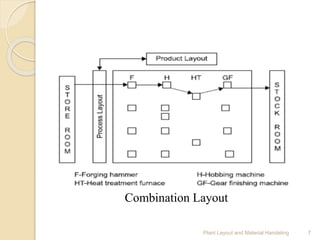
A combination of process and product
layouts combines the advantages of both
types of layouts. A combination layout is
possible where an item is being made in
different types and sizes. Here machinery
is arranged in a process layout but the
process grouping is then arranged in a
sequence to manufacture various types
and sizes of products.
Plant Layout and Material Handeling 6
Plant Layout and Material Handeling 7
Combination Layout
Fixed Position Layout
This is also called the project type of
layout. In this type of layout, the material,
or major components remain in a fixed
location and tools, machinery, men and
other materials are brought to this
location.
Plant Layout and Material Handeling 8
Material Handling
Materials handling can be also defined as
‘the function dealing with the preparation,
placing and positioning of materials to
facilitate their movement or storage .
Material handling is the art and science
involving the movement, handling and
storage of materials during different stages of
manufacturing. Thus the function includes
every consideration of the product except the
actual processing operation.
Plant Layout and Material Handeling 9
Material handling does not add any value
to the product but adds to the cost of the
product and hence it will cost the
customer more. So the handling should be
kept at minimum. Material handling in
Indian industries accounts for nearly 40%
of the cost of production
Plant Layout and Material Handeling 10
Objectives of Material
Handling
Minimize cost of material handling.
Minimize delays and interruptions by
making available the materials at the point
of use at right quantity and at right time.
Safety in material handling through
improvement in working condition.
Maximum utilization of material handling
equipment.
Lower investment in process inventory.
Plant Layout and Material Handeling 11
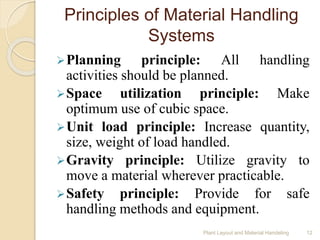
Principles of Material Handling
Systems
Planning principle: All handling
activities should be planned.
Space utilization principle: Make
optimum use of cubic space.
Unit load principle: Increase quantity,
size, weight of load handled.
Gravity principle: Utilize gravity to
move a material wherever practicable.
Safety principle: Provide for safe
handling methods and equipment.
Plant Layout and Material Handeling 12
Classification of Material
Handling Systems
 Conveyors
 Industrial Trucks
 Cranes and Hoists
 Containers
 Robots
Plant Layout and Material Handeling 13
Conveyors
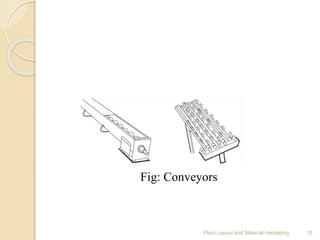
Conveyors are useful for moving material
between two fixed workstations, either
continuously or intermittently. They are
mainly used for continuous or mass
production operations indeed, they are
suitable for most operations where the flow
is more or less steady. Conveyors may be of
various types, with rollers, wheels or belts to
help move the material along: these may be
power-driven or may roll freely.
Plant Layout and Material Handeling 14
Plant Layout and Material Handeling 15
Fig: Conveyors
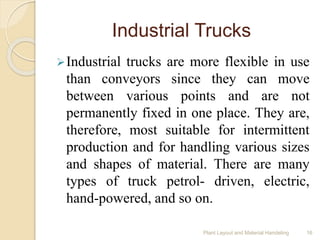
Industrial Trucks
Industrial trucks are more flexible in use
than conveyors since they can move
between various points and are not
permanently fixed in one place. They are,
therefore, most suitable for intermittent
production and for handling various sizes
and shapes of material. There are many
types of truck petrol- driven, electric,
hand-powered, and so on.
Plant Layout and Material Handeling 16
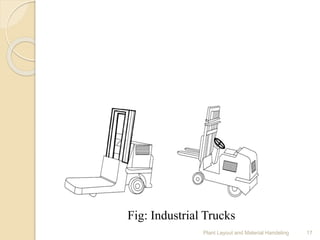
Plant Layout and Material Handeling 17
Fig: Industrial Trucks
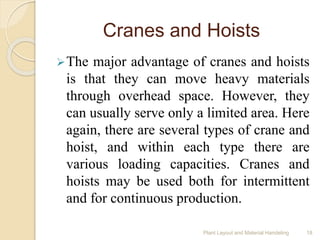
Cranes and Hoists
The major advantage of cranes and hoists
is that they can move heavy materials
through overhead space. However, they
can usually serve only a limited area. Here
again, there are several types of crane and
hoist, and within each type there are
various loading capacities. Cranes and
hoists may be used both for intermittent
and for continuous production.
Plant Layout and Material Handeling 18
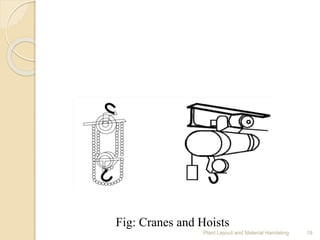
Plant Layout and Material Handeling 19
Fig: Cranes and Hoists
Robots
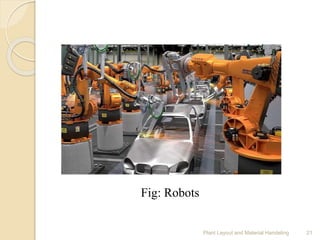
Many types of robot exist. They vary in
size, and in function and maneuverability.
While many robots are used for handling
and transporting material, others are used
to perform operations such as welding or
spray painting. An advantage of robots is
that they can perform in a hostile
environment such as unhealthy conditions
or carry on arduous tasks such as the
repetitive movement of heavy materials.
Plant Layout and Material Handeling 20
Plant Layout and Material Handeling 21
Fig: Robots
Thank you
22Plant Layout and Material Handeling

Plant Lay out and Material Handeling

  • 1.
    Plant Layout andMaterial Handling Prepared By : Patel Shreyash K. Branch : M.E. (Production) Pen No. : 170490728016 Subject : Production & Operation Management SHRI SITARAMBHAI NARANJIBHAI PATEL INSTITUTE OF TECHNOLOGY AND RESEARCH CENTRE 1Plant Layout and Material Handeling
  • 2.
    Plant Layout  Aplant layout study is an engineering study used to analyze different physical configurations for a manufacturing plant. It is also known as Facilities Planning and Layout. Plant Layout and Material Handeling 2
  • 3.
    Classification of Layout Process layout  Product layout  Combination layout  Fixed position layout  Group layout Plant Layout and Material Handeling 3
  • 4.
    Process Layout In aprocess layout, management groups together machines that perform similar functions. For example, it may put all of the lathes together in one part of the factory. The part that is being manufactured goes from one process area to another process area as it is manufactured. Hospitals typically follow a process layout. Example, the maternity ward is in an area where the hospital attends to all aspects of the maternity process. Plant Layout and Material Handeling 4
  • 5.
    Product Layout The productlayout approach involves setting up the production facilities around the steps involved in manufacturing the product. The product goes from one step to another as it is manufactured. This is the typical assembly line approach. Example, in the manufacturing process of a car, the car body goes from one stage of production to the next. Plant Layout and Material Handeling 5
  • 6.
    Combination Layout A combinationof process and product layouts combines the advantages of both types of layouts. A combination layout is possible where an item is being made in different types and sizes. Here machinery is arranged in a process layout but the process grouping is then arranged in a sequence to manufacture various types and sizes of products. Plant Layout and Material Handeling 6
  • 7.
    Plant Layout andMaterial Handeling 7 Combination Layout
  • 8.
    Fixed Position Layout Thisis also called the project type of layout. In this type of layout, the material, or major components remain in a fixed location and tools, machinery, men and other materials are brought to this location. Plant Layout and Material Handeling 8
  • 9.
    Material Handling Materials handlingcan be also defined as ‘the function dealing with the preparation, placing and positioning of materials to facilitate their movement or storage . Material handling is the art and science involving the movement, handling and storage of materials during different stages of manufacturing. Thus the function includes every consideration of the product except the actual processing operation. Plant Layout and Material Handeling 9
  • 10.
    Material handling doesnot add any value to the product but adds to the cost of the product and hence it will cost the customer more. So the handling should be kept at minimum. Material handling in Indian industries accounts for nearly 40% of the cost of production Plant Layout and Material Handeling 10
  • 11.
    Objectives of Material Handling Minimizecost of material handling. Minimize delays and interruptions by making available the materials at the point of use at right quantity and at right time. Safety in material handling through improvement in working condition. Maximum utilization of material handling equipment. Lower investment in process inventory. Plant Layout and Material Handeling 11
  • 12.
    Principles of MaterialHandling Systems Planning principle: All handling activities should be planned. Space utilization principle: Make optimum use of cubic space. Unit load principle: Increase quantity, size, weight of load handled. Gravity principle: Utilize gravity to move a material wherever practicable. Safety principle: Provide for safe handling methods and equipment. Plant Layout and Material Handeling 12
  • 13.
    Classification of Material HandlingSystems  Conveyors  Industrial Trucks  Cranes and Hoists  Containers  Robots Plant Layout and Material Handeling 13
  • 14.
    Conveyors Conveyors are usefulfor moving material between two fixed workstations, either continuously or intermittently. They are mainly used for continuous or mass production operations indeed, they are suitable for most operations where the flow is more or less steady. Conveyors may be of various types, with rollers, wheels or belts to help move the material along: these may be power-driven or may roll freely. Plant Layout and Material Handeling 14
  • 15.
    Plant Layout andMaterial Handeling 15 Fig: Conveyors
  • 16.
    Industrial Trucks Industrial trucksare more flexible in use than conveyors since they can move between various points and are not permanently fixed in one place. They are, therefore, most suitable for intermittent production and for handling various sizes and shapes of material. There are many types of truck petrol- driven, electric, hand-powered, and so on. Plant Layout and Material Handeling 16
  • 17.
    Plant Layout andMaterial Handeling 17 Fig: Industrial Trucks
  • 18.
    Cranes and Hoists Themajor advantage of cranes and hoists is that they can move heavy materials through overhead space. However, they can usually serve only a limited area. Here again, there are several types of crane and hoist, and within each type there are various loading capacities. Cranes and hoists may be used both for intermittent and for continuous production. Plant Layout and Material Handeling 18
  • 19.
    Plant Layout andMaterial Handeling 19 Fig: Cranes and Hoists
  • 20.
    Robots Many types ofrobot exist. They vary in size, and in function and maneuverability. While many robots are used for handling and transporting material, others are used to perform operations such as welding or spray painting. An advantage of robots is that they can perform in a hostile environment such as unhealthy conditions or carry on arduous tasks such as the repetitive movement of heavy materials. Plant Layout and Material Handeling 20
  • 21.
    Plant Layout andMaterial Handeling 21 Fig: Robots
  • 22.
    Thank you 22Plant Layoutand Material Handeling