PLANNING FOR WELDING
OPERATIONS: PREPARATION FOR
SMAW WELDING OPERATION
Prepared By:
Meghani Abhishek
ME-1 Met & Mats
(Welding Technology)
CONTENT
 SMAW Process
 Welding Equipment
 Steps & Planning
 Inspection of weld
 WPS & PQR
 Referances
SMAW Process
 A manual metal arc welding process that uses a
consumable electrode coated in flux. An electric current,
either alternating current or direct current, forms electric
arc between the electrode and the metals to be joined.
 As the weld is laid, the flux coating of the electrode
disintegrates, providing a shielding gas and a layer of
slag, both of which protect the weld from contamination
until it cools.
 Because of the versatility of the process and the
simplicity of its equipment and operation, shielded metal
arc welding is the most commonly used welding
Equipments
 Power source
 Electrode
 Base metal
 Electrode Holder
 Lead cable
 Workpiece connection cable
 PPE (safety Equipment)
Steps & Planning
1. Prepare the base materials
2. Choose the right Electrode
3. Set a current & voltage
4. Assess and comply with safety requirements
5. Start the weld
6. Clean and Inspect the weld
Prepare the base materials
 Before welding edge of workpiece are suitably
prepared.
 Edge preparation is selected based on the thickness
of the base metalJoint type Thickness
Square joint Up to 1⁄4 in (6.35 mm)
Single-bevel joint 3⁄16–3⁄8 in (4.76–9.53 mm)
Double-bevel joint Over 3⁄8 in (9.53 mm)
Single-V joint Up to 3⁄4 in (19.05 mm)
Double-V joint Over 3⁄4 in (19.05 mm)
Single-J joint 1⁄2–3⁄4 in (12.70–19.05 mm)
Double-J joint Over 3⁄4 in (19.05 mm)
Single-U joint Up to 3⁄4 in (19.05 mm)
Double-U joint Over 3⁄4 in (19.05 mm)
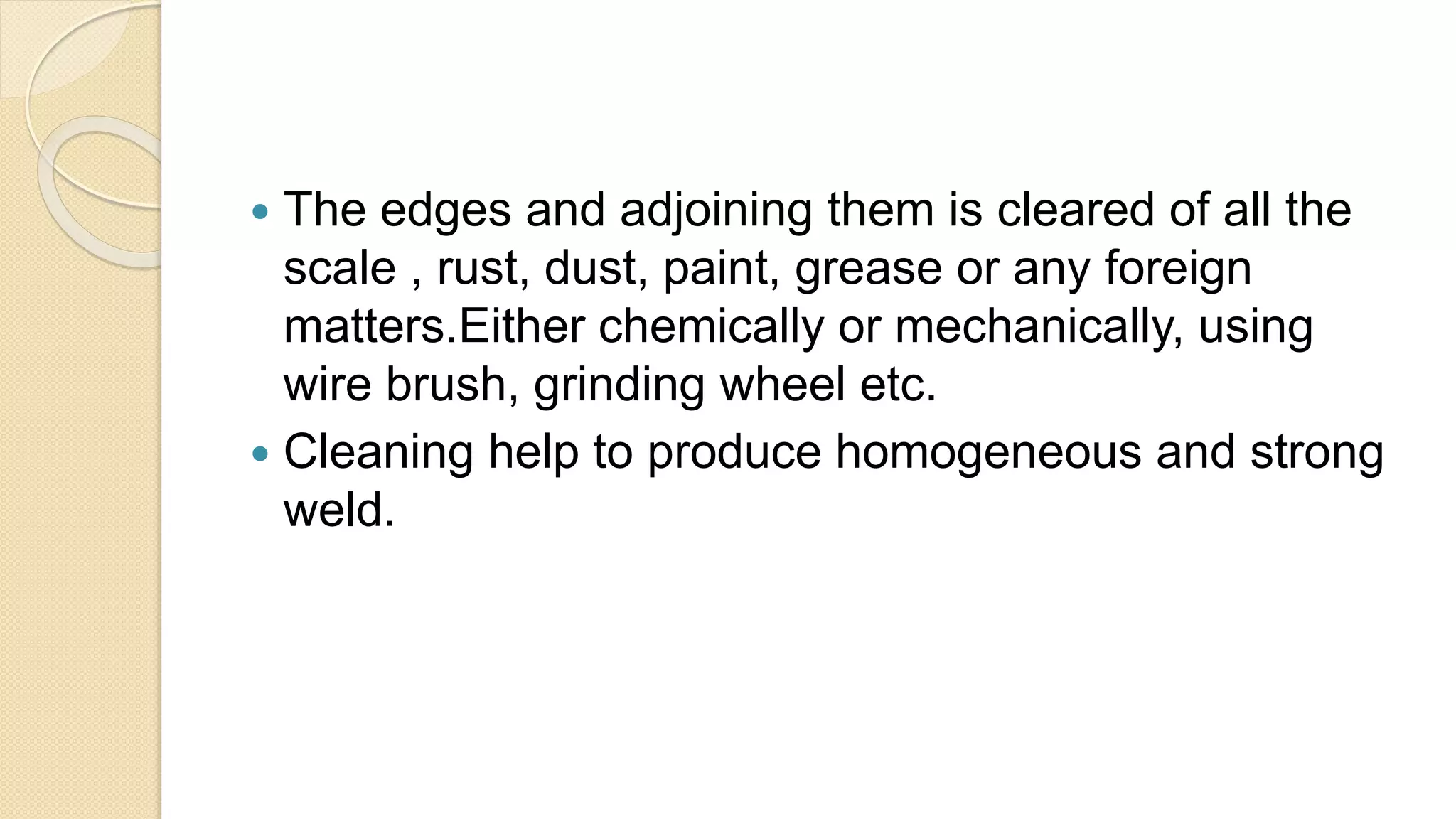
 The edges and adjoining them is cleared of all the
scale , rust, dust, paint, grease or any foreign
matters.Either chemically or mechanically, using
wire brush, grinding wheel etc.
 Cleaning help to produce homogeneous and strong
weld.
Choose the right Electrode
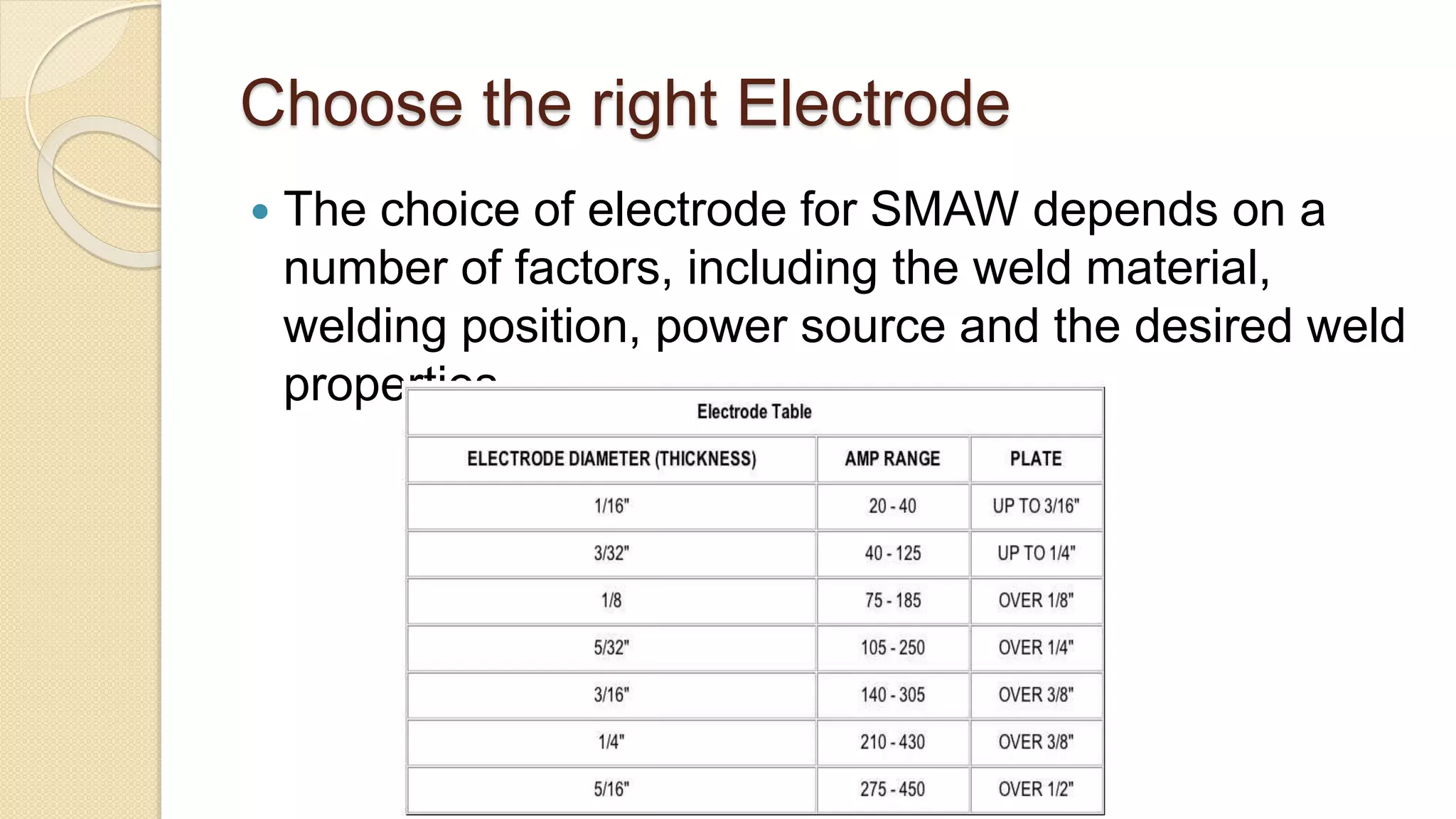
 The choice of electrode for SMAW depends on a
number of factors, including the weld material,
welding position, power source and the desired weld
properties.
 Sometimes electrode is
preheated to remove
moisture from it to
prevent hydrogen
embrittlement of weld.
Set Current & voltage
 Generally Constant current type of power source is
used
 Current and voltage are selected according to types
of power source, required metal penetration,
electrode diameter.
Assess and comply with safety
requirements
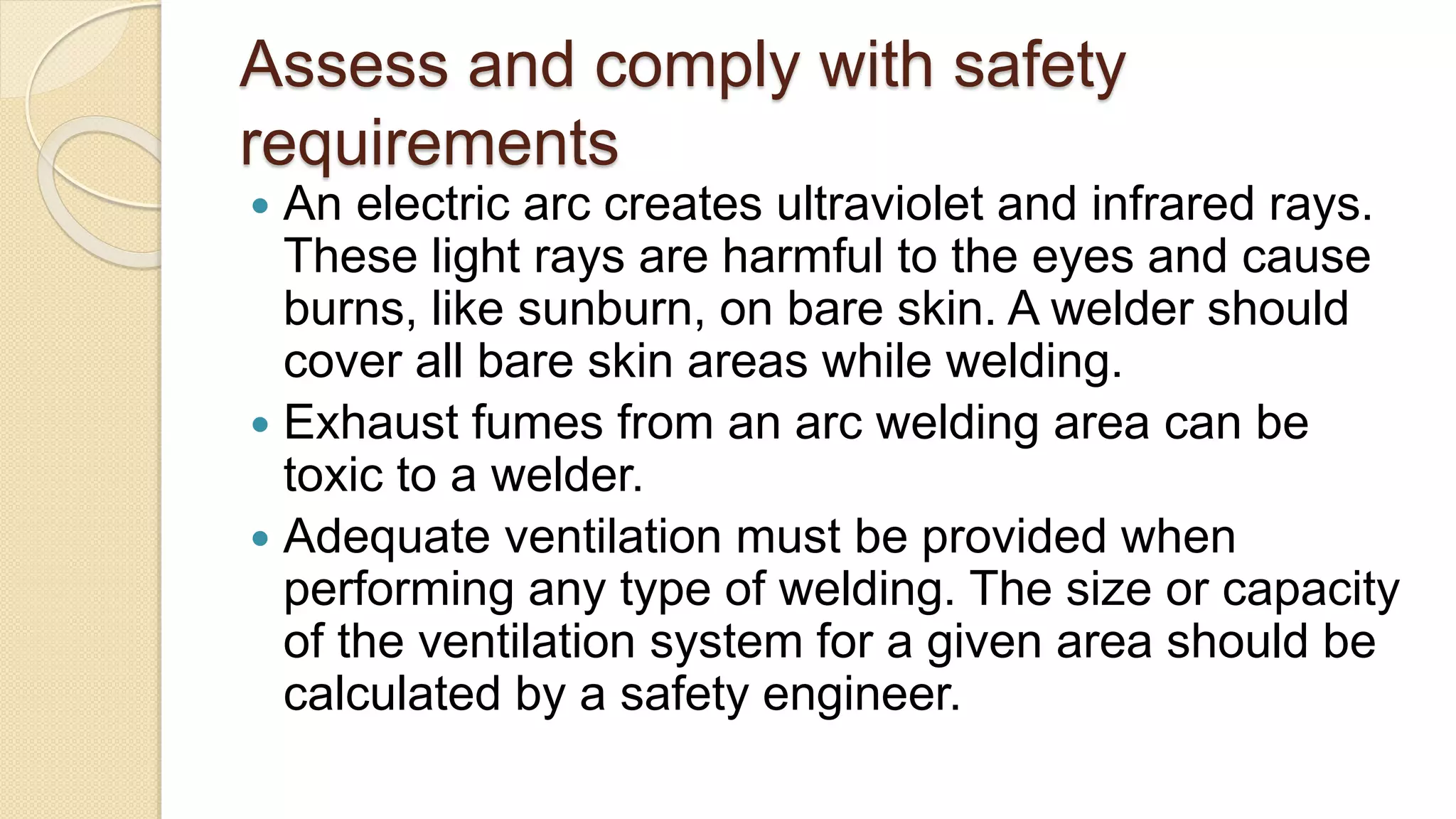
 An electric arc creates ultraviolet and infrared rays.
These light rays are harmful to the eyes and cause
burns, like sunburn, on bare skin. A welder should
cover all bare skin areas while welding.
 Exhaust fumes from an arc welding area can be
toxic to a welder.
 Adequate ventilation must be provided when
performing any type of welding. The size or capacity
of the ventilation system for a given area should be
calculated by a safety engineer.
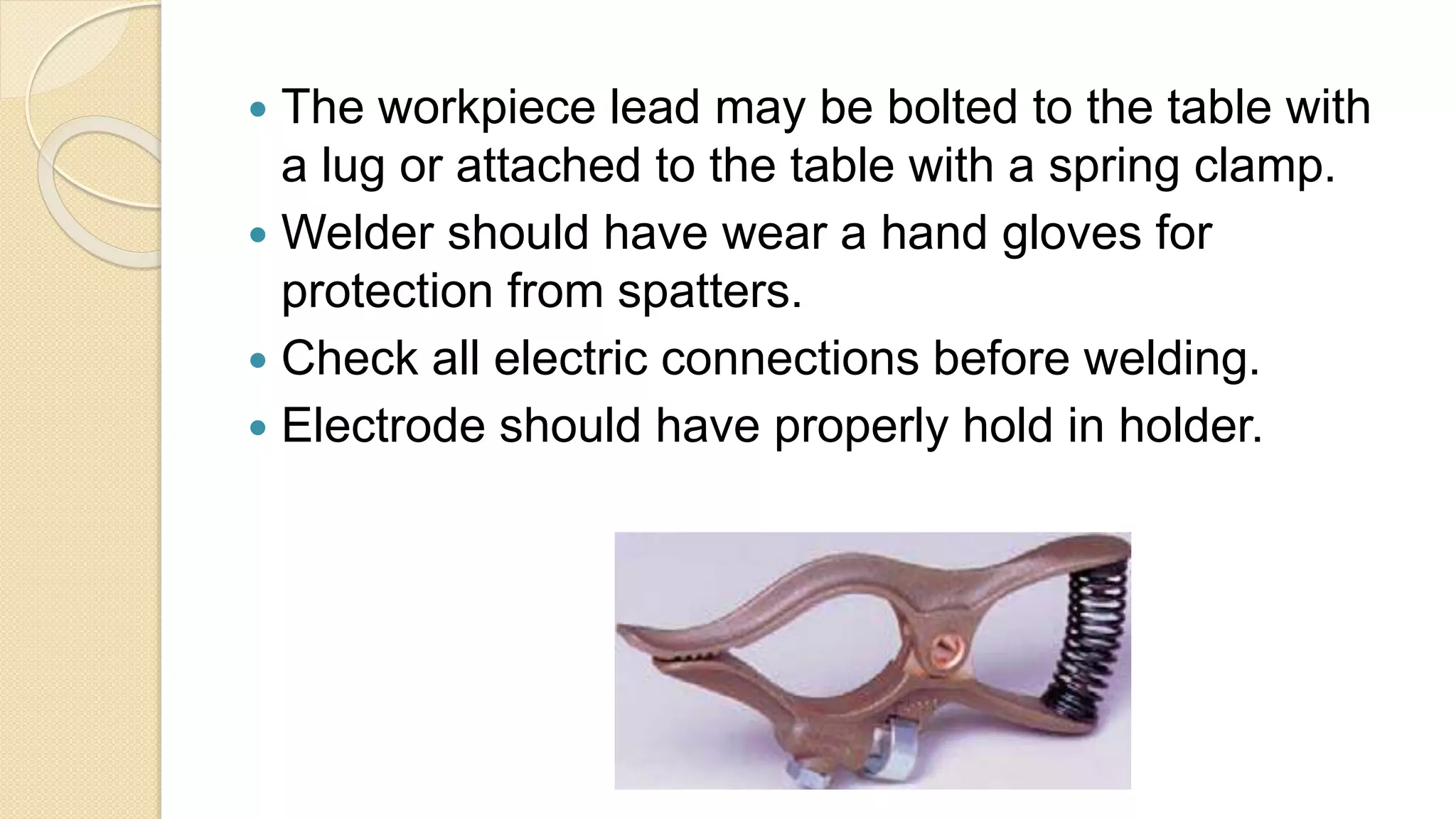
 The workpiece lead may be bolted to the table with
a lug or attached to the table with a spring clamp.
 Welder should have wear a hand gloves for
protection from spatters.
 Check all electric connections before welding.
 Electrode should have properly hold in holder.
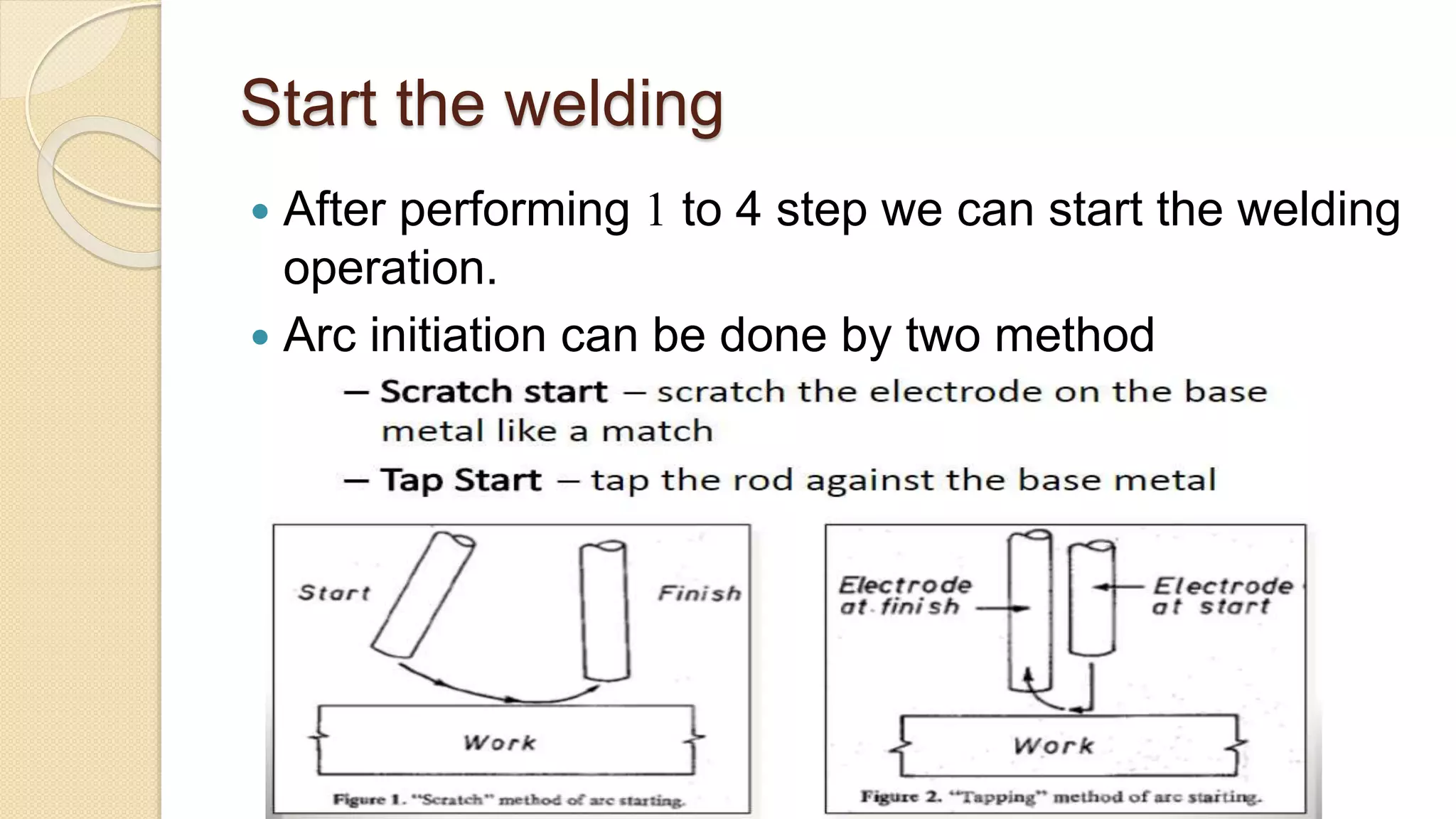
Start the welding
 After performing 1 to 4 step we can start the welding
operation.
 Arc initiation can be done by two method
 After initiation arc maintain a stable arc for good
weld quality.
 At the end of the weld, the operator breaks the arc
which creates a ‘crater’.
 Use a short pause or slight back step at the end of
the weld to fill the crater.
Clean and Inspect the weld
 Slag must be removed after each arc weld bead or
weld pass is completed. Slag is the hard, brittle
material that covers a finished shielded metal arc
weld.
 The next weld bead will have slag trapped in it if the
previous weld bead is not cleaned thoroughly. Slag
is chipped away using a chipping hammer.
 After chipping the slag, the weld bead is further
cleaned using a wire brush.
 rotary wire wheel in a portable electric drill motor
may also be used to clean the weld.
 Always wear goggles when chipping or wire
brushing the slag from a weld. This will help to
prevent eye injuries.
 After cleaning inspection is done by NDE.
WPS & PQR
 “WPS” (Welding Procedure Specification) and “PQR”
(Procedure Qualification Record) are documents that
refer to the practice of welding.
 WPS is a set of welding instructions. It aids
in planning and ensuring quality control of the welded
product as well as future reproductions of the product.
Welding parameters, such as joint design, position,
base metals, electrical characteristics, filler metals,
technique, shielding, preheat, and post-weld heat
treatment are all detailed in the WPS document.
 Simply put, a WPS is like a blueprint for welders to
produce the same quality of welded product over and
over again.
 The PQR form covers all the welding parameters in the WPS
document. In addition, it also includes some observations or
other matters regarding welding procedures and specific tests
like tensile tests and guided bend tests. It may also show the
visual inspection and fillet weld test results.
 The main difference is the orientation of the document’s
contents. A WPS is usually filled with numerous texts, images,
and sentences in accordance to its being an instructional
guide. On the other hand, a PQR is like a checklist with blank
lines and spaces for written notes that will be filled out by the
inspector during the inspection.
 Before the inspection, the WPS document is the object of
attention of the welders. Meanwhile, during and after the
inspection, the PQR is the document of concern for
Planning for welding operations preparation for  smaw welding operation

Planning for welding operations preparation for smaw welding operation

  • 1.
    PLANNING FOR WELDING OPERATIONS:PREPARATION FOR SMAW WELDING OPERATION Prepared By: Meghani Abhishek ME-1 Met & Mats (Welding Technology)
  • 2.
    CONTENT  SMAW Process Welding Equipment  Steps & Planning  Inspection of weld  WPS & PQR  Referances
  • 3.
    SMAW Process  Amanual metal arc welding process that uses a consumable electrode coated in flux. An electric current, either alternating current or direct current, forms electric arc between the electrode and the metals to be joined.  As the weld is laid, the flux coating of the electrode disintegrates, providing a shielding gas and a layer of slag, both of which protect the weld from contamination until it cools.  Because of the versatility of the process and the simplicity of its equipment and operation, shielded metal arc welding is the most commonly used welding
  • 5.
    Equipments  Power source Electrode  Base metal  Electrode Holder  Lead cable  Workpiece connection cable  PPE (safety Equipment)
  • 6.
    Steps & Planning 1.Prepare the base materials 2. Choose the right Electrode 3. Set a current & voltage 4. Assess and comply with safety requirements 5. Start the weld 6. Clean and Inspect the weld
  • 7.
    Prepare the basematerials  Before welding edge of workpiece are suitably prepared.  Edge preparation is selected based on the thickness of the base metalJoint type Thickness Square joint Up to 1⁄4 in (6.35 mm) Single-bevel joint 3⁄16–3⁄8 in (4.76–9.53 mm) Double-bevel joint Over 3⁄8 in (9.53 mm) Single-V joint Up to 3⁄4 in (19.05 mm) Double-V joint Over 3⁄4 in (19.05 mm) Single-J joint 1⁄2–3⁄4 in (12.70–19.05 mm) Double-J joint Over 3⁄4 in (19.05 mm) Single-U joint Up to 3⁄4 in (19.05 mm) Double-U joint Over 3⁄4 in (19.05 mm)
  • 8.
     The edgesand adjoining them is cleared of all the scale , rust, dust, paint, grease or any foreign matters.Either chemically or mechanically, using wire brush, grinding wheel etc.  Cleaning help to produce homogeneous and strong weld.
  • 9.
    Choose the rightElectrode  The choice of electrode for SMAW depends on a number of factors, including the weld material, welding position, power source and the desired weld properties.
  • 10.
     Sometimes electrodeis preheated to remove moisture from it to prevent hydrogen embrittlement of weld.
  • 11.
    Set Current &voltage  Generally Constant current type of power source is used  Current and voltage are selected according to types of power source, required metal penetration, electrode diameter.
  • 12.
    Assess and complywith safety requirements  An electric arc creates ultraviolet and infrared rays. These light rays are harmful to the eyes and cause burns, like sunburn, on bare skin. A welder should cover all bare skin areas while welding.  Exhaust fumes from an arc welding area can be toxic to a welder.  Adequate ventilation must be provided when performing any type of welding. The size or capacity of the ventilation system for a given area should be calculated by a safety engineer.
  • 13.
     The workpiecelead may be bolted to the table with a lug or attached to the table with a spring clamp.  Welder should have wear a hand gloves for protection from spatters.  Check all electric connections before welding.  Electrode should have properly hold in holder.
  • 14.
    Start the welding After performing 1 to 4 step we can start the welding operation.  Arc initiation can be done by two method
  • 15.
     After initiationarc maintain a stable arc for good weld quality.  At the end of the weld, the operator breaks the arc which creates a ‘crater’.  Use a short pause or slight back step at the end of the weld to fill the crater.
  • 16.
    Clean and Inspectthe weld  Slag must be removed after each arc weld bead or weld pass is completed. Slag is the hard, brittle material that covers a finished shielded metal arc weld.  The next weld bead will have slag trapped in it if the previous weld bead is not cleaned thoroughly. Slag is chipped away using a chipping hammer.  After chipping the slag, the weld bead is further cleaned using a wire brush.
  • 17.
     rotary wirewheel in a portable electric drill motor may also be used to clean the weld.  Always wear goggles when chipping or wire brushing the slag from a weld. This will help to prevent eye injuries.  After cleaning inspection is done by NDE.
  • 18.
    WPS & PQR “WPS” (Welding Procedure Specification) and “PQR” (Procedure Qualification Record) are documents that refer to the practice of welding.  WPS is a set of welding instructions. It aids in planning and ensuring quality control of the welded product as well as future reproductions of the product. Welding parameters, such as joint design, position, base metals, electrical characteristics, filler metals, technique, shielding, preheat, and post-weld heat treatment are all detailed in the WPS document.  Simply put, a WPS is like a blueprint for welders to produce the same quality of welded product over and over again.
  • 19.
     The PQRform covers all the welding parameters in the WPS document. In addition, it also includes some observations or other matters regarding welding procedures and specific tests like tensile tests and guided bend tests. It may also show the visual inspection and fillet weld test results.  The main difference is the orientation of the document’s contents. A WPS is usually filled with numerous texts, images, and sentences in accordance to its being an instructional guide. On the other hand, a PQR is like a checklist with blank lines and spaces for written notes that will be filled out by the inspector during the inspection.  Before the inspection, the WPS document is the object of attention of the welders. Meanwhile, during and after the inspection, the PQR is the document of concern for