WELCOME
IN
TRAINING
PRESENTATION
Date:16/06/2015
Prepared by :
ILiyas Mahmed Siroya
QA/QC Dept.(Alfanar Steel)
SMAW
SHIELDED METAL ARC WELDING /
STICK WELDING
TRAINING PRESENTATION
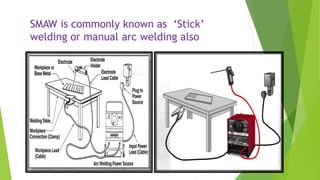
SMAW is commonly known as ‘Stick’
welding or manual arc welding also
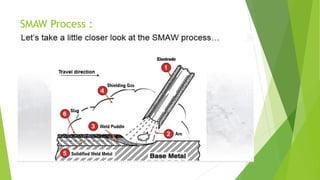
SMAW Process :
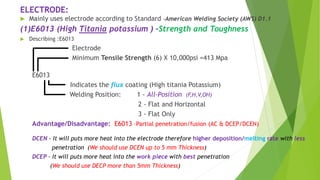
ELECTRODE:
 Mainly uses electrode according to Standard -American Welding Society (AWS) D1.1
(1)E6013 (High Titania potassium ) –Strength and Toughness
 Describing :E6013
Electrode
Minimum Tensile Strength (6) X 10,000psi =413 Mpa
E6013
Indicates the flux coating (High titania Potassium)
Welding Position: 1 - All-Position (F,H,V,OH)
2 - Flat and Horizontal
3 - Flat Only
Advantage/Disadvantage: E6013 –Partial penetration/fusion (AC & DCEP/DCEN)
DCEN – It will puts more heat into the electrode therefore higher deposition/melting rate with less
penetration (We should use DCEN up to 5 mm Thickness)
DCEP – It will puts more heat into the work piece with best penetration
(We should use DECP more than 5mm Thickness)
ELECTRODE:
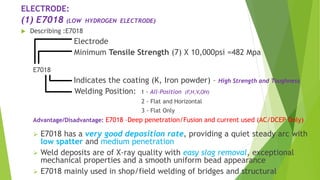
(1) E7018 (LOW HYDROGEN ELECTRODE)
 Describing :E7018
Electrode
Minimum Tensile Strength (7) X 10,000psi =482 Mpa
E7018
Indicates the coating (K, Iron powder) – High Strength and Toughness
Welding Position: 1 - All-Position (F,H,V,OH)
2 - Flat and Horizontal
3 - Flat Only
Advantage/Disadvantage: E7018 –Deep penetration/Fusion and current used (AC/DCEP Only)
 E7018 has a very good deposition rate, providing a quiet steady arc with
low spatter and medium penetration
 Weld deposits are of X-ray quality with easy slag removal, exceptional
mechanical properties and a smooth uniform bead appearance
 E7018 mainly used in shop/field welding of bridges and structural
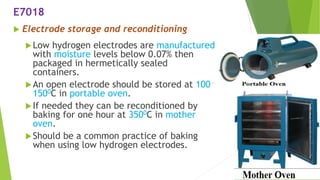
 Electrode storage and reconditioning
Low hydrogen electrodes are manufactured
with moisture levels below 0.07% then
packaged in hermetically sealed
containers.
An open electrode should be stored at 100 –
1500C in portable oven.
If needed they can be reconditioned by
baking for one hour at 3500C in mother
oven.
Should be a common practice of baking
when using low hydrogen electrodes.
E7018
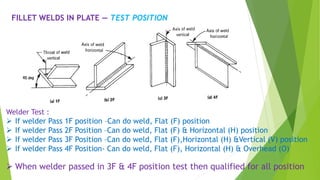
FILLET WELDS IN PLATE — TEST POSITION
Welder Test :
 If welder Pass 1F position –Can do weld, Flat (F) position
 If welder Pass 2F Position –Can do weld, Flat (F) & Horizontal (H) position
 If welder Pass 3F Position –Can do weld, Flat (F),Horizontal (H) &Vertical (V) position
 If welder Pass 4F Position- Can do weld, Flat (F), Horizontal (H) & Overhead (O)
 When welder passed in 3F & 4F position test then qualified for all position
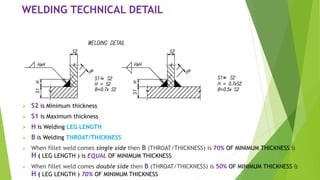
WELDING TECHNICAL DETAIL
 S2 is Minimum thickness
 S1 is Maximum thickness
 H is Welding LEG LENGTH
 B is Welding THROAT/THICKNESS
 When fillet weld comes single side then B (THROAT/THICKNESS) is 70% OF MINIMUM THICKNESS &
H ( LEG LENGTH ) is EQUAL OF MINIMUM THICKNESS
 When fillet weld comes double side then B (THROAT/THICKNESS) is 50% OF MINIMUM THICKNESS &
H ( LEG LENGTH ) 70% OF MINIMUM THICKNESS
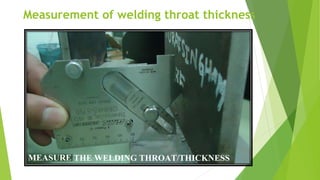
Measurement of welding throat thickness
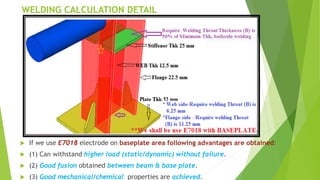
WELDING CALCULATION DETAIL
 If we use E7018 electrode on baseplate area following advantages are obtained:
 (1) Can withstand higher load (static/dynamic) without failure.
 (2) Good fusion obtained between beam & base plate.
 (3) Good mechanical/chemical properties are achieved.
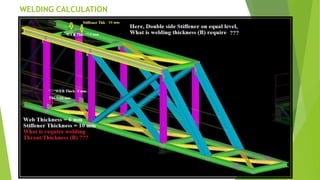
WELDING CALCULATION
Defects in SMAW
(1) Porosity
Causes :
 Grease/ hydrocarbon/ water
contamination on surface
 Too high arc voltage / arc length
 Incorrect/insufficient de-oxidant in
electrode, filler or parent metal
 Damp fluxes/ corroded electrode
Prevention :
 Must clean welding area prior start the
welding
 Reduce arc voltage or arc length
 Use electrode with sufficient de-oxidation
activity
 Use dry electrodes in good condition
Defects in SMAW
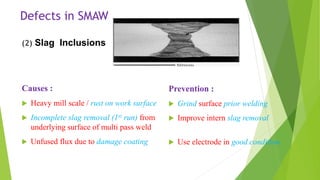
(2) Slag Inclusions
Causes :
 Heavy mill scale / rust on work surface
 Incomplete slag removal (1st run) from
underlying surface of multi pass weld
 Unfused flux due to damage coating
Prevention :
 Grind surface prior welding
 Improve intern slag removal
 Use electrode in good condition
Defects in SMAW
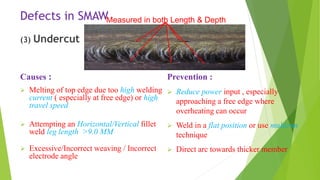
(3) Undercut
Causes :
 Melting of top edge due too high welding
current ( especially at free edge) or high
travel speed
 Attempting an Horizontal/Vertical fillet
weld leg length >9.0 MM
 Excessive/Incorrect weaving / Incorrect
electrode angle
Prevention :
 Reduce power input , especially
approaching a free edge where
overheating can occur
 Weld in a flat position or use multirun
technique
 Direct arc towards thicker member
Measured in both Length & Depth
Defects in SMAW
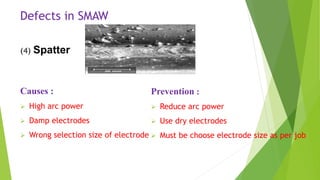
(4) Spatter
Causes :
 High arc power
 Damp electrodes
 Wrong selection size of electrode
Prevention :
 Reduce arc power
 Use dry electrodes
 Must be choose electrode size as per job
Check-Point/List for welder
1 Turn power supply on
2 Connect work clamp
3 Select electrode
a. Type (E6013/E7018)
b. Diameter (Ф2.5, Ф3.2 & Ф4.0mm)
4 Adjust output
a. Current/Polarity (DCEP/DCEN)
b. Amperage Setting
5 Insert electrode into electrode holder
6 Work Angle
7 Travel Angle
8 Arc Length
9 Travel Speed
10 Tools like….(1) Chipping Hammer (2) Wire brush (3) Cleaning brush (4) Chisel for metal
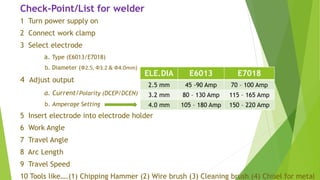
ELE.DIA E6013 E7018
2.5 mm 45 -90 Amp 70 – 100 Amp
3.2 mm 80 – 130 Amp 115 – 165 Amp
4.0 mm 105 – 180 Amp 150 – 220 Amp
THE END
Thanking you all on behalf
of QA/QC Department
Alfanar steel
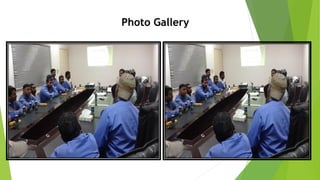
Photo Gallery
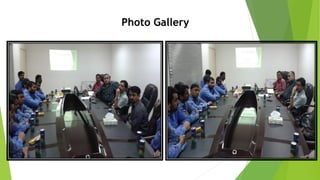
Photo Gallery
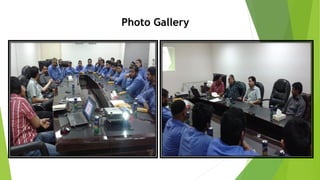
Photo Gallery
Training SMAW Module

Training SMAW Module

  • 1.
  • 2.
    SMAW SHIELDED METAL ARCWELDING / STICK WELDING TRAINING PRESENTATION
  • 3.
    SMAW is commonlyknown as ‘Stick’ welding or manual arc welding also
  • 4.
  • 5.
    ELECTRODE:  Mainly useselectrode according to Standard -American Welding Society (AWS) D1.1 (1)E6013 (High Titania potassium ) –Strength and Toughness  Describing :E6013 Electrode Minimum Tensile Strength (6) X 10,000psi =413 Mpa E6013 Indicates the flux coating (High titania Potassium) Welding Position: 1 - All-Position (F,H,V,OH) 2 - Flat and Horizontal 3 - Flat Only Advantage/Disadvantage: E6013 –Partial penetration/fusion (AC & DCEP/DCEN) DCEN – It will puts more heat into the electrode therefore higher deposition/melting rate with less penetration (We should use DCEN up to 5 mm Thickness) DCEP – It will puts more heat into the work piece with best penetration (We should use DECP more than 5mm Thickness)
  • 6.
    ELECTRODE: (1) E7018 (LOWHYDROGEN ELECTRODE)  Describing :E7018 Electrode Minimum Tensile Strength (7) X 10,000psi =482 Mpa E7018 Indicates the coating (K, Iron powder) – High Strength and Toughness Welding Position: 1 - All-Position (F,H,V,OH) 2 - Flat and Horizontal 3 - Flat Only Advantage/Disadvantage: E7018 –Deep penetration/Fusion and current used (AC/DCEP Only)  E7018 has a very good deposition rate, providing a quiet steady arc with low spatter and medium penetration  Weld deposits are of X-ray quality with easy slag removal, exceptional mechanical properties and a smooth uniform bead appearance  E7018 mainly used in shop/field welding of bridges and structural
  • 7.
     Electrode storageand reconditioning Low hydrogen electrodes are manufactured with moisture levels below 0.07% then packaged in hermetically sealed containers. An open electrode should be stored at 100 – 1500C in portable oven. If needed they can be reconditioned by baking for one hour at 3500C in mother oven. Should be a common practice of baking when using low hydrogen electrodes. E7018
  • 8.
    FILLET WELDS INPLATE — TEST POSITION Welder Test :  If welder Pass 1F position –Can do weld, Flat (F) position  If welder Pass 2F Position –Can do weld, Flat (F) & Horizontal (H) position  If welder Pass 3F Position –Can do weld, Flat (F),Horizontal (H) &Vertical (V) position  If welder Pass 4F Position- Can do weld, Flat (F), Horizontal (H) & Overhead (O)  When welder passed in 3F & 4F position test then qualified for all position
  • 9.
    WELDING TECHNICAL DETAIL S2 is Minimum thickness  S1 is Maximum thickness  H is Welding LEG LENGTH  B is Welding THROAT/THICKNESS  When fillet weld comes single side then B (THROAT/THICKNESS) is 70% OF MINIMUM THICKNESS & H ( LEG LENGTH ) is EQUAL OF MINIMUM THICKNESS  When fillet weld comes double side then B (THROAT/THICKNESS) is 50% OF MINIMUM THICKNESS & H ( LEG LENGTH ) 70% OF MINIMUM THICKNESS
  • 10.
    Measurement of weldingthroat thickness
  • 11.
    WELDING CALCULATION DETAIL If we use E7018 electrode on baseplate area following advantages are obtained:  (1) Can withstand higher load (static/dynamic) without failure.  (2) Good fusion obtained between beam & base plate.  (3) Good mechanical/chemical properties are achieved.
  • 12.
  • 13.
    Defects in SMAW (1)Porosity Causes :  Grease/ hydrocarbon/ water contamination on surface  Too high arc voltage / arc length  Incorrect/insufficient de-oxidant in electrode, filler or parent metal  Damp fluxes/ corroded electrode Prevention :  Must clean welding area prior start the welding  Reduce arc voltage or arc length  Use electrode with sufficient de-oxidation activity  Use dry electrodes in good condition
  • 14.
    Defects in SMAW (2)Slag Inclusions Causes :  Heavy mill scale / rust on work surface  Incomplete slag removal (1st run) from underlying surface of multi pass weld  Unfused flux due to damage coating Prevention :  Grind surface prior welding  Improve intern slag removal  Use electrode in good condition
  • 15.
    Defects in SMAW (3)Undercut Causes :  Melting of top edge due too high welding current ( especially at free edge) or high travel speed  Attempting an Horizontal/Vertical fillet weld leg length >9.0 MM  Excessive/Incorrect weaving / Incorrect electrode angle Prevention :  Reduce power input , especially approaching a free edge where overheating can occur  Weld in a flat position or use multirun technique  Direct arc towards thicker member Measured in both Length & Depth
  • 16.
    Defects in SMAW (4)Spatter Causes :  High arc power  Damp electrodes  Wrong selection size of electrode Prevention :  Reduce arc power  Use dry electrodes  Must be choose electrode size as per job
  • 17.
    Check-Point/List for welder 1Turn power supply on 2 Connect work clamp 3 Select electrode a. Type (E6013/E7018) b. Diameter (Ф2.5, Ф3.2 & Ф4.0mm) 4 Adjust output a. Current/Polarity (DCEP/DCEN) b. Amperage Setting 5 Insert electrode into electrode holder 6 Work Angle 7 Travel Angle 8 Arc Length 9 Travel Speed 10 Tools like….(1) Chipping Hammer (2) Wire brush (3) Cleaning brush (4) Chisel for metal ELE.DIA E6013 E7018 2.5 mm 45 -90 Amp 70 – 100 Amp 3.2 mm 80 – 130 Amp 115 – 165 Amp 4.0 mm 105 – 180 Amp 150 – 220 Amp
  • 18.
    THE END Thanking youall on behalf of QA/QC Department Alfanar steel
  • 19.
  • 20.
  • 21.